Thursday, 8 September 2011

Airlie Beach to Mission Beach

Wednesday 7th September

We breakfasted on the boat, then packed and left at 8.30 when our bus came to collect us. I managed a slightly better picture of Southern Cross, which was one of the smaller boats on the marina. It can carry 14 passengers and the two crew, though we were only 9 passengers. The big black poles are not part of the boat, they are part of the marina and allow it to float up and down with the tides - and storm surges!

It was a fairly boring drive, and unfortunately it went on all day. We were not able to make good time because of the high number of road works, so the road was down to one lane, controlled by people with stop-go boards. This meant that we were then in a long procession of traffic, and after the road works, there is still only one lane in either direction, with occasional passing places. This meant that we had mostly to travel at the space of the slowest vehicle, passing whenever we came to a passing place; but with 40 or 50 vehicles this was difficult – especially with big groups of 40 or 50 vehicles coming in the other direction.

We stopped outside Townsville for lunch, but didn’t go through the town. We were not surprised at the stories of flooding though, it is very flat and there are lots of creeks and even large rivers coming down from the surrounding mountains. We stared carefully at all the rivers and creeks, hoping to see a crocodile, but without result. We have been warned that, now we are north of the Tropic of Capricorn, we must stay 5 meters away from water until we are told it is considered safe and crocodile free. Paul has spent the time since then muttering ‘You see. I was right!’ and hourly expecting to be attacked by a 5 meter one.

A short drive north from Townsville, we saw Hinchingbrook Island, which I visited with a friend 12 years ago. You can see some evidence of the cyclone in February in the number of bare sticks visible amongst the trees, though this doesn’t show in the photographs.

Cardwell was unrecognisable. Twelve years ago, it was very small, but now it is much bigger, with lots of holiday homes and an enormous marina. The marina and a lot of the boats were destroyed by the cyclone, and destroyed boats lay about, some quite close to the road. I couldn’t recognise anything of the Cardwell of 12 years ago, and quite few of the new properties were damaged or even roofless. I would have taken some pictures, but we were late for the sky diving which had been booked for 3 o’clock, and 6 of our party were anxious to get on into Mission Beach and do their sky dive, so we didn’t stop.

We didn’t actually make it to Mission Beach until after 3.30, but fortunately the sky divers were not too late and went to register and sign terrifying forms absolving the company of responsibility in case of accident or death. We went away to get into our rooms and unpack, then came back at 5.15 to see them land on the beach.

After something of a wait, we saw a tiny plane, very high up, and a number of little white dots behind it. After about a minute, the parachutes opened, and we were able to see our six fellow travellers descending. The descent seemed very quick to me, so it was difficult to take photographs that looked like anything at all.

They all landed on the beach within a few feet of us, but very quickly, and sometimes behind other spectators. As a beginner, you come down in tandem with an experienced sky diver, fixed to his front, so it wasn’t always possible to recognise people until they had actually landed. They were all very happy and enthusiastic and babbled about the experience all evening!

We ate in the restaurant attached in the place where we are staying, and Paul was able to eat kangaroo, which he said was delicious!

Tuesday, 6 September 2011

The Whitsundays

Tuesday 6th September

We didn't get up too early this morning, and after breakfast, sails were hoisted and we ran without engine to Whitehaven Beach. The weather had been very wet during the night, and it continued equally bad in the early morning. Paul was steering the boat, so I went up on deck, but quickly became drenched by the rain squalls, in spite of wearing a raincoat supplied by the boat crew.

Fortunately, the weather cleared up a lot and we were delighted that it had improved enough for us to visit Whitehaven Beach, which is on the eastern side of Whitsunday Island. We climbed down the side of the boat and into the dinghy, and the outboard motor then failed to start. We drifted about the bay for a bit, then a passing dinghy owner took us in tow back to the boat and we climbed back on, while the boat crew fixed the outboard motor. Then we got back into the dinghy and went to the beach. The beach is unbelievably beautiful, a huge half moon of fine white sand, backed by dense green forest, and the water is very clear and the most beautiful turquoise blue.

There were very few people there, and it was very quiet and peaceful. It was warm but not unbearably hot so it was very pleasant in the water, and there was a huge shoal of quite large fish which came into the shallows but seemed worried by the feet and legs and swam quickly back into deeper waters. As the morning passed, more boats arrived and the beach became a little more crowded, but it is so big we were never very close to other people.

At midday, the dinghy came back to fetch us for lunch, and after lunch we sailed off to a good spot for snorkelling. The islands are of different sizes, mainly high and rocky, and thickly forested.

The snorkelling did not look easy, as one had to climb down a ladder from the boat and swim quite a distance, wearing a stinger suit in case of any jellyfish. Only 4 people decided to give it a go, and Paul, who was one of the four, never even made it to the reef owing to be unable to see the reef without his glasses, being unable to hear any shouted instructions, and finding it difficult to swim in the stinger suit and impossible to manage the mask and snorkel. So he eventually gave up and the dinghy went to fetch him back to the boat. Once Paul was in the dinghy, the outboard motor stopped working again and the dinghy had to be paddled back to the boat. Reports from the snorkelling were mixed. Two people found it disappointing, one thought it was marvellous, saying he saw a lot of fish, some of them quite big. Anyway, I don't think it was a disaster that we didn't have a go at it, we may try again at the Great Barrier Reef.

It was quite a long sail back to the marina, again steered by Paul, where we will spend the night, leaving the boat after breakfast to get back on the road for Mission Beach. One delightful feature of the Marina is wonderful hot showers, much better than the 30 seconds we are allowed in the tiny space on the boat.

Lochenbar Station to Airlie Beach

Monday 5th September

We had to rise at 5.30 again, breakfast being at 6. I can't believe I forgot to take a picture of the breakfast campfire. Actually, there are two fireplaces, one about hip high is used for the billy cans of tea and coffee and the saucepan of breakfast beans. The other one, slightly higher, is used with a grill on top for making the toast. The mornings have been very cool, so it has not been a trial to be so near the fire, though it has warmed up later. Likewise, it has cooled quickly in the evening when the sun goes down, so we have been glad of the huge campfire in the bar area. Last night, it was burning half of tree trunk about 8 feet long and about two feet in diameter at the root end. The bar area is outdoors, not even roofed, though the eating areas both have a roof.

We set off at 6.30 and drove down from the mountains back towards the coast. About 9 a.m. we stopped in Rockhampton for coffee, and I noticed I had a phone signal so posted two days worth of notes. The pictures will have to wait until we get a wireless Internet signal for the laptop.

It was a long drive of nearly 700 km. We have been surprised by Australian highways. Apart from near the cities, main highways are just one lane in each direction and there is relatively little traffic. We stopped for lunch which we ate outside, and were joined by flocks of sparrows and a very brightly coloured bird, a blue eyed honey bird or some such name.

We finally arrived about 3.30 at Airlie Beach. The Marina was full of rather expensive boats.

We are on a sailing yacht called Southern Cross, which is 68 feet long and used to be a racing yacht. About 30 odd years ago, it was Australia's entry for the Americas cup.

It is quite snug inside, Paul and I are sharing a double bunk in the stern. There are berths for every body, but no cabins. There is also a shower and a loo.

We left the marina running on the engines, then the sail was put up. I've never been on a sailing boat so I found it quite worrying when we started to sail and heeled over quite sharply. We were warned about holding on, with both hands if possible, when moving about the boat. We don't wear life jackets either, so I intend to remain fixed sitting in one place whenever the boat is moving! In about an hour and a half or two hours we sailed to Hook Island where we moored for the first night. I haven't taken many pictures because of being too terrified to move off my seat in the stern!

Monday, 5 September 2011

Lochenbar Station

Goodness, a Vodaphone signal in a little town - I am typing this on my knee in the bus while we are stopped for coffee.

Sunday 4th September

We did not rise particularly early this morning, since the morning's activity was riding quad bikes, and we are not insured for that, as it is classed as a dangerous activity. We went for a walk instead, along the creek at the edge of the property.

It was very pretty, though we could see a lot of evidence of previous severe flooding; there were quite a few places where tee trunks and branches were piled together. There were quite a few unfamiliar birds and a lot of butterflies. There are also several peacocks and peahens, which are very noisy. We watched one of the station staff on a motor bike rounding up the  horses for the afternoon's riding.

When the quad bikers returned, we all got into a truck and were taken up a nearby hill to see the view, which certainly is fabulous. The hill is the highest for miles around, and one can see a long way in the clear air. The path down again was very steep and rocky though, so I did not enjoy that part of the walk back to the station.

The afternoon's activity was horse riding to help round up the stock. This was another activity in which we could not take part, since it is also classed as dangerous. We decided to spend a peaceful afternoon instead. However, after the horse riding there was clay pigeon shooting, which we were taken to riding on the back of a lorry.

Once again, our insurance didn't allow us to take part in the shooting, I can't quite think why - we assume insurance companies think at at our age, we will be so blind we will shoot other people by mistake. Or each other, possibly.

Fortunately, the mind of an insurance person had been unable to conceive of goat rodeo, so that wasn't banned and we DID take part in that. We learned to throw a lassoo and then had a go at roping goats. I managed to rope two goats at once, but was disqualified on the grounds of going over time. Personally, I think it was really on the grounds of poor technique, as I didn't whirl the thing round my head in the approved manner. I imagine if I had, I would probably have dropped the loop over my own head and strangled myself.  Anyway, I roped a goat, even if not in the approved manner, and I have the picture to prove it!

The poor goats looked quite bewildered, having spent the early afternoon being rounded up by people on horses and driven into an arena, at 5 p.m., the same people came into the arena with them, grunted a lot, and threw ropes which sometimes hit them on the head or back. Then there was a lot of clapping and they were let out to run again - only, presumably, to do it all again in a couple of days.

Rainbow Beach to Kroombit

Saturday 3rd September

We had to arise at 5.30 and were eating breakfast by 6. We were joined by two Sulphur Crested Cockatoos that seemed to have little fear of humans, in fact Paul was a bit reluctant to open the gate we had to go through in case the cockatoo bit him.

We were picked up at 6.30 and driven to the boat that took us across to Tin Can Bay to see the dolphins. Apparently, dolphins have been coming to Tin Can Bay since the mid 1950s when a wounded dolphin was fed by some fishermen. Once recovered, it kept bringing other members of its pod into the bay to be fed, and they have been coming in twice a day ever since. These are wild dolphins, but they don't mind humans, and they like the fish they are given! People are allowed in to the water with the dolphins, though they aren't allowed to touch them. So I duly got my socks and shoes off and got into the water. Only two dolphins came this morning; there can be up to four. They arrived very promptly at 8, obviously having reliable watches. They were quite happy to nose around the feet and ankles for a few minutes, anticipating their fish breakfast. There was a big queue of people anxious to pay 5 dollars to feed them a fish, and it was quite funny watching mothers and fathers trying to persuade small children to feed the fish to the dolphin - the child obviously being worried that the the dolphin might prefer a breakfast of small child to a breakfast of small fish!

There was also an enormous pelican which was anxious to have a fish breakfast too iand was menacing any small child who looked as if they might have a fish.

By 8.30 we had been picked up and were off on the next stage of our journey, a drive of about 600 kilometres. We drove through pine plantations and eucalyptus forests, and passed some wild horses grazing by the side of the road. As we went north, the forests gave way to more open country with grasslands and some cane fields. We turned inland a little south of Rockhampton, through a small town called Calliope, and started climbing into the hills. Here, we were surrounded by pasture land and cattle and some grain fields. Eventually, we turned towards Kroombit Park and Lochenbar Station, where we are staying. We were immediately supplied with hats and bandanas, which we are supposed to wear at all times -in spite of the fact that we already have our own silly hats.

This is yet another type of accommodation that will be of great interest to the friend with whom I shared some reasonably similar accommodation in Canada! I think you might call it a bunkhouse, we certainly have two bunks in it. They are very comfortable, so we slept very well.

After supper, there were various activities, like learning to crack a whip or riding the mechanical bull. We did not take part in the latter activity, thinking it would not do our backs any good. Our fellow tour participants were mostly thrown off after a few seconds. Paul has a sore arm from attempting, unsuccessfully, to get the whip to crack.

Friday, 2 September 2011

Fraser Island back to Rainbow Beach

Friday 2nd September

This has been another packed day.

After a delicious buffet breakfast provided by Eurong Resort, where we were staying, we started by driving through the forest on wild switchback roads to Central Station, which used to be the location of the original logging camp. There are some replica houses and some interesting photographs on information boards. The satiney trees were cut down and exported all over the world, reputedly even to help with the building of the Suez and Panama canals. The forest giants are mostly gone now, though there are a few big trees left.

We then walked along Wangboolga Creek to see some of the original rainforest. The rainforest is maintained partly by the humidity of the creek water. The creek is hard to photograph because the water is crystal clear and just looks like a ribbon of sand in the photographs. Nevertheless, it is between 6 inches and a foot deep, and runs reasonably fast.

The rainforest walk was interesting, walking through the green gloom seeing the variety of trees and other plants, and appreciating the almost total silence. There did not seem to be many birds, or they were all still asleep. We walked through to Pile Valley, so called because it was a source of marine piles, having trees which were very resistant to sea water.

We got back into the 4WD and set off for a series of ‘perched lakes’. These lakes are all found in sand dunes and are only filled with rainwater. They have a layer of decaying vegetation at the bottom, and this layer stops the water leaking away into the sand. The first one we visited was Lake Mckenzie. We had intended to swim, but a very cold wind had started, so we ended up just wading again. The sand is beautifully white and the water is very clear. The lake is surrounded by forest which in some cases comes right down to the water’s edge, so there isn’t a beach all round the lake – or at least, not today.

We hadn’t appreciated that there has been an unprecedented amount of rain, and the lakes are flooded, which in some cases means there is little or no beach left at the moment. The next lake, Lake Birrabeen, had some beach but we had to wade to get to it. The wind had died and it was warm, so it was very pleasant in the water, and the beach had not a single person on it! We had lunch at the next lake, Boomanjin Lake, which is the largest. It is 10 metres higher than normal, and as a result, has no beach at all that we could see. The water had drowned the lower slopes of the forest all round the lake.

We were booked onto a Dolphin spotting tour at 3.30 at Rainbow Beach, so we set off for the ferry, thankfully driving along the beach this time. We had found the switchback roads quite wearing after some hours, and were glad not to be heaved up and down and have our heads banged on the ceiling and windows. There was quite a queue for the ferry, but most of the people in the queue were too timid to drive through the creek to get to the ferry. Our drivers just went straight through the creek without pausing and straight to the front of the queue, so we were soon on the ferry – leaving quite a few annoyed people behind us, I think.

Unfortunately, our trip to view dolphins was cancelled because of bad weather, so we were re-united with our baggage and had time for laundry instead. We will see the dolphins at 6.30 a.m. tomorrow instead, weather permitting, which means getting up at 5.30!

This will probably be my last post for 4 days. We have 2 nights on a cattle station and two nights on a boat cruising round the Whitsundays, and there is no internet in either place. I would post something if I could get a 3G signal on the iPad, but for the last 2 days I just have ‘No Signal’. People have told me since I arrived that Vodafone don’t have good coverage in parts of Australia, but it’s a bit late now!

Thursday, 1 September 2011

Rainbow Beach to Fraser Island

Thursday 1st September

Goodness, this has been a very full day. We left for Fraser Island at 8 a.m. with only overnight bags, as there isn't much room in the 4WD vehicles we are using. Everything else has been left at Rainbow Beach.

We drove down a long road surrounded by forest to Inskip Point, one of the places from which the ferry departs. The ferry doesn't have room for a lot of cars, but as it happened, there were only our two at that early hour. The ferry is just a flat platform with a ramp at either end and a tower at one side for the captain.

The trip only takes a few minutes, and then we were off driving on wild roads, or on the beach.

Fraser Island is off the Queensland coast, and is the largest sand island in the world, 76 miles long and 16 miles wide. It is a world heritage site, and is a mixture of hills and valleys, with a number of lakes of clear water. It is mostly thickly forested.

We began by driving across the island through the forest on a very dusty corrugated road which reminded me of roads in Kenya when I was a little girl. We drove right across the island on onto the beach at the eastern side. At this point, our vehicle began to smell as if it was overheating, and in fact we soon had to stop and send for help. We left the sick vehicle and driver and all crammed into the other vehicle and set off for Wobby Lake, driving along the beach and through some quite deep creeks. I was quite worried by more than one of these crossings, the water seeming quite deep and the sand not providing a good grip.

From the car parking spot, it was a 40 - 50 minute climb through the forest and across dunes to a sand blow which had the lake at its foot. We descended to the lake, and found the water to be very cold indeed, though a few people were swimming. We waded and admired the fish, which were over a foot long and kept coming to see what we were doing. We managed to photograph a heron and a couple of cormorants which were all resting on a branch probably after catching some of the fish - not, presumably the fish which were watching us, which were bigger than the birds.

After the 40 minute walk back to the car, we had undone all the pleasant cooling from wading in the cool waters. However, at least this time we were going down. The overheating car had been repaired, and we were no longer crammed together. We drove to a picnic spot called Happy Valley, where we made some lunch. A passing kookaburra stopped on a nearby branch to see if there might be anything for him, and we were able to get a reasonable photograph of him - or at least, I was. Paul's camera seems to have died.

We drove back to the beach, and along to a place called Eli Creek, which is a large and spectacular creek pouring gallons of water into the surf. It is lined with trees and pleasantly cool, and we waded along the creek. It varies between knee and thigh deep, and the water is completely clear and very cool, so it was lovely on such a hot day.


We continued along Seventy Five Mile Beach to view the wreck of the Maheno, which has been there for years (since some time in the 1930s) and is rusting away. Its demise has no doubt been hastened by the fact it was used for target practice during the last war. We drove on up the beach as far as Indian Head, and climbed the hill to visit the Champaign Pools. These are rock pools which are used for swimming, and are kept bubbling by the surf which breaks over the rocks which form them.

They did look very inviting, but a very cold wind had sprung up, and nobody was anxious to take off their clothes again, so we went back to the cars.

The next stop was at a viewpoint where you could see the beaches stretching away in both directions. The rocks were very slippery and the climb was steep, and as I was rather tired by then, I decided to stay in the car. There was plenty to look at on the beach, lots of washed up jellyfish, oystercatchers which were not in the least timid, and whales breaching well offshore. We had omitted to bring the binoculars, so we didn't have a clear view of them.

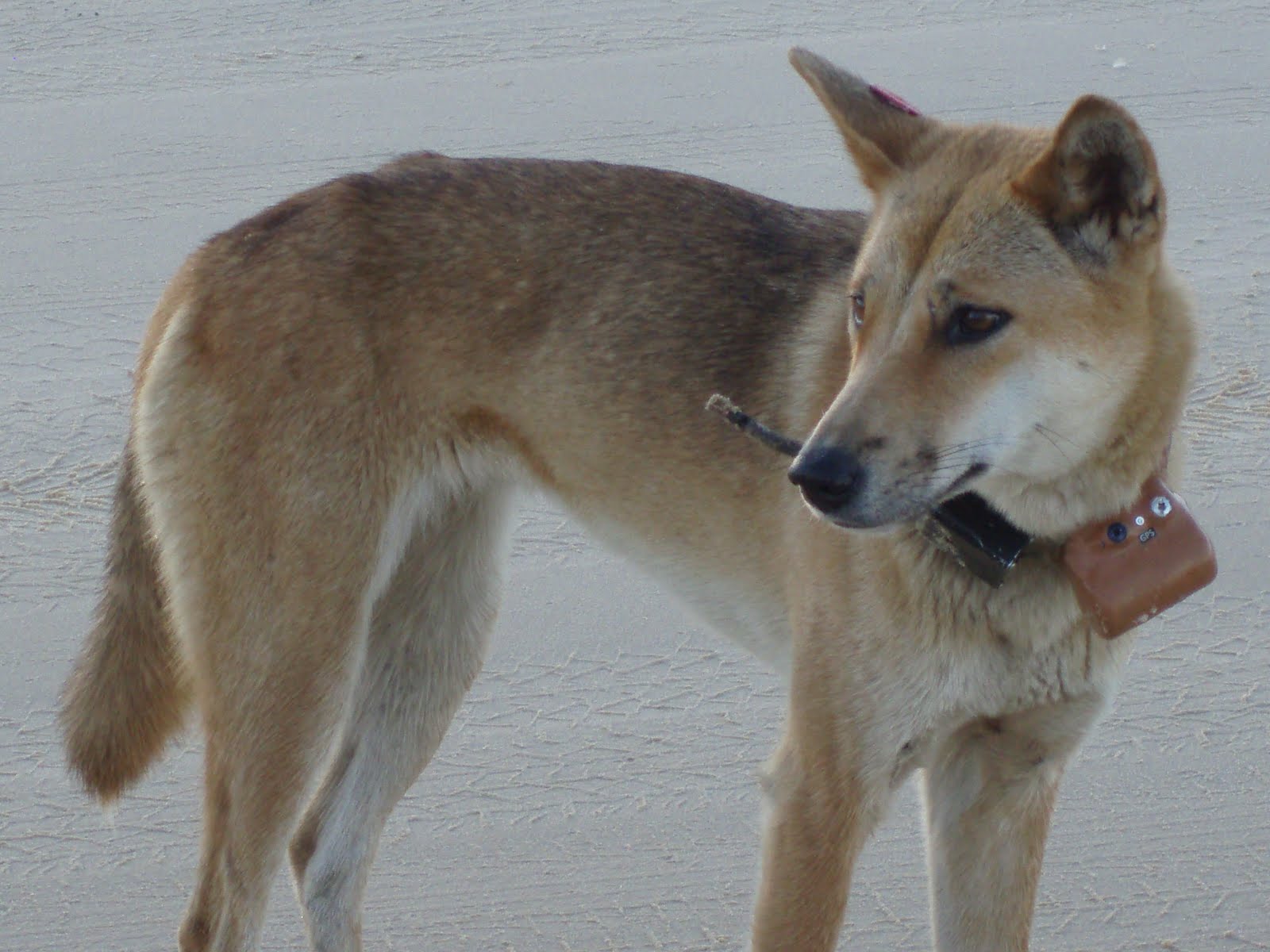
On the drive back, we passed two dingos and managed to get photographs. The first one was digging in the sand, as he had found some fish trimmings left by a fisherman. The second was just walking on the sand. He was wearing a tag, so had obviously been caught and tagged at some time.

I was pleased we had seen real wild dingos - I didn't see one at all last time I was here.