Friday 16th September
We seem to have done quite a few things today. Paul had heard that there was a wave pool in the harbour, so he was determined to have a go. The walk there was very pleasant, as the whole harbour area has recently been rebuilt in the last two or three years, and various bridges and a lift take you down to the waterside. On the way there, we passed one or two of the historic buildings, particularly the ruin of the old Town Hall, which was destroyed in 1974 by cyclone Tracy. There is some public art on display, I liked this one of an ancestral spirit who takes the form of a bird.
We had some superb views of the harbour on the way down. There is one bit, called the lagoon, which is cordoned off for swimming and looked very inviting.
It was later explained to us that Darwinians do not swim in the sea, for fear of crocodiles and box jellyfish, so there have to be plenty of alternatives, and the lagoon is one and the wave pool is another.
We went into the wave pool, but I didn't stay long, I found the waves were huge and constantly knocked me off my feet. Paul enjoyed it very much, I wished I was like all the other women and most of the children and had thought to take a big inflatable. I ended up sitting in the children's pool to keep cool while Paul played in the huge waves. We couldn't stay for hours anyway, as we had booked a city tour, and had to walk back to the city centre for that. On the way, we stopped to lunch on the ubiquitous pie. Paul is becoming addicted to the pies - but possibly because we have yet to eat an acceptable sandwich here. They all seem to be made with very dreadful white sliced bread which has neither taste nor texture.
The city tour was interesting, taking us quite far afield to places we had not thought of visiting. We went onto one of the wharves and found ourselves staring at an enormous cruise ship. We passed Government House and paused for photographs.
We spent an hour in the Museum and Art Gallery, and Paul wants to go back because there is much more to see.
We drove up past Mindil Beach, where we were last night for the night Market, past Fannie Bay, (pausing only to admire the jail) and on to East Point. This is an area set aside for leisure. There is an artificial salt water lake, Lake Alexander, in which people can swim, fish, etc. The sea water is filtered to remove any crocodiles or jellyfish, so it is safe to go into the water.
From the point, we had some beautiful views back over Darwin.
Our next visit was to the Botanical Gardens. We saw an interesting old building, pre-1900, which was the oldest church in Darwin, and was originally the Wesleyan Methodist Chapel. It was in constant use until well after the war, but fell into disrepair and was relocated here in 2000.
The Botanic Gardens are beautiful, with lovely pools and fountains
as well as many unfamiliar plants and trees.
The frangipani weren't properly in flower, but I photographed them anyway, I haven't seen any frangipani since I left Kenya 50 years ago. Paul was delighted to see pineapple and pawpaw growing, he's only ever seen them on shelves in shops before.
We drove round Cullen Bay, admiring the marina and the houses of the wealthy, then we looked at some historic houses (1930's!) designed specifically to suit the climate. One is run by the National Trust, so I would like to go and see it tomorrow, if time permits.
Friday, 16 September 2011
Thursday, 15 September 2011
Darwin
Thursday 15th September
Darwin is a very hot place, though at present it is a very dry heat. We have spent our time dodging from one patch of shade to the next.
Not having yet been threatened by a crocodile, Paul was filled by the urge to see one, so we decided to go to something that described itself as a crocodile park and zoo. As it is some way outside Darwin, we went on the bus.
I must say buses in Darwin are wonderful. $2 is sufficient to allow you to ride any number of bus anywhere for 3 hours - you can change bus as many times as you like within the three hours. And they seem to run exactly to time. Interestingly enough, those we have used have not been at all full, and other passengers have mostly been schoolchildren, pensioners and Aboriginal people. I suppose it is likely that most people in Darwin have cars - certainly there are an awful lot of car showrooms in the city, for both new and second hand cars.
We were interested in the trip out of the city, as it soon became clear how dry the countryside was. What grass we could see was short and bleached to a sort of beige colour. In many places though, there was just bare red earth and the occasional tree.
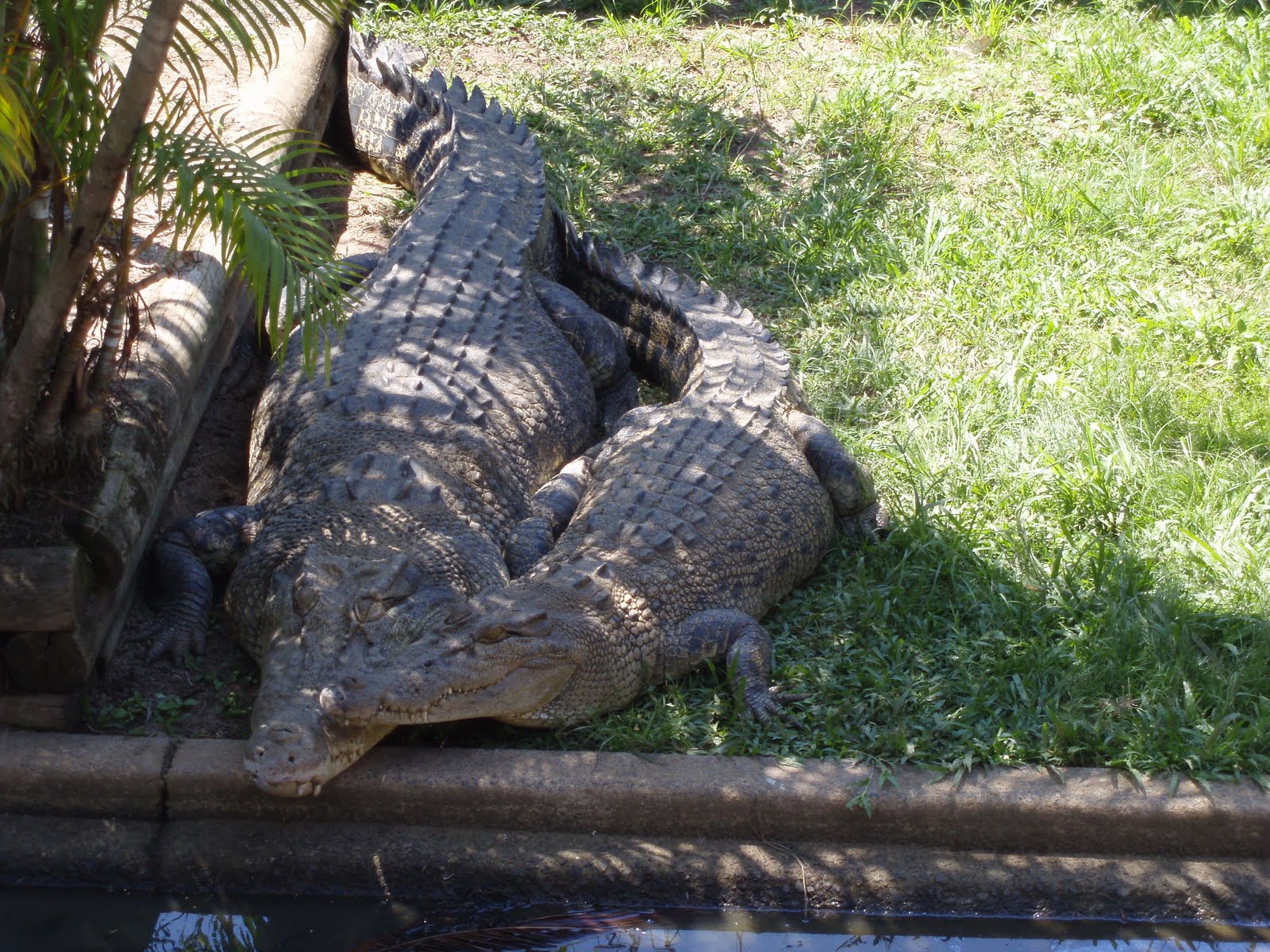
The crocodile park was, in fact, a crocodile farm, and I am far from certain I would have gone had I known that beforehand. Many of the crocodiles we saw were destined to become handbags, and their meat is sold as steaks, sausages or burgers.
However, the guide who took us round said that crocodile farms were ensuring the survival of crocodiles, since they were not now suffering from poaching. There was no need for handbag makers to buy poached skins when they could buy farmed ones so cheaply. Moreover, farmers now welcomed crocodiles on their land, since they were paid $100 for each crocodile egg - and the eggs were collected by the crocodile farmers, not the landowners. The result of this was that crocodiles were no longer endangered - their numbers, which had dropped to as few as 5000 during the 1970s, were now in the hundreds of thousands.
The farmed crocodiles were grown up to about 2 metres (around 5 years old) and then killed for the skins, which were sent away to be tanned. However, we also saw some of the biggest crocodiles I have ever seen in my life - some must have been nearly 20 feet long.
These were mostly ones which had been removed from Darwin harbour, and were part of the captive breeding programme. They were paired with a female, and the eggs were taken and put in an incubator so that all would hatch safely. Some looked quite content.
However, there was one miserable enormous one with his jaws wired shut because he had bitten his wife. They were waiting to see if he continued to attack her, or if he had learned that domestic violence did not pay. If he continued to attack her, he might be given a bigger, stronger wife in the hopes she would bite him back.
We also saw the smaller (2 meters) crocodiles jump out of the water to catch some meat. It certainly cures you of any desire to go near the water!
At the end of the tour, we all had the chance to hold a baby crocodile. I found it quite sweet, it was warm with a very soft skin, and it listened to me most carefully when I spoke kindly to it. Of course, it might not have listened so carefully had its jaws not been taped shut!
We had a brief look at some of the other animals in the zoo part. I photographed some rather depressed looking turtles, who swam around us, obviously hoping we would do something interesting.
I don't think I've ever been so close to ostriches. I only managed a photo of Mrs. Ostrich, who I was hoping wouldn't peck me - she was much taller than her fence. I failed to photograph Mr Ostrich, who was seeing off some Japanese tourists, and I found it too hot in the sun to wait for him to come back.
The emu was having a dust bath, and the cassowary just looked cross. The male dingo was pacing nervously, and the red kangaroo came to see if we had anything to give him, and appeared disappointed that we had not.
The monkeys were in cages with very thick bars, and we felt they would have been happier in the freedom of Singapore Zoo. The ocelot was curled up asleep behind a tree, and the lions had found a place in the shade at the back of their cage to sleep. The tiger had, apparently, been removed.
We had a brief lunch and a look at the crocodile museum, then caught the bus back and spent some time cooling off in our air-conditioned room.
In the evening, we headed off to the night market and ate our supper at one of the stalls there.
Wednesday, 14 September 2011
Cairns to Darwin
Wednesday 14th September
There is really nothing much to say about today, and no pictures, as so much of it was spent in airports and planes.
We arrived at our hotel in Darwin around 4, and spent some time reading the brochures to decide where to go. It seems there is a lot to see, and we have to try to avoid seeing things we are going to see anyway on our next tour, which starts on Sunday at some ungodly hour - before 6, I think.
It is certainly hot in Darwin, though I am told it is cooler than some other places as the sea breezes cool it.
Tuesday, 13 September 2011
Cairns
Tuesday 13th September
This has been rather a lazy day. It was good to have a day to relax, and also to catch up with our laundry and email.
Our morning was enlivened by the discovery of the beautiful skink in the bathroom.
This has been rather a lazy day. It was good to have a day to relax, and also to catch up with our laundry and email.
Our morning was enlivened by the discovery of the beautiful skink in the bathroom.
After a lazy morning, we went to Trinity beach for lunch. The sun was warm but it remained very windy.
After lunch, we went for a drive round Cairns looking for examples of the type of house called a Queenslander. This is a traditional style of wooden house, raised on piles and often with a wrap-around verandah. There seem to be relatively few of them around Cairns, possibly because they are expensive to maintain. It was interesting to see the suburbs of Cairns, it makes you realise why people leave England to come here; the lifestyle seems much better, with far more space and bigger houses.
We went out to dinner tonight, and the restaurant told us it was so cold we should bring coats and they would provide blankets if necessary - this is the tropics after all!The last part of the day will be spent re-organising the suitcase ready to fly to Darwin tomorrow.
Cairns - Kuranda and Atherton
Monday 12th September
Paul wanted to experience the scenic railway journey up to Kuranda, and I was more than happy to go again, I enjoyed it so much last time, so we set off for Freshwater station to catch the 9.50 train. The wooden station is pleasantly old –fashioned.The journey itself was just as wonderful as I remembered. It is hard to imagine that so many tunnels were built just using pick and shovel, and the bridges across the enormous chasms are quite amazing.
It was hard not to photograph everything.
The views down along the Barron River and across Cairns were as spectacular as I remember.
I managed an even more spectacular view of the Barron Falls than I managed when we went by road – still not much water over them, but the terrain, with steep beetling cliffs and a deep, almost circular pool, is amazing.
Rather than another visit to the tourist shops of Kuranda, we opted for a trip round the Tablelands, which was most interesting. We had not previously realised how fertile it was up there, and the variety of crops grown. We stopped at Lake Tinaroo for a picnic lunch. The lake is a reservoir, and is dedicated to water sports; boating, fishing, swimming, water-skiing, sailing, canoeing and wind surfing are all catered for, in a very beautiful setting.
The sun was shining, and it was a beautiful day, in spite of the cutting wind. After lunch, we toured some of the towns like the charming Yungaburra, which looks delightfully old-fashioned. Some of the countryside looks surprisingly like parts of southern England – until you notice the row of banana trees. We paid a visit to the Curtain Fig tree, a species of strangler fig, which is nearly 50 feet tall. I see that Wikipedia describes it as one of the largest trees in Tropical North Queensland.
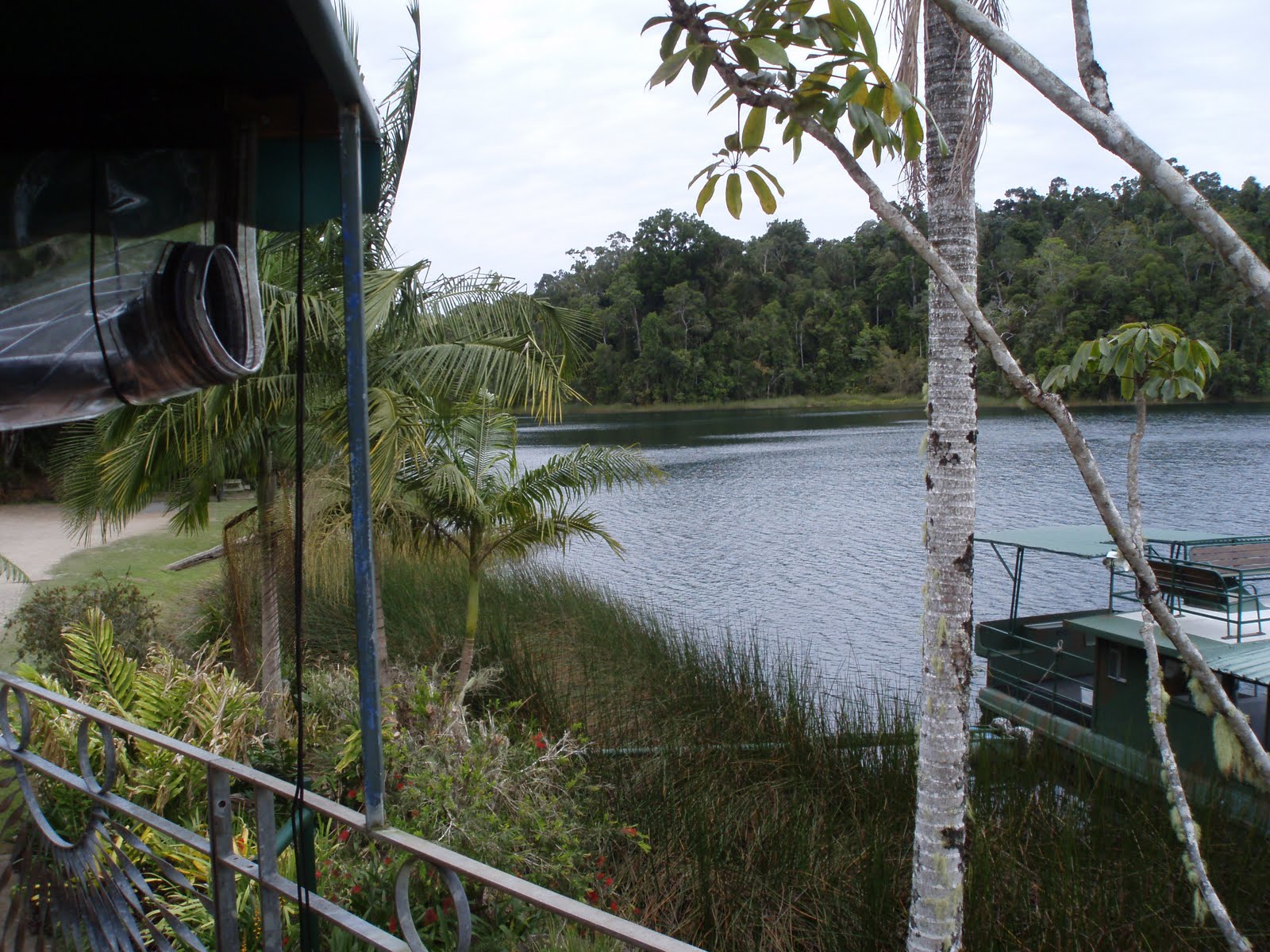
We visited lake Barine, which is a volcanic crater lake and very pretty indeed.
As well as having a very nice cup of much needed hot tea (the cutting wind had started again and it was absolutely freezing) we took a walk to see the giant kauri pines. These giant trees have mostly been cut down, but these two remain as a reminder of what the area used to be like.
Cairns - Great Barrier Reef
Sunday 11th September
This was the day for our trip to the Great Barrier Reef. At 7 a.m. we walked down to the boat dock which wasn’t that far from where we were staying. Cairns has also changed a lot since our last visit – the boat dock has become very elegant with a smart hotel and expensive shopping mall, not to mention an infinity fountain.
We were travelling in a big catamaran called Pleasures of Paradise which took 80 people on board. It took two and a half hours to reach the first stop, Michaelmas Cay. We had travelled inside, as the journey was very choppy and the wind very cold. So it was with great surprise and displeasure that we realised quite how cold and windy it was when we got into the glass bottomed boat in our swimsuits. The glass bottomed boat was excellent. We saw a great diversity of coral and of fish. Paul was at first surprised by the fact that so much of the coral was mud coloured. But after you look at it a bit, you see many different gradations in the colour and it is fascinating. We saw so many giant clams, often with deep purple insides, though they usually quickly flicked shut as soon as the boat passed over them. After our journey, when we saw a lot more than coral than the snorkelers, we went onto Michaelmas Cay. The Cay is a world-famous bird sanctuary with a beautiful sandy beach, and is supposed to give you an opportunity to snorkel and dive straight off the beach in protected, calm waters. Apparently, sea turtles are common and you are also likely to see giant trevally, small black tip reef sharks, bat fish and hundreds of species of colourful reef fish. Most of the Cay is roped off and set aside for the birds.
Unfortunately, it was absolutely freezing and the wind cut like a knife so we opted not to stay and not to snorkel, and took our shivering selves back to the boat and the warm saloon. When lunch time was declared, the saloon was filled with people who were covered with gooseflesh, whose knees were knocking, and who looked like smumfs , they were so blue with cold. Fortunately, there was some hot food for lunch.
After lunch, we set off for Paradise Reef, a hard coral reef featuring a ribbon of small reefs, with depths of up to 25 metres. As there was no prospect of going in here from the beach, we didn’t even contemplate it.
Most of the snorkelers opted not to go in again because of the cold, and those who did go in didn’t stay more than 10 minutes. After an hour, it was time to sail back to Cairns, which we did mostly by sail. This made it very rough and some people were quite ill during the journey – not us, fortunately. It was quite disappointing that it was so cold and windy that we felt too uncomfortable to swim, I certainly managed to do a bit last time I was out there. But it appears Cairns has been having an unseasonably cold snap, which makes a bit of a change. No doubt we will be longing for the cold again when we get to Darwin!
On our return to cairns, we said goodbye to the last of our fellow travellers, that being the end of our first trip, and went off to visit family who live in Cairns.
Saturday, 10 September 2011
Cape Tribulation to Cairns
Saturday 10th September
I thought Crocodylus was absolutely wonderful. I had wanted to stay there twelve years ago when I visited Cairns with a friend, but she didn't like the idea. Now at last I have been able to do it!
The huts you stay in are almost tents, but with a wooden frame and a wooden floor. The roof and walls are canvas, and each one has a proper toilet, washbasins and shower.
The water is lovely and hot in the shower. The huts are set in the rainforest.
Ours was right on the forest edge, looking right into the forest, so the view from our verandah was lovely.
The kitchen makes lovely food, and the dining room and other public areas are just canvas roofs over huge wooden beams.
The only power points were in the public areas, so charging everything was hard. There was no phone signal of any sort, though there was wireless Internet, which was switched off at 9.30, to my great consternation!
When I could no longer use the Internet, I noticed an animal looking vaguely like a rat with long legs, but the size of a big cat, hopping about round the chairs. This was a bandicoot, the first I have ever seen. I was really excited, I thought it was a charming animal but sadly there is no picture, because Paul had gone on a night walk, taking my camera. Even more annoying, after I had gone to bed, a male cassowary and his two babies visited the dining area (the males raise the babies, while the females go off to seek an alternative husband). I have been longing to see a wild cassowary, but will have to content myself with the one I saw in Bird World in Kuranda.
The night was far from quiet, because there was a very short but very sharp shower of very heavy rain. It made an extremely loud noise on our tent roof, which woke us up. What was even louder was the screams of rage from all the birds in the trees surrounding us, who really objected to the sudden cold shower, and all screamed with temper until the water was turned off! Fortunately, the shower didn't last long, and after a lot of dark muttering and grumbling the birds finally dropped off to sleep again, and we were able to do the same.
After breakfast next morning, we went for a walk in the rainforest. The path is clearly marked with orange rope so you don't get lost, and it really makes you appreciate how easy it would be to get lost and even walk in circles. It all looks the same, and you can't see more than a few yards in any direction. I had hoped to see the cassowaries, but we weren't so lucky, we only saw some bush hens and heard some wild pigs snorting and snuffling. We walked for over an hour, then it was time to go. I was really sorry to leave, I would have loved to have stayed longer.
We returned to Cairns, where some of our fellow travellers were anxious to do a bungy jump. It looked absolutely awful, but they seemed to enjoy it.
Three of them also tried the jungle swing - they were winched up to tree top level (about 170 feet, in this case) in a prone position and then allowed to fall, so that they swung about like a pendulum. To me it looked just as awful as the bungy jump.
After that we came into the centre of Cairns to find where we were staying, and had time before our last supper together to have a brief walk round Cairns.
Subscribe to:
Posts (Atom)