Friday, 16 December 2011

Samoa Thursday

Thursday 15th December
Well, the day didn't begin too badly, with confirmation from the travel agent that the Qantas web site was having problems and that we did still have flights.  Thank goodness! It wasn't raining and the day looked sunny too, though it quickly became too hot for Paul.

However, things deteriorated from there on. My 5 hours of wireless for the iPad ran out, and I am not prepared to pay for another 5 hours just to post the blog this evening, so I knew I'd have to use the PC, with a much more clunky interface.

We had booked another tour to different parts of the island with the taxi driver we had used before, who seemed a nice friendly chap. However, Paul had made the mistake of paying for the trip beforehand, and this time the chap didn't turn up. Even worse, we did not have his full name, or the number of his taxi, so we could not do too much by way of complaint. We both felt like a couple of idiots for not refusing to pay in advance, and for not taking an elementary precaution before handing over money, like asking for a receipt or taking the car number.

We waited for a while, with Paul getting more and more hot and cross.  I was keen to try a trip with another taxi, but Paul felt that all he wanted to do was sit in air-conditioning somewhere, and slip occasionally into the pool. So that has been our day. There are no photos, and no events to write about. In between enjoying the air-conditioning and the pool, Paul has spent more time on his photos and on snoozing. And I have read more from the library in the lounge area. At least we have been able to relax after all the mad rushing about we have done.

The taxi driver had also invited us to come to his house tonight to meet his wife, but of course that didn't happen either. Now I wonder if there was anything true in what he told us.

Well, it will make us that more suspicious of people in the future, which is probably a shame, and has also destroyed some of our pleasure in Samoa. Everybody here is very friendly and helpful, and now we will be looking at them and wondering if they are really friendly and helpful, or just trying to rip us off.

Tomorrow we check out and head for the airport, to fly back to Fiji. Our day starts on 16th, but when we arrive in Fiji an hour later it will be the 17th. We had Saturday twice on the way here, now we are going to lose Friday. We will have another day twice when we cross the dateline again on the way to Los Angeles. However, with spending 12 hours in a plane, we may not notice it.


Thursday, 15 December 2011

Samoa Wednesday

Wednesday 14th December
We woke this morning to bright sun and a very hot day. It was hot even at 8.15 as we sat down to breakfast.


Breakfast needs to be protected from the flies, as you can probably see. I don't know if you can see all the Christmas decorations hanging from the rafters above our heads, but we find it difficult to feel very festive. It is hard to believe it is December in all the heat!

Before going out to have another look round Apia I wanted to log on to the Qantas web site and check our flight details. To my horror, the Qantas web site was denying all knowledge of us or our booking. We spent quite a while discussing what to do. I was all for contacting the Pacific Air/Qantas agent in Samoa. Paul thinks, as we have a printed itinerary, we should be OK. I am really quite worried, I don't want to be trapped in Samoa. When I went to the Air Pacific web site, it didn't even acknowledge the existence of a flight on the day we have booked. I am not sure how I will sleep at night until we get to the airport and find out if we have a flight or not. Of course, the London agent responsible for our booking had gone home for the night by then, so we couldn't even send him panicky emails. Paul said he would email him later, when there would be somebody in the office.

Paul insisted that I was worrying for nothing, so we went out. I just hope he is right.

It was certainly very hot. The road where our hotel is located eventually turns into the cross island road, and it is quite wide at the point where it nears Apia. It is a road of some contrasts.


The French High Commission is just down the hill from us.


There is also a grocery store


This is one of the older houses in the road.


This house looks almost derelict. And yes, that is a tomb in the garden. Apparently, some people like to bury members of their family close to them, and some houses have lots of graves in the garden. Paul says he quite likes that idea. It does assume though, that your family will own the home for generations. How could you possibly sell your house if it contained all the family graves?

Below is one of the newer houses. You can see how everything is in bloom at present, there is a profusion of blossom everywhere, almost hiding the house.


The white blossom on the tree is frangipani. I don't know the name of the red blossom tree, our taxi driver told us Manuka but I wasn't sure he was correct. The yellow bushes look very like potentilla but I don't think they can be, the flowers are so huge.


We also see a lot of hibiscus. Most people have fruit trees in their gardens, and we see lots of coconuts, bananas and mangoes. This is breadfruit.


The fruit are small at present because they are not ripe. I've never seen a breadfruit tree before, nor eaten breadfruit. As it's out if season, I'm not likely to eat it now either!

The main street in Apia is called Beach Road


You can see the new buildings at the far end - I believe the tall one with the dome is a Government building. There seem to be very few new ones at the end where we were standing. Apia town is in a curved bay which makes a sheltered harbour, and you can see the surf breaking on the reef outside. There is a channel through the reef to let ships into the harbour.


This is a ferry coming in through the channel and I think you can just see the surf breaking on the reef at the left of the picture.

The majority of the good beaches are in the south of the island. There are beaches east of the town but swimming is discouraged because of strong currents.


As it was extremely hot in the sun and there was not much shade on the beach, we decided to return to the hotel for the rest of the afternoon and make use of the pool.


- Posted using BlogPress from my iPad

Wednesday, 14 December 2011

Samoa Tuesday

Tuesday 13th December
We awoke to the merry thunder of rain and more rain. We breakfasted listening to it hammering down onto the roof. Paul did not mind too much, as he is trying to spend time organising his photographs. I didn't really mind because there are plenty of books here, so I am reading some of them. It was good to relax and do nothing, after the frantic way we have been rushing around. But I would like the opportunity to see more of Samoa; I can sit and read in any old place.

By mid-morning, the rain had gone off, and we were able to go out. I wanted to see the Museum of Samoa, so we went there.

It is hard to describe the town of Apia, which is a mixture of smart new buildings, decaying old buildings, expensive houses, and old shacks. Some of what are clearly important government buildings obviously have no money to spend - like the Museum.


It is old and I don't suppose it was originally designed as a museum. There are only four rooms, and not that many exhibits. But great care has been taken in the arrangement of the artefacts, and there was great pride shown in the culture and the history. The rooms were comfortably air-conditioned, and there were some excellent information panels on the walls. We learned a lot on our visit. I had not previously realised that archeology on Samoa has revealed human habitation there from at least 800 BC, and there are cases of stone axes and ancient pottery. First contact with Europeans might not have been until whalers arrived in the 1820s.

We spent some time looking at the room that described Samoan culture. There was a good display on the importance in society of tattooing. I suppose I was already familiar with that idea from reading Arthur Grimble's 'Pattern of Islands', but was intrigued to see the bone combs which he describes being hammered into the skin. That was in the Gilbert and Ellis Islands of course; I can't remember what they are now called - one half is Tuvalu I think. Anyway, the process seems identical, though the tattoos differ in style. I didn't photograph the bone combs, they were in a glass case with lots of reflections. The comb itself was small, only 3 or 4 cm in length, and less than a cm in width, and expertly cut into small sharp pointed teeth. This was fastened at one end to a piece of wood, at right angles to it. It was placed on the skin and then hammered in, and the resulting holes filled with ink made from soot. Combs of various sizes are used to build up the patterns. Arthur Grimble describes the excruciating pain of it, and how he wasn't supposed to moan or cry with the pain, but various young women who were accompanying him had to do the crying and screaming for him. The museum had the words of various songs which the witnesses in Samoa were supposed to sing, presumably also to drown out any moans or cries.

There were some very artistic examples of bark cloth


as well as a variety of woven mats. The making of bark cloth is a long and laborious process, involving much soaking and bashing by the women, and the joining together of smaller pieces. Then it can be printed, which is done using carved wood patterns.

There were various carved cups and bowls, all behind a perspex screen which made photography difficult, but we learned all about the kava ceremony. There were also some excellent examples of weapons


I imagine some of them would do a great deal of harm, when wielded in anger.

An interesting display on fishing revealed this


I know it looks more like an elegant lampshade, but it is, in fact, a fish trap. It is made from string hand-made from twisted fibres. It is hard to imagine the time that would be needed for twisting the fibre to make the string, let alone the artistry and skill required to make the trap out of it.

In the same display was a shark rattle


By contrast, not a lot of skill or artistry was needed in making this. But an unimaginable courage was required to use it. You went out in a canoe, which might well have been smaller than the shark, and used the rattle to attract a one - under water, the rattle can sound like the struggles and twisting of an injured fish. When the shark arrives, you slip a noose over its head so it can't escape, then kill it by bashing it over the head with a club. I know not all sharks are Jaws, but the whole thing sounds incredibly dangerous, with, I would have thought, more opportunities for the fisherman to end up in the water with the angry shark than for the shark to be successfully bashed and killed.

There was an interesting room on art in the South Pacific, with some wonderful carvings. This one from Papua New Guinea particularly caught my eye.


So did this sand picture from New Caledonia


There was a display on the history of Samoa, and we realised how deficient our previous knowledge had been. I even did a course at University on Colonial History, and I know it was a long time ago, but I can't remember anything about the colonial history of the South Pacific. I hadn't realised, for instance, that Samoa was a German colony from 1900 until 1914, when the New Zealanders took it over. I realised my South Pacific knowledge has largely rested on 'Pattern of Islands', 'The Moon and Sixpence' and stories about the life of Gauguin - and the odd travel brochure. And of course I knew the country was very keen on rugby. Well, we are both a bit better informed now, though I think I have a lot more to find out.

We were a bit tired after the museum, so we returned to the hotel where Paul wanted to concentrate on getting his photos organised once and for all. I am hoping that the current dry weather lasts for two more days so we get a chance for some more sightseeing, and some visits to a beach. I'm not hoping for any sun, none is due until Friday and we will be on our way back to the airport by then. The temperature is warm so I am in my summer clothes at last, but I'd just prefer not to get drenched every time I go out.

- Posted using BlogPress from my iPad


Tuesday, 13 December 2011

Samoa on Monday

Monday 12th December
We arose rather later than intended this morning, because, for some reason I don't quite understand, both of our iPhones and this iPad are one hour slow. They were also wrong in Fiji. As the time is set automatically and the phones and iPad get their time from the Internet, I am not quite sure why this should be so. I don't know whether it's a feature of Apple, or whether these countries alter their time for winter but have no time-server. Anyway, if you rely on your phone to wake you up, you have to remember it's an hour slow, and we didn't.

So showering, dressing and breakfast were all a bit hurried. But we were in time for our tour when the taxi arrived, and, for once, it was not raining. Robert Louis Stevenson's house is a couple of miles away from where we are staying, on the same road, so it was not a long journey there. The house looks exactly as it does on the postcards.
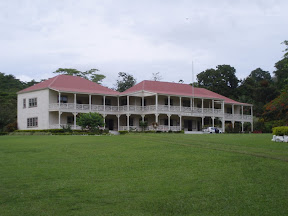


Only the central and left side of the house were built by RLS. The wing on the right was built by the person to whom the house was sold by the family after RLS's death. The gardens are extensive, as the whole estate is 350 acres. There is a long drive to the house, which is surrounded by lawns bordered by trees and shrubs.
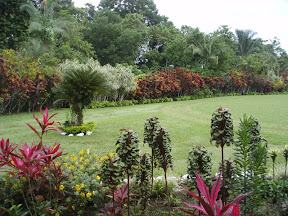


There are not huge numbers of visitors at this time of year, so we had a tour all to ourselves, given us by a very nice young man wearing a lava-lava; he said his name was Nigel, but looked just like James Wong.

We started with the Smoking Room, which had a big deep fireplace
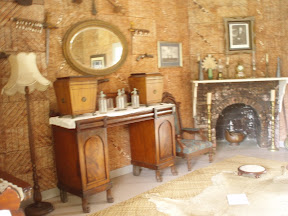


Nigel explained that this wasn't a working fireplace, in fact there was no chimney, so no fire could be lit; in Samoa you don't need a fire anyway, it was just to make the family feel at home, as they were accustomed to fireplaces. The was a similar one in RLS's bedroom as well.

His bedroom was large, and was actually a library, full of bookshelves. This is one end of it - there were too many bookshelves to get them all in one picture.
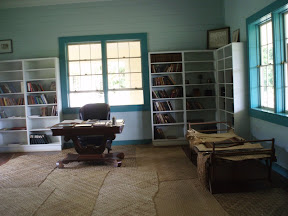


Apparently he often slept on that bed under the window which had no mattress, only some finely woven Samoan mats. At the other end of the room was a single bed.


Because of his TB, he did not share a bedroom with his wife, who had her own bedroom through the doorway you can see on the left of the picture. And that's a tray-table by the head of the bed, so he could work in bed.

There was a hospital in the house, so the doctor could treat him when he was ill.
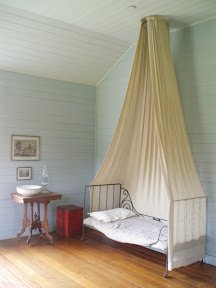


There was quite an extensive medicine chest, full of interesting herbal remedies.

I was a bit surprised to see no guest rooms, but apparently, though he had a lot of visitors and parties, he did not have people to stay.

The main room downstairs was very large, and consequently a bit difficult to photograph.
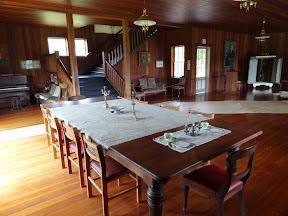


It could be used as a ballroom as well as a dining room. There were a piano, a pianola, a banjo and a couple of zithers on the left, behind the table. Also behind the table you can see the main staircase up to the bedrooms. There was an outside staircase too. Just on the right of the photo, you may be able to see his portrait. Paul took a better picture of that than I did.
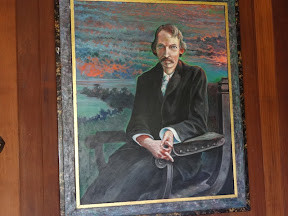


As you can see, I was fascinated by the house, which I have wanted to visit for over 40 years, and we spent almost two hours there and took a lot of pictures. It was strange to see so much Victorian furniture in such a setting. There were a couple of treadle sewing machines, since the women made all their own clothes. I suppose it was difficult to obtain European style clothes in Samoa at the time, so I imagine they had to make their own. They must all have been very hot most of the time.

We had planned to walk up to the tomb, but Nigel warned us that the short path was steep and difficult, and the less steep path took an hour each way, and still required good shoes and plenty of water. So we decided to leave that for another day - if the rain stops.

We set off along the cross island road for the south of the island, through farms of coconut palms, taro, sugar cane and vegetables. The photo below shows the taro, which has leaves that are almost heart-shaped. That may be some young sugar-cane in front of it.


We climbed steadily through the volcanic hills, and stopped to photograph the highest waterfall in Samoa, which is called Papapapaitai Falls
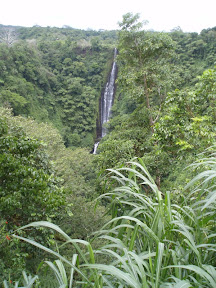


There is a deep pool at the foot of the falls, which used to be popular for swimming. However, it is very deep and apparently there were some accidents, so now swimming is not allowed.

Eventually, we crossed over the highest mountain, and had a view of the south coast.


We drove down to look at a couple of the nice resorts there, which are very romantic. Both were destroyed in the tsunami, but one has been completely rebuilt and you would not know anything had happened there. It has a golf course, though with all the coconut palms, it looks quite hazardous. Everything is built under shady palms, and it all looks looks very expensive.
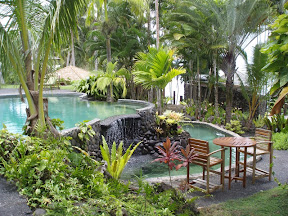


The other one, the Coconut Resort, is still not finished, and was full of builders. Part of it was open though.
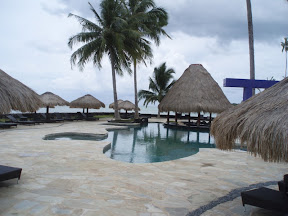


The beach was very romantic
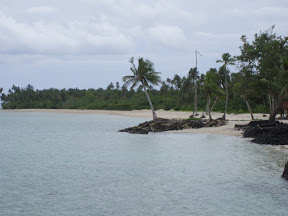


I went into the sea here to take this picture, but not for long, because the rain started. It seemed reasonable to return to Apia then, especially since the rain soon made it difficult to see well enough to drive. Apparently, this is not typical weather during the rainy season, when it usually rains two or three times a week, not all day for weeks. Just our luck! It has rained, off and on, for the rest of the day. We are hoping for better tomorrow!

- Posted using BlogPress from my iPad

Monday, 12 December 2011

Samoa on Sunday

Sunday 11th December
We decided to have a lazy day today, rather than sightseeing, and this is probably just as well, since the rain has been falling in a waterfall. Breakfast was tropical fruits, toast and butter with jam or honey, taken in the dining area, which is just a roof over the tables and chairs.


We though we might use the pool today, but it has hardly stopped raining all day, and we have done nothing except lie about and read. It has been good to relax, after all the rushing from place to place we have done. Fortunately, there is a library here, so quite a lot of our day has been spent reading in the comfort of our air-conditioned room.


We also have a patio which we used yesterday, but cannot use today, as it has no roof. There is a patio umbrella, but the rain has been too heavy to think of putting it up.


You can probably see that the rain has knocked down most of the frangipani blooms, which are lying on the grass under the tree.

One of the very popular options here instead of a standard room is to book a bure, either a beach bure or a garden bure. Our hotel, being up the hill, has no beach bures, but it does have garden bures.


They were open yesterday when I took this picture, as it was slightly drier. Today it has been so wet that they have all been closed up. Paul says he is very glad he was not tempted to book one - we might have done it if the weather was better, though I don't suppose there would have been any power to charge the cameras, computers or phones. Reading the travel sites and reviews has shown us that people often book a night or two in this type of accommodation to try to experience 'the real Samoa', but I certainly don't fancy it in the rain. Just as I am a fair weather walker, I like my comforts!

Paul has been very taken with the garden, where, amongst other things, there are coconut palms, with coconuts.


though he is getting quite blasé about seeing all these exotic things growing. The place where stayed in a cottage in the garden (outside Kerikeri) was also an avocado orchard and he didn't even insist on photographing it.

We really hope the weather will be better tomorrow, because we have fixed to go to Robert Louis Stevenson's house and then to see some other parts of the island. (The house shuts at 12 on Saturday and is not open on Sunday). Of course we can see the house in the rain, but there is also the garden, and then it is quite a walk to his tomb. And if we are to see other parts of the island, even the charms of beautiful white beaches and swimming in the cool clear sea fade somewhat if the rain is falling by the bucketful, as it is today.

- Posted using BlogPress from my iPad

Samoa

Saturday 10th December (repeated by popular request)
Having left Fiji on 11th December (at 1.45 am!) we found ourselves back in September 10th when we landed in Samoa (around 4.30 am). After we had gone through immigration and collected our baggage it was a longish drive from the airport to the capital city, Apia, 35 or 40 km. I felt completely exhausted by the time we arrived, and we rejected any offers of breakfast and fell into bed, from which we failed to arise until after lunch.

This was a bit of a mistake, because Samoa is rather like Wallington or Banstead 50 years ago. Saturday is half day, and everywhere is shut by 12 or 12.30. On Sunday, everywhere is likewise shut, and most people go to church in the morning.

We wandered about for a while, looking at closed shops, cafes and other buildings, then we found a taxi driver who took us about a bit to show us around, which was something of a relief as there are no street names or street signs and the rain had started to descend in a waterfall. The streets are named on the map, but not on the street itself. You can navigate to a certain extent by buildings which are named on the map, because many of the buildings have a sign with the name on the building, but not all of them. This is why you need a taxi!

Apia is not really like any capital city we have recently visited, though there are some beautiful new buildings, and some historic ones. We will have to wait for more information until the tourist office is open on Monday - it closes at 12 on Saturdays. However, our taxi driver showed us some of the highlights. This is the old Parliament building, which is very traditional.


And this is the new one, which has preserved the traditional round shape.


The most impressive building is the Justice Building, which houses all the courts.


This is the main Radio Station, which is more typical of the buildings we have seen.


This is the tomb of a local politician, who was dearly loved. I have forgotten his name, but I will look it up when I next connect to the Internet. (I have bought 5 hours of connection, so I am being sparing and will see how it lasts)


It did occur to me to wonder which of our own politicians might be so dearly loved that we would build him such a tomb and so revere him (or her).

As you can see from the pictures, it was a pretty stormy day and we kept having to shut the taxi window to keep the rain out. The rain seems to be intermittent. It is sometimes so heavy it is like a waterfall, sometimes quite light, sometimes just drizzle, and sometimes there is no rain at all. It is warm -about 28 - 30 degrees C and very humid, so we are glad of the air-conditioning in our room.

It is a beautiful place, with lots of flowers. Our room was decorated with frangipani flowers when we arrived. Unfortunately, I was too tired to take a picture. The place is full of tall trees with beautiful red flowers which our taxi driver told us were called Manuka trees.


These are clearly not the same as the Manuka trees in New Zealand, so I am not sure if it is the same spelling or something completely different.

Later in the evening we went out to eat, as our hotel only provides breakfast. Fortunately, there is a restaurant which is open within one block, though the menu is not extensive. It is an Italian restaurant! The food was nice, and we sat in the open under a roof while the rain poured down again. It was a little odd listening to the piped music, which was Xmas songs. So we were in the wet heat, listening to 'I'm Dreaming of a White Christmas' , 'Let it Snow' and other such songs.

- Posted using BlogPress from my iPad

Saturday, 10 December 2011

Auckland to Fiji

Saturday 10th December
There is hardly anything to write about today, and no pictures. We seem to have done little except sit in airports - I am sitting in one now.

We checked out of our hotel at 10, and drove to the car rental office to return the car. The car rental office shuttle took us to the airport, where we had an hour to wait until the check-in opened.

Once checked in, we went through security, where I was examined very carefully because of the plastic knife and fork I had stupidly left in my coat pocket. Fortunately for my peace of mind, it did not take long for them to work out that there was only a limited amount of damage to be done with a plastic fork, especially when wielded by a lady no longer in the first flush of youth! Anyway, I played safe and kept my mouth shut. The urge to make some jokey remark was strong, but I fought it - I didn't want to get into more trouble. And I have made sure there is no longer any plastic cutlery in my coat pocket!

Once on the plane, in the centre seat of 3, I found that my neighbour in the aisle seat was a teenage boy who was not willing to switch off his mobile phone. He spoke on it the whole time the plane was taxi-ing and when the take-off started. He hid it from the hostess when she came past. Fortunately, he turned it off before the wheels lifted. Then his little sister or brother, who was sitting in the seat behind me, kicked me in the back during most of the flight.

Anyway, we took off safely and arrived safely in Fiji, where it is hot. Weather is around 30 degrees C, humid and with a chance of thunderstorms. The weather report for Samoa is similar. I have a lot of e-books with me and I can see I may be doing a lot of reading!

We arrived in Fiji at 6 pm local time, and have nearly 8 hours of stop-over; the flight to Samoa leaves at 1.45 am. So I have plenty of time to write this in Fiji airport.

We are scheduled to arrive in Samoa at 4.30 am local time, the previous day, because of crossing the date-line. We cross it again in the opposite direction when we come back to Fiji, then we cross it again when we fly to Los Angeles. So I probably won't know which day of the week it is for a while.

We have Fiji connectivity already, courtesy of Vodafone. But Samoa may be more of a problem - I will probably try for wireless in the hotel. So I'm not sure when the next post will be.

- Posted using BlogPress from my iPad