Sunday, 9 March 2014

Salt Lake City - Natural History Museum

Friday 7th March

After our brief stop for coffee and biscuits near Temple Square, we jumped on the Trax again and caught a different line out to the University area. We had been told we would be able to walk from a stop near the end of the line, called Fort Douglas, but in fact it proved to be rather a long walk.

At the start of the walk, we had to cross the very busy road on a footbridge, which gave a good view over the area.


The roofs on the right are those of the Trax station, and you can see the lines beside the road.

We had been given instructions to look for a gravel hiking trail, but we failed to find it and ended up walking through some of the University Halls of Residence and some of the original Fort Douglas buildings.


Fort Douglas was established to hold the soldiers who were quartered in the area to control the unruly Mormons! These old buildings we think must have been officers' quarters, around a pleasant green with a bandstand on it.

Nobody seemed able to direct us to the Museum, but fortunately it was marked on Apple Maps so we managed to find it. It was a very long walk though, perhaps a couple of miles or more and all uphill, and as the sun had come out, we were very hot.

When we eventually found the Museum, we discovered that the free Campus Shuttle bus can be caught to the Museum from the last Trax station on the line, which would have saved us a very long hot walk.

Unlike Museums in Britain, this one is not free, but it is really quite spectacular. How often do you get a view like this in a museum?


I was anxious to see the dinosaur bones and to take lots of photos for my older grandson; although his first love is Thomas the Tank Engine, he is also very fond of dinosaurs; they often seem to figure in his games with Thomas. I don't know if he has any concept of size, so I wanted to take lots of photos, preferably with Paul in them for a size comparison.

My first attempt was this replica dinosaur footprint.


That's my foot at the bottom of the picture - I wanted some sort of size comparison.

The dinosaurs are all very well displayed. This is one of my better photos, though sadly, I have forgotten to photograph its name.


I was particularly taken with this dinosaur version of a crocodile, though I didn't manage to get anybody in this photo for a size comparison.


My grandson is also very interested in crocodiles, though I think he would find this one quite frighteningly huge. Mind you, he has seen bits of the Disney film of Peter Pan, and can sing 'Never Smile at a Crocodile' so I suppose he must have a pretty fair idea of their size. The one above, however, is truly massive - it must be about 30 feet long.

As well as dinosaurs, there were bones of some ice age animals.


There's a mammoth in this photo, and a huge aurochs I think.

At that point, my camera battery ran out, so I didn't have the opportunity to photograph anything else. There were some very interesting artefacts though, human leavings dating back 10,000 years with a lot of stone axes and arrowheads. As people became more settled and less nomadic, they began to make more things and there was early pottery and some fascinating remains of early moccasins and sandals. The area round the Great Salt Lake had always attracted a lot of birds and hence other wildlife, so there were many resources for early hunters. The earliest sandals were made from the reeds that grow around the lake, and the moccasins from animal skins - usually with the fur inside! There were cloaks or blankets made from the reeds, and these showed traces of having been adorned with feathers as well.

There was quite a bit on geology, so we admired the many examples of gemstones that can be mined in the area, and a huge section on the formation of rocks. I spent some time studying the seismograph, since it was claimed that there is an earthquake somewhere every 11 seconds, but I saw nothing on the three sensors while I was there - though there was evidence of the seismograph needle having moved quite violently in the past.

By now we were quite exhausted, and even the snack we had eaten at the Museum café had failed to sustain us for long, so we went outside and caught the 3.30 Campus Shuttle back to the last Trax Station on the line - it's called Medical Center. We didn't have long to wait for the first train, and, although it was a different line from the one we had caught in the morning, it called at the station where we had boarded, so we didn't even have to change train. Even better, there was a bus waiting at the station which took us back to just outside our hotel, where we arrived just before 5pm, so we could make a start on our packing. We leave on the 9.15am airport shuttle

- Posted using BlogPress from my iPad

Salt Lake City - Temple Square

Friday 7th March

This was the day we had set aside for a tourist visit to Salt Lake City, so we set off fairly early. The hotel shuttle kindly took us to the nearest Trax station. Trax is an electric train but it runs on tracks through the city just like a tram - apart from the fact there are 8 or 10 coaches. I don't seem to have taken a photo of it, unfortunately - I don't know why. I was probably too busy getting on and off.

We got off at Temple Square and went in through the gates to see the Mormon Temple and its surrounding buildings.


This is my best photo of the Temple, though it's taken later in the visit, looking down from the 10th floor of another building. The building with the oval roof behind the Temple it is the Tabernacle. This is where you might hear the Mormon Tabernacle Choir.

Only Mormons can go into the Temple, but we walked round the outside. There were several weddings, with brides and bridesmaids in flimsy dresses, having their photos taken in front of the Temple or running about the gardens. Paul was regretting not wearing his long johns and a thermal vest, so they must have been very cold indeed.

You may be able to see a fountain and pool to the left of the Temple in my photo. It is in a garden in which there are statues of Joseph Smith and other people, showing various important events in his life. There is also mention of his martyrdom - we were later told he and his brother were jailed on something of a pretext in a neighbouring state and a lynch mob shot both of them. They obviously took their religion very seriously!

Another nearby building is the Assembly Hall, with Seagull Monument outside.


The monument is in thankfulness to God for his goodness to the Mormons - I don't understand the seagull reference at all.

Also outside the Assembly Hall is this statue group, called the Handcart Pioneer Monument.


This is described as a tribute to the thousands of Mormon pioneers who, because they could not afford ox-drawn wagons, walked across the plains in the 1850s pushing and pulling all their possessions in handcarts. The monument claims that although 250 died on the way, around 3000 people walked the 1350 miles from Iowa City. This seems to me such a hard journey, pulling and pushing a cart, I am amazed so many made it.

By then, Paul was freezing cold, so we went into one of the Visitors' Centres where we were greeted by two very friendly girls who asked us about ourselves and from whom we got the information about the martyrdom of Joseph Smith and his brother Hiram.

There was a lot of information about the Temple in this building, and a very interesting model of it, showing the various rooms inside. A room I didn't understand in the basement with 12 oxen in a circle supporting some sort of vessel turned out to be the baptismal font. Mormons use total immersion for baptism, which I didn't know. The twelve oxen represent the twelve tribes of Israel. There are many other rooms in the temple, some huge ones for worship and smaller ones for teaching. These latter rooms have very colourful murals completely covering the walls; for instance, the Garden Room represents the Garden of Eden and is used for teaching about Adam and Eve and the Garden and the power of temptation.

There were other interesting pieces of information, often illustrated with models and photographs.

The Temple took 40 years to build from granite blocks brought from 20 miles away from Little Cottonwood Canyon (where we have been skiing for the last two weeks.) The stones were rough cut and transported on ox-carts like the one below.


Once at Temple Square, the blocks were cut to the size needed, using hand tools, and hoisted into place using block and tackle. There were lots of examples of the hand tools used.

The Temple took 40 years as to build, and the walls are nine feet thick at the base and six feet thick higher up. Many of the builders were volunteers, though obviously some of the more skilled people were employed.

After that, we went out to have a look at the Tabernacle, the building in my Temple photo with the huge oval roof. It has an enormous organ - apparently there are 13,000 pipes. The building currently seats 5000, though it was originally build to hold 10,000. Some more spacious pews were installed so people were more comfortable, because it it was no longer large enough to hold all the people who came to conferences; there is now another building for conferences, which can hold 25,000.

I wanted to take a photograph inside, but the very friendly girl who gave us all the information on us began to practise her missionary skills on us, so we left before I had time for a photo.

Our last building was the Joseph Smith Memorial Building, which was originally a hotel and is now used for administration as well as housing two restaurants and a café. This is the entrance hall.


I'm afraid it came out rather dark, but I didn't like to use a flash, as it was full of people. In the opposite corner from where I am standing, which you can't really see in the murk, is a grand piano.

We went up to the 10th floor, where we were able to admire the view.


This is one side of the city, looking towards some of the mountains which surround it. This is also where I took the photo I posted first, of the Temple and some of the other buildings surrounding it.

The whole building is pretty impressive inside.


This is one part of the hall that runs along the public side of the 10th floor, showing some of the magnificent carpets and the stained glass ceiling. And yes, that is an indoor fountain.

Once downstairs again, we went outside to look at some of the other historic houses. The next photo is of the Lion House, so called because there's a lion sculpture on the front of it.


It originally belonged to Brigham Young and his extended family. From the front it looks like a small house, but I photographed it from the side to show how deep it was, with lots of bedrooms to accommodate all the wives and children. It now houses the Lion Pantry, where you can eat. It's next to another old house, referred to as the Beehive House, as there is a beehive, a common Mormon symbol of industry, on the roof. There are free tours of these old houses, but there wasn't one starting soon, and we weren't certain if we would meet more missionaries who would want to convert us, so we gave it a miss.

We made our way up a slight hill towards the Brigham Young Historic Park (which proved to be closed - it's only open in summer.) On the way, we passed the Eagle Gate.


This used to be a gateway which was closed at night for privacy when Brigham Young lived in the Square, but the gates were taken down when the road was widened. It is no longer the original eagle either - that was wood and didn't last well, so this is a replica. You may not be able to see it in my photo, but the eagle is on top of a beehive.

We were quite exhausted with all the sightseeing, but finding a cup of coffee in this area was a problem. Mormons do not approve of coffee, which Paul found hard to believe. He asked in the Lion House Pantry and in the café in the Joseph Smith Memorial Building, though I could have told him it was a forlorn hope. Eventually, somebody took pity on us and we were directed to a café some distance away where we could have a rather late morning coffee and biscuits.

After that, we felt we needed a change so we decided to make an expedition to the Natural History Museum which is famous for dinosaur bones. I'll have to put those photos in my next post, this one is already too long.

- Posted using BlogPress from my iPad

Saturday, 8 March 2014

Still More Alta

Saturday 1st March - Thursday 6th March

Following my fall and the subsequent pain in my tail bone, I found even walking painful so there was no prospect of skiing for a few days. I stayed in the hotel and read, though most days I walked the mile or so to the supermarket to buy supplies for Paul's lunches. It seemed a good idea for me to keep moving, rather than just sitting around - especially since sitting wasn't entirely comfortable, and I was having to sleep on my front.

After a few days, I felt able to go out skiing again, though somewhat carefully. I really didn't want to fall over again. Although I could walk without problems, sitting down could still be uncomfortable, and climbing stairs was painful. So I started on the easiest trail of all, one of the steeper parts of which is in the photograph below.


The trail goes round to the left, around the trees, and down a fairly steep and fast trail towards the restaurant at the foot of the slope.


This is taken from the balcony of the restaurant, showing the nice long final run down to the restaurant. There are some people who have taken chairs out onto the snow, hoping to catch some sun. The balcony is partly covered, you can see the roof at the top of my photo. I found the balcony a pleasant place to sit if the weather wasn't too cold.

Some of the balcony isn't covered. When it snows, nobody wants to sit outside, and the staff lift up the outdoor tables so that they don't disappear under a heap of snow.


You can see that it had snowed again on some of the days when I wasn't skiing, and that quite a lot of snow had fallen!

I was fortunate that some days were bright and sunny, but our last day was quite dull and made the trails quite difficult to see.


It isn't difficult to see where you need to go, it's just difficult to see what the surface is like. Below is a photo of me, half way down one of the slopes.


You can probably see, by the very tiny figures behind me, that it's quite a long slope, rather longer in fact than it looks in this photo. I had to stop half way down to catch my breath, before tackling the rest of the slope, which you can see below.


However, I did rather better than this person on the slope in front of me. I am managing to ski parallel again for most of my turns - or at least, for those turns where I'm not panicking!

Our last day is to be spent sightseeing in the city, so Thursday 6th was our last day of skiing. I caught the 3.30 bus home, but Paul, who had spent the afternoon skiing with friends, hung on until the lifts closed and caught one an hour later.

- Posted using BlogPress from my iPad

More Alta

Thursday February 27th - Friday February 28th

I'm repeating a day here because Paul went out skiing on the Thursday of the storm and I didn't. I'm extremely glad I didn't - it was very cold, with poor visibility; this photo, taken by a friend with whom Paul was skiing, gives some idea of what it was like.


This is the sort of weather where Paul wears several layers of clothing under his ski anorak, and puts on a neck gaiter, a balaclava and a face mask. I can't bear the idea of a face mask, the prospect of having to cover my face to protect it from freezing ice spicules does not appeal to me at all! Also I like to be able to see where I'm going. When you ski in bad light like this, you often can't see much of the surface ahead of you until you're actually skiing on it, which I find quite worrying.

Of course, the easy slopes on which I ski aren't likely to conceal any dreadful cliffs - unlike the places where Paul skis.


This is Paul and another friend, standing on a very high trail, as you can see. I am never likely to be found on high slopes like these.

After the day of snow on Thursday, the weather was lovely on Friday so I went out again. You get some spectacular views from the bus as you climb up into the mountains. The road the bus takes up to Alta goes into Little Cottonwood Canyon, and as it climbs up the canyon, you can see back down towards Salt Lake City.


The city sits in a sort of bowl, surrounded by snow-capped mountains on all sides.

As we climbed, we reached the area where the previous day's precipitation had fallen as snow, rather than the rain that fell in Salt Lake City. On the lower slopes, we entered a scene out of The Lion, the Witch and the Wardrobe, with all the trees coated with snow as though they had been sprinkled with sugar icing.


The dots at the foot of my photo are markings on the bus window - this is a photo taken from the bus.

As we climbed, we reached an area where there was more wind and the trees were no longer sprinkled with snow; however, you can see the start of some of the ski runs.


As you can see, this is another photo taken from inside the bus.

It was a beautiful day, and I was prepared to enjoy the skiing. Unfortunately, quite early on, Paul's skis became entangled with mine when we got off the chair lift, and I fell heavily and bruised my coccyx quite badly. As we were still up the hill, I had to get down somehow, in spite of the pain in my tail - and a twisted knee. To add insult to injury, there was so much blasting going on - avalanche mitigation - that the trail I had intended to use was closed and everybody was directed down a somewhat steeper slope. Quite a few people were in difficulties, some of them lying on the slope, and one elderly couple took off their skis and climbed down it. I got down somehow - partly sliding down on my extremely painful backside - but the fall had destroyed my confidence and I couldn't bear the thought of falling over again. So I stopped for the day and Paul went off to ski with friends after lunch. We met again on the 3.30 bus back to the hotel, where I was sorry there was no mantelpiece at which to stand and eat my supper - I was finding it quite hard to sit down!

- Posted using BlogPress from my iPad

Friday, 28 February 2014

Alta

Tuesday 25th February - Thursday 27th

Well, I seem to have caught up again, but only by dint of spending most of a day sorting out my photographs, getting them off the iPhone and the camera and onto the iPad, and typing like a mad thing. The problem is, as I may have indicated in my last post, that we are too tired to do anything else if we go skiing. There is no time to write anything before our evening meal, and after our evening meal, we just fall asleep!

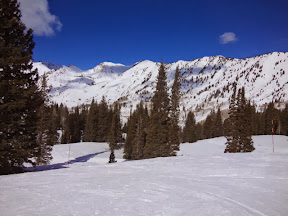
On my first day skiing, we caught the bus up to Alta, where there is a good selection of easy runs. This is where I stood immediately I got off the lift.


You can see how much snow there is.

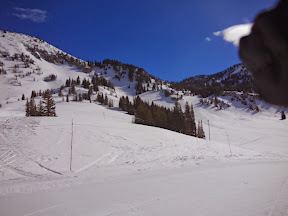
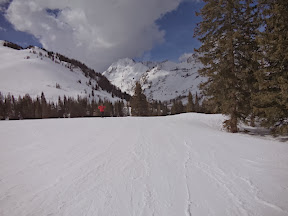
This is the view of one of the easy trails just after you get off the lift.


Those are my ski sticks which I have parked in the snow so I have my hands free to take a photograph. Although I am standing on a fairly flat area, the slope is a bit steeper on the left of the photo; this is what it looks like as you start to ski down.


You can see the trail carrying on down in the distance.

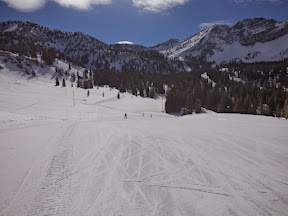
The next photo is taken a bit further down the slope.


It isn't fantastically steep, so I didn't find most of it too worrying, although there was hardly anywhere to practise my turns, and I spent most of my time standing on my left leg because the trail slipped down to the left as well as down straight ahead. This led to my falling over on one occasion because I found myself skiing down to the left and falling off the trail as I tried to avoid people who were hanging about in the middle of the trail. Fortunately, I didn't hurt myself.

After 4 long runs, I decided I had had enough for the day and retired to the restaurant for a much needed rest. We parked our skis close to the stairs that went down to the restaurant, and Paul came in with me so he could leave me various things he no longer wanted to carry in his backpack. A few minutes later, he went back out again only to find his skis had disappeared, and came back into the restaurant, shouting 'my skis have been stolen'.

I went out with him, and soon saw that, right next to my skis were an unfamiliar looking pair of skis, so I judged that some idiot had taken Paul's skis by mistake. The other skis looked nothing like Paul's, but the poles were the same, and people are awfully careless, especially when not paying attention but chatting with their friends or fiddling with their phones. Paul had already called a friend to arrange meeting her so they could ski together, so I had to text her an explanation to prevent her standing about waiting for him for ages, while Paul went off to see how to report his loss.

Paul was convinced his skis had been stolen and was keen to buy another pair immediately, but I persuaded him to wait to see what happened. He went to the local ski shop to see what they had, but fortunately decided there was nothing there that interested him anyway. Otherwise, I insisted that we wait patiently to see if the idiot returned Paul's skis.

After two and a half hours, the unfamiliar skis were still next to mine, so I got Paul to write a note to the owner, asking him, if he had taken Paul's skis by mistake, to leave them at the ski school if it was still open, or to phone us if it was closed. Then we caught the 3.30 bus home.

On the way, Paul regaled the whole bus with his misfortune, and everybody was very kind and concerned. One man, who was staying in our hotel, said he would lend Paul his spare skis and sticks. He said he always brought spares because he broke things. His room was close to ours, and he duly brought us the spare skis and sticks, and by great good fortune they were the correct length and the bindings fitted Paul's boots.

Next day, we set off again for the slopes with the spare skis, arriving just before 10. While I went to buy my lift ticket, Paul went off to examine all the ski racks, and, lo and behold, there were his skis, in the racks outside the ticket office and ski school! Paul was delighted to see them, and we used his lock to chain up the kind man's skis so no other fool would take them away in error. Then we went off to ski.

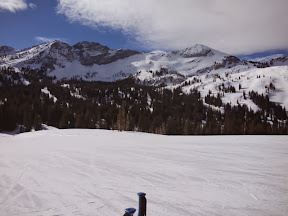
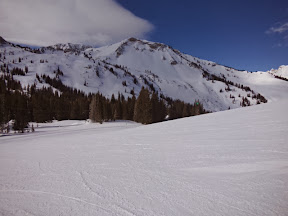
We tried a different trail this time, one which was slightly steeper so I could have the opportunity to practise my turns. This is the view part of the way down. As you can see, the snow is deep and wonderful, and the scenery is quite breathtaking.


Later on down the slope, I took the opportunity of standing on a flat area to photograph the surrounding mountains.


That's Paul you might just be able to see in the red jacket standing at the top of the next steep bit waiting for me to catch up.

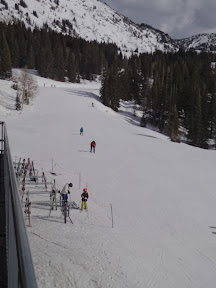
The photo below shows the final stretch down to the lift.


You can probably see that I am standing on the balcony of the restaurant, looking down on the skiers. As it is a sunny day, quite a few people are sitting out in the sun on the left, just out of my photo. They have stacked their skis in the snow close to them - probably to ensure somebody doesn't take them by mistake!

After another 4 long runs, my legs were aching again and I felt I had had enough, so Paul had some lunch and then spent the last hour and a half skiing the more difficult runs with friends. While we were sitting in the restaurant, Paul left his skis where he could see them so that they didn't disappear again. After this, he says he will chain them every time he leaves them in a rack, but he couldn't do it immediately as his chain was already in use on the spare skis.

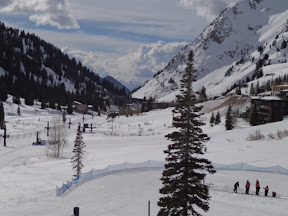
While Paul was away skiing, I sat quietly in the restaurant and read my book, and took the opportunity of some further photos. This is the view from the restaurant balcony looking down the valley - I had previously been skiing higher up the valley.


You can see the rather spectacular cloud formations which indicate that there will be storms the next day - that was when I decided that, if it was going to snow, I would have a day of rest.

We caught the 3.35 bus again, struggling a bit with three pairs of skis and three pairs of sticks, as we had to bring back the spare skis and sticks which our nice neighbour had lent Paul, and which he turned out not to need.

When we woke on Thursday, we could see there would be a storm, so I sent Paul off on his own, saying I would have a day of rest. My legs were aching so much anyway I was finding it hard to walk, so I welcomed the opportunity to rest them. I had thought I'd take a nice walk to the supermarket, but as soon as I left the hotel, the heavens opened and rain fell out of the sky like stair-rods so I hurried back inside. I could only hope that it was falling as snow higher up the mountain, and apparently it was, but the snow was very wet. Paul arrived home soaking wet and very late; apparently, the wet slidy snow caused the traffic all down the valley to be very slow, and the bus was very late. I am glad I stayed indoors and didn't even try to ski.

- Posted using BlogPress from my iPad

To Salt Lake City

Sunday February 23rd - Monday 24th

I left my Denver hotel around midday to set off for the airport and to meet Paul who was travelling down from Breckenridge after breakfast. I was there long before he was, so sat quietly and waited for him.

Our plane was unfortunately delayed by almost an hour, so we sat at the gate and read until eventually we were able to board. The flight was only 65 minutes, though they were extremely bumpy minutes, so I was glad to arrive. Fortunately, it being an internal flight, we were in the arrivals hall very quickly, though it was quite a long wait for our luggage. When it had arrived, Paul phoned for the hotel courtesy bus, but it wasn't available so we had to take a taxi - which the hotel paid! Transport to and from the airport is included in our room price.

The hotel is to the south of Salt Lake City, in a suburb called Murray. We can see the mountains from our bedroom window.


You can see that we are quite a long way from the mountains - about an hour's drive - but this hotel is specially set up for skiers - and it's full of them.

This is how the hotel works.There is a very hearty skiers' breakfast in the morning, between 6 and 10 am and the early ski bus to the slopes (8 o'clock) can be boarded nearby. Other later buses are further away, and not within walking distance - especially with ski boots on! So I have chosen to go a bit later (8.40) when the hotel shuttle will take you to the further away bus stop. The ski bus then takes you up to the resort area, taking about an hour.

So far we have returned on the 3.35 bus, arriving at the stop near the hotel around 4.35, at which point you have to call the hotel to ask them to collect you in their shuttle. This means you arrive back at the hotel at close to 5 pm, and the evening meal is between 5 and 7. So it's the hurried shower and re-dressing before going to eat.

It isn't a restaurant, there's no choice, but there's always a huge salad and some sort of main dish with rice or potatoes or pasta or similar. There's no dessert, but there's a supermarket not too far away, so you can buy yoghurt or fruit, and the hotel sells ice creams and various chocolate biscuits. If you can't bear the meal of the day, the hotel also sells microwave meals - there's a microwave in every room. You could also walk to the supermarket for a better meal selection, and there are various restaurants nearby. So far, we have just eaten in the hotel, as the food has been quite acceptable - and nothing vegetarian to put Paul off.

After the meal, we are so exhausted we just seem to fall asleep - some nights I haven't made it past 8 o'clock; and the alarm goes at 7 am so we can start all over again!

I should perhaps explain that on the first day, Monday 24th, I didn't go out skiing, I left Paul to look round the resort at the possibilities of really easy slopes for me. I only skied about 3 or 4 days in France and about the same in Breckenridge so I'm still trying to re-learn any sort of technique. So on the first day here I had a relaxing day in the hotel - especially since I am still finding the altitude a trial, though it isn't very high here; the city is only about 4300 feet, so I ought to find it easier than Denver, and certainly easier than Breckenridge.

- Posted using BlogPress from my iPad

Thursday, 27 February 2014

Denver Art Gallery

Saturday February 22nd

As this was my last day in Denver, it had to be the day for the Art Gallery. I set off for the somewhat laborious trip into the city - made even more laborious because the free shuttle to the airport was nearly 15 minutes late and I missed the bus into the city - I watched it leaving as the shuttle pulled up nearby. So I had a whole hour to wait for the next one.

I got out at Market Street Station again, but this time I took the free bus down to the end of the 16th Street Mall so that I wouldn't be totally exhausted by the time I reached the Art Gallery.

You can see the distinctive Art Gallery building from some distance away,


so you are not in any doubt as to whether you are in the right place.

It was extremely hot inside and I was much too warmly dressed, but fortunately there are lockers so I was able to leave my heavy ski anorak and everything else I didn't need to carry. A very helpful volunteer suggested a route round the gallery, so I started at the top floor, with Western American art. There were some wonderful sculptures, akin to those on the way to the area which I posted in the previous blog.


This one shows a pioneer family, and is difficult to photograph adequately because it is so different from every side.

I enjoyed the western paintings, many of which were landscapes, and others of which attempted to capture images of the 'old west' through wonderfully evocative portraits or through scenes, real or imagined, like the one below.


This one, called 'The Stagecoach', is by Norman Rockwell. It was an illustration for the 'Saturday Evening Post', advertising the remake of the classic western film 'Stagecoach'.

The next floor down was European painting, starting from the Renaissance. Actually, I would have called several of them pre-Renaissance, being dated from 1360. There were none of my favourite artists though.

Somewhat later, I noticed this not very well known portrait of Henry Vlll, painted in the year of his coronation,1509.


Although I have seen illustrations of this portrait before, it seems not to be very well known in England. We are more familiar with portraits of a much older Henry, grossly fat and bearded and very unattractive. I suppose this is because we are more familiar with the portraits of him we have in England - particularly the Holbein one.

There were a few old masters - a lovely Renoir, an exquisite Sisley, and this beautiful Chagall.


There were plenty of examples from other well-known artists too - I failed to photograph a Picasso collage, but you can't photograph everything.

On the same floor there were some wonderful examples of textiles, which I photographed avidly, and which all turned out to be out of focus! I was using the camera phone, having left my camera in my anorak pocket in the locker, and I imagine it couldn't cope with the light levels in the textiles room.

The next floor was Asian art, with some examples from all over Asia. There was some particularly beautiful Japanese lacquer, but it didn't photograph well, being behind glass.

Other items were more successful.


I particularly enjoyed this Thai lion from the Ayutthaya period, some time between around 1350 to around 1760. There was no indication of a more exact date.

Some of the pieces were very large indeed.


This is a section of a palace facade, from the Swat Valley in Pakistan, dating from 1836. Sadly, we often associate the Swat valley today only with the Taliban, but it has thousands of years of history; it was already inhabited with well-planned towns which were stormed by Alexander the Great in 327BC. It would be interesting to see more art from this ancient area.

The next floor down was pre-Columbian art, and I was interested to compare this with the recent exhibition I saw in the British Museum.


There were many pieces similar to those in the exhibition, though these came from all over South America, not just ancient Colombia, like the ones in the British Museum exhibition.

The same floor also had Spanish Colonial Art, but I only walked through that very quickly, as my back was starting to hurt.

The final floor I tackled was American Indian art, and I was sorry not to have more time to spend on it. I failed to photograph the wonderful bead work, and my photographs of the pottery, rivalling Ancient Greek pottery, are out of focus. I did manage some of the textiles though.


These are all relatively modern.

There was plenty more to see, but my energy had run out, and I took myself back to Barnes and Noble for a reviving coffee before catching the bus back up to Market Street Station for the bus back to the airport. I was very fortunate in that the bus arrived at the airport at the same time as the shuttle to the hotel, so there was no waiting around. I was glad not to arrive back too exhausted, as I had to pack for my departure to Salt Lake City the following day.

- Posted using BlogPress from my iPad