Thursday, 17 September 2015

In Vienna 2, pm

Wednesday September 16th, afternoon

After lunch, we set off on a tram for the Belvedere.
The Belvedere consists of two magnificent palaces, the Upper and Lower Belvedere, which were built in the 18th century in Baroque style as the summer residence for Prince Eugene of Savoy. The palaces and their extensive gardens are considered to be one of the Vienna's finest Baroque landmarks.

The Upper Belvedere originally had a representative function so apparently many momentous public events took place here. Later it served as an imperial painting gallery, and it is still a picture gallery today.

This is a view from the upstairs of the Upper Belvedere across the magnificent gardens to the Lower Belvedere.


As you can see, it also gives a good view over Vienna.

Some parts of the building have been preserved in their original state. You are not allowed to photograph the paintings, but nobody stopped me from photographing the ceiling of this circular room.


Here you can see the typical rococo interior, white paint with gold leaf adorned decorations in high relief and chandeliers dripping in crystals to reflect the light. Mind you, the decorations are not in such high relief as those of the Schönbrunn Palace we saw yesterday, nor are the chandeliers so enormous but this is the general idea.

The Upper Belvedere houses a collection of Austrian art dating from the Middle Ages to the present day, including the world’s largest Gustav Klimt collection. Sadly, the section on the Middle Ages is currently closed.

The highlights of all the collections are Klimt’s golden pictures Kiss and Judith, though there are also masterpieces by Schiele and Kokoschka, neither of which we particularly like. So we looked at them, but we preferred to concentrate on things we liked.

Everybody wants to see and photograph Kiss, but of course you are not allowed to photograph it, so there is a reproduction downstairs which you can photograph instead.


We were the only tourists in the building not taking a selfie with it, as far as I can gather, so we had to form an orderly queue.

The room with the most famous Klimt paintings has a guard in it all the time, and he spends his time running about preventing naughty tourists like me from taking photos, so we have been obliged to buy some reproductions.

However, some of the other rooms are not so closely guarded, so I snatched a quick photo of this one by Klimt, which I really like.


I also managed another photo of a second one, Avenue to Schloss Kammer, which I liked even more, but such was my haste the photo is really squint, I didn't have time to line the camera up properly.

I also couldn't resist the picture below, by an artist I've never heard of.


This is called, sensibly enough, Pond, and was painted in 1900 by an artist called Wilhelm Bernatzik.

There are prominent works by many of the French Impressionists, including a Van Gogh, but I preferred this Monet


It's called Path in the Garden at Givernay and I would ideally have wanted to take it home with me - but I don't think the museum would have liked that!

There were several rooms full of paintings classed as Biedermeier, which covers the period between the Congress of Vienna in 1814 and around 1848. I am told that these paintings are characterized by their striving for a true-to-life representation of the visible world and so they are described as Biedermeier Realism. The most important artist of this period was Ferdinand Georg Waldmüller, but I was beyond caring about art by then, my feet hurt and I was exhausted. I wanted to sit and rest in the museum café, but there wasn't one, so I found an armchair to rest while Paul browsed the shop. Then we caught the tram and then the U-bahn back to the hotel, where we had about an hour to rest and eat a quick sandwich before it was time to get ready for the concert at the Schönbrunn.

Concerts at the Schönbrunn are normally in the Orangerie, but we were told the Orangerie had already been booked, so this one would be in the Grand Gallery. We had really been looking forward to that, so we really didn't mind walking the considerable distance from the U-bahn to the Palace gates; when we finally got there, we were told that the concert had been moved back to the Orangerie after all. So we had to walk all the way back there, which was more or less opposite the exit from the U-Bahn! Normally I would have no problem in walking, but my knee was aching, as was the opposite hip because of the limping, and my feet and ankles had swollen up like balloons.

The concert was in two halves, extracts from three different Mozart works in the first half, then various things from the Strauss family in the second half. There were two singers, and two dancers. The singers sang bits from Don Giovanni and The Marriage of Figaro, and a couple of Strauss pieces, the dancers danced a ballet minuet from Don Giovanni, and a polka and a waltz during the Strauss parts, both in ballet style and therefore not the sort of thing you might expect to dance yourself. The singers were reasonable, the baritone had a strong voice though the tone was sometimes a bit thin. The soprano had the most beautiful voice but it wasn't very strong so she was sometimes drowned out by the orchestra.

It was quite an enjoyable evening, but afterwards we did feel envious of one of our party who had decided to go to the Opera instead, something we never even thought of doing. No tickets were available, but he bought two from one of the ticket touts and, though he said the seats were quite poor ones, at least they had seats!

Anyway, at least we have listened to Mozart and Strauss played in the city where they worked,and next time we come to Vienna, we'll try booking for the Opera on-line well before we travel.

- Posted using BlogPress from my iPad

Tuesday, 15 September 2015

In Vienna

Tuesday September 15th

My knee seemed a bit better this morning, so we decided to take the city tour that has been organised for the morning and then go off to the hospital in the afternoon. So at 9am, I clambered clumsily into a bus and we set off to be driven round the Ringstrasse, a circular boulevard which rings the city, created in 1859 when the defensive wall round the city was demolished. Many wealthy people had their prestigious town houses built along the Ringstrasse. The architecture here is absolutely marvellous.


This is a fairly typical building.

One of the first public buildings we saw was the Opera House.


It was the first of the new monumental buildings on the Ringstrasse, and was build in what was referred to as 'Italian Renaissance Style'. There are guided tours, but I doubt we will have time to take one, there are too many other things to see.

As well as a rather grand City Hall ( which I missed photographing when a bus got in the way) there is an imposing neo-classical Parliament building.


And yes, that is a statue of Athena in the front of it. There are also winged figures in chariots on top of it. On the left of my photo is a bronze statue of a horse tamer, and there is another on the right somewhere which I think might be hidden by the flagpole. They symbolise the Members of Parliament who have to keep their emotions under control during parliamentary sessions!

I think the architecture in this city must be second to none. It is just stuffed with baroque, neo-classical and neo-Gothic buildings, not to mention the many built in Art Nouveau or Art Deco style after people became tired of the older styles and rebelled against them. I have far more photos than I'll be able to post here, and I tomorrow I hope to get some better ones than I've been able to take today out of the bus window.

The bus took us next to the Schönbrunn Palace, the summer residence of the Hapsburg Emperors, which was built in the late 17th century on a more modest estate originally acquired in the previous century.


As you can see, it is huge and built in the baroque style. Inside it is rococo, with huge and imposing rooms full of paintings and frescos and absolutely dripping in high relief decoration adorned with gold leaf. Our tour guide told us that 5 kilos of gold were used in the gold leaf decoration. It's a real shame that no photos are allowed inside, but I imagine my camera wouldn't do the place justice anyway.

The most imposing room of all is the grand gallery, 133 feet (40 metres) long and 33 feet (10 metres) wide, painted white with huge quantities of gold leaf decorations in very high relief, three enormous ceiling frescos and a number of huge chandeliers reflected in the mirrors around the walls. This room can be hired out and is sometimes used for public functions, and we are going to a music concert there tomorrow night!

After our tour round the imperial rooms, we went outside to have a brief look at the gardens, which are extremely extensive. We didn't have time for much, as we only had a short time before we were back on the bus for more sightseeing. We were driven round more sights, and also had a very brief walk round some of the centre of the old town.

We were able to walk past the stables of the Spanish Riding School.


We were fortunate in being able to see some of the Lipizzaner stallions being brought out for exercise. It was quite strange to me to see these horses living in the city centre like this, but I suppose in the past a lot of horses lived in stables in towns.

The Riding School is near a wing of the Imperial Palace called St Michael's Gate, which now houses Imperial apartments and some museums,


This is another imposing baroque building, with four groups of Hercules statues in front.

We hurried back to the bus which returned us to the hotel, from where we took a taxi to the Vienna General Hospital so somebody could look at my knee. The knee was X-rayed and fortunately I was told it is nothing serious and should clear up in a couple of weeks - just in time for me to come home, in fact! We then spent some time finding our way home by U-bahn, the equivalent of the Tube I suppose.

Tomorrow we intend to look at some museums.


- Posted using BlogPress from my iPad

To Vienna

Monday September 14th

Today has not been a memorable day. Just after 9 am I limped into Cologne station, waited for a train and then spent 9 hours in it, travelling to Vienna - it's quite a long journey, 900 km or about 560 miles.

We travelled in an ICE train, an Inter-city Express, which is a high speed train that travels at a speed of up to 300 km an hour - that's 186 mph. Consequently, any photos I attempted to take were NOT a success! Also, we began our journey with our backs to the engine, so we couldn't see where we were going, only see where we'd been.

We zoomed down along the Rhine, through Bonn and many of the places we visited last year, most of which I couldn't remember, though a lot of them looked vaguely familiar.


You can see it wasn't a very bright day!

Eventually we came to Mainz. Here we seemed to spend a very long time in a tunnel, and I fell asleep. When I woke up, we were in Frankfurt, and facing the other way, so we could finally see where we were going!


I assume this to be the River Main which we are crossing over.

We continued through places like Nuremberg (very big and industrial) and Passau and other much smaller towns, and on into Austria. By then we were passing along the Danube, though it was on the other side of the train. I don't know what river this was, presumably some tributary of the Danube.


We finally arrived in Vienna in the dark and were taken to our hotel in time for dinner.

We had attempted to hire a wheelchair for me - our tour guide phoned the hotel to try to arrange it - but apparently you can't do that here, so I have a walking stick instead. I called my travel insurance company and they want me to go to hospital tomorrow, so photos from this holiday could be a bit thin on the ground!

- Posted using BlogPress from my iPad

Sunday, 13 September 2015

London - Cologne

Sunday September 13th

We are off on holiday today, heading by train towards Vienna, followed by Budapest, Prague and Berlin. There will be no photos today though, for reasons I shall shortly explain.

We started off well, our taxi to the station being punctual and getting us to Oxted station in good time for our train. The problems began just outside East Croydon, where there was obviously some sort of delay because the train sat outside the station for ages and it looked as if we would miss our connection to St Pancras. However, I didn't worry too much as I had expected that might happen, so I had made sure we were early enough to wait for the next one and still be in good time at St Pancras for the Eurostar.

When we finally arrived in East Croydon station, there was already a Thameslink train waiting on a nearby platform so we ran along our platform, up the long ramp and then down the other side so that we could catch it. As we approached the destination boards, it became obvious it would be a very good idea to catch it, because it was an earlier train which was being delayed as later ones had been cancelled.

We managed to jump on just before it left, throwing our luggage in just as the guard was blowing her whistle, and saw that it was really very crowded. I made my way right down the carriage to an empty seat, when the train started going out the wrong way! A woman sitting opposite saw my consternation and reassured me that the train was just moving to a different line. As I was talking to her, I started sitting down while turning to continue the conversation, and the train jerked and my knee twisted in a most painful way, making the most appalling cracking noise.

After I had managed to finish yelling, two people who said they were doctors came to help me, but my trousers were too tight round the ankle to roll up to my knee so nobody could look at it closely. The consensus of opinion seemed to be that it was probably ligament damage, and my knee needed to be rested and iced - a bit difficult given my circumstances.

By the time we reached St Pancras, my knee was swollen and very painful. I sat down to have a cup of coffee while Paul searched the station for a branch of Boots where he might buy me some sort of knee bandage. He was eventually successful, and I now have a huge elastic knee brace, without which I think I would find it almost impossible to walk.

Thus today's journey has not been easy. St Pancras is quite a big station, but both Brussels and Cologne would appear to be bigger, so I feel as if I have limped miles. Fortunately, there have been lifts everywhere so I haven't had to struggle up and down stairs with baggage. Paul has had to do the heaving of luggage on and off trains - we caught the Eurostar to Brussels, spent an hour and a half in Brussels station, then caught a second train to Cologne, so there has been quite a bit of baggage heaving. We are staying tonight in the same hotel where we stayed when we went on last year's Swiss holiday, which is conveniently just opposite Cologne railway station. It's a fine clear night so I'd like to be able to go and get a better photo of Cologne Cathedral, but I'm afraid my knee is too painful to walk even that short distance.

I would also like to have taken some photographs travelling through Kent or through Belgium (not France though, it poured with rain in France) but I'm afraid I have not been capable of getting out of my seat. I hope things improve a bit tomorrow, as we have a long train journey from Cologne to Vienna.


- Posted using BlogPress from my iPad

Wednesday, 9 September 2015

Biggin Hill

August 17th - September

On Monday August 17th I read on the BBC News website that there was to be a Battle of Britain commemoration the following day. Eighteen Spitfires and six Hurricanes would gather at Biggin Hill the following day, 75 years on to the day from the ‘hardest day’ of the 1940 air battle to honour all those who took part. I immediately realised that this was be something quite out of the ordinary. It is unusual to see more than two or three Spitfires or Hurricanes in the air at one time, but just close to us in Oxted we would have the opportunity of seeing 24 of them in the air all at once. I immediately planned to visit Biggin Hill the next day to see them. It was unfortunately far too late to get any tickets, but I knew there would be a view from outside the airfield.

I should perhaps explain that Biggin Hill Aerodrome was a key station during the Battle of Britain, from which 32 Squadron were flying Hurricanes and 610 Squadron operated Spitfires. At lunchtime on August 18th 1940, nine Dorniers launched a heavy attack on Biggin Hill and Kenley that continued in waves throughout the day. Apart from landing to refuel and re-arm, the Hurricanes and Spitfires were airborne continuously long into the evening and despite intense damage to the airfield, at no time was it non-operational. As dusk approached, 32 Squadron had lost seven Hurricanes but not one pilot, and 610 Squadron had lost two Spitfires, also with no loss of life. Overall, on that day, the RAF lost 136 aircraft – but for the Luftwaffe, it had been a disastrous day, numerically and for their morale. On no other day during the Battle would either side suffer such losses.

The plan for the following day,was that the Spitfires and Hurricanes would fly a commemoration sortie with three formations, starting with a take-off at 1pm.

The first formation would head south to the Solent, Portsmouth and the Isle of Wight. The second formation would head east to Dover, and the Battle of Britain Memorial on the white cliffs at Capel-Le-Ferne. The third formation would fly over former Battle of Britain airfields at West Malling, Detling and Gravesend.

August 18th this year was a really gloomy day, but it didn't deter us, or the thousands of other people who hoped to see this once in a lifetime display. The sky was so dark that photography was really difficult, and I anyway I realised I had no power in my camera battery so I only had the camera on the phone. The road up to Biggin Hill was really crowded, Paul had to drop me off and then find somewhere miles away to park and walk back, but at least I was outside the fence in time to see the first formation take off.

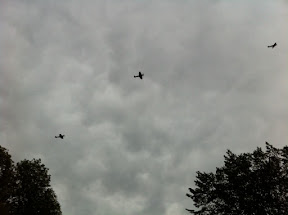
I am embarrassed by the awfulness of the next two photos, but it was difficult to capture the aircraft, especially as they took off from the opposite end of the runway from where I was standing. In the first photo, I didn't even manage to get all four aircraft.


When another flight took off, I did at least manage to get all four, albeit just specks in the sky.

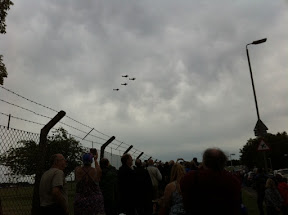
With 24 aircraft and 3 flight formations, that meant there would be 8 aircraft in each formation. In practice they arranged themselves in two groups of four, so here you can see the four little specks.


You can also see what a terrible day it was and just how many people were standing outside the fence, crowded four and give deep in places.

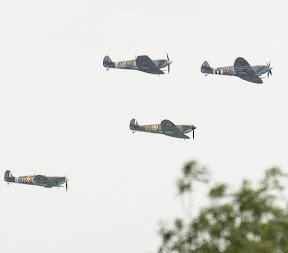
Other people than me took better photos - or had better cameras, so this was more typical of what we saw in the sky. - not my photograph, needless to say!


A Daily Mail photographer took a truly wonderful photo of fourteen of them all in the sky at once, but I didn't see so many at one time. There are quite a few high trees near the fence where I was standing, so I might not have had the best view, but it was still exciting.

Actually, the Daily Mail photos were quite outstanding, some of them obviously taken from other planes in the air at the time.

Somebody else also took this marvellous photo, with the huge commercial airliner in the sky above. This was also a more typical view of the aircraft as they left.


I can't tell you how thrilling it was as those historic aircraft roared over our heads, more and more of them, all flying in close formation and then peeling off in the three different directions.

The formation which was only going as far as Gravesend were back first and they flew patrols over the airfield, just as the aircraft did 80 years ago to protect the others returning. This meant that we got a really good view of them as they flew round and round close over the heads of the crowds. I abandoned all hope of taking a decent photo and just concentrated on watching them. Sometimes they were so low you could see the pilot's head in the cockpit as they went over.


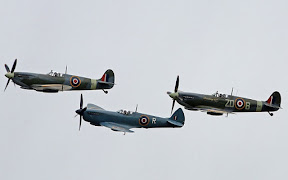
This is also somebody else's photo, but one I would like to have taken, because I really was that close at times.

As they returned, more and more of them landed until at least there was only one solitary Spitfire patrolling the skies above the airfield. He swooped low over the road and the crowds there and out over the hillside where it falls away down into the valley below the airfield, then he quickly did a victory roll before turning round and coming in to land. What a marvellous moment that was!

It had all been so exciting we didn't really notice we hadn't had any lunch.

The next few days felt rather flat after all that excitement, but I had several medical appointments and the following weekend all my family were back again. The Manchester family left just before the Bank Holiday, but my sister stayed on until September 1st, and we had visits from my other son with his wife and my younger grandson, so it has been a very busy family time. I'm still trying to finish the washing of sheets and towels as well as trying to get ready for when we go on holiday ourselves in a few days. This has not been helped by my having another attack of renal colic, which is acutely painful and is probably caused by yet another kidney stone. I only hope I can avoid having any on holiday!

- Posted using BlogPress from my iPad

Borde Hill Gardens

Saturday August 15th

After our friends had left and before my sister came to stay again we took the opportunity of a dry day to pay a visit to Borde Hill Garden, which is just north of Haywards Heath. The garden was created in the early 1900s with plants gathered by the great plant collectors from their travels to the Himalayas, China, Burma, Tasmania and the Andes, and in one of the old greenhouses there is a very interesting display of their letters from all over the world.

I'd love to post some of the letters here, but I think the typing will probably be too small to read. However, I'll quote one, written in Tibet in 1933 by Frank Kingdon-Ward, a well- known botanist and collector who collected plants for a period of 50 years in Tibet, North Western China, Burma and Assam.

He encloses a few seeds, apologising that there are so few and explaining that this is because it is not seed-collecting season, and not much is currently in flower. He goes on:

'I am faced with the usual problem of transport and food supply in a not thickly populated country; and being about half way between the last village on this side of the snow range and the first village on the other with a 15,000 ft pass ahead does not make matters easier. At present we are in the clouds and can see nothing. It is wet and cold, and not very comfortable in small Alpine tents. But we keep pretty cheerful in spite of all the drawbacks.

The murder of my mail runner rather jammed things. In future my mail will probably go to Lhasa under the care of the Tibetan Government. But it is 300 miles from Lhasa to Shinden Gompa, so don't expect frequent communications!'

I think this gives a real flavour of what life must have been like in the plant collecting world 80 years ago. I'm not sure whether the viewing of the murder of one of his staff as an inconvenience points to the intrepid nature of his character, or just reflects a horrifyingly uncaring colonial attitude towards indigenous people.

The garden is divided into a series of outdoor 'rooms', each with its own distinctive character and colour. This is the rose garden, though it's unfortunately a bit late in the year to see many roses.


This garden, like the two other gardens we have visited recently, is also full of statues for sale. I don't think the fountain was one of them though.

The statues for sale here differed from one another in style. There were some stylised human figures, a rather different stylised horse, and the most dreadful highly coloured five foot long ceramic grasshopper. I gave that a wide berth!

The flowers below are part of the Mediterranean Border, which has plenty of colour, even in August.


We crossed in front of Borde Hill House, which is privately owned. It is very old, having originally been built in 1598 and extensively altered 300 years later when it was bought by Colonel Stephenson Robert Clarke, whose family still own the property. It was this family who were patrons of some of the great plant collectors of the last century whose letters we read in the old greenhouse.

In front of the house was the strange stylised statue of a horse made from silvery tubes. I haven't posted it here because the photo isn't very good.

A tranquil path took us round towards the Long Dell.


From the far end of the garden we could see outside the garden wall and across the South Park to the lake, another beautiful and tranquil landscape.


I'm not sure if that's the normal colour of the tree on the left, or if it's already putting on its autumn colours.

We continued on to the ruins of old potting sheds. This has clearly been a garden that formerly employed a great many gardeners - apparently 27 at one point - who raised a lot of their own plants. When we were looking at the greenhouses earlier on, it was clear that most of them were no longer in use and a couple were completely derelict.

We carried on to the Italian Garden, a most beautiful space.


The garden booklet mentioned that this used to be the family tennis court, and was only converted to an Italian garden in 1982. Apparently it is now one of the most popular areas in the entire garden. Around the pool are several unusual trees and shrubs and the Italian pots are filled with agapanthus which I'm afraid put my own agapanthus to shame. From the terrace there are more wonderful panoramic views stretching across the South Park and lakes.

The strange silvery thing you might just be able to see at the far end of the garden above the steps is another of the statues. This one is of a silvery woman with her arms outstretched and head tilted back, a figure of ecstasy. Clearly, she likes the garden too!

Paul was so taken with this garden he didn't watch where he was putting his feet, and fell into a little rill which feeds the pond. It was several inches deep and he had to take off his sock and shoe to empty out and water and wring out his sock. He walked round the rest of the garden with one wet trouser leg rolled up a bit and a shoe with no sock, which can't have been comfortable and made him look vaguely like somebody participating in some weird Masonic-like ritual.

On leaving the Italian Garden, we passed some wonderful dahlias. I know I just posted a dahlia photo in Chartwell, but this one was so spectacular I couldn't resist it!


We completed our tour round the garden, walking up to the so called Garden of Allah, created in the early 1920s with rhododendrons collected by Frank Kingdon-Ward, the writer of the letter I quoted at the beginning. There are also some very large trees, as well as magnolias and camellias. This is an area which would be at its very best in the spring.

We walked on into Warren Wood, which has many fine trees and continued for some time before we realised we had no idea of the extent of the wood or the length of the walk, so we headed back, passing across the back of the house and round into the Azalea Ring which is apparently a riot of colour in May and early June from a wide range of deciduous azaleas. Clearly, we need to come back!

- Posted using BlogPress from my iPad

Tuesday, 8 September 2015

Chartwell in early August

August 12th.

Some friends came to stay with us for a few days. It was rather a shame that the days they chose to come were dull and often rainy, especially since the weather had been so beautiful for several days before they arrived.

At least it wasn't too cold for the visit to Chartwell, though it would have been nice to see the sun. However, even the dullness of the day failed to detract from the design of the landscape, with the swimming pool built into a terrace on the hillside and the lake in the valley below it.


The Nation Trust say that these hillside gardens reflect Sir Winston’s love of the landscape and nature, in fact they say that one of the reasons he bought Chartwell was for the water features he could create. The lake already existed but in 1924 a dam was built to create the upper lake. The swimming pool in the photo above was built in 1937, and apparently was heated, which I hadn't realised.

Below is the relaxing spot where Churchill used to feed his fish.


In this case, I've managed to include some of the fish as well. Somewhere there's a painting of Churchill as a very old man sitting here contemplating his fish, and it's easy to picture it in this atmospheric setting.

Churchill himself built some of the walls of the kitchen garden and just nearby is the Marycot, a playhouse designed for his youngest daughter Mary.


It's quite difficult to get into it because it's usually full of children. It has tiny child-sized furniture, and I imagine it would be very appealing to most children.

Just adjacent to the kitchen garden are some truly magnificent flowers.
There were some gladioli in wonderful colours.


And the dahlias must be among the best I've ever seen.


My mother used to grow dahlias, they're a lot of work with the necessity of lifting the tubers after they've finished flowering and storing them over the winter and planting them out the next year. So I guess this keeps the gardeners busy.

I know I've photographed this view before, but I never tire of it.


This is the view that is said to have particularly moved Churchill as he thought it showed the the essential England.

We saw all round the house - no photos allowed - and the painting studio - also no photos allowed, and thoroughly enjoyed our day.

- Posted using BlogPress from my iPad