Tuesday, 22 September 2015

In Prague 1, Part 1

Monday September 21st

We set off in the early morning for Prague Castle, though there is so much to see there I feel we only scratched the surface, and we intend to go back tomorrow. The castle complex dates from the 9th century, and I'm told is listed in the Guinness Book of Records as the largest ancient castle in the world.

Although the construction of the first walled building was in 870 AD, you won't find many examples of such early building, as the current ground level is well above what it would have been then. What you see is a real hodgepodge of architectural styles, with virtually every architectural style of the last millennium. It includes the Gothic St Vitus Cathedral, the Romanesque Basilica of St. George, Renaissance palaces, Baroque Palaces and Neoclassical style wings.

There are three courtyards and several streets. An ornate entrance gate at the Castle Square leads to the first courtyard, decorated with large sculptures of fighting pagan Gods and Titans.
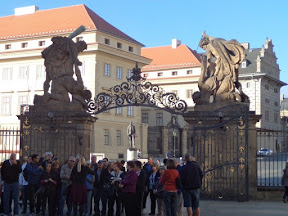


The third and largest courtyard is dominated by the enormous St Vitus Cathedral, started in 1344 but not completed until the 20th century.
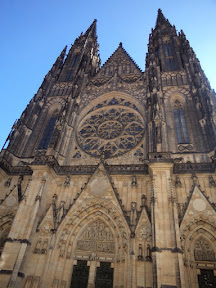


It is so enormous there seems to be no way of getting a decent photograph. It isn't open on Mondays, so we intend to go back tomorrow to see inside it, and perhaps see some other things as well. There is a magnificent 14th century mosaic and a clock, but I'm limited to the number of photos I can easily post, so I might manage some of those tomorrow if we go back.

The courtyard opens up into St George's Square, where you will find the Basilica of St George.


This was built in the twelfth century and replaced an older, tenth century church. The façade was added in the seventeenth century. Our Czech guide told us the the two towers were of unequal sizes because they represented man and woman, so they are called the Adam and Eve Towers.

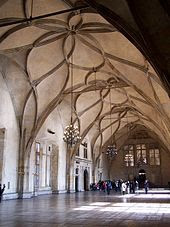
In the same square you also find the Royal Palace, also known as the Old Palace. Romanesque and Gothic stories were built on the remains of the first, ninth-century structure. The biggest part you can visit is Vladislav Hall, built in 1493. Unfortunately, this is a place you have to pay to photograph, and we had not yet visited an ATM so we couldn't pay anything! The photo here comes from the Internet, and I hope it isn't too small to see, as it's quite impressive.


The last place we visited in the Castle was Golden Lane. Originally, there was just a wall behind Prague Castle. In the 15th century, the first very modest houses were built along it. As the original name of the street was Goldmakers Lane, it is thought most of the first inhabitants were probably goldsmiths. These houses were demolished in 1591. Six years later, Emperor Rudolph II allowed the 24 Prague Castle´s fusiliers to build their houses there, and because the area is small, the houses were tiny.

Later, various craftsmen and servants lived in the houses. According to local legends, Emperor Rudolph II had some of his court alchemists accomodated in Golden Lane, where they tried to turn metal into gold, so that could also be the origin of the name Golden Lane.

One of the more famous ones was number 22.
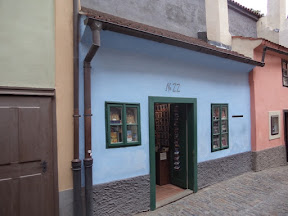


Frank Kafka lived here for two years, 1916 - 17, as he was looking for a quiet place to write. At the beginning of the 20th century, the owners of the houses became aware of their unique charm and many moved elsewhere to more comfortable apartments and opened their tiny Golden Lane houses to tourists, charging a fee. Others let their houses to writers or artists who were looking for inspiration.

Perhaps the saddest one is the little house of the psychic who called herself Madam de Thebes. She was a widow who could never believe that her son, who was killed in the First World War, was never coming back, and set the table for him every day.
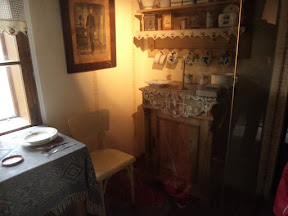


She became a fortune teller and card reader, but her constant predictions of the end of the Second World War and the fall of the Third Reich led to her arrest by the Gestapo and she was tortured to death.

On that happy note, we left the castle and descended an interminable number of steps to the Lower Town at the foot of the hill. So I'll continue that in the next post.

- Posted using BlogPress from my iPad

In Prague 1, Part 2

Monday September 21st

Once down from the Castle, we walked through some very picturesque streets with beautiful buildings, on our way back down to the Charles Bridge.


I mentioned the bridge last night, so I won't repeat myself here, but will just add that originally the Charles Bridge was devoid of any ornamentation, except for a wooden cross that was placed at its center. In the seventeenth century the cross was replaced by a bronze crucifix. The first statue - of St. John of Nepomuk - was added in 1683. There are now 30 statues, of which I think the one below is the biggest.


It represents the time the area came under the rule of the Turks. You might just be able to see the raised arms of the miserable people kept in prison under the main group. This photo isn't helped by the passer-by in the blue coat, but it's hard to take photos on the bridge, there are so many people.

There are beautiful river views from the bridge, so we spent some time admiring them, though the sky had unfortunately clouded over by then.


This is a view from slightly further along the bridge, showing the back of the Old Town, with many beautiful buildings.


It takes a while to walk across the bridge, there are so many people. Eventually, we made our way to the Old Town Square.


This is another picturesque place where we'll try to return, but there's so much to see, it's difficult to imagine how we will find the time.

By now it was lunch time, so we stopped to eat. After lunch, we walked through some very smart streets full of expensive shops located in some of the beautiful buildings.


This was absolutely the most beautiful, and if my photo doesn't end up too small, you will see that it is occupied by Bulgari. I was standing outside Prada when I took this photo, and had recently passed Louis Vuitton. There are not places where we shop - you may see Paul striding swiftly past! (He can't buy me a birthday present anyway, he has no money and no cards, thanks to the pickpocket.)

Eventually, we made our way back to the coach which returned us to the hotel about 3.30. Many of our group stayed in for the rest of the day, being too exhausted to do any more walking, having walked for about 4 hours.

- Posted using BlogPress from my iPad

Monday, 21 September 2015

Budapest to Prague

Sunday September 20th
We had a distressingly early start this morning, so we were at the station in very good time for our train to Prague. The station has some wonderful murals in the entrance hall, though the platforms themselves look very old fashioned.


Our Hungarian guide was very keen for us to take photos of the murals, suggesting we could use Photoshop to select the angel above and use it to send in Christian emails to our friends! She didn't leave us quite enough time to take the pictures though, so mine was too hurried and not satisfactory. I really need to photoshop out the stray hand which got into this photo!

The train journey took 8 hours, taking us through Slovakia and eventually bringing us to Prague where a coach collected us to take us to our hotel, which is the smartest yet. We had dinner there - a very nice buffet - and then set off with our tour leader to see the city centre by night. It certainly is beautiful.

We caught the Metro to Wenceslas Square, then walked to look at the medieval astronomical clock.


Later, we were back to hear it strike 10, but somehow we missed the figures coming out, I think perhaps they do it at the beginning.

We then walked through the old town at a pretty fast pace, our tour leader having forgotten my painful knee. It was very crowded and the shops were all open even though it was after 9, but we didn't have time to stop and look at anything as the party galloped on towards the Charles Bridge.

This is the tower that protects the entry to the bridge. There's one the other end too.


The Bridge crosses the Vltava river. Construction on it was started in 1357, and when it was finished at the start of the 1400s, it was called the Stone Bridge.

The bridge is 621 m long and nearly 10 m wide, resting on 16 arches. It is is decorated by a continuous alley of 30 statues, most of them baroque-style, originally erected around 1700 but now all replaced by replicas. I'll take photographs of them in the light, you couldn't see them in the dark.

This is the tower at the other end of the bridge.


It marks the entry into what is called the Malá Strana or "Little Side", because it was on the left bank of the river Vltava, on the slopes just below the Prague Castle.

Thank goodness we went no further, but turned back to retrace our steps. My back and hip both hurt from walking fast on the irregular cobbles. I hope to be recovered by tomorrow, as this is clearly a beautiful city and I look forward to seeing it.

- Posted using BlogPress from my iPad

Sunday, 20 September 2015

In Budapest 2

Saturday September 19th

Dear me, this has been a day filled with event, and not in a good way.

After dinner last night in a restaurant near our hotel, I became aware that my right eye was painful and weeping, so I was glad to get back to the Hotel and take my contact lens out. Unfortunately, removal of the lens did not seem to help at all, and my eye continued to be painful and weepy. It was still painful this morning, so I wore my glasses, and considered going to the chemists for some eye ointment. However, it seemed to improve after breakfast, so I decided to delay any visit to the chemist.

As we had no money, Paul having changed only a small amount which had been used at dinner the previous night, we went out looking for an ATM and Paul used his card to get some more money out. We had a lot of discussion about how much to get, as we didn't know what expenses we might have during the day, and Paul was anxious not to get too much as he didn't want to be left with currency we will never use again. It came out in one big note, so Paul put it in his wallet, leaving me penniless.

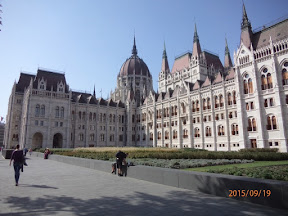
Anyway, we walked down towards the Danube and caught a tram along as far as the Parliament building so as take photos.


This is a photo from the back, my previous photo having been taken from the front - just like our Parliament building, it stands on the river bank.

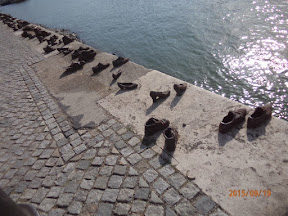
I had hoped to photograph 'The Little Shoes', a memorial created it on the bank of the Danube to honor the Jews who were killed by fascist militiamen in Budapest during World War II. I though this might be near the next Tram stop, so we caught another tram, but there was no stop nearby and we ended up going as far as the chain bridge so that we could cross the Danube.

We discovered that there was to be some sort of car racing, as streets were closed off and crowds were starting to gather, so there was no traffic across the Chain Bridge.

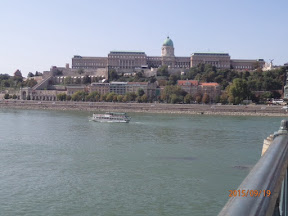
We walked across the bridge, stopping on the way to take photos.


This is a view of the Royal Palace, though of course it isn't a palace any longer.

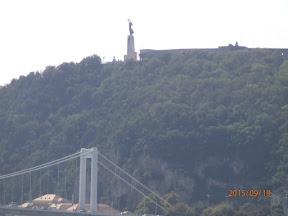
Further down the river, we had a view of the statue on Castle Hill.


It represents Liberty, but had to be called Peace under the Soviets, as that was felt to be more politically correct. The bridge in the foreground is the Elizabeth Bridge; I imagine this was probably named after the wife of Emperor Franz Josef, as she was particularly popular, in which case it must also have been politically incorrect under the Soviets!

We intended to go to the Hungarian National Gallery. As I mentioned yesterday, the Museum of Fine Arts was closed but 57 of the best works had been transferred to the National Gallery, and we thought we would like to see them. The National Gallery is at the very top of the hill, not very far from Holy Trinity Square and the Matthias Church, and we intended to use the Funicular to get up there. However, the queue was truly enormous and we didn't fancy the wait in the hot sun, so we decided to take the bus instead. When the bus arrived, it was extremely crowded and Paul and I were separated in the crowd.

Once off the bus, we had some difficulty in finding the National Galley as the signpost pointed in completely the wrong direction, and then we were directed round to the side entrance because there was a special event taking place at the main entrance. Museum entrance is free for the over 65s, but you have to pay if you want to take photos, so Paul went to get his wallet, only to find it was gone! He had fallen victim to the pick-pockets again.

This meant we had no Hungarian money, as all I had was Euros or pounds. The value of the Hungarian money was not high - about £50 - but Paul also had a credit and a debit card, a Senior Railcard, a Bus Pass and his driving licence! We called to cancel the bank cards first, then called our tour leader. He pointed out that Paul might well have a £50 excess on his policy, and reporting to the police might take up to 5 hours and would require Paul to pay for an interpreter! So he decided against going to the police, and we just progressed into the Museum to see the art without taking any photos.

This was a shame, as, once we had wandered slowly through the rooms full of Hungarian paintings we came to some wonderful old masters which are not well known elsewhere. I had been excited by tales of a Raphael, but I found it very disappointing, it was an early one and I wouldn't have recognised it as a Raphael. But there was a beautiful Giotto and a totally unfamiliar Titian, a particularly lovely Canaletto, an El Greco I think I've seen in a book somewhere, a wonderful portrait by Franz Hals, and a Monet I was particularly anxious to take home with me! Paul took the opportunity of my bad behaviour - our tour leader rang me to check that we were managing without any money, and the museum guard escorted me off the premises - so he was able to sneak a photo of the Monet which I will post here if I can get it from his camera card. I would have bought a reproduction of it in the shop, if I had had any money...

I got told off a lot in this museum, there were no seats at all and I put my hand against one of the cabinets so as to take the weight off my sore knee, which necessitated the first telling off. Then my phone rang, a severe sin, and later I sat in a guard's chair when I got desperate to sit down. Our Hungarian guide had cautioned us that, if you were picked up by the police, they were likely to cut off your nose and ears, then 'the most noble part of a man's body', and then fire you into space, so I dreaded to think what I might be in for if I transgressed again!

We had the greatest difficulty in leaving the Museum, as the main entrance was blocked for the event, so we had to retrace our steps right through the museum to go out by the side entrance. Then we went back to the number 16 bus stop to rake through all the litter bins to see if the pick-pocket, who we assume had struck while we were in the bus, had thrown away the wallet when they got off. We had no joy - of course, the thief might have got off at a different stop, but with the temperature of over 30 degrees again, we weren't inclined to visit other stops on the off-chance. I used my card to get us some money, and we went to the Funicular to go down - there being no queue at all to descend. It wasn't cheap, especially for the few seconds it took to descend, but there were good views as we went down.

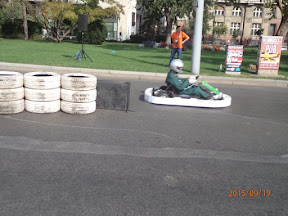
When we were back on the Pest side, we found that the go-kart racing had started, so we watched for a few minutes.


However it was very hot and we were right by a corner and a couple of them hit the tyres near us, so we decided it might not be the smartest place to stand, and went back to catch the tram.

I was determined to photograph the little shoes, so we got off at the Parliament building and walked back. As I said earlier, it is a memorial created it on the bank of the Danube to honor the Jews who were killed by fascist militiamen in 1945.


They were ordered to take off their shoes, and were shot at the edge of the water so that their bodies fell into the river and were carried away. The Jews were some that had originally been hidden in various buildings by Swedish people, Raoul Wallenberg and others. The memorial, which is made of metal, represents their shoes left behind on the bank. It was very moving, especially when you see that some of the shoes are the same size as my grandsons'.

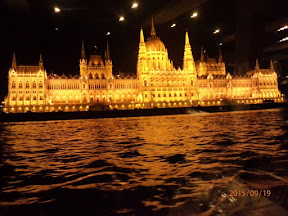
We returned to the tram and went back to our hotel to have a little rest before going out to dinner. Dinner was actually a dinner cruise on the Danube. The main public buildings are lit up until midnight, so it is quite a sight.


This is the Parliament building again. I'm afraid other photos didn't come out so well. After dinner, the boat docked and prepared to take on its next quota of diners, and we got back into our coach and went for a drive round the illuminations. We went up to a viewpoint where we had a wonderful view over the whole of Budapest, but I'm afraid my photos were all a disaster.

We were back at the hotel by 10, but we needed to pack and get organised for the next morning - in our case, it was the 6am alarm to shower and have our cases ready to collect by 7. How I dislike early mornings!

- Posted using BlogPress from my iPad

Saturday, 19 September 2015

In Budapest 1

Friday September 18th
Today was a very busy day, and extremely hot, over 30 degrees. My feet had become unrecognisable by the end of the day as they were so swollen.

We had a bit of a rush this morning as we had to fight the shower; all the fittings were so tight they couldn't be moved and the shower was set to spray straight out so it sprayed the wall at the end of the bath. Washing my hair was almost imposible. By the time we had finished showering, the bathroom was deep in water and all the towels were wet and we were late and very ratty. The hotel is huge and so was the breakfast buffet - we took about 10 minutes to walk round it, pushing through the crowds of other eaters, and then we couldn't find 2 chairs together! We were in time to meet the guide at 8.40, but only just.

She took us in a coach to Heroes' Square, a monument to various important figures in Hungarian history.


It's a bit hard to photograph at present, as horse races are due to be run there this weekend, and large parts of the square are cordoned off and others strewn with bits of equipment. It's one of the major squares in Budapest and is noted for its iconic statue complex featuring the Seven Chieftains of the Magyars and other important national leaders, as well as the Tomb of the Unknown Soldier. You can see the statues of the seven chieftains around that enormous column in the centre. The column was built to commemorate 1000 years since Hungary was founded, so it was built in 1896, as apparently the tribes who migrated to the Carpathian plain and first formed Hungary arrived in 896AD. The figure on top of the column is the angel Gabriel. This is because the angel Gabriel appeared one night to the founder of Hungary, King Saint Stephen, and told him to join the western Christian Church, not the Orthodox Church.

At one side of the square is the Museum of Fine Arts, it's just behind the Millennium Column in my photo. It's shut for renovations at present, or else we would go. There's a matching gallery on the other side of the square, used for art exhibitions.

After that, we next went to to the largest cathedral in the city, St Stephen's Basilica.


It was built in the neo-classical style, but I'm not sure how to describe the interior - I think it's rococo.


As well as all the marble, gold leaf decorations, statues, murals and frescos, it houses the mummified holy right hand of King Saint Stephen. Unfortunately, I only found this out afterwards by reading the guide book, otherwise I would have gone looking for it.

After this, the coach collected us and took us over to Buda, which is the hilly side of the city. We went up to the top of Castle Hill, where the Royal Palace is situated. We did not go there however, but to Holy Trinity Square. The biggest feature in this square is the Romanesque style Matthias church.


The church dates from the 13th century and rebuilt for the 1896 anniversary of the founding of Hungary. It is actually the Church of Our Lady in Buda Castle, but everybody calls it the Matthias church after a king of Hungary who was very popular. I don't think I've ever seen a church roof like that before, in fact I was so concerned with photographing the roof, I managed to cut off the very top of the spire.

Just at the edge of the square is the Fishermen's Bastion. According to legend, there was a stronghold here which was protected in medieval times by the guild of fishermen.


You can pay to climb up and stroll on the walkways And the view from here down to the Danube is superb. Of course, we were fortunate in having a clear day.


The huge building you can see on the far bank on the right of the photo is the Hungarian Parliament building, modelled on Westminster. On the far left of the photo, the green area you can see is Margaret Island, an island in the middle of the Danube.

After a quick lunch, we were back in the coach and heading for an afternoon in the Buda Hills where we took a ride on the Children's Railway. This is really a sort of extracurricular educational institution, where children from 10 - 14 learn about railway professions. The idea originated in the USSR and was greatly developed in Soviet times. Apparently many children's railways are still functioning in post-Soviet states and Eastern European countries, and many use railway technology no longer current on the main lines so they can be seen as heritage railways. Budapest's one is a narrow gauge railway.


This shows the inside of one of the trains. Outside, you can see one of the boys who will collect the tickets and ensure safety procedures are followed.

Below is one of the little boys who has just signalled to our train driver that it is safe to leave the station


Apart from train driver, all the jobs are done by children under adult supervision, and our guide told us there was considerable competition for the places there, and children who are accepted have to be be successful in their studies at school.

It was a very pleasant ride through the forests, and we noticed many walking trails, so obviously this is a popular recreation area.

At the terminus, we walked a short distance to the terminus of the cog railway, a rack and pinion system that took us right down out of the hills to the level of the Danube, where our coach collected us to take us back to the hotel.

- Posted using BlogPress from my iPad

Thursday, 17 September 2015

Vienna to Budapest

Thursday September 17th
We were due to catch a train to Budapest this morning. However, owing to the situation with refugees and migrants in Hungary, it seemed likely that nothing would be moving either in or out of Budapest station, so the company decided to provide us with a coach. Apparently they had provided the previous tour with a hydrofoil down the Danube, but people had complained of feeling queasy on the water, so this is why we had a coach. We'd have preferred the hydrofoil!

Our hotel had been fairly central in Vienna, just outside the Ringstrasse, down a little cobbled alleyway, so quite picturesque.


The hotel itself had a lot of stairs though - small sets of a few steps to reach one part from another, so a bit of an effort for somebody like me who was limping.

Our coach driver was late, as he drove to Vienna from Budapest, and it took him 5 hours instead of the normal 3 hours because of difficulty getting across the border into Austria. We appreciated what he meant when we saw the queues to get into Austria, which stretched for miles. We, however, drove straight through the border without stopping, there are currently no checks when you go from Austria to Hungary, only if you want to go the other way!

We stopped around lunch time for a comfort break, and Paul and I ate our sandwiches. The motorway services area was on the completely flat Hungarian plain, and the wind was fierce; Paul had to chase the pack of sandwiches which blew away as soon as they were put down! There was a huge wind farm adjoining the motorway services, and we passed several more as we drove along. I'm not surprised Hungarians take advantage of this fierce wind, I imagine the wind farms produce a lot of electricity.

Later, we left the plains and entered a more hilly area, and then we were in the outskirts of Budapest, which, like the outskirts of many towns, are not very prepossessing.

I wasn't quite quick enough with the camera to take the beautiful view as we crossed the Danube, but I did manage a few as we drove alongside it.


Like the majority of photos taken from a moving bus, most of them are hopeless, but I hope to get some better ones tomorrow.

We arrived at our hotel soon after 4, and Paul immediately went out to have a look around. I didn't, as my feet were very badly swollen again, so I spent the afternoon with my feet propped up, hoping they would improve by the time we met to go out to dinner. Sitting with my feet in cold water has certainly helped, though they are still very swollen.

The hotel is not nearly as picturesque as the one in Vienna, but Budapest is very different from Vienna, there's a distinct lack of Baroque buildings for a start! Tomorrow we are having a tour round the sights, so we'll hope for some good views.

Dinner tonight is in a restaurant rejoicing in the name The Blue Tomato. We are hoping for the best!

- Posted using BlogPress from my iPad

In Vienna 2, am

Wednesday September 16th

I think I'll have to split this post in two, there are so many photos. I seem to be having such difficulty in posting, I'm posting a few at a time - come back later if you can't see all 8!

This being Museum day, we did not make a very early start as Museums don't open until 10. First on our list was the Museum of Fine Arts, an extremely imposing baroque building. It was opened around 1891 at the same time as the Natural History Museum, by Emperor Franz Joseph I of Austria-Hungary. The two museums have identical exteriors and face each other across Maria-Theresien-Platz. They were commissioned by the Emperor in order to find a suitable shelter for the Habsburgs' formidable art collection and to make it accessible to the general public.


Maria Theresien-Platz is the area of grass, trimmed shrubs, fountains and statues which you can see in my photo. The building is rectangular in shape, and topped with a dome that is 60 meters high. The inside of the building is lavishly decorated with marble, stucco ornamentations, gold-leaf, and paintings.

We had found our way there by public transport, so while Paul searched around to find the things he wanted to see, I went for a cup of coffee. The museum houses a big Egyptian section, a great many Greek and Roman Antiquities as well as a Picture Gallery with an impressive collection of Renaissance and Baroque paintings which was what we wanted to see, so Paul ran about deciding where to go while I relaxed in the coffee shop.


I don't think there can be too many museum cafés where you drink your coffee in quite such grand surroundings.

The main staircase is pretty impressive too


Some of the paintings in the corners above the arches are by Klimt, but I'm afraid you can hardly see them - they're almost impossible to photograph.

We seemed to start at the wrong side, so we began with Caravaggio, of whose paintings the museum has a fine collection. The most famous one, the Madonna of the Rosary, did not photograph very well, but I preferred David with the head of Goliath anyway


I'm afraid my photo isn't as sharp as it might be, it's always difficult taking photos inside this museum. You were allowed to take photograph here, without flash, but it's still hard because the light isn't always right and you need to get out of the way quickly as other people want to look at the paintings.

One of the real jewels of the museum is this Raphael, The Madonna of the Meadow.


The whole room was devoted to Raphael, Bellini and Parmigiano and followers of Raphael, but I really preferred the one above.

There was also quite a collection of Titians, more than I'm accustomed to seeing elsewhere, but I can't post everything I liked!

This museum contains the world's largest collections of paintings by Peter Bruegel the Elder, so it was difficult to choose my favourite.


In the end I chose Hunters in the Snow to post here, but they also had other old favourites which everybody knows, like Peasant Wedding or Peasant Dance. The Museum favours The Tower of Babel, but I don't like it as much as some of others.

There was a wonderful Rembrandt self portrait, tucked away somewhere in a back room.


I chanced upon this quite by accident, and am surprised this museum doesn't make more of its Rembrandts.

There was just one Vermeer, again one which I think everybody knows, The Art of Painting.


I don't think I'll be able to post any more photos, but I have a great many more. So there's no room here for the van Dykes, the Rubens (I don't like Rubens anyway) the Holbeins or the Dürers.

We were quite tired after all of these paintings, so we went back to the imposing café for a humble sandwich before setting off for the second art gallery of the day.

- Posted using BlogPress from my iPad