Wednesday, 7 September 2016

Otranto

Wednesday September 7th

At 9 this morning, a coach came to take us to visit Otranto. It's about 45 kilometres from Lecce, and we drove through miles and miles of olive groves.


The name of Otranto might still be known in Britain for 'The Castle of Otranto', by Horace Walpole, often described as the first true Gothic novel. However, his novel is about a medieval kingdom of his imagination, and the creepy castle he describes bears little resemblance to the rather stolid fortress in the real Otranto.

Like much of the region, Otranto has a colourful and mixed past. It was important as a Greek and then Roman port, called Hydruntum. Later it was ruled by the Byzantines, the Normans and then the Aragonese. In 1480 the town was invaded by Turks, and 800 locals were executed for refusing to convert to Islam. The bones and skulls of the martyrs of Otranto are now stacked behind glass in one of the chapels in the cathedral in a very creepy manner that would have satisfied Walpole's Gothic imagination.

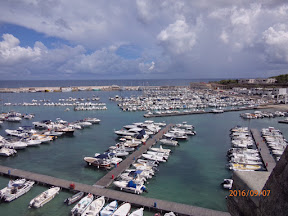
We were dropped beside the very pretty harbour


and we made our way up some steps and into the town through one of the recreated gates. The outer fortifications had been allowed to deteriorate after the Battle of Lepanto in 1571 and a church was built where the gate had been. The church deteriorated in its turn and was demolished in 1960 and the port gate was re-instated.

From the gate, a very steep little main street runs up to the piazza outside the cathedral.


This is a view over the space outside the gate and the steep little Main Street which I took from the town walls later, but it gives quite a good view of the place, which is really tiny.

The town's most important attraction is the twelfth-century mosaic in the Romanesque cathedral, which was built in 1088.
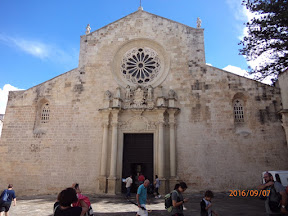


The facade was partly destroyed when the town was taken back from the Turks in 1481, but was immediately rebuilt in the same style. The rose window is in the Renaissance style though, and the portico, which was added later still, is in the Baroque style.

The famous mosaic, dating to the 12th century is charmingly quaint and on a huge scale, so it fills the whole church.
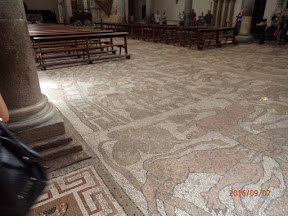


It is in the Byzantine style, having been carried out by a Byzantine monk called Pantaleone. The church is felt to be a symbol of how the two different strands of Christianity, the Latin Christians and the Byzantine Christians, co-existed peacefully in this place until the 16th century. Pictures within the mosaic include religous stories like Noah's ark, but also depictions of historical, mythical and even pagan figures, including Alexander the Great and King Arthur. Our guide explained all the symbolism to us at great length, otherwise it would have been completely lost on us as it included references to stories common at the time which have now been lost to us. I'd never heard, for instance, about Alexander the Great wanting to travel up to heaven, and putting meat on top of two spears to attract griffons to carry him up there, but the story is in the mosaic!

The real-life 'castle of Otranto', properly called the Castello Aragonese, is a solid construction which forms part of the tough defences of Otranto. The current building is fifteenth-century, though it was built on an earlier one.
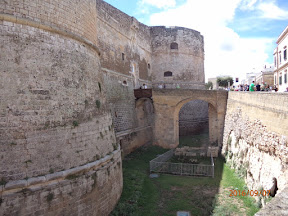


The moat was always dry, apparently; you get more injuries, when attacking the walls, if you fall onto the ground than if you fall into the water.

We walked onto the town walls, from which we had fine views of the town and the harbour. Then there was just time for a quick lunch before we were back in the bus and off to the olive mill.

We had a very fascinating talk on olive oil. I had no idea that there were over 60 million olive trees in Italy! We learned how extra virgin olive oil is made and had the process explained to us. The essential fact to know is that no chemicals or additives are used to extract the oil, it is all mechanical, and these days takes about an hour. The mill we visited stores about a quarter of a million litres of olive oil in huge silos
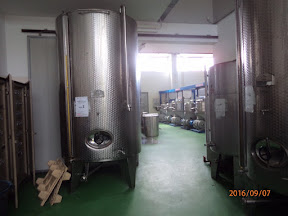


Apparently we have been storing our own olive oil all wrongly. It should be kept out of the sunlight, which is bad for it, and not next to the cooker, as its temperature should be no higher than 24 degrees and no lower than 18 degrees. So we need to go home and move it into a cupboard!

After the talk, which was very interesting, we tasted various different oils. Of course I bought some. Do you need to ask?

After that, the coach took us back to Lecce. We had been very lucky with the weather, we had avoided all the rain, which we saw in the distance. But we had hot sunny weather, and will hope for something similar tomorrow.

- Posted using BlogPress from my iPad

Tuesday, 6 September 2016

Lecce

Tuesday September 6th

Today was our day for a walking tour of Lecce, and initially we had not been hopeful about the weather. However, it had rained heavily in the night, with lots of thunder and lightning (the latter killing off the hotel's air conditioning) and it was dry by morning, though cloudy. So we hoped for the best, and I took my raincoat. Paul had decided not to bring a raincoat on holiday at all, for reasons best known to himself.

The town of Lecce is more than 2,000 years old, and was founded by people from the eastern Adriatic. As well as remains from every age since then, it has an abundance of Baroque architecture which would make it one of Italy's most visited cities if it weren't quite so far away from the centre. Apparently the local limestone is described as butter-soft and easy to carve into intricate and detailed embellishments for the many churches and palaces, and it hardens on contact with the air. Everywhere you walk in the city, you can look up to see carvings of angels, human faces, animals, plants, and fanciful curlicues - supporting balconies, surrounding doorways and windows, and decorating the capitals of columns. It was a 15 minute walk into the main square and the historic centre, and once there, we first looked at the Roman amphitheatre.


You can see that it's currently in use, though not tonight, apparently. It was built in the second century AD and held more than 25,000 spectators - though the population of the town in Roman times was only 6000! In the Middle Ages it went out of use and was buried under what became the Piazza Sant'Oronzo, the town's main square. It was discovered again in 1929 during excavations for the building of a bank and has since been partially excavated. More of it remains buried under adjacent buildings, so it is no longer a complete oval. However, the seating tiers and part of the floor that have been uncovered are now open and used for concerts and other performances in the summer.

Just behind the amphitheatre in my photo you can see a loggia called the Palazzo de Sedile - Sedile meaning seat or bench. It was built in 1592 to accommodate the local government, and was open at the sides so the governors could be seen governing. To the right of that, you can see a column topped by a statue of the city's patron saint, Saint Oronzo, who is credited with saving the region from the plague. He was an early Christian who was beheaded by the Romans for refusing to worship pagan gods, and he appeared in a vision to the local bishop during the plague in the 17th century, which stopped all plague in the area. The column under the statue is actually Roman, and came from the city of Brindisi whose citizens donated it because they were so grateful that they too had been saved from the plague.

As well as palaces, Lecce is full of churches as there were so many different monastic orders here, and so I photographed quite a few. However, photography in the streets was not easy because, just after we had left the amphitheatre, the heavens opened and a wall of water descended from the sky. The streets were soon ankle deep in running water - and we had no umbrella. We were obliged to buy 2 cheap umbrellas, and even so, we got very wet indeed. So we saw the insides of many more churches than we intended, as we took shelter from time to time. This is the reason for few outdoor photos - they could only be taken in the brief breaks from the heavy rain.

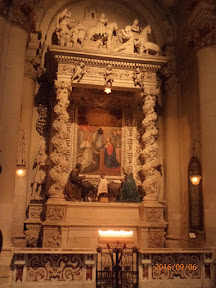
We hurried into the nearest church, which was full of niches encrusted with baroque ornament. The guide asked us to guess what the ornaments were made of, and we guessed stone, plaster and wood. But we were all wrong, it was made of papier-mâché. I did take photos, but without flash, so they aren't very good. However, I took similar photos in the Duomo where we went next


The ornamentation here was carved stone, but I think you can see what I mean by describing it as encrustations! There was a wedding being held here, amidst all the damp tourists listening to guides in several different languages. The bride was late because of the rain, and her bridesmaids were even later. It must have been quite difficult for women wearing long dresses because the piazza outside was under several inches of water

We went into St Irene's church, where I was told off for taking pictures, then, as the rain had lessened a bit, we went to look at the Roman theatre.


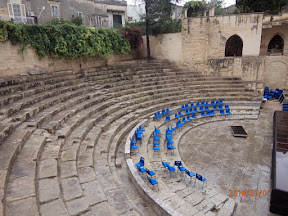
Like the amphitheatre, this small semi-circular Roman theatre had gone out of use and been buried before the Renaissance. It was uncovered in the 1930s, and though it looks small, it apparently would have seated 8000 people. It is in use for theatrical performances and there was one proposed for this evening which, given the rain, we did not fancy. Also, there were not many seats and those stone tiers look very hard!

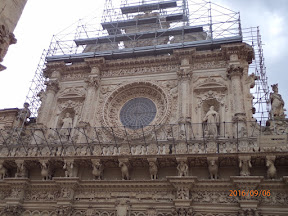
The last church we visited was the Basilica di Santa Croce, widely considered to be the finest example of the Barocco Leccese style, and its façade is a riot of ornamentation. Unfortunately when we visited much of that façade was covered in scaffolding as restoration was in progress.


The church was built over a lengthy period, starting in the mid sixteenth century when construction started on a replacement for an earlier monastery church on this site. The lower part of the façade was finished by 1582 and the dome by 1590. But it was 1699 before the church could be considered finished, with the addition of the upper façade.

The columns you can see just at the bottom of my photo are surmounted by a frieze and above that a number of human and animal figures support the upper section. The human figures represent Turkish prisoners taken by the Christian League at the Battle of Lepanto in 1571, while the animals symbolise the Christian powers who fought the battle: the eagle the Holy Roman Empire, the dragon the symbol of the family of the Pope at the time, the griffon the Republic of Genoa, the lion the Republic of Venice and so on. Near the top in the centre is the elaborate rose window.

Santa Croce means Holy Cross, and this church is so called because it has a relic, a piece of wood said to be a fragment of the true cross. I took a photograph of the reliquary, but, like many of my interior photos taken without flash, it wasn't very good.

By the end of the tour we were extremely wet, especially about the feet, and very tired, so we went to find a sandwich for lunch, and after that, we went to see the Faggiano Museum, an independent archaeological museum authorized by the Lecce government. Mr Faggiano, a chef, bought a building hoping to transform it into a trattoria, but there seemed to be a problem with damp and a possible broken sewer pipe, so Mr Faggiano called his sons to help and they started digging. They found a subterranean world dating back more than 2000 years. They found post holes from ancient wooden houses dating to the 5th century BC, a Messapian tomb (the Messapians were the people from the eastern Adriatic who founded the town), a huge cistern, a Roman granary, etchings from the Knights Templar, 16th century frescos and the remains of a nunnery. So after 7 years of digging by the family, supervised by an archaeologist, instead of a trattoria, the building became a museum.

On the ground floor, glass panels let you look into the the cistern, the granary and the tombs. A system of pulleys let the earliest occupants draw up water from the cistern up three floors.


Upstairs, we looked at the nuns' dormitory.


There was a nun's bed under each of the arches.

A further narrow staircase led up to a balcony turret used as a watchtower in the 14th century. You would have been able to see beyond the old city walls, though today the view is obscured by modern apartment buildings.

Later we returned to the hotel for our siesta. My back is holding out so far, thanks to the shoulder brace, but more than half a day of slow walking and standing about puts it under some strain.

Tomorrow we go to Otranto and the weather report is for more thunderstorms, so we can only hope for the best.

- Posted using BlogPress from my iPad

Monday, 5 September 2016

To Lecce

Monday September 5th

Really, there is nothing much to say about today, as a good part of it it was spent on a train. As we had to be up before 6 and on the train before 8, part of the day was also spent sleeping.

Part of the train journey was very fascinating because we crossed Italy from West to East through a very wild and apparently uninhabited area of hills and forests, with just a few dirt track visible. Once on the east coast though, we were back into a flat agricultural plain where the main interest was in trying to identify the crops and wondering why the vines were all covered with plastic or tarpaulins.

Tomorrow, we don't have to make an early start and we're having a walking tour of Lecce, and there are Roman ruins and a museum to see, as well as Baroque buildings. The day after that, we might go to Gallipoli. But we also hear the weather is planning to be very bad, so we'll just have to wait and see.


- Posted using BlogPress from my iPad

Sunday, 4 September 2016

Rome!

Sunday September 4th

Today we had one complete day in Rome. We had obviously chosen the wrong day, because today was the day Mother Theresa was being canonised, so we were warned that it would be impossible to approach St Peter's Square or the Vatican because of the crowds. Because of terrorism fears, many streets in the area were completely blocked off. So no visit to the Sistine Chapel either! It's 50 years since we were in Rome - we were here for a few days when we were on honeymoon - and we had seen St Peters, the Vatican and the Sistine Chapel, but had intended to go again. But we were obliged to do other things instead.

In the morning our group had a long bus and walking tour round the city. We started at the Coliseum, one of the most popular of the city's sights, built by the Emperor Vespasian and his son Titus and completed in AD 80. Our guide told us that it would have seated between 50 and 60 thousand people, and they were able to enter and leave very quickly because there were 80 entrances.


It almost seemed as if there were very nearly that number queuing to get in today, this being the first Sunday of the month so that Museums were free. But there weren't 80 entrances today, so the queues were rather slow, and standing in the hot sun did not appeal. Our guide suggested trying to get in around 5pm when it should be quieter and certainly cooler, but we were a bit too exhausted by 5.

We also drove round the old Forum, with views up to the Palatine Hill, another place we visited 50 years ago and would like to visit again. We passed the site of the Circus Maximus.


There's not a lot of it left,but you can clearly see the shape in the valley, with raised areas on either side for the spectators. There would have been a wall down the centre, the spina, round which the chariots raced.

We drove past the Baths of Caracalla, an enormous edifice where 6000 people a day could bathe in four shifts


The grounds are extensive, and this was another place we would like to visit - clearly we will need to return.

We drove past another building where we paused very briefly to admire the balcony from which Mussolini made most of his speeches, then we went on to the Victor Emmanuel monument, looking even more gleaming white in the bright sunlight. It's often known as Mussolini's wedding cake, and it certainly looks as if it was made of white icing. My photo, taken as it was from the bus window, isn't very good so I won't post it here.

We had to get out of the bus and walk after that, and we walked to the Trevi Fountain where we spent quite a while.


It was extremely difficult to photograph with so many heads in the way, but it was slightly easier from the side. Our guide explained that it's at the junction of three roads (tre vie) and the water comes from a source called the Acqua Vergine; this used to be called the Aqua Virgo and was one of the aqueducts that supplied water to ancient Rome, built by Agrippa. The legend about the water is that in 19 BC, a young girl showed some Roman soldiers a source of pure water a few miles outside the city, hence the aquaduct's name.
I threw a small coin into the fountain to make sure I come back again. I did it last time I was here and it obviously worked, even though it took 50 years. The coin I threw today had better work a bit quicker!

We passed through a nice air conditioned shopping mall and went outside again to admire the column of Marcus Aurelius, which is quite similar to Trajan's column. I didn't get a decent photo of Trajan's column, so I took several of this one.


We stopped to admire the building housing the Chamber of Deputies, with a very nice Egyptian obelisk outside, then passed on to the Pantheon.


This was a building we didn't visit 50 years ago so I was desperate to go inside but today is Sunday, and it was time for mass, so there was a service inside and it was closed to tourist visits, which was a great disappointment.

Nearby is the French church in Rome. It is called the Chapel of St Matthew and contains 3 wonderful Caravaggios which we went in to see. I took photos but they aren't very good, sadly.

We went on to the Piazza Navona, very picturesque, which was built on the site of the Stadium of Domitian. The Romans used the stadium for athletic competitions.The piazza follows the shape of the open space of the stadium, so it's curved at one end.

The whole piazza is an example of Baroque architecture, with many fine buildings. In the center stands a famous Baroque fountain, the Fountain of the Four Rivers, sculpted by Bernini; it stands right in front of a church designed by Bernini's great rival, Borromini. It's said that the figures on the fountain facing the church are shielding their eyes in horror from the facade of Borromini's church. I'm afraid my photographic skills aren't quite up to that!

By this time my back was getting sore so we headed for the bus back to the hotel for a rest, passing by the Baths of Diocletian. As they are very close to our hotel, we thought of visiting them, but decided against it later owing to a poor review in our guide book.

We cooled down and rested over the lunch period in our hotel room, (first ice cream of the day!) and decided that we might devote ourselves to art in the afternoon. So we set off for the Palazzo Barberini, a place we had never visited before. There was a most interesting exhibition of recovered cultural artefacts which had been stolen at one time or another, and the selection was highly eclectic, ranging from ancient Etruscan artefacts, Roman frescos and pottery to paintings from the 20th century.


The photo above is of a statue said to be connected to the cult of Mithras. Mithras was the a soldiers' cult and involved bull sacrifice, and this is a Roman soldier sacrificing a bull.

There was a huge collection of red figure pottery, and the collection of paintings ranged right through the centuries, some having been looted by the Nazis, but many more having been stolen from museums and private collections relatively recently. And of course there was quite a collection of ecclesiastical artefacts, since churches often have poor security.

The Palazzo itself has an interesting collection of art, and though parts of it were shut today, we saw a great many famous paintings - including the Hans Holbein one of Henry 8th which I think every English schoolchild knows. This post has been long enough already so I won't go on, but we particularly admired a number by Caravaggio


This is his Judith and Holofernes. I don't know why I always seem to photograph paintings squint, and this isn't a very good photo, but at least you can get an impression of it.

Then it was back to the hotel for a further rest before going out to dinner. Later came the second ice cream of the day - melon in my case, and quite delicious. I'm hoping I can count melon ice cream as one of my 5 a day!

- Posted using BlogPress from my iPad
Saturday, 3 September 2016

Strasbourg to Rome

September 3rd 2016

Not having had the time to look at Strasbourg the previous night, we got up just before 7 so as to join a group walking round the city at 7.30am before breakfast.

It really is a very attractive city, completely encircled by a river, and there are any number of decorative bridges over it.


Our hotel was just to the north of the river which encircles the city,so we crossed the river and walked along the side of it. This photo was taken at the start of our walk. If this doesn't post too small, you may notice a small blue blob on the opposite side of the river from where I'm standing. This was a shelter over a homeless person - probably quite a pleasant place to sleep in this hot weather, but I dread to think what it might be like in winter.

We walked into the old part of the city, called Petit France, where they were many interesting old timbered buildings.


After strolling for a while, we noticed a marché aux puces being set up, so we couldn't resist having a quick walk through that.


As you can see, there was quite a collection of different things, and Paul had to be prevented from acquiring a great many objects to bring home.

We stayed rather longer in the flea market than we had intended, so we needed to make our way back towards the hotel for the 8.30 breakfast, but it was hard to resist stopping to photograph the many picturesque timbered buildings.


This was called Rue des Cordonniers - shoemakers. You might be able to see the medieval looking shoes on the banner if this hasn't posted too small.

After breakfast, we were off to the station for the day of three trains. The first train took us to Basel, where we walked from France into Switzerland - the border runs through the station. This was the most interesting part of this first train journey, which was through a rather flat area of arable farms - maize, mainly.

We had a short while to wait in Basel station, then we caught a train for Milan. This was a far more interesting journey scenically, as we progressed through the mountains and alongside lakes.

The snowy peaks in the far distance wouldn't appear on the photographs, they were too faint, but the lower mountains were quite interesting shapes.


It's difficult taking photos from a moving train; half the time you are on the wrong side of the train for the good view, the windows are dirty and full of reflections, and trees and buildings and lampposts jump into the photo just after you have pressed the button to take it. But this one does at least show the mountains.

We passed down the side of two lakes. This one is is near the town of Thun, and is called Lake Thun or Thunersee in German.


It's obviously a nice holiday area, though I had never heard of it. My photos of Lake Maggiore, which we passed before we reached Milan, weren't nearly as good as this one, in spite of Lake Maggiore being so much bigger.

We passed through a lot of typical Swiss scenery, like the view below.


The third train of the day took us from Milan to Rome. There are no photos because the sun was so low in the sky it was impossible to take photos. Also, the line had so many tunnels that, by the time I noticed a nice view, we had dived into another tunnel and there was no prospect of a photo.

The train was half an hour late into Rome, which made dinner very late indeed. We didn't reach the restaurant until 10 past 9, and dinner wasn't over until 11!

- Posted using BlogPress from my iPad
The Start of the Holiday

September 1st and 2nd 2016

Our Eurostar train was to leave quite early on September 2nd, and we were supposed to be at St Pancras before 9am. So, rather than cram ourselves and suitcases onto commuter trains, and risk the Thameslink being cancelled, I booked a hotel at Kings Cross and we went up the night before after an early supper. This was probably a very good idea, as our train was late and the lift was broken at East Croydon station so we missed our Thameslink connection. Then the next one was cancelled, so we had quite a wait and didn't finally arrive at Kings Cross until well after 9 pm. I was glad I hadn't left it until the morning, and at least we got a night's sleep before the holiday - when we leave in the morning, we always seem to be up packing and organising until 3 am!

The hotel bed was comfy, but we discovered we only had one towel, and couldn't quite manage the long walk down to reception in our night attire, so we just shared the sole towel.

We tried to use the lift in the Eurostar terminal to check in with our tour organisers, and the lift got stuck. That's the only time in my life so far I've been stuck in a lift, and I sincerely hope it's the last. At least it was a large lift and had glass sides, and we were only trapped for a few minutes before the engineers got it going again. We went down on the escalator!

Our Eurostar train left on time, and just before midday French time we were served with a second breakfast! I'd have preferred a light lunch. We reached Paris to find our connection to Strasbourg had been changed, so we had 2 hours to wait in Gare de L'Est. I spent my time updating the blog as there was an Internet connection of sorts in the station. I'm hoping for a better one at the hotel, or posting this will be a real chore. It amazes me that I posted 10 or 12 photos every day from the Australian outback 5 years ago, and I have to add them one at a time in Europe!

At least I'm up to date now, though I haven't had time to see any of Strasbourg and we leave for a 3 train trip to Rome tomorrow, so I don't have much hope of sightseeing. Perhaps tomorrow will be a more interesting day - at least I won't have to spend hours bringing this blog up to date! Thank goodness for the fast Internet connection in the Novotel in Strasbourg - I only hope the other hotels we stay in will be as good.


- Posted using BlogPress from my iPad
Update 6

August 2012

I seem to have deleted this post by mistake while unscrambling the mess my previous posts got into, and I don't have a copy of it. So if you read it before, it could well be very different this time! I still haven't managed to correct the huge photo in Update 3 though, so can only hope that though it looks awful in Safari it might be better in other browsers. It looks OK on my phone.

This month we finally finished all the niggly little renovation jobs needed on my older son's London house, and it was put on the market. Unfortunately, it appeared on the web site designated as a flat, with the road spelt wrongly and only 4 photographs, so we can only hope for the best.

We looked after my younger grandson quite a bit, and enjoyed taking him to a new playground we found in Limpsfield


Now that he is slightly older, he really enjoys the challenge of things that are slightly different from the normal swing, slide and roundabout, and there are some climbing challenges just suitable for his age, so he loves going there.

We had the usual busy time with my frequent physiotherapy appointments, and our younger son and wife packed up their house ready to leave before the Bank Holiday.


Most unfortunately, they had agreed to exchange and complete on the same day, and a few days before moving day, the buyers solicitors discovered a problem with the Title Deeds. When the house was divided, it was called 78 and 78a. Somebody made a mistake in copying and designated one of the rooms as belonging to house number 76a, which is 200 yards down the road as there is a large park in between! Nobody noticed this for about 100 years, so it was really bad luck to have it discovered on this occasion. Now they hope to move in September, after the corrections have been made.

As my son had taken some days off to move, they just finished as much packing as they could and came down to stay with us for the Bank Holiday. They went home on Tuesday, leaving us just a few days to get ready for our holiday at the start of September.

- Posted using BlogPress from my iPad