Tuesday, 28 May 2019

Tuesday May 28th

Today we decided to brave the crowds in Piazza San Marco and go to the Canaletto and Venice exhibition, which is in the Doge’s Palace.

On the way to the exhibition, we walked along Riva Degli Schiavoni, thronged with tourists and packed with stalls selling things and we crossed over the Ponte della Paglia from which you get an excellent view of the Bridge of Sighs.


I had to queue to take this photo, along with thousands of others. At least I wasn’t taking a selfie - though I suppose I could have done; along with all the other stuff I didn’t want or need, all the stalls were selling selfie sticks!

The we fought our way into the Piazza San Marco.


Of course I couldn’t resist a photo of Basilica San Marco, but you can see how crowded it was. It was impossible to get a photo without the stalls - I managed to avoid all but one in my photo.

It looked as if we might have hours to wait in a huge queue as the exhibition tickets were being sold at the same ticket booth as those for the Doge’s Palace. However,  we had been advised by our friend to buy ours at the Museo Correr where there was no queue, so we were able to get in to the exhibition right away.

The exhibition relates Canaletto’s work to other masters of art in Venice, so there was plenty to see. Photos were, by and large, not allowed, but I managed quite a few by turning off my flash and choosing a time when the guardian was out of the room. Photographs were possible because the rooms were not crowded; sometimes I was the only person there, and there were never more than three or four other people. Most people obviously went to the Doge’s Palace.

This is one of my favourite paintings by Canaletto, The Church and the School of Charity from the Marble Workshop of San Vital. It also looks familiar to my eyes because it comes from the National Gallery in London.


It isn’t what you think of as a typical Canaletto, more a reflection of urban working life. I note that the catalogue points out that the bell tower at the left of the painting would collapse in 1744, so you can’t find the same view today.

This next one looks much more like a typical Canaletto, featuring the Grand Canal.


It’s called The Grand Canal from Palazzo Balbi at Rialto. The notes on the wall comment on the astonishing accuracy he achieves by working with light and shadow.

I couldn’t resist this one either, which also comes from Britain. 


It’s called The Grand Canal from Campo San Vio. 

As I said, in this exhibition, Canaletto’s work was related to other masters of the Venetian school. The one below is by Francesco Guardi, and it’s called Fondamenta Nuove with the Island  of San Michele 


Fondamenta Nove is where we get off the boat every day to walk back to our friend’s flat. It doesn’t look that different today, apart from the addition these days of the vaporetto stop.

Both Paul and I particularly liked the one below, which is by Bernardo Belotto, a nephew and pupil of Canaletto.


It’s called View of Pirna and the Sonnenstein Castle. I’m not at all sure where that is, but but Belotto apparently travelled to Tuscany, Rome, Milan and Turin and subsequently abandoned Venice for Dresden and then other European capitals. I’m guessing that it might be somewhere in Germany.

This next paining is The Charlatan, and it’s by Giandomenico Tiepolo.


I love it for its observation of everyday life, and because it’s so vivid and full of life and colour. I also love it because the charlatan is obviously a dentist, that’s a tooth he’s holding up in a pair of pliers. I’m sure my son the dentist would appreciate that!

I won’t post any more from the exhibition, or this will end up like a catalogue. But we remarked on a full length portrait of Farinelli, the celebrated Italian castrato and one of the greatest singers in the history of opera. Farinelli has apparently been described as having the vocal range of a soprano and sang the highest note customary at the time, though I don’t know what that was.

We were both amazed at a marble sculpture by Antonio Corradini, Bust of a Veiled Woman, because you can see her features beneath the veil. I would have taken a photo, but the guardian in that room wasn’t permitting photos. She got a bit fed up with me, probably because she didn’t like the fact I looked so closely at the sculpture, I think she thought I was going to touch it. Then I went next door and tried to read a small label and got too close to the glass case on the wall so I set off the alarm, which really annoyed her. I do think they ought to make the labels a bit bigger!

By then it was well past lunch time so we went off for a very late lunch. After that, I thought I’d have a third go at getting into the sacristy at Salute, and this time it was open. So I was at last successful in seeing the ceiling painted by Titian - 3 large panels, The Sacrifice of Isaac, Cain and Abel, and David and Goliath. They are flanked by 8 small round ones, The Four Evangelists and The Four Fathers of the Church.  The guardian gives you a small mirror so you can examine the painting without having to lie down, but the ceiling is very high so they are hard to make out. I did better by photographing them with a zoom.

There was also this Titian altarpiece, Saint Mark Enthroned with Saints Sebastian, Roch, Cosmas and Damian, painted in 1510. I don’t understand this fashion of grouping together people who didn’t live at the same time, let alone not knowing each other! 


There’s also a big Tintoretto, The Wedding at Cana, but my photo of that was so poor I bought a postcard!

After al, that, we though we would have a rest from art and take advantage of the good weather before the rain started. So we took a boat over to the Lido, where we strolled and ate ice cream. It’s much calmer and less crowded that Venice. This is the lovely little canal not very far from the bus station and vaporetto stop.


After supper the rain started and our friend, who was out at a concert, was completely soaked. I can hear thunder as I type. The weather forecast is poor for tomorrow, so I hope not to get too wet because it is our last day.


Monday, 27 May 2019

Monday May 27th

I have to write all this down quickly while it’s still fresh in my mind. We saw 5 different churches today, and I’m seriously in danger of confusing them!

We took two different boats down the Giudecca Canal to the far end, in an effort to see 4 churches in the southern part of Dorsoduro. We hadn’t realised how long it would take us to get there (nearly 2 hours), so two of them were shut for lunch when we arrived but we were able to see them later.

We started with San Sebastiano, one we had tried to see before but it had shut early. It’s a 16th century church replacing earlier ones going back to 1396. 

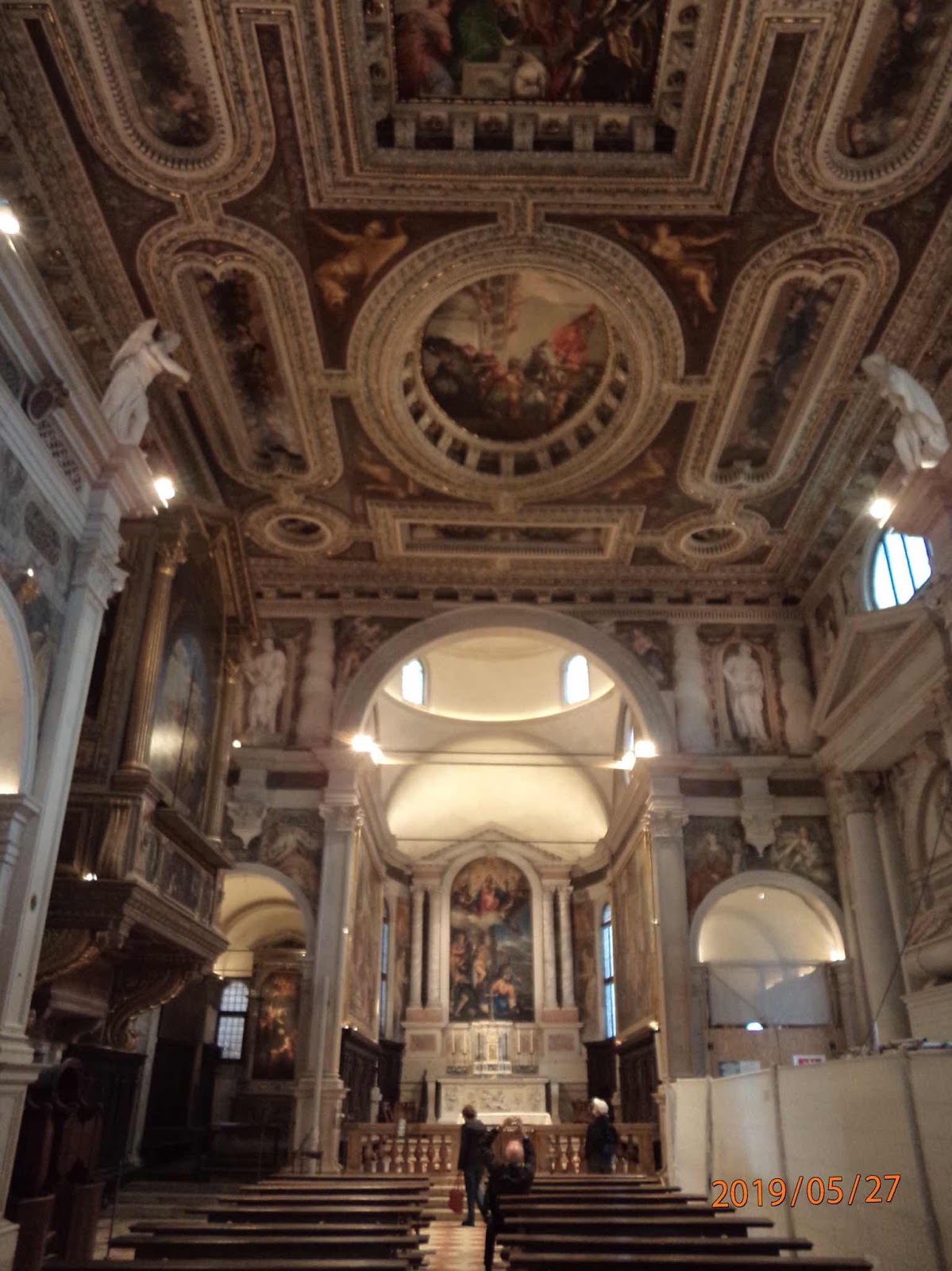
San Sebastiano is the church where you come to see paintings by Paolo Veronese. It was his parish church, and he began decorating it at the age of 30, working here from 1555 to 1560 and again from the 1570s to 1581. He died in 1588 and was apparently buried here, along with his brother Benedetto Caliari, also a painter, who helped to complete the work in the nave. 


This is the nave. He painted the sacristy ceiling, the nave ceiling, the frieze, the east end of the choir, the high altar, the doors of the organ and the chancel. It’s hard to know what to photograph first! 

There are 3 ceiling paintings which tell the story of Esther, the queen of Persia who is credited with bringing about the deliverance of the Jewish people. These are felt to be particularly fine, but I don’t seem to have made a very good job of photographing them - ceilings are quite difficult. I made a slightly better job of the sacristy ceiling, which shows the Coronation of the Virgin.


The surrounding 4 panels feature evangelists and there are putti in the circular panels in the corners. There are other paintings all round the sacristy walls, but not by Veronese.

The high altarpiece was commissioned from Veronese by the famous Cornaro family. 


It depicts the Madonna in Glory with Musician Angels at the top, Saint Sebastian being martyred lower down, and there are apparently also other saints including John the Baptist, Peter and Frances. I’m not quite sure why there are so many of them all there at once, but presumably that was part of the commission.

There are supposed to be other art works in the church, including a Titian, but restoration work is continuing and most of the right hand side of the nave is screened off and covered in scaffolding.

After spending a lot of time there, we walked down the Zattere to the Gesuati (not to be confused with the Gesuiti in the Cannaregio). This one was built by the Dominicans in the 17th Century when they got possession of the site following the suppression of the Gesuati order in 1668, which explains the name.

It is the most conspicuous building along the Zattere.


The facade is quite heavy, and is said to be modelled on Il Redentore church opposite it across the Giudecca Canal. The interior is also modelled on Il Redentore so the nave has no aisles.


The ceiling features frescos by Tiepolo, depicting the life of St Dominic.


In one of the side chapels is a Virgin with Saints by Tiepolo which is also felt to be very fine.


The photo above isn’t mine, mine was too awful. The light was poor and reflections sometimes make photography impossible.

It was then time for a late lunch and we found a bar on the Zattere. After lunch, I went to use the ladies, a very tiny cubicle, and the lock failed so that I was locked in this very tiny space right at the back of the place far from the bar and the café tables with no phone signal. Being claustrophobic, I had a complete panic and screamed and yelled and hammered on the door until one of the waiters found a screwdriver and opened the lock from outside to let me out. My hand is now blue with bruises and I'm quite hoarse! I must remember to kick the door if this ever happens again. This is the second time I have been locked in a ladies loo (it happened at work about 9 or 10 years ago and I was trapped for much longer) and I fervently hope there won’t be a third time!

We next went to San Nicolò dei Mendicoli.  There is supposed to have been a church on this site since the 7th century, destroyed and rebuilt several times, remodelled in 1553 and given a new facade in 1750. 


The interior is 16th century gilded wood, but so dark it is very hard to photograph and I am amazed anything came out at all. It was so dark I didn’t even spot Paul getting his head into the photo - and my second effort is even less sharp.

Next, we went to Angelo Raffaele, traditionally supposed to be one of the oldest in Venice, allegedly founded in either the 4th or the 6th century. The existing church was built between 1676 and 1685. 


The main attraction of this church is a series of panels that tell the tale of Tobias, the blind prophet cured by the archangel Raphael, after whom the church is named. You might be able to see him, or at least his wings, on the painting behind that construction with a crucifix on it behind the altar.

It was by this time after 4, and, though we had hoped to get to Il Redentore next, we had a bit of a wait for a boat across the Giudecca Canal, and only arrived about 4.25 when the church closes at 4.30. So we stayed on the boat and visited San Giorgio Maggiore instead. There’s been a church on this site since 790, and a later 10th century church was replaced after an earthquake and fire in the 13th century and rebuilt in the 15th century. The current church, designed by Palladio, began in 1556. It’s a church built for ceremony, so it’s monumental and imposing.


This isn’t my photo I’m afraid. I did take one from this position, but the church is housing some works from the Biennale and there is a tall multi coloured glass erection, filling the centre of the nave almost to the roof, so it’s impossible to photograph the interior without it.

There are some late works by Jacopo Tintoretto, The Fall of Manna in the Desert on one side of the altar, and The Last Supper on the other.


Both of these are hard to photograph because they are so massive, you can’t get near them and you have to view them either from the far right or the far left as you can’t get right under them. The Last Supper i have posted above is regarded as revolutionary because of its diagonal design.

There is also a campanile, but we were too tired by then to go up it, so we caught the two boats home. The rain, which had been coming and going all day, set in with a vengeance and the lagoon was very choppy with a marked swell, making for a rough trip. We had to make a very wet trip to the supermarket for supplies, so the flat is now draped with damp clothes and wet umbrellas and we are hoping our shoes will dry by tomorrow.


Sunday May 26th

Today being Sunday, all the churches full of art were closed for tourist visits - they open only for church services; so we decided it would be a day for museums.

We began at Ca’Pesaro, a Baroque Palace completed in 1710, now housing the museum of modern art. It was originally built for the Pesaro family (hence the name) and was bequeathed to the city in the 19th century for exhibiting the works of unestablished Venetian artists. It became the Gallery of Modern Art in 1897.

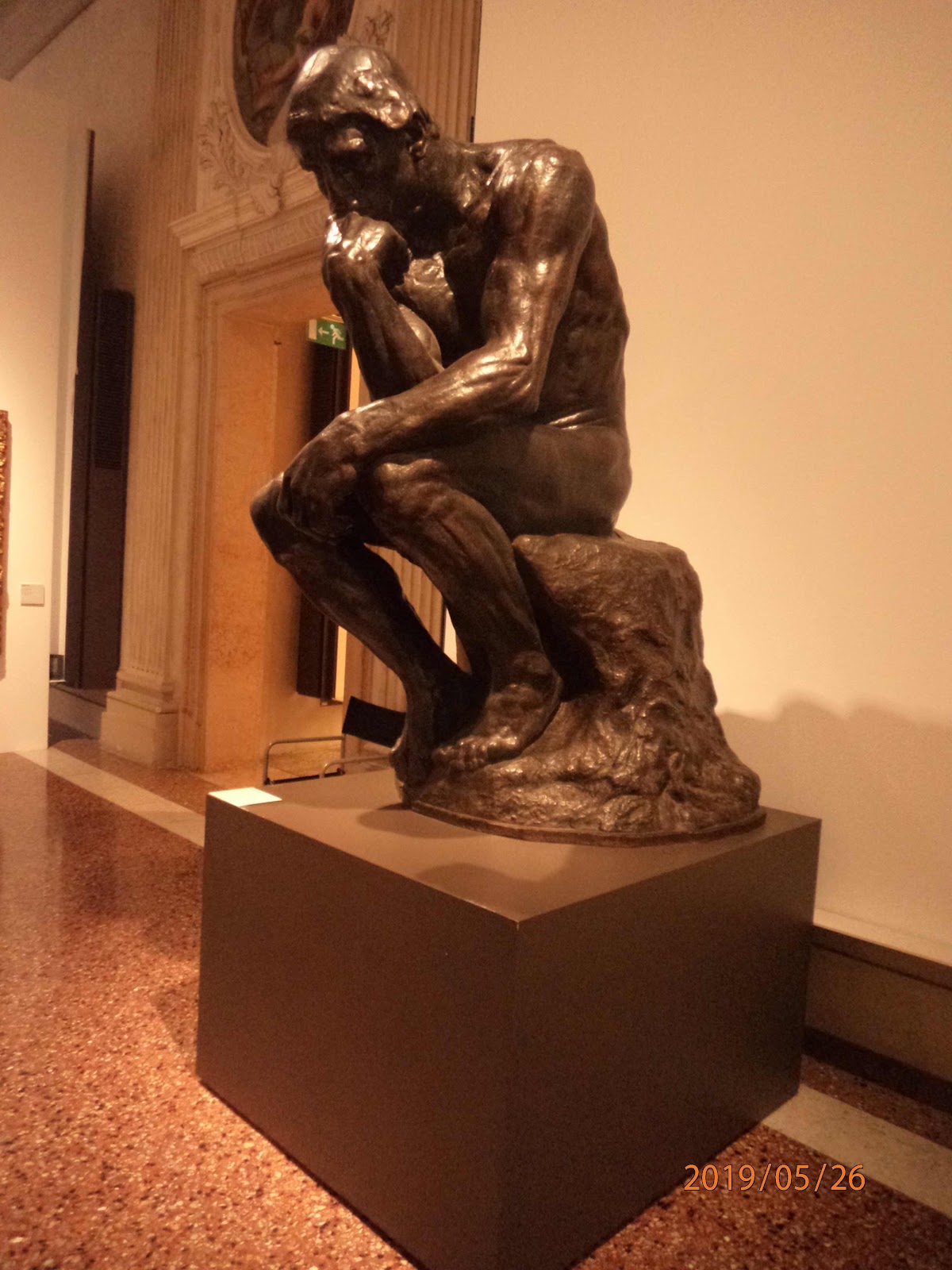
It’s difficult to pick out individual works of art. But most people will recognise this one by Rodin


It’s not a statue though, it’s in polished plaster.
There’s also a plaster of Rodin’s Burghers of Calais just close to it. There’s quite a bit of sculpture in the gallery in fact, mostly by Italians whose names are not familiar to me.

I really liked this beautiful portrait, Lady in Pink


It’s by John Lavery, one of the ‘Glasgow Boys’, and he is apparently particularly appreciated in Italy, where he is seen as a refined commentator of British society.

The Klimt below is one that appears on museum posters, the only Klimt in this gallery


It’s in a room with other similar paintings by Italian artists, so he appears to have been very influential.

I also picked out this Boudin, View of Antwerp.


The gallery has a lot of painting and sculpture, quite a collection of glass and even some Art Nouveau furniture, designed by Carlo Bugatti, father of the car manufacturer. 

There are three floors, the one I have covered in some detail,  one housing a collection of Chinese and Japanese artefacts collected by the Count of Bardi on this travels during the 19th century, and one devoted to Arshile Gorky, an Armenian-American painter who had a huge influence on Abstract Expressionism. He spent most his life as a national of the United States and is apparently regarded as one of the most powerful American painters of the 20th century, along with the likes of Mark Rothko and Jackson Pollock. As I am a complete Philistine as far as Abstract Expressionism is concerned, and my back was troubling me, I gave that a miss and went to the café for lunch. 

One of the best aspects of the café was sitting on a verandah looking over the Grand Canal and watching the world go by. There’s a variety of traffic on the Grand Canal, sometimes quite a traffic jam. There are 3 different vaporetti routes, and they vie for space with water taxis, private speedboats both large and small, working boats carrying goods, hotel boats carrying passengers followed by others piled high with the guests’ suitcases, gondolas, police boats, and today, a group of six canoes and another of 3 dragon boats! Now that I mention gondolas, I’ve just recalled that, as we went under Rialto Bridge today I looked out of the vaporetto window and saw a young couple in a gondola. As I looked, the young man went down on one knee and produced a ring box. The girl clapped her hands to my mouth, obviously saying ‘Oh my goodness’ or its equivalent in some language. Clearly, romance is not dead!

After lunch, we set off for Ca’Rezzonica, today a museum reflecting 18th century Venice. The building was begun in 1667, but lack of funds meant it wasn’t finished. It was bought by the Rezzonico family who completed and decorated it in 1712. In 1888 it was bought by Robert Browning, who didn’t enjoy it for long poor man, as he died of bronchitis in 1889.

You begin in the ballroom, full of trompe l’oeil frescos, elaborately carved and gilded wooden chandeliers and carved furniture.


Look carefully at the black statue on the right of the picture. That, and the two chairs next to it are the only things that aren’t painted fresco. The pillars behind the statue, the door surround, the circular pillar and the grey statue are all paint on a flat wall. I don’t know what that red and black thing in the middle of the wall is, but suspect it’s something connected with the Biennale. It certainly isn’t part of the palace decorations.

Adjoining rooms have ceilings with frescos by Giambattista Tiepolo. Below is one of them.


It’s allegorical, and according to the notes, the central figure represents Nobility.

Because this is a Baroque Palace, there is Baroque furniture. Most of it seems hideous to me. This is one of the ugliest chairs I have ever seen in my life.


It’s actually a throne used by Pope Pius VI in 1782 when he stayed as a guest, but it was made about 70 or 80 years earlier. It’s what my mother would probably have described as a real dust trap, but, as our friend commented, why worry about dust when you have an army of servants to take care of that sort of thing.

There is a Canaletto painting in a nearby room, which I liked very much


It’s called View of the Rio dei Mendicanti.

By contrast with the beggars, another room is set up as a typical opulent bedroom.


That’s just the bed. The door on the left leads into the dressing room, where there are some beautiful cupboards for clothes, and a small sitting room. And to the right of the bed, which you can’t see in my photo, is a cupboard with a large collection of silver which was the lady’s toilet set. 

Further up there is a huge picture gallery with a collection of largely Venetian paintings, and Giandomenico Tiepolo’s series of frescos painted for his family villa. Rivalling the paintings were views over Venice from the windows.


I believe that further up still is a reconstructed 18th century apothecary’s shop, but my back was so troublesome that I had to give up. I retired to the café to drink coffee, and shortly after that, we were all told to leave as it was closing time. So Paul and I made our way back home, via two different boats. As the supermarkets are all shut on Sunday, we had dinner in a local restaurant. 

Descriptionan Armenian-American painter, who had a seminal influence on Abstract Expressionism. He spent most his life as a national of the United States. Along with Mark Rothko, Jackson Pollock and Willem de Kooning, Gorky has been hailed as one of the most powerful American painters of the 20th century.

DescriptionArshile Gorky was an Armenian-American painter, who had a seminal influence on Abstract Expressionism. He spent most his life as a national of the United States. Along with Mark Rothko, Jackson Pollock and Willem de Kooning, Gorky has been hailed as one of the most powerful American painters of the 20th century.

DescriptionArshile Gorky was an Armenian-American painter, who had a seminal influence on Abstract Expressionism. He spent most his life as a national of the United States. Along with Mark Rothko, Jackson Pollock and Willem de Kooning, Gorky has been hailed as one of the most powerful American painters of the 20th century.

Description


Arshile Gorky,was an Armenian-American painter, who apparently had a seminal influence on Abstract Expressionism. He spent most his life as a national of the United States and is regarded as one of the most powerful American painters of the 20th century, on a par with Mark Rothko and Jackson Pollock. I have to admit I gave him a miss as my back was giving me some pain. 

Saturday, 25 May 2019

Saturday May 25th

We started the day by walking along to a church near where we are staying. Its consecrated name is Santa Maria Assunta, but it is usually known as the Gesuiti, having been built by the Jesuits. The Jesuits were never popular in Venice and had been expelled in 1606, but were allowed back to what was then a remote location in 1657 because Venice needed money. They acquired a church which had occupied the spot since 1155 but had been rebuilt a number of times after a succession of fires. The Jesuits had this church demolished in 1715 and instead built a rather overblown baroque church, perhaps hoping to demonstrate their power or their wealth. 


This isn’t my photo - mine is squint, as usual. But it certainly shows the style.

The interior is even more amazing. The walls seem to be covered in what looks like the wallpaper in a traditional Indian restaurant - though it’s green, not red. But it's all marble inlay made to look like fabric - swags and all. Almost every surface is decorated - there's even marble carved and inlaid to look like carpet in front of the high altar. And of course the entire ceiling is painted.


I’d need a separate photo to show the detail of the pulpit on the left; you would swear it was draped in swags of heavy fabric but it’s all marble. One writer has described this interior as having ‘a harshness indescribably table-clothy’ - a description on which I cannot possibly improve!

There’s a Titian painting, The Martyrdom of Saint Lawrence, which I find an extremely unpleasant subject (he’s being grilled over a very hot fire), and a Tintoretto Assumption of the virgin which is extremely badly lit and almost impossible to photograph so I preferred this by Jacopo Palma


One of the reasons Paul likes this photo is the mummy of a monk in a glass case which you might just be able to see under the painting.

After this, we set off to visit the Ca’ d’Oro, often considered to be the finest example of Venetian Gothic architecture in the city.


It was once a Palazzo for a wealthy family, built in 1420, but it has suffered many changes of fortune. It has been remodelled a number of times, became almost derelict in the 18th century, and was eventually restored and bequeathed to the state in 1915. It now houses the Giorgio Franchetti collection of art, and currently includes some modern artworks as part of the Biennale. 

There were a number of lovely Madonnas from the 15th and 16th centuries, but I always find the Madonna beautiful and the baby awful. I’m not sure whether this is because male painters are unacquainted with babies or whether it is the difficulty of trying to portray God as a baby and not make Him too babylike.


This is one I like, from the workshop of Bellini, but the baby looks like a tiny little man.

I particularly appreciated this beautiful Titian paining ‘Venus at the mirror’


But it was hard to photograph because of the modern art installation in the room. There were groups of mirrors standing upright on the floor, each approximately the size of this iPad, and they were set up to turn and move with the people in the room; this was disconcerting, as well as being pretty difficult not to trip over them while viewing the pictures.

Another thing I enjoyed was the view over the balcony of this Palazzo.


There are beautiful buildings wherever you look.

The families never lived in the lowest floor of a Palazzo because it was so often flooded, and this one had some delightful downstairs space - as long as you ignored the strange modern art which looked like a series of punch bags hanging from a scaffolding. You can just see one at the top of my photo on the left.


Sometimes this lowest floor was used for storage, but the flooring here and in the adjoining hall is so beautiful I wonder if it wasn’t used for recreation; it seemed such a pity to hide it under piles of things.

After a late lunch, we set out to go back to Salute in the hopes of seeing the paintings in the sacristy which had closed early on the day we visited. So we took the number 1 vaporetto (which is very slow) down to Salute, only to find the sacristy was closed again. So we still haven’t seen the paintings! 

The we had to catch the slow number 1 again (it’s the only one that stops at Salute) to another stop where we caught a second vaporetto back in the opposite direction along the Giudecca to the south to visit the church of San Sebastiano, which has a number of pictures by Veronese. When we got there, that was closed too. So we gave up, got back on the boat, and returned home where we consoled ourselves with Italian ice cream.

On the way to the supermarket for supplies, we need to pass the hospital. Just as in any hospital, the ambulances are lined up outside.


And this is what one looks like, rushing past with siren sounding loudly, speeding to an emergency. It isn't my photo I’m afraid, it had to be emailed to me by Paul, my camera was too slow moving the zoom and all I got was the back of the boat - it moves at some speed!


Friday, 24 May 2019

Friday May 24th

We don’t seem to make very early starts, in spite of my good intentions, though we managed it a little earlier today. We started with a visit to the Basilica of Santa Maria Gloriosa del Frari, usually known just as the Frari. The name is because the original church was built by Franciscan friars between 1250 and 1338. 

The current church, huge and gothic, which replaced this early church was built in the mid 15th century, and is imposing inside. There are twelve huge round pillars between the nave and the aisles to represent the apostles, but the division of the nave and aisles is pretty unobtrusive, so you just have the impression of a single space.


Around the walls are masterpieces by Titian and Bellini and a statue by Donatello. It also has monuments to Titian and Canova, and the tomb of Monteverdi.

Titian’s masterpiece, The Assumption of the Virgin, is over the main altar and dominates the church. You can just glimpse in in my photo above, through the carved marble screen which separates the nave from the choir. I believe the original is now somewhere else, and what you currently see above the altar is a photograph.

I preferred the other Titian, Madonna Ca’Pesaro, which is at one side of the nave.


I also liked the Madonna with Child and Saints by Bellini


After that feast of art, we needed to refresh ourselves, and stopped for lunch next to the Scuola Grande di San Rocco, which we visited next. Set up originally as a charitable institution for the sick, it was begun in 1515 and financed mostly by donation from wealthy Venetians who hoped Saint Roch would save them from the plague. In 1564 Tintoretto was commissioned to decorate the walls and ceilings, and I think must be one of the most amazing place I have ever been in in my life.

This is the upper hall.


I’m afraid my photograph can’t possibly do justice to the place. You can see how enormous it is, and every inch is painted. You can take a mirror to examine the ceiling paintings, which is a lot better than my usual practice of lying on my back. That’s Paul in the photo, using one of the mirrors, which are rather large and heavy.

A room to the side has the most enormous crucifixion, but I’m afraid my camera was completely unable to do it justice. The fact that the paintings are not well lit does not help, and the painting is so enormous it is hard to get it all in without getting too far away to see anything.

The ground floor hall is rather less overwhelming, as there are only eight enormous paintings, illustrating the life of Mary. 


I particularly liked The Assumption, partly because of the expression on Mary’s face.


We had intended to go into the church of San Rocco next, but decided to look instead for San Pantalon which was fairly close by.

San Pantalon is dark and somewhat awe-inspiring because of the painted ceiling which is remarkable for its illusionistic effects.


There is no way to take a decent photograph of this ceiling, and anyway there is supposed to be a ‘no photographs’ rule. I lay on my back on a pew to take this when the guardian wasn’t looking. There are 40 different scenes in it, depicting the martyrdom of the physician St Pantalon, and the artist took 24 years to complete it.

There is a painting by Veronese, St Pantalon Healing a Boy, in a side chapel, but it is badly in need of cleaning and so poorly lit you can only see it by paying 1€ to light it, otherwise it is just a black rectangle.

In an adjoining chapel, I preferred these three, attributed to Veneziano.


They are The Annunciation, Madonna and Child, and Presentation at the Temple.

By then it was late and after that we became hopelessly lost in the tiny alleyways as we tried to find our way back to the vaporetto stop. With the help of the GPS in Apple Maps we finally found our way, but even the GPS is confused by the narrow alleyways so that the satellite presumably has difficulty in locating you, especially as some of the alleyways are really tunnels - they are just passageways under buildings.

Five o’clock is a bad time to catch a vaporetto, and today was a particularly bad day as we had noticed on our morning journey that two huge cruise ships had arrived. Our boat home was like Southern Rail at peak times, standing room only. It was was stuffed with people with suitcases (presumably a tour group travelling to the station), as well as the usual complement of tourists from many countries, commuters going home, and elderly Venetians with trolley bags of shopping, often accompanied by their dogs!


Thursday May 23rd

We seem to have had another late start this morning, as Paul had a lot of email to answer. We had decided to see some local churches this morning, and eventually set off to catch a vaporetto; I decided that the only way to deal with my problem back is to walk about a bit less, so we bought a 7 day travel pass and will hop on and off whenever is convenient. It won’t be any quicker than walking, but it will save my back.

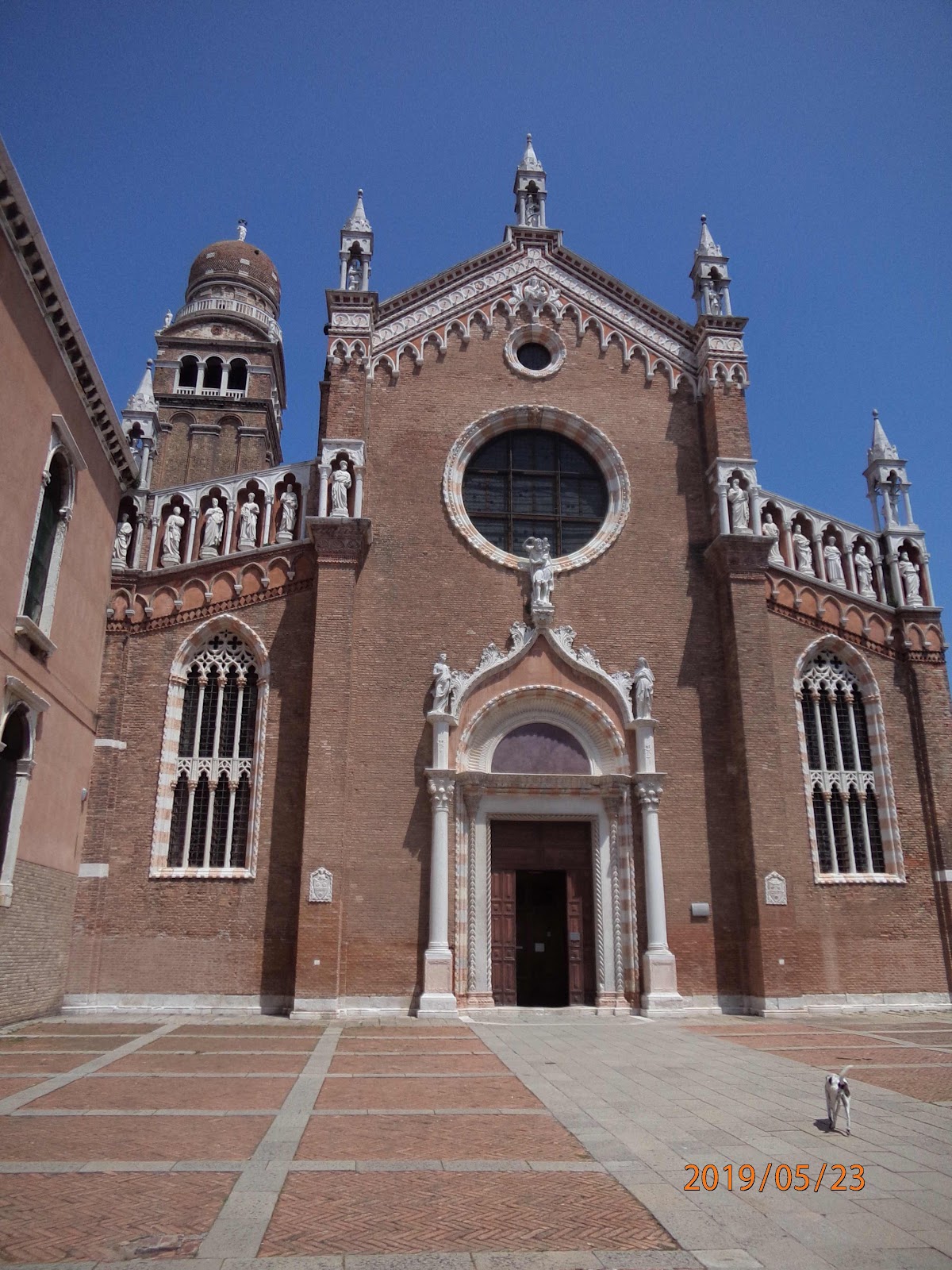
We went one stop, then it was a fairly short walk to the church of Madonna dell’Orto, a brick built church with an onion dome that, in a novel by Donna Leon, reminds her protagonist of a panettone. 


I have a slightly better photo of the church, but it doesn’t show the onion dome.

The original church dates to 1350, and during its building a statue was discovered in a nearby orchard (Orto). It had been placed there after it was rejected by the Prior of Santa Maria Formosa, and it then began to get a reputation for glowing and working miracles. So the statue was bought and placed in this church, in 1377, hence the church became know as  Madonna dell’Orto. I photographed the statue, but it’s quite ugly in my opinion, so I won’t post it here.

Inside, rows of columns of striped Turkish marble separate the nave from the aisles. There is a flat timber ceiling.


This was the parish church of Jacopo Tintoretto, he lived nearby, and there are 11 paintings by him inside. The biggest are absolutely huge, and flank the altar. They are really hard to photograph, as you can’t get to the front of them, you have to look at them from the side and they are very dark. The one on the left of the altar, The Adoration of the Golden Calf, is said to feature portraits of Giorgione, Titian, Veronese and Tintoretto himself amongst the worshippers of the golden calf. The one on the right, The Last Judgment, is so threatening that it supposedly caused John Ruskin’s wife Effie to run out of the church. It is now so dark and hard to see that I couldn’t really make it out at all. The Presentation of the Virgin above the door to a chapel is a bit more cheery, and was apparently painted in an attempt to outdo Titian’s painting of the same name. Apparently, Titian and Tintoretto did not get on!

There is a painting by Titian in one of the side chapels, Tobias and the Angel


I had to take it from one side to escape the reflections from a nearby window.

The church used to house another famous painting, this one by Giovanni Bellini, but it was stolen (for the third time) in 1993, so now there is just a colour photgraph of it instead.

Outside the church there is a charming cloister which currently houses sculptures as one of the Biennale exhibitions.

After this we returned to the vaporetto stop and caught another boat for just one stop; then it was another short walk to Sant’Alvise, a church with a very plain exterior and a surprising inside. The original church was built in 1388, originally in wood, but rebuilt in stone in 1430. The interior decoration dates fron the 1600s, and the most amazing thing is the ceiling which is entirely covered in fresco depicting the heavens and full of hovering cherubs. 


I had to lie down on the of the pews to view it. There are three paintings by Tiepolo, all in very awkward places so photographs are difficult. Two are early and rather dark, but the third, Ascent to Calvary, which is closer to the altar is very dramatic.


After we had looked at all the paintings in the church, we walked along little alleyways and over a number of the humped bridges over canals to reach the old Jewish Ghetto.


Jews were originally confined to the Ghetto in 1516; it was cut off from the rest of Venice by canals and had 2 gates which were guarded. By days they were allowed out to work but had to return every night. As the population expanded the buildings rose vertically, and spread into neighbouring areas in 1541 and again in 1633, by which time there were over 5000 Jews. 

The buildings surround this charming square, and there are a few Jewish shops and a café. There are only 500 Jews in Venice today, and apparently only 30 of them live in the ghetto.

By then it was getting late so we made our way back to the vaporetto stop and took one round to the railway station. Here we found a nice café for a late lunch, before catching another vaporetto right down the Grand Canal to its entrance to visit Santa Maria della Salute, a Baroque church which is one of the most imposing landmarks of Venice.

There was originally a monastery on this site, but it was demolished to build this huge church to celebrate the end of the great plague of 1630 - 31. It was dedicated to the Virgin Mary who was thought to have helped to save the Venetians.


The grandest facade faces onto the Grand Canal, with huge buttresses supporting the dome. The interior is rather more plain, an octagonal space with 6 radiating chapels. 


There are a number of paintings by Titian, all now in the sacristy, but the sacristy had closed early so we were not able to see them. 

The main altar has a Byzantine icon of the Virgin said to have been painted by Saint Luke and to have worked miracles. It’s actually from the 12th or 13th century, and was brought to Venice from Crete in 1669 when the Crete fell to the Ottomans.


By the time we had seen all this it was quite late, so we made our way back to base via a supermarket for supplies for supper.