Tuesday, 20 September 2011

Kakadu to Darwin

Tuesday 20th September

We managed to sleep quite well, the tent had proper beds and a light and the great luxury of a fan, so it was relatively comfortable. Arising at 5 for the shower and hair wash wasn't great, but I managed it. Once again, breakfast was at 5.45 and we were packed and on the road by 6.30. The animals round the camp site this time were dingoes - not so cute as the wallabies and they raided the dustbins and made quite a mess.

One of our fellow passengers was generous enough to take my place in the bus, so I spent the last day sitting in the back of the bus, being saved the discomfort of the hot motor and burning floor. I think my core body temperature had risen too high after a second day too close to the engine, because I certainly felt awful last night. For some reason, this tour company does not insist that passengers rotate round the seats, and some people hog the good seats while others always have the awful ones.

We were soon off the tarmac roads onto dirt roads, and then the 4 wheel drive had to be engaged and we were off on a really wild ride. The roads were far worse than those on Fraser Island, and it was rather like a roller coaster. Sometimes the vehicle bucked from side to side until you wondered if it would roll over. The seat belt does a good job of tightening and keeping your backside in the seat (though mine nearly cut my throat at times) but the vehicle is bouncing around so much your feet frequently leave the floor. At one stage there was quite a wide river to cross, but the markers said it was only 60 cms. deep, so we crossed it.


Apparently, the company prefers the vehicle not to be in water deeper than 50 cms. but we did it anyway. It is a bit disconcerting to see that there are so many notices on the bank warning about crocodiles, and it makes you wonder what will happen if the vehicle gets stuck and you have to get out!

Eventually, we arrived at the place where you can take a boat to view Twin Falls. The river passes through a deep gorge of fractured red rock, and the boat captain pointed out rock shelters which had been used by Aboriginal people in the distant past. It was very calm and quiet apart from the bird calls, though we saw two sea eagles. The water was very calm and clear and you could see the fish and the sandy bottom. We couldn't swim though, there were traces of a crocodile on the beach, and the boat had anti-crocodile mesh at the sides to prevent a hungry croc from snatching one of us.


You could see the falls, which were high but didn't have a lot of water, from where we got out of the boat. It is a picturesque place, and Paul thought the last part of the walk, right up to the falls, took you to the prettiest place he had yet seen.


Then we were off for another wild ride, back across the river and then to the walk to see Jim Jim Falls, where once again you can swim. The walk is classed as difficult, so I elected not to do all of it, and went part of the way and then sat quietly waiting for the others to return. Paul went all the way, leaving some other people who had difficulty in a nearer pool and swimming through to the very cool plunge pool. The cliffs on either side are very high, and shade the plunge pool, though there is no water over the falls themselves, it being the dry season.


Everybody was hot and sweaty again by the time they got back for lunch, the walk back not being any easier. Meantime I had spent just over an hour relaxing in the shade. The flies were a nuisance though, and I had to make copious use of the insect repellant and the head net.

After lunch, it was back to the wild roads. Half a dozen people in the back of the bus decided to have a competition to see who could keep the most water in one of the mugs used for breakfast. The back of the bus got quite wet, and there was virtually not water in the mugs by the time we got back onto a Tarmac road. It was so hot that everybody dried quite quickly.

It was a very long and hot drive back to Darwin, in 38 degree heat with no air conditioning in the bus, and we were all very hot and tired, especially since it was after 8 until we got back, and we have to leave again at 5.30 a.m. tomorrow morning. Everybody has written a complaint on their feedback form about the excessive heat in the bus.

We have been reunited with our main luggage and after eating we now have to repack everything again and get organised for getting up before 5 tomorrow. Everything, including the camera battery, has to be re-charged, so I probably won't have time to put in the pictures until we get to Alice Springs in 3 days time. By then, I hope I won't have forgotten what they are pictures of!

Kakadu

Monday 19th September

It was the 5.30 alarm this morning again, ready for the 6.30 departure. There were lots of little wallabies springing around on the road, one very small indeed and either too inexperienced or too muddled to actually cross the road, just going boing boing boing down the road in front of our vehicle.

We had quite long drive to our first stop. The main part of the drive was through a landscape I have been referring to as grassland with trees. I have now discovered that the correct term is savannah woodland. It is quite unlike African savannah, because there are far more trees. Like the African savannah, it is regularly burned, in this case to lessen the chance of wildfires. We passed a number of smouldering areas. Eventually we approached the roch escarpment which I think marks the edge of Arnhem Land, and that is the area where there are rock paintings. This is known as the stone country; the landscape is quite different, with beetling, mostly red, cliffs all round.

At the first stop, there was a fair bit of rock scrambling, which I found quite trying, and quite a few difficult places to get to. The paintings, unfortunately, do not photograph well, though I took quite a lot of photographs.


Many of the paintings are over 2000 years old, some are thought to be 5000 years old. Some are about the food that can be caught, others are illustrating stories, like the sisters who turned themselves into crocodiles. They didn't need their human teeth any more, so they planted them by the riverbank and they turned into a variety of tree whose name now escapes me. Aboriginal children are taught that, when they see those trees, they should not go near the water because the crocodile sisters might get them. Another story was about obeying the laws. The ranger who told us this story explained that the local people who live in the area have rules about who can and can't eat barramundi. Apparently, only old people are allowed to eat the big barramundi, and if a young person catches one, he can't eat it, he has to give it to an old person. Paul approved of that! Apparently, if the young person is lucky, the old person will invite him to share part of the fish, then the young person is allowed to eat it. Sometimes, young women are not allowed to eat barramundi until they have undergone a certain ceremony. After seeing the rock paintings, we climbed up to the lookout point, where we had a fabulous 360 degree view over the floodplains.


We drove to a picnic spot for lunch, and in the burning sun, the vehicle was becoming unbearable. The over-heating engine where I was sitting made everything so hot, and if you were sufficiently unwise to leave your bottle of water on the floor, it became hot enough to make coffee. I was very glad when we reached our next stop, though it was a very hot walk. For the first part of the walk, we were surrounded by signs warning us of crocodiles, including one on a riverbed which was completely dry, so we became a bit disconcerted and began to wonder why we had swimsuits on and were being taken to swim.


However, it soon became clear why there were no crocodiles in the upper parts of the river - they couldn't manage the climb over the rocks. I could hardly manage it myself, the rocks were very slippery with sand and I made very slow progress indeed. Once we were in the rocks, the journey was made more difficult by the large biting flies, and in between rock scrambling, we were all madly windmilling our arms, jumping up and down, and slapping various parts of our body. One of our fellow travellers believed this to be the original of some aboriginal dances!

After such a hot and difficult walk, it was wonderful to lie in the cool clear water, and there were lots of small fish to watch. However, the fish started to bite as well, and what with the flies biting any part of the body not in the water, and the fish biting any parts of the body that were in the water, it was not an entirely successful outing. And there was the long hot rock scramble to look forward to, back to the vehicle.

Then there was another very hot journey for some hours in the vehicle to get to our camping spot near the town of Jabiru (it's pronounced 'Jabba-roo', like 'kangaroo'). This was a very superior camp site, with a wonderful swimming pool, and that's where we all went immediately to cool off. I was really too tired to swim, but I sat in the lovely cool water.

I was very exhausted, and after managing to post the text of Sunday's trip (I found the camp had a phone signal) and helping to make the supper, I was really too tired to eat anything much, and just went to bed. A consequence of this meant, of course, I had to rise in time to shower, so the alarm had to be set for 5 a.m.!

Monday, 19 September 2011

Darwin to Mary River

Sunday 18th September

We seem to have packed a lot of things into today, since being picked up at 6.30. It is quite confusing that we have joined a group that have come up from Sydney together and are at the end of their tour. They are having the final 3 days of their tour, and we are having the first 3 days of ours. We have not yet met anybody who is on our tour.

We all go back to Darwin on Tuesday, so I hope to be able to post to the blog then, as there is not likely to be any signal of any sort before that.

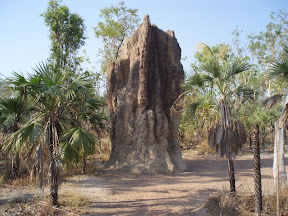
We first visited Litchfield National Park. Our first stop was at the magnetic termite mounds. They look like a big field of giant tombstones, because they are wide and flat and aligned north-south. There are also two huge ones in a field nearby.


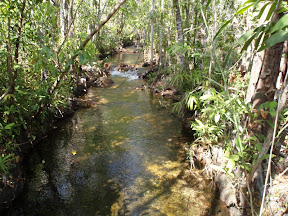
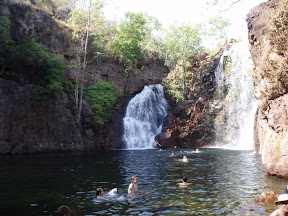
Our next stop was Florence Falls, where we had a pretty walk through the forest beside a small creek and arrived at the falls.


Here, you can swim, and we all got in because it was so hot we were glad to cool down.


The rocks were slippery and it was hard to get in, but worth it. The water was wonderful, and there were some big black fish who swam up and muzzled against us to see what we were. Paul put on goggles to look at the fish, and make up for no snorkelling on the Barrier Reef. I would happily have stayed all day, but after some time, we needed to get out and leave. We didn't bother taking off the swimsuits because another swimming place was coming

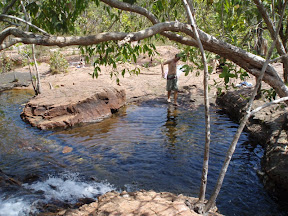
The next stop was not far, at a place called Buley Rockholes. Here, the water originates from freshwater springs and flows towards Florence Falls. The holes were smaller and most of us just sat in the water.


There were a few small fish in my pool which nibbled me gently, and something like a crayfish which I sat on by mistake and it bit my backside! Paul jumped into a much deeper hole, but said it had no fish.

After a brief half hour, we were back in the vehicle and off for lunch, then it was a long drive for our next stop. Unfortunately, the 4WD vehicle we are using has a number of problems, the engine runs very hot indeed and the air-conditioning doesn't work. The floor where I was sitting got so hot I couldn't bear to leave my feet on the floor. It was a really uncomfortable and exhaustingly hot journey.

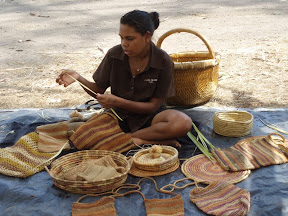
Our next stop was at a place where we were to get some instruction in Aboriginal life. We had to be welcomed with 'head water' - we were in danger because we were strangers in the land. So those to whom the land belonged had to spit water from their land over our heads. The girl who explained this to us took water from the billabong, and spat it on each of our heads in turn. It was quite cooling! We had a dreamtime story, a demonstration of didgeridoo making and playing, and a demonstration of making the baskets and dilly bags.


Then it was back into the stupidly hot bus for another long drive.

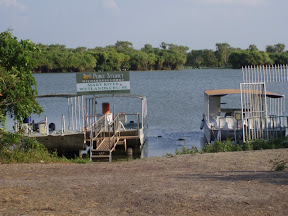
I was extremely glad when we reached our last stop, which was near the Mary River, where we were to have a sunset cruise on Rockhole Billabong, on a fairly flat-bottomed boat.


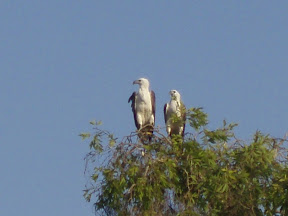
We were really looking for crocodiles, but we saw a lot of other wildlife as well. We saw a lot of birds; there were two White-chested Sea Eagles sitting in a tree.


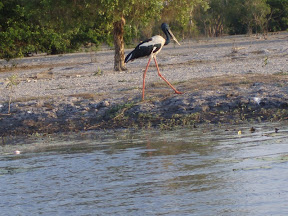
We saw a lot of heron and egrets, and things which looked like cormorants but were actually called snake-necked birds. We saw a wild cat, but were too slow to photograph it. We saw brolgas in the distance, too far away to photograph, and we saw two weird stork-like birds called jabaru.


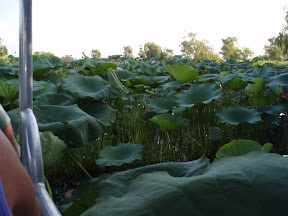
And we did see lots of crocodiles; most were freshwater ones and fairly small. But we finally saw a big 5 metre long salt-water one, though he was so intimidated by our boat that he slid into the water and disappeared quickly. We were intrigued by the lilies which grew everywhere, with huge round leaves shaped like a coolie hat.


The leaves could in fact be used as a hat, and as they repelled water, they could also be used for carrying water. They could also be used to wrap food for cooking. The seeds were also edible, so we tried them, they were quite nice.

We watched the beautiful sunset over the billabong, then we got back into the hot vehicle again and drove to our camp site, where we are sleeping in a proper bed, but in a tent. There were lots of wallabies hopping around the camp site.

Saturday, 17 September 2011

Still more Darwin

Saturday 17th September

Today we decided to take the opportunity of having a further look at things we had only visited briefly on yesterday's tour.

First stop was the historic houses. The four remaining, all built in the 1930s, are good examples of colonial architecture felt to be suitable for the tropics. The houses were built on piles, and provided shady space underneath.

One of them, the one open to the public, had some downstairs living space, but surrounded by a shaded area under the upper floor, so that much of the living space was outside in the shade of the upper floor so as to be cool.

The upstairs was an open space divided by partitions which extended neither to the floors nor the ceilings. The walls were louvered so there was a constant breeze through the house, and the flow of air was not impeded because there were no walls upstairs, just partitions with space above and below. This area was a cool space for sleeping

or sometimes just for sitting.

We had missed the bus to the houses, and as it was only a 20 minute walk and the next bus wasn't for half an hour, we had walked to the houses. We were quite hot when we got there, and of course there was no air conditioning, only fans, so we had the opportunity of assessing how good the house design was at cooling people who were already very hot. The answer, not surprisingly, was that it wasn't as efficient as air conditioning.

The very kind National Trust volunteer who showed us the house also showed us a more pleasant walk to the Museum and Art Gallery, another 20 - 30 minute walk away. It was an interesting walk though, alongside the beach, and relatively shady. However, I was very hot and thirsty when I arrived, so first stop was the Museum Cafe for lunch. Then we went to have a further look at the museum. There was a lot of local art, which was interesting to read about, but no photography allowed.

There was also a most interesting display on cyclone Tracy. Somehow I had not previously taken on board the extent of the destruction - 95% of the town was destroyed - nor had I previously realised that the majority of the residents were evacuated and almost the entire place bulldozed. The houses we had just visited had needed extensive reconstruction and one was in such a bad state it was just demolished.

After the Museum, I felt a 40 - 50 minute walk back to town in the heat would be too much, so we walked to the main road and caught a bus back.

We took the opportunity of going to have a further look at some of the historic buildings in the town centre. Brown's Mart was originally built as a warehouse in the 1880s, and had since served many purposes. It was damaged by cyclone Tracy, but has been restored and is used as a community theatre venue.

The original Christ Church Cathedral, built in a similar style, was almost totally destroyed by Tracy, and the new design incorporates the only remaining part, the entrance porch. The Old Town Hall, originally built in 1883, was completely destroyed by Tracy, and only the ruined walls are left standing as a reminder.

We went round to the Chinese Temple and Museum, all that is really left of the old Chinatown. Although the temple was open, the Museum was closed, and the temple is modern, having been rebuilt 3 times after cyclones, so we did not go in.

We are being picked up at 6.30 tomorrow morning, and before that we have some suitcase reorganisation to do, since we are only allowed 10 kilos for the next couple of days. Our main luggage has to be left in Darwin until our return from the Kakadu.

I am not certain how regularly I can post things from now on. We are doing some camping, and I am uncertain about wireless connections, and Vodaphone connections for this iPad may not be too reliable either. Also I'm not sure if I can keep everything charged - I may even have to make notes on a bit of paper if I can't charge the iPad!

Friday, 16 September 2011

More Darwin

Friday 16th September

We seem to have done quite a few things today. Paul had heard that there was a wave pool in the harbour, so he was determined to have a go. The walk there was very pleasant, as the whole harbour area has recently been rebuilt in the last two or three years, and various bridges and a lift take you down to the waterside. On the way there, we passed one or two of the historic buildings, particularly the ruin of the old Town Hall, which was destroyed in 1974 by cyclone Tracy. There is some public art on display, I liked this one of an ancestral spirit who takes the form of a bird.

We had some superb views of the harbour on the way down. There is one bit, called the lagoon, which is cordoned off for swimming and looked very inviting.

It was later explained to us that Darwinians do not swim in the sea, for fear of crocodiles and box jellyfish, so there have to be plenty of alternatives, and the lagoon is one and the wave pool is another.

We went into the wave pool, but I didn't stay long, I found the waves were huge and constantly knocked me off my feet. Paul enjoyed it very much, I wished I was like all the other women and most of the children and had thought to take a big inflatable. I ended up sitting in the children's pool to keep cool while Paul played in the huge waves. We couldn't stay for hours anyway, as we had booked a city tour, and had to walk back to the city centre for that. On the way, we stopped to lunch on the ubiquitous pie. Paul is becoming addicted to the pies - but possibly because we have yet to eat an acceptable sandwich here. They all seem to be made with very dreadful white sliced bread which has neither taste nor texture.

The city tour was interesting, taking us quite far afield to places we had not thought of visiting. We went onto one of the wharves and found ourselves staring at an enormous cruise ship. We passed Government House and paused for photographs.

We spent an hour in the Museum and Art Gallery, and Paul wants to go back because there is much more to see.

We drove up past Mindil Beach, where we were last night for the night Market, past Fannie Bay, (pausing only to admire the jail) and on to East Point. This is an area set aside for leisure. There is an artificial salt water lake, Lake Alexander, in which people can swim, fish, etc. The sea water is filtered to remove any crocodiles or jellyfish, so it is safe to go into the water.

From the point, we had some beautiful views back over Darwin.

Our next visit was to the Botanical Gardens. We saw an interesting old building, pre-1900, which was the oldest church in Darwin, and was originally the Wesleyan Methodist Chapel. It was in constant use until well after the war, but fell into disrepair and was relocated here in 2000.

The Botanic Gardens are beautiful, with lovely pools and fountains

as well as many unfamiliar plants and trees.

The frangipani weren't properly in flower, but I photographed them anyway, I haven't seen any frangipani since I left Kenya 50 years ago. Paul was delighted to see pineapple and pawpaw growing, he's only ever seen them on shelves in shops before.

We drove round Cullen Bay, admiring the marina and the houses of the wealthy, then we looked at some historic houses (1930's!) designed specifically to suit the climate. One is run by the National Trust, so I would like to go and see it tomorrow, if time permits.

Thursday, 15 September 2011

Darwin

Thursday 15th September

Darwin is a very hot place, though at present it is a very dry heat. We have spent our time dodging from one patch of shade to the next.

Not having yet been threatened by a crocodile, Paul was filled by the urge to see one, so we decided to go to something that described itself as a crocodile park and zoo. As it is some way outside Darwin, we went on the bus.

I must say buses in Darwin are wonderful. $2 is sufficient to allow you to ride any number of bus anywhere for 3 hours - you can change bus as many times as you like within the three hours. And they seem to run exactly to time. Interestingly enough, those we have used have not been at all full, and other passengers have mostly been schoolchildren, pensioners and Aboriginal people. I suppose it is likely that most people in Darwin have cars - certainly there are an awful lot of car showrooms in the city, for both new and second hand cars.

We were interested in the trip out of the city, as it soon became clear how dry the countryside was. What grass we could see was short and bleached to a sort of beige colour. In many places though, there was just bare red earth and the occasional tree.

The crocodile park was, in fact, a crocodile farm, and I am far from certain I would have gone had I known that beforehand. Many of the crocodiles we saw were destined to become handbags, and their meat is sold as steaks, sausages or burgers.

However, the guide who took us round said that crocodile farms were ensuring the survival of crocodiles, since they were not now suffering from poaching. There was no need for handbag makers to buy poached skins when they could buy farmed ones so cheaply. Moreover, farmers now welcomed crocodiles on their land, since they were paid $100 for each crocodile egg - and the eggs were collected by the crocodile farmers, not the landowners. The result of this was that crocodiles were no longer endangered - their numbers, which had dropped to as few as 5000 during the 1970s, were now in the hundreds of thousands.

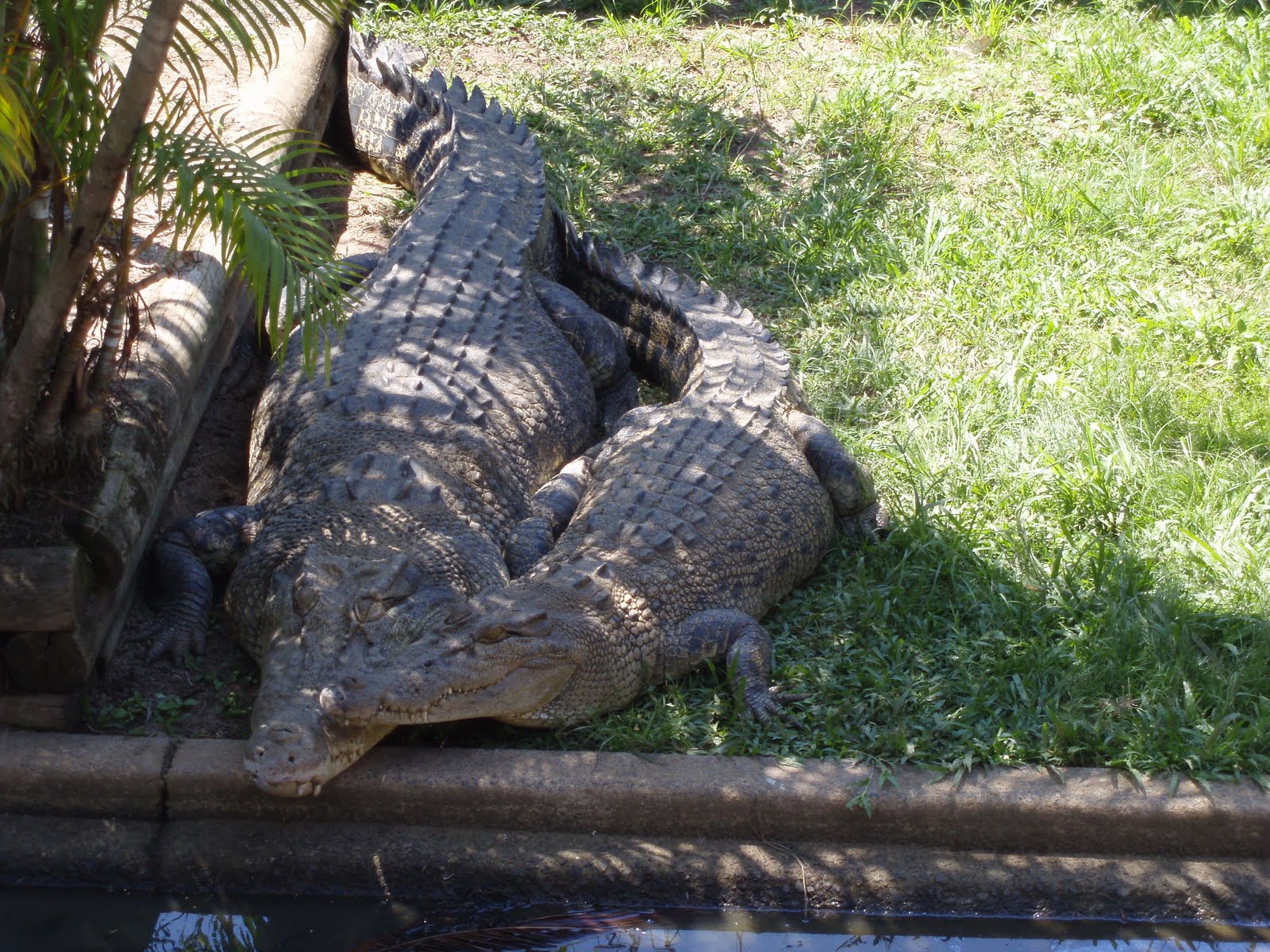
The farmed crocodiles were grown up to about 2 metres (around 5 years old) and then killed for the skins, which were sent away to be tanned. However, we also saw some of the biggest crocodiles I have ever seen in my life - some must have been nearly 20 feet long.

These were mostly ones which had been removed from Darwin harbour, and were part of the captive breeding programme. They were paired with a female, and the eggs were taken and put in an incubator so that all would hatch safely. Some looked quite content.

However, there was one miserable enormous one with his jaws wired shut because he had bitten his wife. They were waiting to see if he continued to attack her, or if he had learned that domestic violence did not pay. If he continued to attack her, he might be given a bigger, stronger wife in the hopes she would bite him back.

We also saw the smaller (2 meters) crocodiles jump out of the water to catch some meat. It certainly cures you of any desire to go near the water!

At the end of the tour,  we all had the chance to hold a baby crocodile. I found it quite sweet, it was warm with a very soft skin, and it listened to me most carefully when I spoke kindly to it. Of course, it might not have listened so carefully had its jaws not been taped shut!

We had a brief look at some of the other animals in the zoo part. I photographed some rather depressed looking turtles, who swam around us, obviously hoping we would do something interesting.

I don't think I've ever been so close to ostriches. I only managed a photo of Mrs. Ostrich, who I was hoping wouldn't peck me - she was much taller than her fence. I failed to photograph Mr Ostrich, who was seeing off some Japanese tourists, and I found it too hot in the sun to wait for him to come back.

The emu was having a dust bath, and the cassowary just looked cross. The male dingo was pacing nervously, and the red kangaroo came to see if we had anything to give him, and appeared disappointed that we had not.

The monkeys were in cages with very thick bars, and we felt they would have been happier in the freedom of Singapore Zoo. The ocelot was curled up asleep behind a tree, and the lions had found a place in the shade at the back of their cage to sleep. The tiger had, apparently, been removed.

We had a brief lunch and a look at the crocodile museum, then caught the bus back and spent some time cooling off in our air-conditioned room.

In the evening, we headed off to the night market and ate our supper at one of the stalls there.

Wednesday, 14 September 2011

Cairns to Darwin

Wednesday 14th September

There is really nothing much to say about today, and no pictures, as so much of it was spent in airports and planes. 

We arrived at our hotel in Darwin around 4, and spent some time reading the brochures to decide where to go. It seems there is a lot to see, and we have to try to avoid seeing things we are going to see anyway on our next tour, which starts on Sunday at some ungodly hour - before 6, I think.

It is certainly hot in Darwin, though I am told it is cooler than some other places as the sea breezes cool it.