Tuesday, 28 April 2015

December 2014

Dear me, I've never left it this long without writing anything here, people will be thinking I have succumbed to one of the many illnesses of which I constantly seem to complain, but it isn't that, it's just that life has just been too demanding for too long.

December was a very busy month. In between more visits to Doctors and hospitals, we fitted in visits to babysit my younger grandson when his mother was unwell, visits to take my sister shopping as she can't walk easily at the moment due to a hip problem, visits to the development where I am a Director to to do some admin work up there, and my own Christmas shopping. As you can see, there was a LOT of Christmas shopping!


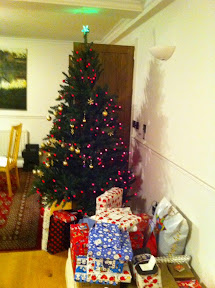
Everybody came to me for Christmas, the first contingent (my sister) arriving on Friday 19th, followed by my older grandson and his mother on the 20th. My son came a few days later. I noticed that most other people's Christmas trees were far more elegant than mine; my excuse is that my grandson was almost solely responsible for the decoration, which I hope will explain some of the gaps!

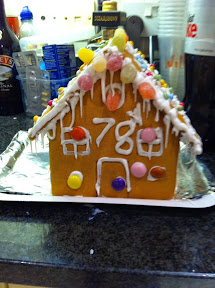
My grandson, like his father, really does enjoy making things - various of us helped him put together a gingerbread house.


I'm afraid it didn't last very long!

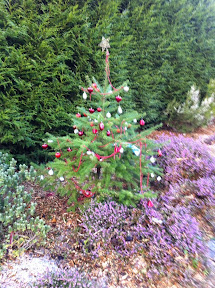
In the garden outside, somebody even decorated a little Christmas tree which is growing near the garages. The heather was clearly impressed, so it flowered and that part of the garden looked quite colourful.


We were planning to be 9 on the night of Christmas Eve, as my older son and his wife and son were due to arrive then, but illness prevented that, which was a real shame.

All our guests left on Sunday 28th, and on the 30th, after a mountain of laundry, we drove up to Manchester where I have rented a flat for 6 months. It's a two bedroomed flat (to allow for visitors) in the same road as the church where we stayed last time but a couple of blocks south. It's about a 15 minute walk from my son's house. I wasn't really looking forward to being in Manchester, previous experience being that it's cold and dark and it rains a lot!

- Posted using BlogPress from my iPad

Friday, 19 December 2014

October - November

Chaos begins

Once we were back from holiday, I had 5 days to do my post-holiday washing and ironing, and cram in a haircut, a visit to a gasrto-intestinal consultant, and an have an Endoscopy, before my family came to stay.

When I went up to London, I took the opportunity of of visiting the display of poppies at the Tower of London. They were certainly spectacular, just a sea of red. And of course, they weren't all there yet. It's quite mind-boggling to think of that many people being killed.


I've never seen so many people around the Tower, so taking photos was a longish process, involving queueing to get near enough to see anything at all. Mind you, I believe it got worse in November, and people were being asked not to come.

The day after my endoscopy, my sister, my daughter-in-law and my grandson arrived to stay. My sister was only able to stay three days, and left the morning my daughter-in-law's mother arrived from France. (There had to be some pretty swift sheet-changing.) Apart from the day when she arrived and the rain poured down, the weather was pretty good and she was impressed with the beautiful autumn colours in southern England.


This was taken in our garden, just as the leaves were starting to fall in the last few days of October.

Unfortunately, there wasn't much time for sightseeing with them all as my grandson became ill with a respiratory tract infection, and eventually we had to take him to my doctor to get an antibiotic. We had to change their train ticket back to Manchester as the poor little soul was too ill to travel. My daughter-in-law's mother left after five days to go back to France, and fortunately for us, she didn't develop the illness she caught from our grandson until she got home, when the poor woman was quite ill.

Three or four days after she left, my grandson was well enough to go home, and the following day I was back at the hospital for a long and comprehensive breathing test. The day after that, I got the respiratory illness my grandson had kindly passed on to me, and was ill for some time. Life went on around me as I languished in bed, and eventually I too had to visit the doctor for antibiotics.

On the day I got out of bed again, I thought I should get some air, though the weather was rather damp. So we had a rather muddy walk in Emmets Garden, where there was a wonderful display of autumn colours.


The day after that, we were off to Manchester again. My son and daughter-in-law are due to have a second child, and I am going to spend some time in Manchester to support them. So I spent nearly a week up there, trying to find myself a place to stay. I want to be close to them, but it don't want to stay in their house, which never works well for very long. Anyway, I selfishly don't want too many disturbed nights - I'm not too good if I don't get my sleep.

At the end of November, we came back home again because I had yet another hospital appointment on December 1st. I'm convinced myself that it's acid stomach juices from my constant reflux getting into my lungs which are damaging them and causing my breathing problems, but it seems to take several specialists and umpteen different tests to prove or disprove this.

- Posted using BlogPress from my iPad

Thursday, 18 December 2014

End of the holiday

Saturday October 18th
Because the last day of our holiday was a day of 6 trains, I resisted writing about it, leading somebody to ask me if I had, in fact, ever come back. So, yes, I did come back from holiday but it has taken me a couple of months to steel myself to write about it - I suppose it depends on how much you enjoy train travel, but I did not find 16 hours spent in trains was all that enjoyable!

We left Kanderstag at about 8am - not the best time for photos - but I did take a last few snaps as we walked the short distance to the station to remind me of the place.

The town is in an almost circular bowl and mountains which surround it are high, as you can see.


I imagine the place is often dark like this because it is completely surrounded by high mountains and the sun only reaches into the valley floor later in the day.

You can see the sun effect in my photo of the station.


The sun is striking the mountain tops, but it'll be a while until it shines into the valley. Although it's a pretty village, I think I might find it quite depressing to stay for any length of time, with louring peaks on all sides and only a few hours of sunlight around midday, when the sun is directly overhead.

Train number one took us to Brig, where we caught train number two to Geneva. From Geneva, train number three took us to Paris.

It was evening by the time we reached Paris, where a coach took us through unbelievably awful traffic (Paris needs a congestion charge!) from Gare de Lyon to Gare du Nord. After a short time in the very shabby Eurostar terminal, we caught train number four to London. In St Pancras we said goodbye to the rest of our group and went to the other end of the station to catch train number five, a Thameslink train to East Croydon. Train number six took us to Oxted, from where we caught a taxi home, arriving around midnight; I was too exhausted to unpack anything, and we just fell into bed.

- Posted using BlogPress from my iPad

Friday, 17 October 2014

Swiss Holiday 7 - Bern

Friday October 17th
Today was a free day, but it was rather cold and miserable in Kandersteg in the morning, while the weather forecast for Bern was good. Also, Bern sounded like an interesting town, so Paul and I caught a train there. It took just over an hour, starting high above the valley but soon descending to the valley floor and passing through more and more little towns on the outskirts of Bern.

Once there, we quickly found the tourist office and hired two iPods with a tour of Bern, which is a historic city full of interesting buildings.

One of the first stops on the tour was the Bagpiper fountain.
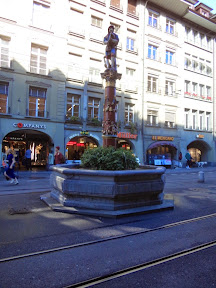


This was the first of about 15 city fountains, all from the 1500s. The city was well supplied with public fountains from the Middle Ages, and they still flow today with water you can drink. We didn't, but later in the tour we passed some workmen who were drinking from one and also washing their faces. The bagpiper fountain showed a rather ragged musician playing the bagpipes, musicians being very popular in the Middle Ages, but not well paid!

The next stop on the tour was the Prison Tower.
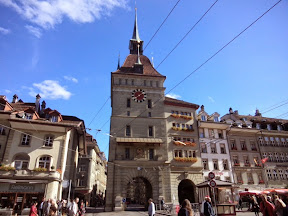

This was actually one of the original gates of the city, and it had been decided to use the upper storeys as a prison. There are still bars on the windows under the clock.

The trams going away from you in this photo pass through this gate. The trams coming towards you pass to the left of the gate.

A little further down the street is the Dutch Tower. This was originally used for secret smoking!


Apparently, the use of tobacco was forbidden in 17th century Bern - which seems to me an excellent idea! Dutch merchants who wanted to smoke tobacco they had imported came to the upper room in this tower to smoke it in secret.

The imposing baroque building below is the Swiss Parliament building.
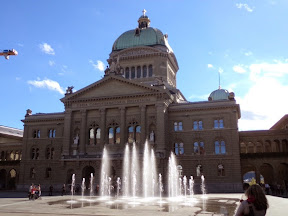

In the summer months when it is hot, the fountains are apparently very popular. It was pretty hot today, we were both in short sleeved shirts, but didn't quite feel inclined to run into the jets of water. Mind you, neither did anybody else!

Our walk took us to the Kirchenfeld bridge where we looked down on a very old part of Bern, called the Mattequartier, medieval Bern's smallest neighbourhood. Workshops and mercantile activity filled this area, and medieval sources tell of numerous complaints about the ceaseless and apparently nerve-wracking noise of machinery, carts and commerce. There were three city-owned watermills built in 1360.
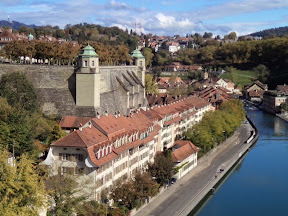

This was also the area where the city bath houses used to be, and consequently it attracted prostitutes. Apparently, Casanova visited here!

The Town Clock just a short distance away is absolutely amazing!
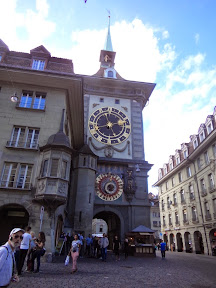

On the very top is a golden man who strikes a bell for the hour. Under him is the big clock, with a pointing hand for the hours and an arrow for the minutes. Under that are 5 panels of Roman Gods for 5 days of the week - Tuesday to Saturday. Sunday and Monday are represented by the sun and moon on the astrological clock just above the arch. They're probably too small to see in my photo, but the moon is half black and half gold and turns to show the different phases. Also too small to see are the moving figures on the right of the astrological clock. There's a golden rooster which crows for the hours, various figures which come out, and above them is the figure of Chronos who turns the hourglass for the number of hours. It's quite a performance!

We went on to the cathedral, which is undergoing restoration so parts of it were swathed in plastic sheeting - hence there's no overall photograph. However, we were able to see the wonderful carving over the main door.
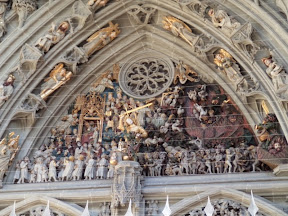


It shows the Last Judgement; the big gold figure with the sword is St Michael, and he's overcoming a kind of nasty grey coloured Satan, who has one foot on a set of scales. Behind them, the saved are on the left, in lovely white garments. And on the left are the damned, all naked and suffering torments; for instance, you won't be able to see it in my photo, but a man on the right is being nipped with big gold pincers in a very painful place, a punishment for the sin of lust!

Opposite the cathedral is the Moses fountain. Moses, with a long beard, is holding the tablet of the Ten Commandments and pointing to the second commandment, the one about not making any graven images; this is a Protestant cathedral. However, the carvings over the door were not destroyed, even though they are also graven images. The guide said it was thought necessary to remind people not to sin; I wonder if it was really an artistic rather than a religious decision, but at least the wonderful carvings weren't destroyed.

We went along a little narrow alleyway nearby to see the Spysi, a charitable institution set up by the burghers of Bern in the Middle Ages to provide low cost meals for those in want during the colder months. It is still open, and apparently popular with workmen and elderly people.

Right next door to it is what remains of a medieval lavatory, so, as I haven't recently been following my usual procedure of photographing historic bathrooms for quite a while, I thought I'd photograph this one!
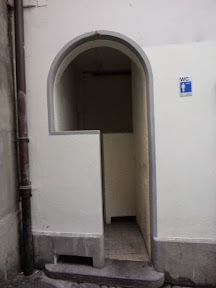


It is set directly over a medieval sewer, now covered over with dark grey paving slabs. There is a gap in the houses opposite, as you don't build over an open sewer. Also on one of the houses opposite is a tiny room on the second floor which overhangs the sewer. This was also another lavatory, obviously with direct sewer access!

We walked across the Nydegg bridge over the river Aar, which is only a few hundred years old but overlooks the first bridge that was originally built a few years after Berne was founded in the 12th century.
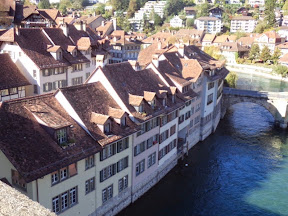


It was originally wooden, and was re-built in stone in the 15th century. Before there were any bridges, the only way into the city from that side was by boat; the gap you can see in the houses was the original landing stage for the boats.

We crossed right over the bridge and went to have a look at the bear pits. Bears are the symbol of Bern, and the city has always kept bears. The bear pits no longer felt to be a suitable environment for bears, so they aren't used today; today's bears have a much nicer and larger enclosure beside the river, with trees for shade and their own long swimming pool which is almost like a canal parallel to the river.
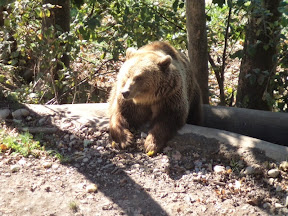


Both bears were looking a bit hot as it was a very hot afternoon by then, and they were sitting panting in the shade.

There was a lot more to the tour, we were walking around for more almost three and a half hours, but I've probably written too much already and there are certainly too many photos.

However, I have to say something about the shopping arcades. Originally, the streets were wider and the traders set up stalls to sell their goods in front of the houses. Then roofs were wanted to shelter the stalls, so the houses began to be built with an overhang, so forming an arcade. This is the case throughout the old town and means shoppers are out of both sun and rain as they window shop.


I certainly found it pleasantly shady and cool to be out of the sun, and the pavement is nice and smooth - the streets are mostly cobbled so I found them a bit hard on my ankles after a while.

There are all the usual high street shops - including C & A! Britain must be the only place where we no longer have one of those, we saw them in Germany too.

Something else we don't have in Britain is anything like this beautiful delicatessen.
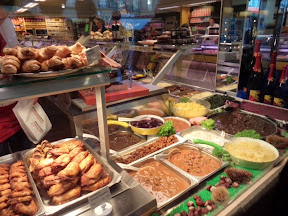


If I hadn't been so tired by then, I'd have gone in and bought something, but my feet were getting very sore and quite swollen so we made our way back to the tourist office to return our iPod tour guides, and were back on the platform 10 minutes before our train.

Our return journey had one big difference; the low clouds had lifted, and we saw a wall of white mountains in the distance.
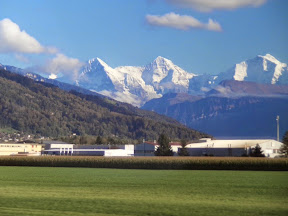


These are three peaks you can see from Bern on a clear day. They are the Eiger, Mönch and Jungfrau mountains, I believe in that order, starting from the left.

- Posted using BlogPress from my iPad
Thursday, 16 October 2014

Swiss Holiday 6

Thursday October 16th
Today we travelled from Kandersteg to Zermatt via Brig. Kandersteg is a very pretty little place, about 25 minutes by train from Brig, which is a main terminus. So we have to travel to Brig before going anywhere else. 

There is a huge tunnel through the mountains to get out of Kandersteg, which sits in an almost circular bowl surrounded by high peaks. It takes 7 or 8 minutes to get through the tunnel, then you are high above the U- shaped valley, looking down at untidy little settlements in the valley below. The train continues along the side of the long valley, gradually descending to the valley floor, and soon you are in Brig. 

The departure platform for Zermatt is on the main street of the Brig, with big hotels overlooking the line. 


We caught the train to Zermatt, with a rack and pinion engine at the front, because some of the slopes the train tackled were very steep indeed. 

We travelled for over an hour, at times ascending or descending very steeply, and sometimes traversing very narrow canyons.


This was one of the narrow canyons, with the river flowing along the bottom.
At other times we were high up the side of the mountain, sometimes looking down on villages far below. Some of the villages were also quite high up the mountain.


This one had a rather fascinating tower.

I took the opportunity of photographing the bit of the rack and pinion system that you can see. This shows the centre rail quite clearly.


The are cog wheels under the engine and under the carriages, and these can be made to engage with the centre rail, preventing the train from sliding backwards on steep ascents - or sliding forwards on steep descents. It is engaged as required, but you usually know when it's engaged because the clanking noise starts, and then the train starts travelling up or down an unusually steep slope.

As we approached Zermatt, we got a vague view of the Matterhorn, but it was very misty so we knew we wouldn't get a clear view and might be lucky to see anything at all. Once we had arrived in Zermatt, we got tickets up the Gornegrat, a mountain just opposite the Matterhorn. This is a rack and pinion railway, and rises to a height of just over 3000 metres.

We were soon climbing up the mountainside and looking down on Zermatt.


The train ascends very steeply indeed in places, in fact it sometimes feels more like a funicular railway.

As we climbed higher, we could barely see the valleys below.


The journey takes about 40 minutes. Well before the end you are above the tree line and in the bare alpine meadows.


This shows part of the route of the train up the hillside. Towards the foot of the photo, you can see the walking path. Some people choose to go up on the railway and walk down; in the train from Brig, we met a Swiss man who was travelling up with his mountain bike, intending to bike down. It is very steep in places though, so I wouldn't care to try it.

Eventually I managed to get a view of sorts of the Matterhorn, when the clouds thinned for a short time.


This wasn't a particularly close view, but for most of our time up the mountain, we could see very little as the clouds were so thick.

At the top, we had a very good view of all the glaciers.


This was the longest glacier, clearly flowing down the mountain, a river of ice.

It was bitterly cold at 3000 metres, and there was snow and ice on the ground. There is a very smart hotel at the summit, as well as a shopping mall, a restaurant and a self-service café, so we were able to warm up and have something to eat after viewing the bare rocky peaks, the ice and snow and all the glaciers flowing down from the peaks opposite.

After lunch, we found more of the mist had closed in and we didn't have such good views as we had enjoyed before.

Once down in Zermatt, we had time for a quick wander through the town. Zermatt is far smaller than I had previously thought, and has some delightfully old fashioned looking buildings.


By 3.30, it was time to catch the train back to Brig, and then our connection to Kanderstag.

- Posted using BlogPress from my iPad
Wednesday, 15 October 2014

Swiss Holiday 5 - Glacier Express and on to Kandersteg

Wednesday October 15th
We didn't have to make a very early start today, which gave us a bit more time to recover from yesterday. We had a leisurely breakfast and completed our packing, then made our way to the station, buying our lunch time sandwich before meeting to join the train.

It was another train with panoramic windows right up to the roof, so we had the same problem with reflections when trying to take photographs. I've had to bin two thirds of my photos, which is bit of a shame.

The journey starts with the train entering the Rhine gorge, which is quite narrow, with steep cliffs.


According to the railway guide book, the area was largely inaccessible until the coming of the railway in 1903.

Further up the Rhine, we stopped at a town called Disentis, which is dominated by a huge monastery.


The original church is claimed to date back to the eighth century, and by the eleventh century, it was established as a monastery which had become a well-known stop on the pilgrim route from Germant to Rome. The current monastery and church was built between 1683 and 1695, so it is the oldest Benedictine abbey in Switzerland.

We made a fairly long stop in Dusentis, as the engine has to be changed at this point. After this, the track is very steep and the train uses the rack and pinion system.


You can see it here in my photo, and you are certainly aware of it because the train is suddenly climbing much more steeply than usual and making a clanking sound. I made several attempts to photograph the train to show how steeply we were climbing, but the reflections in the window made it impossible.

At the highest point, Oberalppass, the train has reached over 2000 metres above sea level and the terrain is quite inhospitable.


There are no trees at this altitude, only sparse alpine vegetation and bare and jagged rocks.

You overlook some more fertile valleys far below, and there are snowy peaks in the distance.


As you approach closer to the snowy peaks, you start to see the glaciers.


Eventually, you begin to descend again towards the town of Andermatt.
The descent is very steep indeed, needing the rack and pinion system to be engaged again.


Paul liked the look of Andermatt, he could see evidence of a lot of steep ski trails and he decided he might like to try skiing there.

After Andermatt, the train follows the Rhone valley.
The river water is green here, because it comes direct from the glacier.


The Rhone often floods, apparently, and we could see dams being built for flood control.

Eventually, the train reaches Brig, where we got off. The Glacier Express goes on to Zermatt, but that is the journey we will make tomorrow. We caught a small local train to Kandersteg, where we are staying for three nights.

Kandersteg is a small village which is completely surrounded by mountain peaks. This is the view from the station platform.


You may just be able to see our hotel in this photo, it is just behind the tree on the left with beautiful deep orange coloured autumn leaves. It is called Hotel Victoria, which you may be able to see written on the front of it.

- Posted using BlogPress from my iPad
Tuesday, 14 October 2014

Swiss Holiday 4 - Bernina Express

Tuesday October 14th.
Today we travelled on the Bernina Express, all the way to Poschiavo, returning by way of St Moritz. It really is a masterpiece of engineering, and the combination of this and the landscape around it led to it's being recognised as a UNESCO World Heritage site. However, I am so exhausted from running up and down the train taking photos, I don't think I have the energy to write very much about it, I'm afraid!

After leaving Chur, the train travels through a valley said to contain Europe's highest density of castles. Owing to the morning fog, they were pretty hard to spot!


This looks like something Turner might have painted!

The journey continues through a gorge and into a valley which contains a world famous viaduct, the Landwasser Viaduct. My photos of the viaduct are awful, but this is the view as you go across it.


It isn't the only stunning view of course, and even the roads are masterpieces of engineering.


The railway climbs and climbs, using 55 tunnels and 196 bridges, running along what seems like a shelf of rock most of the way up the mountain, with sheer cliff faces and bare exposed rocks. Far below, you can sometimes see glacial streams.


At the highest point, there are glaciers.


You can probably see in the distance that there is far less vegetation; the train eventually crosses a bare bleak plateau above 2200 metres, before descending towards Poschiavo.


Poschiavo has a great many old Renaissance buildings in the old town.
This tower next to the main church would not look out of place in Italy


There's even a whole row of 'palaces' at one end of the town.

This looks to be the oldest building, with a date around 1460.


As you can see, the streets are cobbled.

We were due to lunch in Poschiavo, but most of the cafés were closed for lunch - restaurants were open, but we only wanted something light like soup or a sandwich, so it was quite hard to find a place.

Just after 1.30 we set off back towards Chur, stopping around 3 in St Moritz. Unfortunately, the station there is being re-built so you are rather trapped inside it, and we were there for too short a time so we weren't able to walk into town.

We arrived back in Chur around 6, having had the opportunity to photograph a few things we missed in the morning, and being able to see more of the scenery, as much of the morning's fog had cleared.

- Posted using BlogPress from my iPad