Thursday, 19 September 2019

Spoleto

Thursday September 19th

After a night of very heavy rain and a lot of thunder, we drove south from Assisi some distance to Spoleto, one of the most important towns in Umbria. There are traces of massive walls very high up the mountain which are probably 4th century BC. The town was recorded as being founded in 241BC and became an important Roman colony. Later in became the seat of a Lombard dukedom and later still, one of the Papal States. Now it showcases an important international arts festival every year.

We began by visiting the church of San Gregorio. It was founded originally in the 4th century, and renovated in the 12th century, incorporating material from various Roman remains. 
The Romanesque interior is still very spare and relatively unadorned.
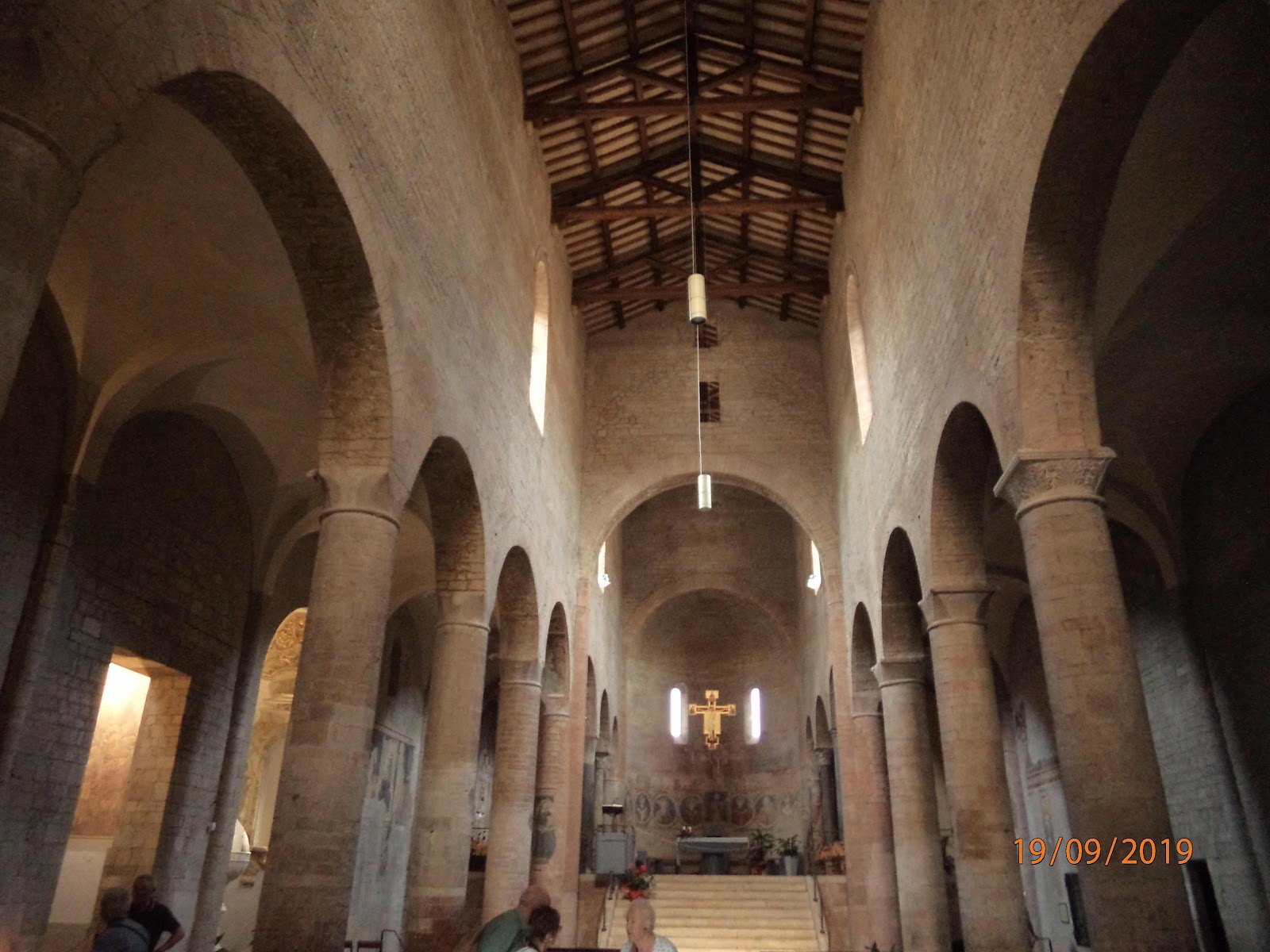

You can possibly see some traces of medieval frescos in the apse below the crucifix. There are further traces of medieval frescos on some of the walls.


We spent some time speculating about the identity of the naked lady lying beneath the Virgin Mary’s feet. Roy thinks it represents Eve, but if so, there don’t seem to be any fig leaves as far as I can see.

We also paid a visit downstairs to the crypt, where a forest of massive pillars supports the building above.

Afterwards, we drove up almost to the fortress built at the highest point of the city, to see what is referred to as the Ponte Della Torri, which isn’t in fact a bridge at all, but an aqueduct built in around 1270 to bring water to the upper parts of the mountain.


Roy told us that it was probable that it was built on Roman foundations, and given the Romans reputation in aqueduct building, that seems highly likely to me.

Swifts swooped and dived above us as we walked. We appreciated the views over the valley, looking the other way from the aqueduct.


The view was so lovely I wanted to stay - but we contented ourselves by spending some time on a terrace overlooking this beautiful view while drinking coffee. Or at least I drank coffee; Paul was still recovering from the very bitter breakfast coffee!

We looked up towards the fortress and admired the massive blocks of the Umbrian walls, underlying the Roman walls, with medieval walls on top. Then we went down the hill to visit the Duomo, built in the 12th century though there are remains of earlier churches beneath it.
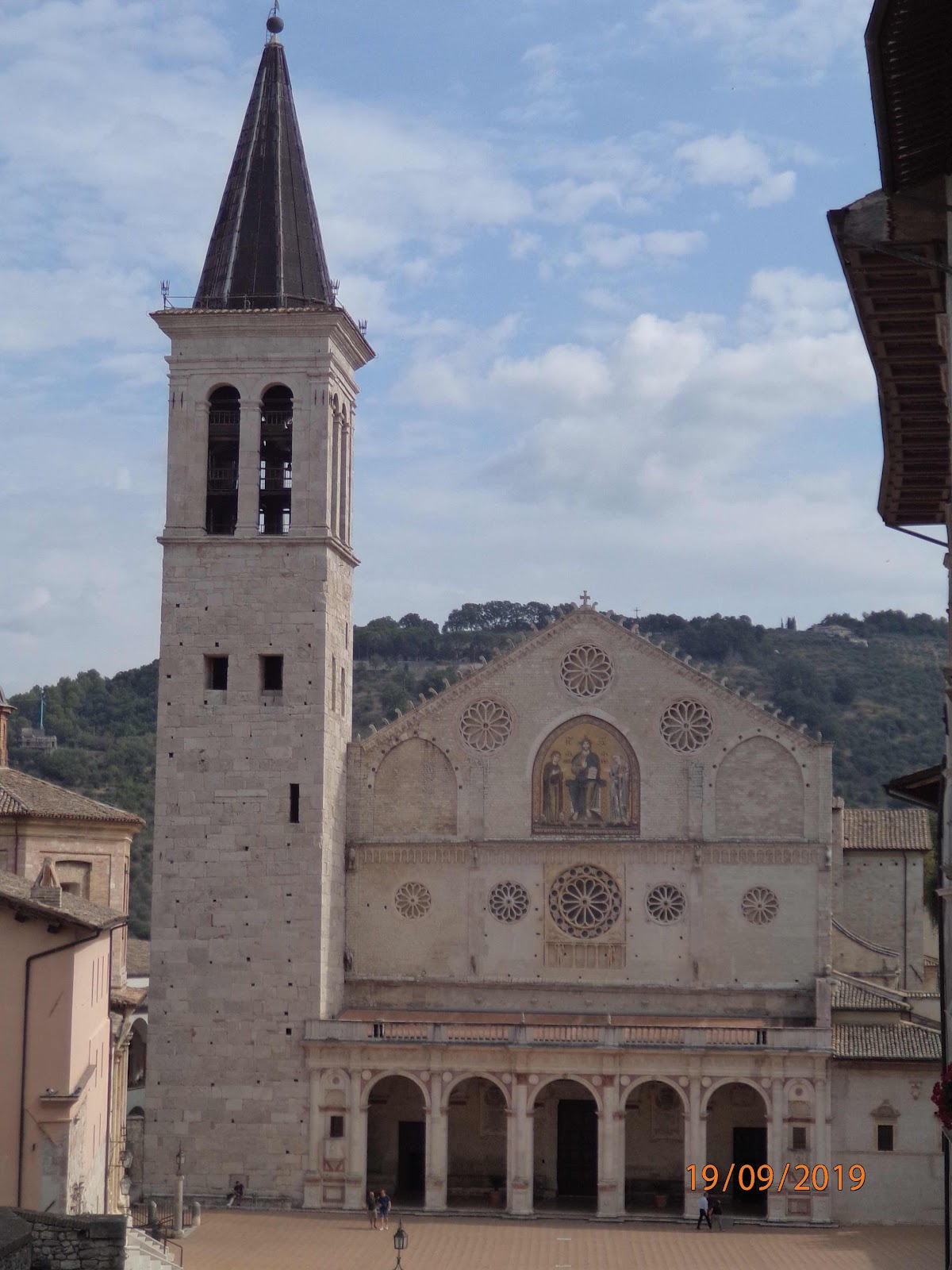

The bell tower is probably also 12th century, but quite a bit of the facade is 13th century. The mosaic dates from 1207, and is framed by the 3 upper rose windows. 

The interior of the church was rebuilt in Baroque style, but fortunately there are still some of the earlier frescos.

This one is by Pinturicchio


It’s in the apse of the chapel of San Leonardo, sometimes called the Eroli chapel. It dates from 1497; above is God the Father with Angels, and under it, Madonna and Child with John the Baptist and Saint Stephen.

I like Pinturicchio, but to my mind this painting pales into insignificance beside the slightly earlier Fra Filippo Lippi cycle of frescos in the apse.


The subject is the life of Mary. On the left one, which my photo shows only a tiny part of, is the Annunciation, in the centre is the Transition of the Virgin, on the right, a Nativity, and above those three, the Coronation of the Virgin. In the centre one Filippo Lippi has painted himself - he’s the man in grey facing you on the right hand side, at the Virgin’s feet. Just  in front of him, the angel in white is his illegitimate son Filipino, who also grew up to be a painter. 

Also in the church is part of Filippo Lippi’s sarcophagus. Apparently, the body was lost during  one of the renovations of the church, so part of the sarcophagus is set into the wall. 

There are some other interesting things in the church. In one of the side chapels is a letter from St Francis written to one of his disciples. There’s also a crucifix by Alberto Sotho, painted on parchment applied to board and dated 1197.

We set off further down the hill for the Diocesan Museum and the church of St Eufemia. The Museum is in a building which has a Roman beginning, 12th century parts and 16th and 17th century additions. It houses works of art from various churches, amongst which I admired this Adoration of the Child.
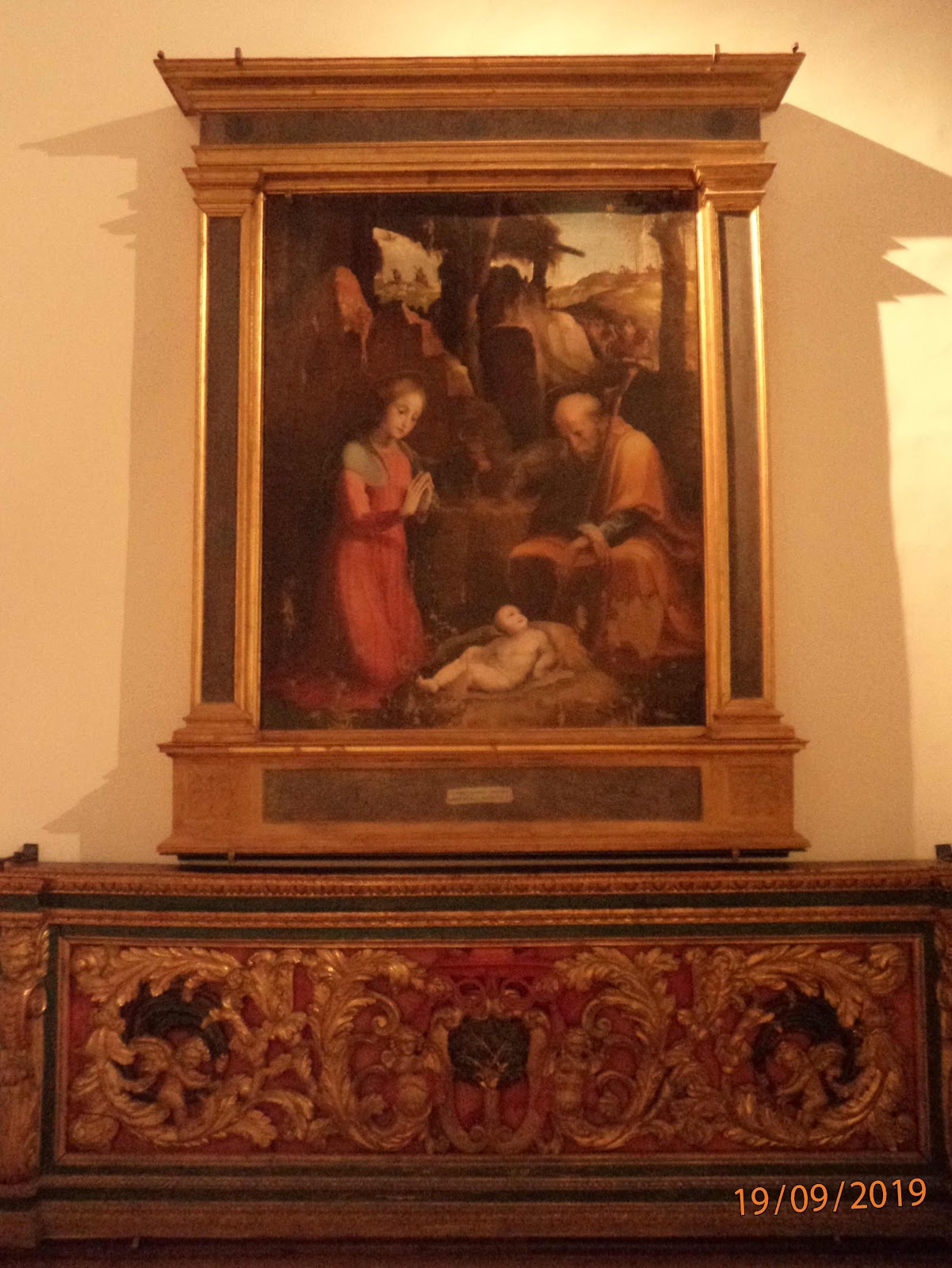


It’s dated to the early 16th century, somewhat later than some of the other paintings I’ve seen, and is by Domenico Beccafumi who came from Siena. These artists were much in demand all over Italy, and their work can be found in many different towns.

There was also another by Filippo Lippi, painted a good 50 years earlier, which I liked very much. However, the work which was really breathtaking was, I though, this wooden group showing the Deposition from the Cross.


There are some information boards in the room which indicate that it is actually made up from 2 or 3 different works, since wood decays over time and parts of several different groups had to be used to get one complete one. Neither artist or date was given but it looks early to me.

We went on into the church of St Eufemia, which is 12th century, Romanesque and quite spare and plain.
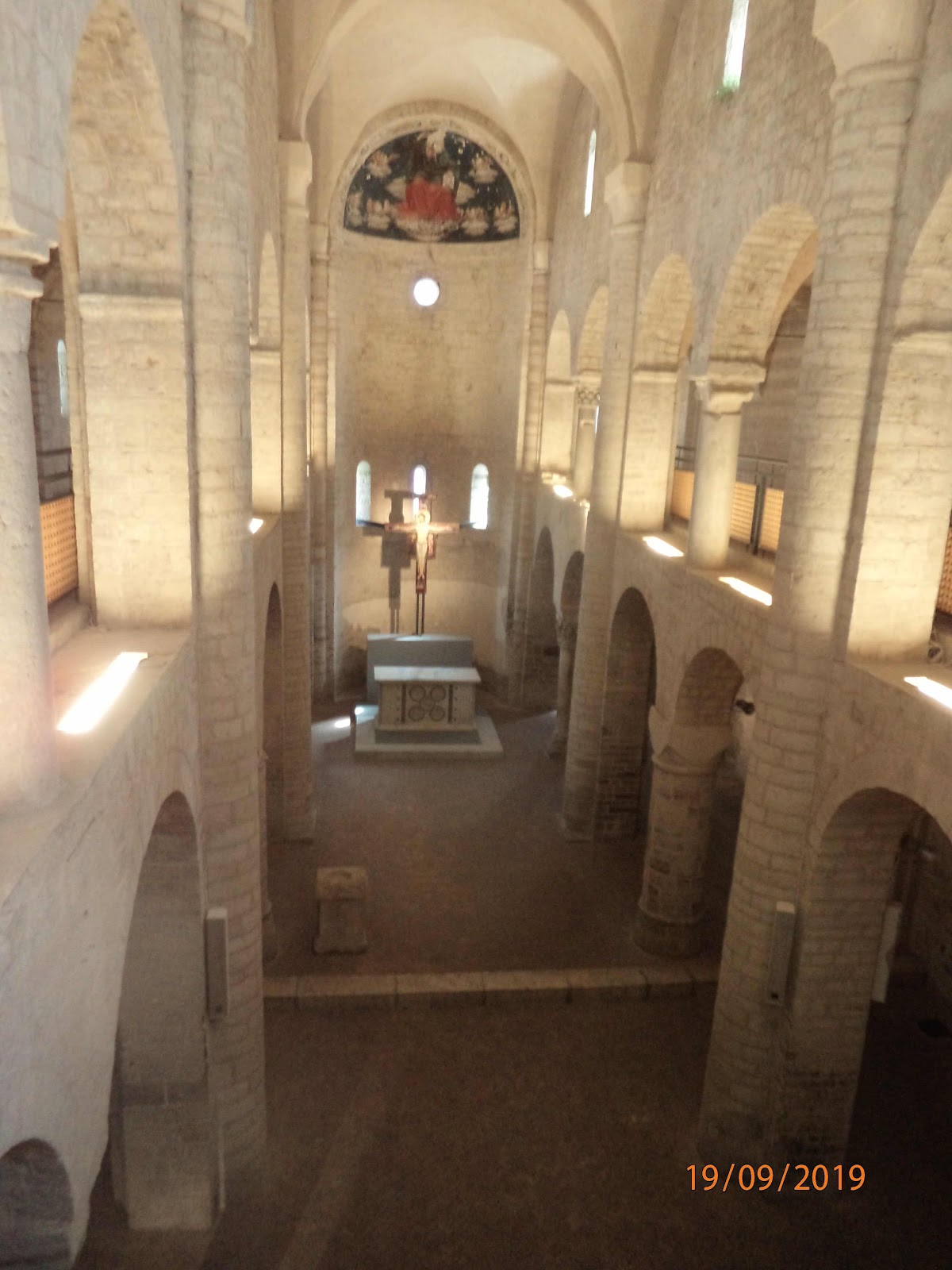

This church is famed for having a very rare women’s gallery, from which this photo is taken. Women did not attend church with the men but had a separate gallery upstairs as they do today in many synagogues. This doesn’t seem to have lasted in western Christian churches, though I’m told you still find it in some Orthodox churches.

Further down the hill, we passed the remains of some medieval shops, though they were closed when we passed.


This design hasn’t changed in 600 or even 800 years. The entrance is narrow as you can see, and the goods can be displayed on the ledges on either side of it. A specially shaped shutter is used to close it at night.

Just below it is a Roman arch, the Arch of Drusus.


There is apparently an inscription still visible, though I didn’t see it, which says it was erected   In 23 AD by the Spoletan senate to honour Drusus and Germanicus, son and adopted son of the emperor Tiberius. 

The arch marked the point where the cardo maximus entered the forum, which is now the Market Square, Piazza del Mercato. At this point some people went off to have lunch, but we only wanted a drink, breakfast having been quite generous. We sat in a cafe at one side of the Piazza adjacent to the Roman Theatre, which we were able to see through gaps in the wall which surrounds this end of the Piazza.


More modern building have come quite close to it, but apparently it is still in use. Roy said he attended a ballet there quite recently. It’s nice to think it’s still being used 2000 years after it was built.

After lunch, we set off for Nera water park, to see the Marmore waterfall, the highest in Italy, where the waters from the river Velino spill over from the uplands of Marmore down into the river Nera. It was certainly spectacular.
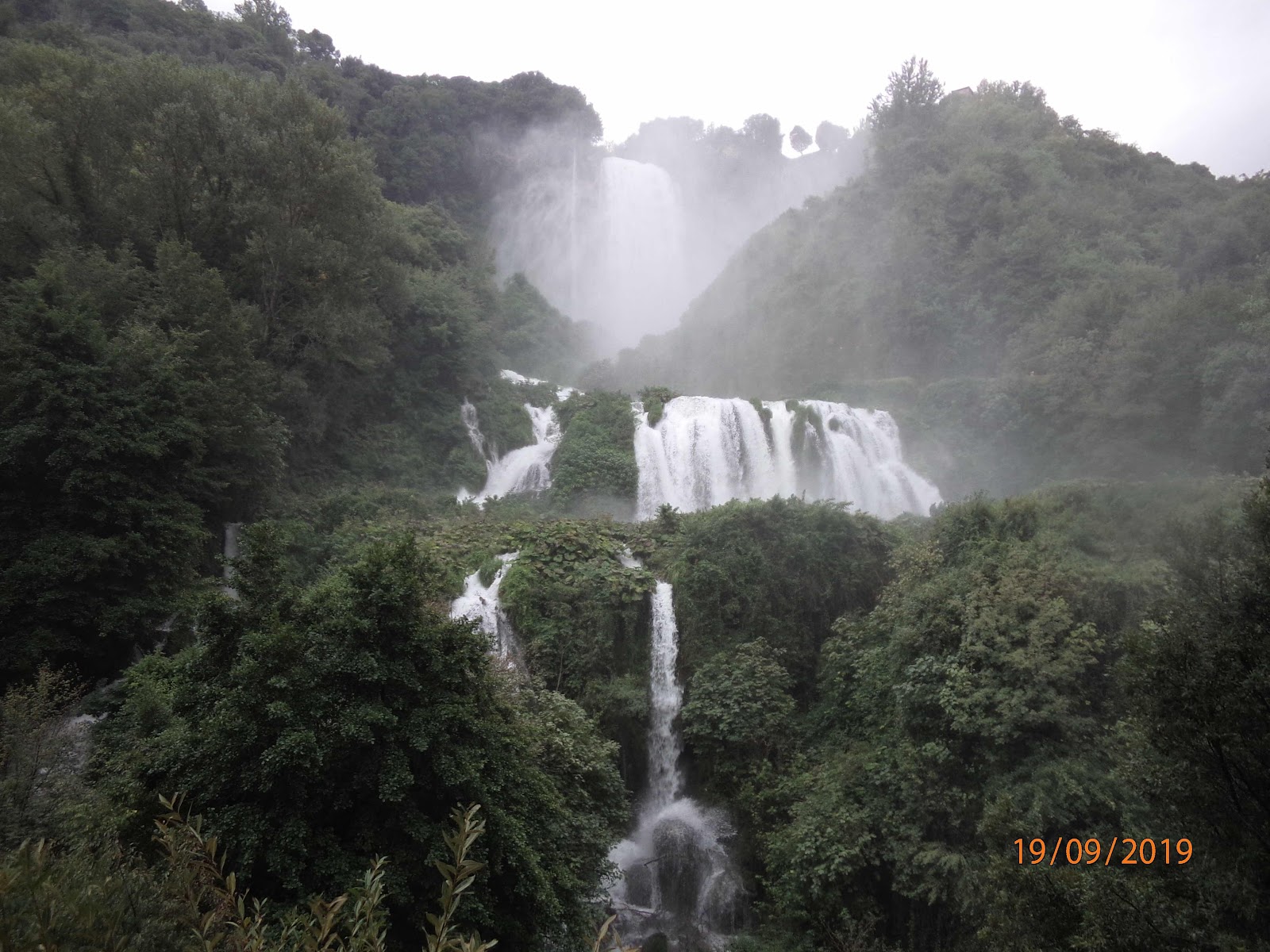

It isn’t, in fact, a natural waterfall. In antiquity, the water from the river Velino stagnated into the marshes of the Rieti plain. It was the Romans, in 271 BC who decided to link the Velino to the river Nera, so as to drain the marshes. The Romans’ system was extended in the 15th and 16th centuries, and later on it was also adapted in the 1920s for hydroelectric power. 

Because it rained very heavily last night and also this afternoon, there was a lot of water going over the falls. We were all in raincoats or carrying umbrellas because of the heavy rain, but it was just as well, because the waterfall created a lot of spray, so the water got you both ways. With no umbrella, the rain fell on your head. If you had an umbrella or a raincoat, your lower half got wet from the spray from the waterfall.

Later, we returned to Assisi, where we rested and then dressed for dinner. Tonight we had a special Umbrian dinner which was delicious, and which I meant to photograph but I forgot and just ate it instead. The dish I particularly wanted to photograph was the pasta course, which featured two sorts of pasta, some with grated truffles and some tagliatelle with mushrooms. 

Wednesday, 18 September 2019

To Assisi!

Wednesday September 18th

Today, we set off for Assisi! It was a very early start, as we had to be at Stanstead airport at 5.30 am. We spent Tuesday night at a hotel at the airport, and even so, we were up at 4 and in breakfast by 5. There was a 5.30 shuttle from the hotel to the airport, which was only 5 minutes away, so we were in good time for the plane, and even had a few minutes to sit and wait.

It was far too bumpy a landing at Perugia airport for my liking, but the airport is small and so we went through quite quickly and were picked up in a taxi and taken to our hotel in Assisi. The town is perched on a steep hillside so you see it in the distance, tumbling down from the fortress of the Rocca Maggiore at the top of the hill.

We drove in through one of the gates in the medieval walls. It’s called the New Gate because it’s newer than the others - it’s 15th century! Our hotel if right in the centre of the old medieval part of the town, so it isn’t far from all the sights, though the hills are very steep and it’s hot so you can’t move anywhere too quickly.

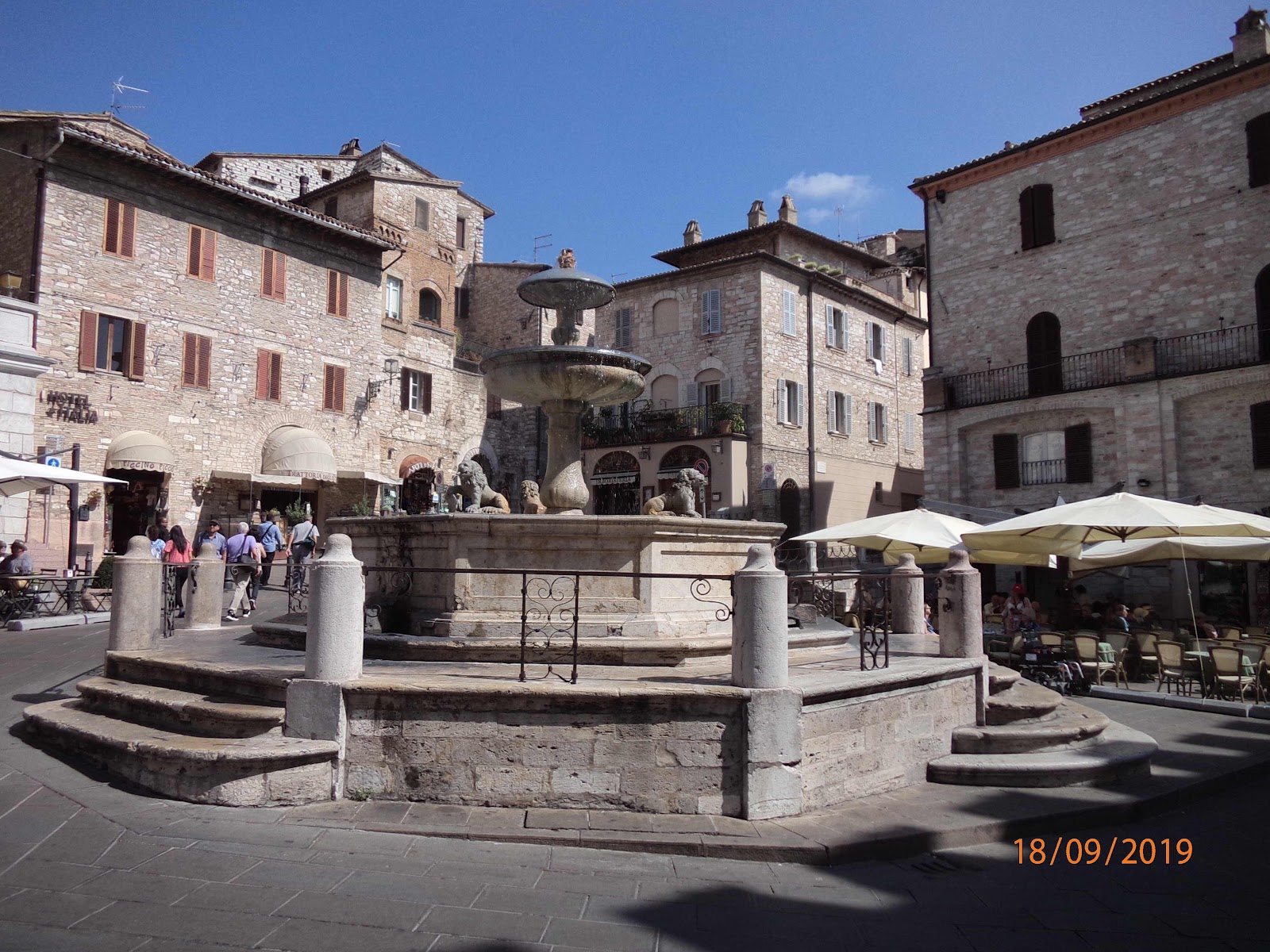
This is the central square, just a few steps from our hotel.


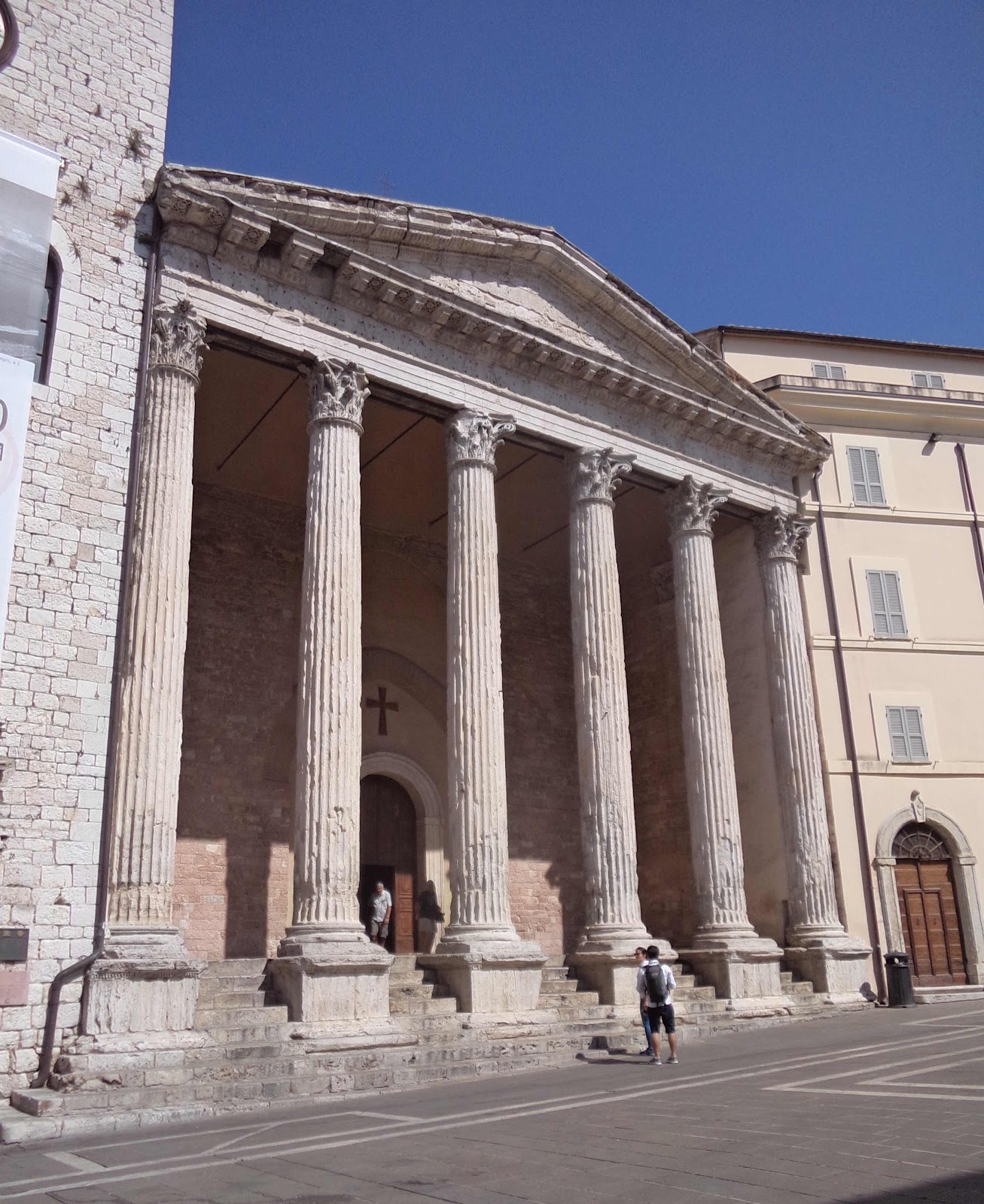
We had spent some time deciding what to do, bearing in mind that we were being taken on a tour tomorrow, so we wanted to see things we might not be taken to see. We settled on one of the churches, which used to be a Roman temple, the Temple of Minerva, built about 40 BC on a set of terraces that marked the centre of the town.


It was converted to a Christian church, then it became shops and later the town hall. It became a church again in 1456, and it’s called Santa Maria Sopra Minerva.

Inside, it’s rectangular, and very baroque.


I took 4 photos in here, and they are all slightly out of focus; I think the camera was havin a nice rest and objected to being made to work again!

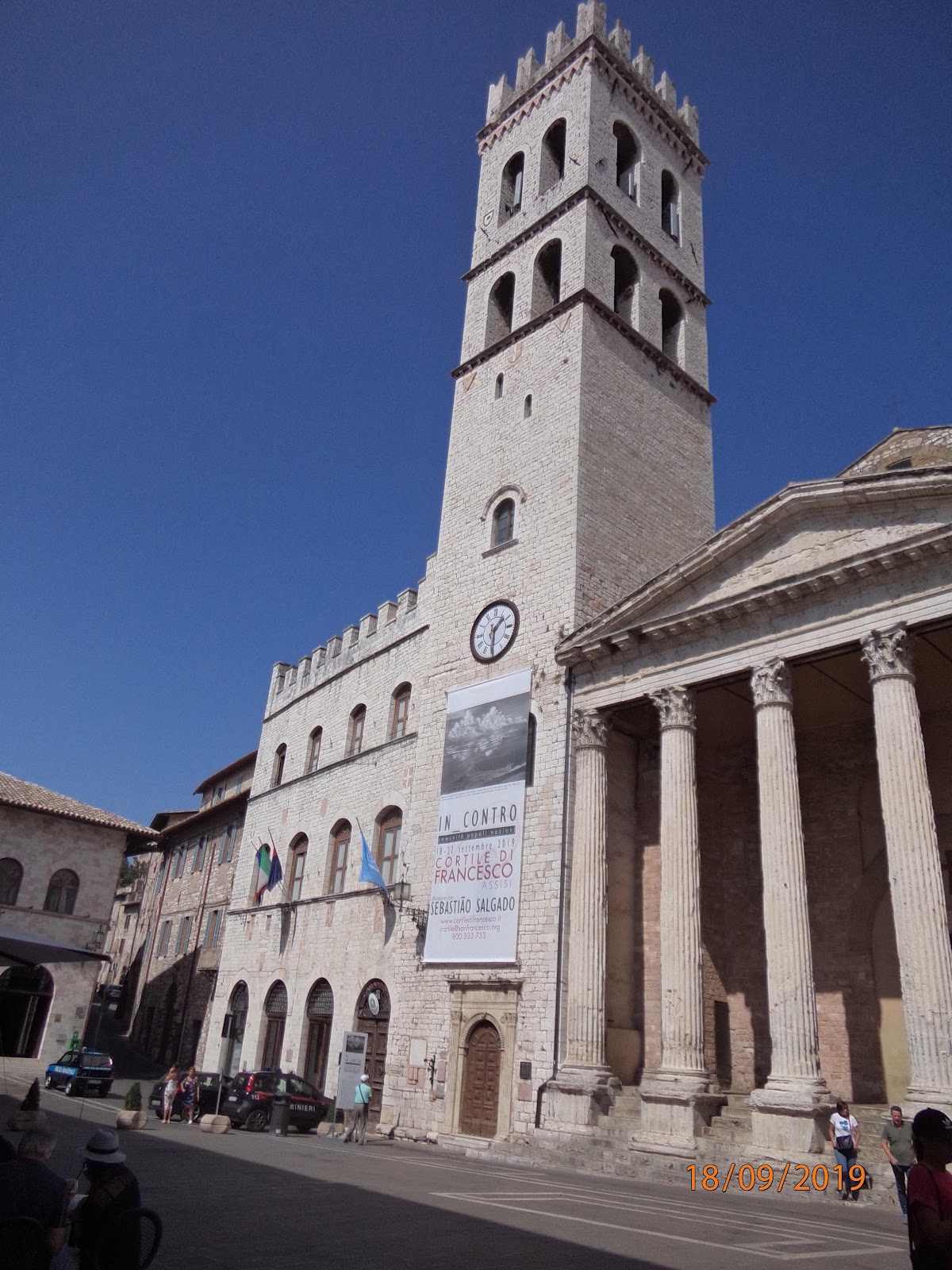
Next door to Minerva is the Palazzo del Capitano del Populo, built in the 13th century and extensively restored in the 20th century.


At the foot of the tower, just next to the rightmost arched doorway, are the 14th century measures for bricks, tiles and fabrics.

We had a quick lunch and then set off towards the Museum of the Roman Forum. This sets out various Roman finds. There are tombstones and sarcophagi and plaques. Then you go through into the ruins of what was probably the forum, under the current level of the city streets. There’s a glass floor you walk on so you can see the drains beneath you as you walk along what was once a Roman Street. There are the remains of a podium, and the remains of many shops.


There are also statues and the huge base of something called the Tetrastyle, which held massive statues of the Dioscuri. Only the base is left.

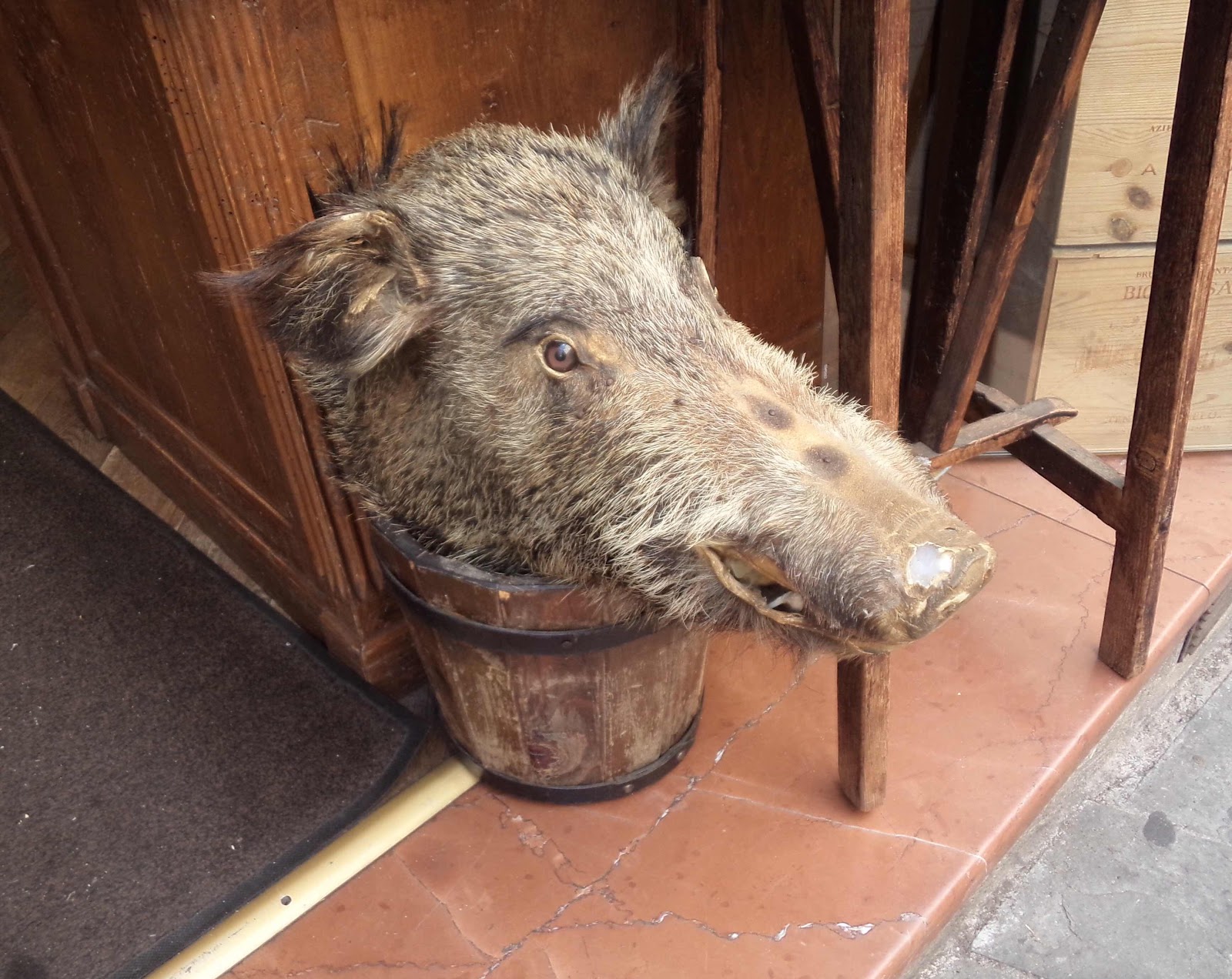
After this we set off for the Museum of Assisi. Some of the shops are fascinating. We saw this outside a shop which sells salami - presumably wild boar salami. 


Poor thing. There was also a baby boar, and more heads inside the shop.

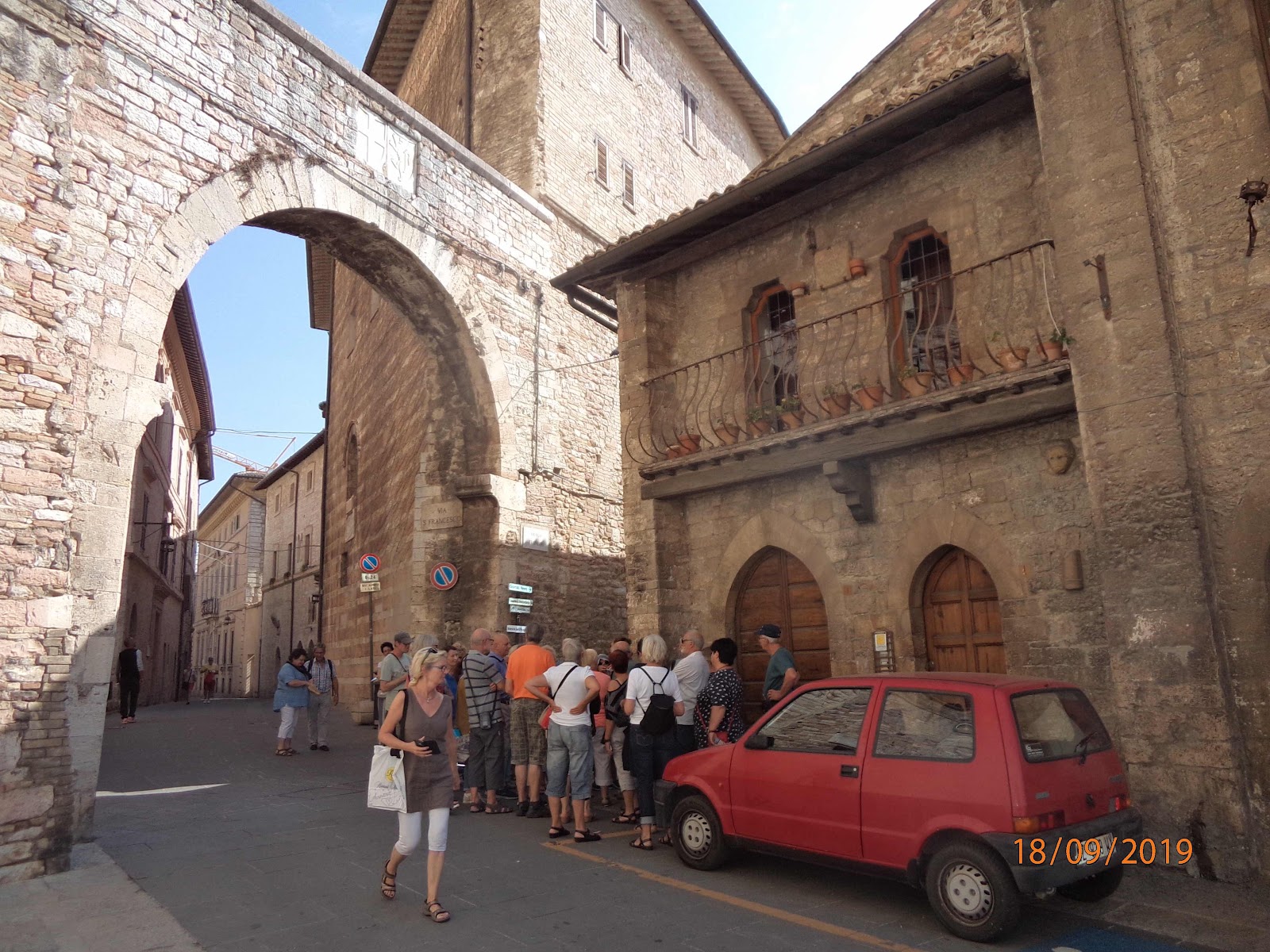
The streets are lined with original medieval buildings; there may have been alterations but the walls are still standing after hundreds of years. I think this was one of the town gates.


That’s a tour group - not ours - being told some details about the house with the metal balcony on it, but as it was an Italian Group, I don’t know what was being said. It’s an interesting building though.

We pressed on to the Museum of Assisi, to see some paintings. The most important one is a Madonna, dated around 1300, originally thought to be by Giotto but now considered ‘school of Giotto’. 


This fresco is not from a church but from the Palazzo del Capitano del Populo. It is though that many of the painters who were painting the Basilica of St Francis were also asked to paint areas in public buildings. I’m afraid it has suffered a bit over the years, so now there are blank areas.

There are many rooms full of frescos, mostly damaged and by artists of whom I have never heard. I liked the one below.


It’s at least a century later than the Giotto, and is by somebody called Tiberio d’Assisi. It’s called Our Lady of Mercy with Saints Ruffino and Francis. It too has suffered a bit - most of the frescos have missing bits.

There’s a room of what look like copies Roman frescos, but there are no notes or information of any sort so you have no idea what they are. And there are some, to my mind, truly dreadful and odiously sentimental Baroque paintings which I walked past rather quickly.

Outside in the street, I was attracted by the view over the hillside and the valley beneath.


I love the old lamp. You see them on quite a lot of the buildings.

We were tired by then, and went back to the hotel for a snooze - or in my case, to write all this.

Later, we were collected by Roy, our host for the tour and taken for a walk to his house so he could give us information about the tour and show us his collection of medieval art.

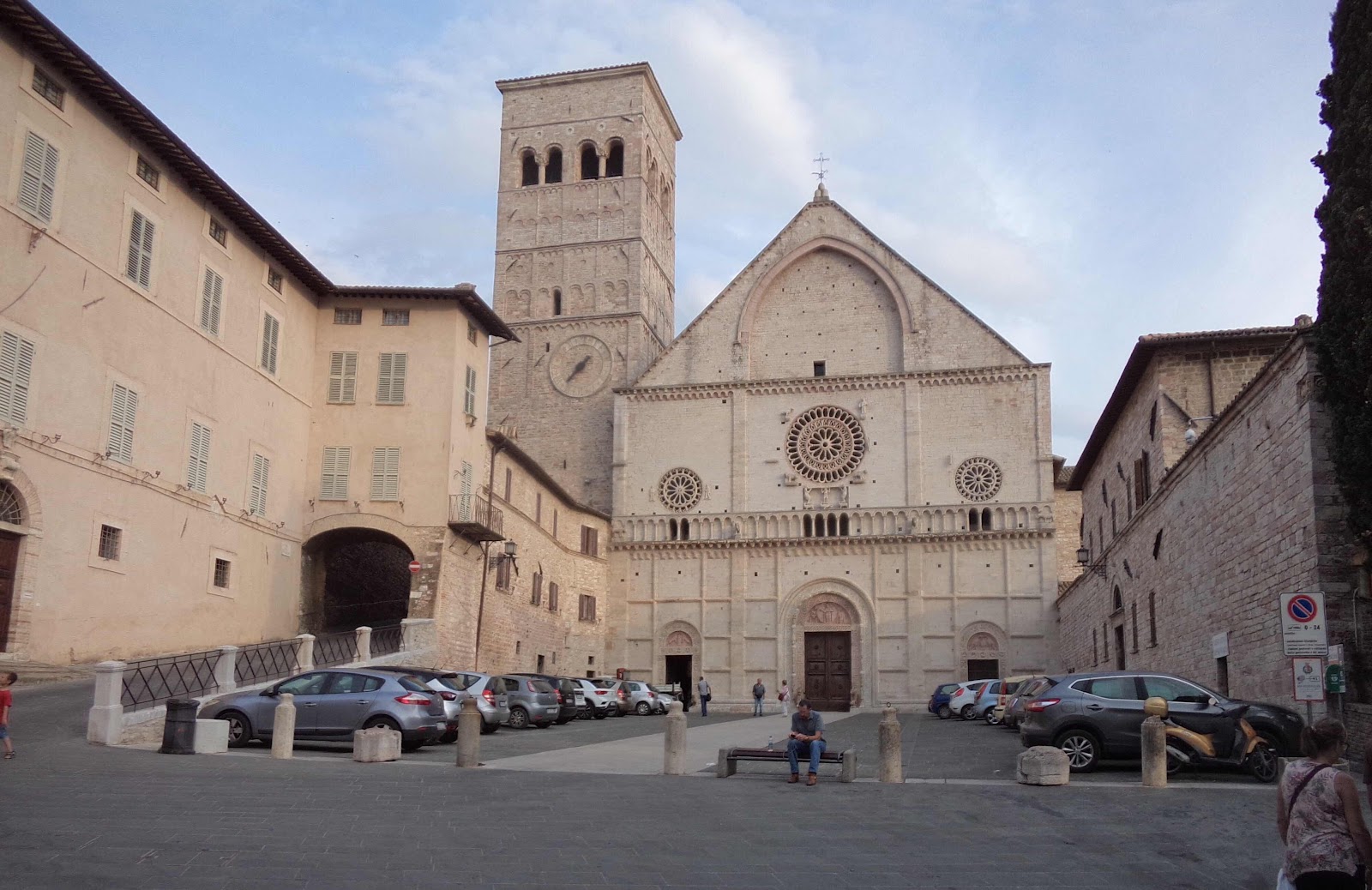
This is the wonderful facade of the Duomo, the church of San Rufino, who is a 2nd century Christian bishop murdered by the Romans, and is now the patron saint of Assisi.


It was built around 1029 on a Roman religious site, and rebuilt in in the 12th and 13th centuries. Roy says it is rather disappointing inside but we didn’t have time to look in and I don’t know if we will have time on any other occasion, as this tour is quite busy. One interesting feature is the old baptismal font where both St Francis and Saint Clare were baptised.

From the terrace of Roy’s little house we looked up to the castle, the Rocca Maggiore, which I hope we have time to see. We also admired Roy’s collection of medieval art, his little house is full of it, most of it not Italian, but very fascinating. He also has some Roman artefacts in his bathroom.

Monday, 16 September 2019

Westerham Fayre

Saturday September 14th

This was another lovely day, so we decided to visit the Westerham Fayre, principally because there was a Punch and Judy, which I know my little grandson loves, so we thought he would enjoy the afternoon.

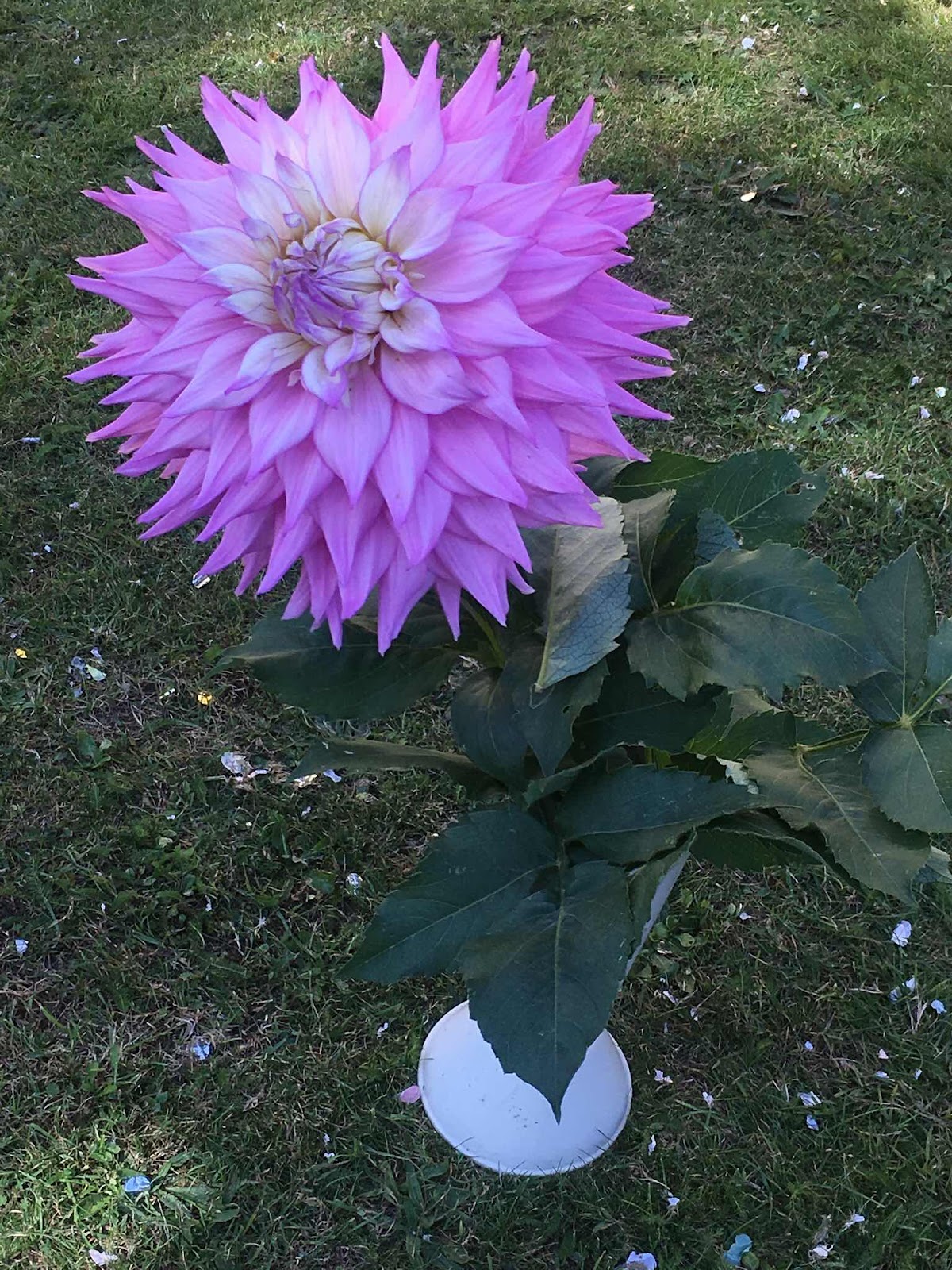
While we waited for my son to arrive, we went to see the Horticultural part of the Fayre. There was an absolutely astonishing Dahlia on display outside. The flower was bigger than my head!


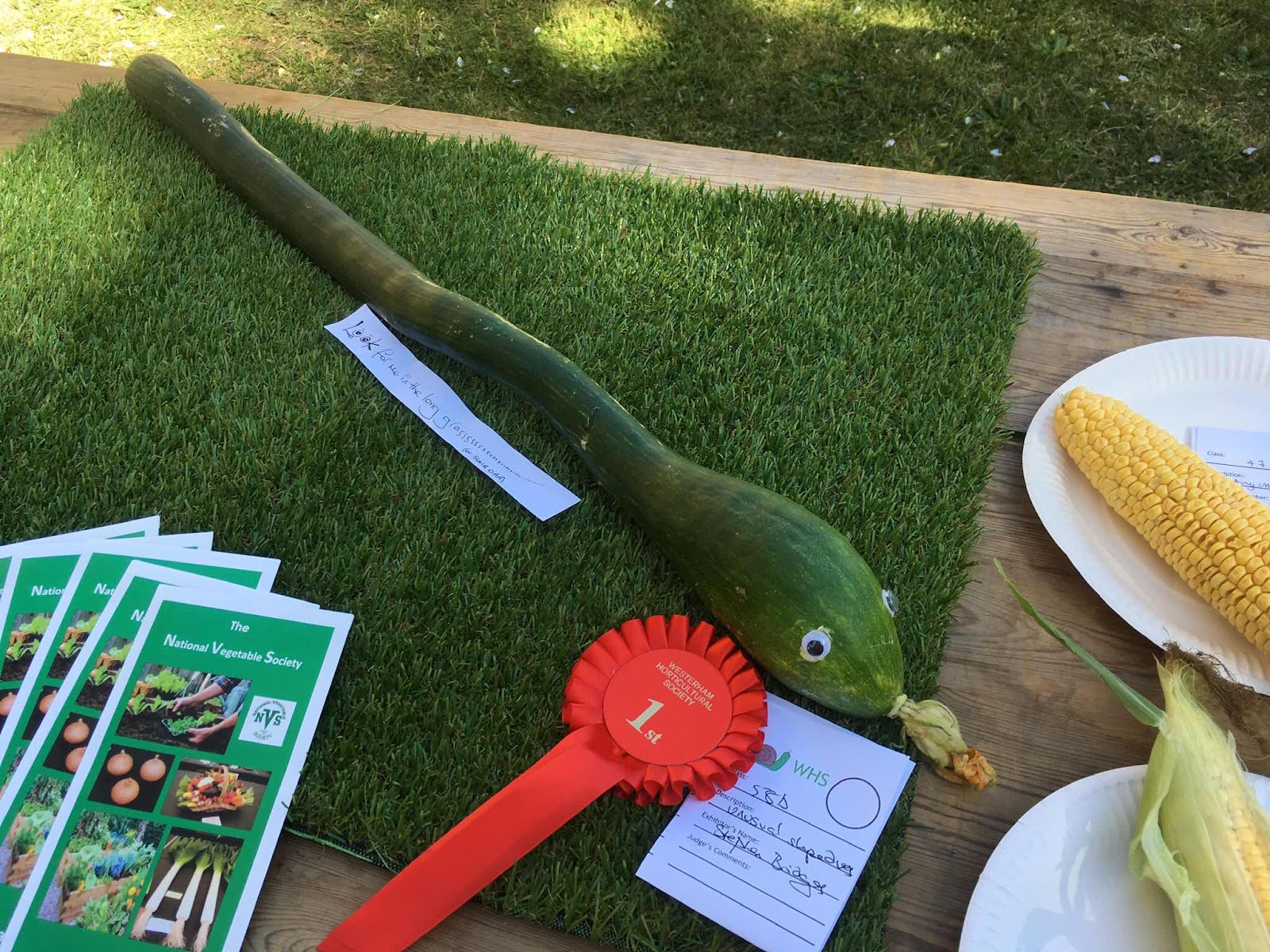
There was also a vegetable display outside of huge vegetables - the most enormous onions I’ve ever seen in my life, and a collection of oddly shaped vegetables. I was really taken with this cucumber snake!


Inside the church were many more vegetables as well as fruit - particularly delicious looking tomatoes, strawberries and raspberries - various handicrafts, and some really yummy looking cakes. I did wish I could have tried some of them, particularly a big  Victoria sponge full of strawberries and whipped cream!

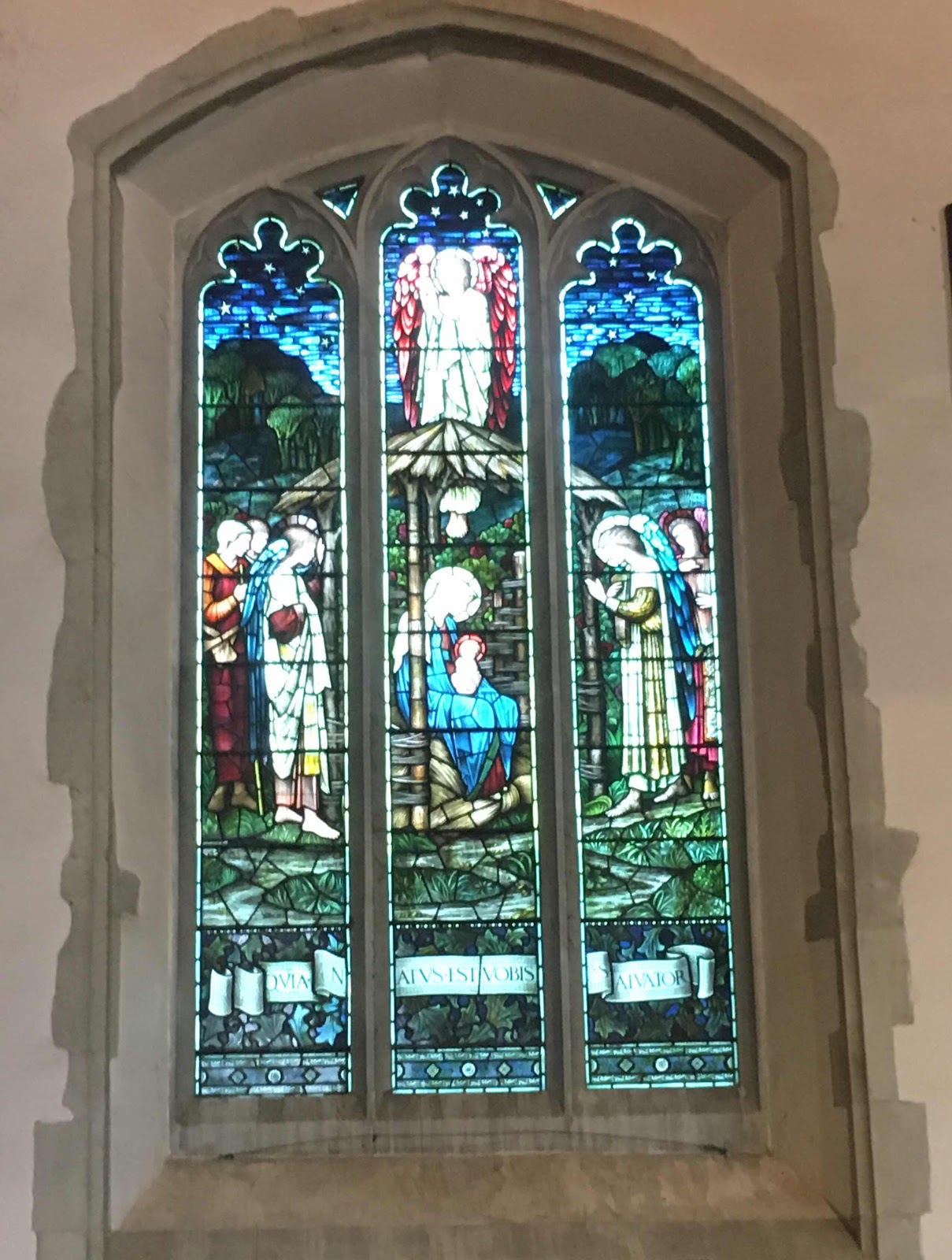
The church is in the Arts and Crafts style and there is a really beautiful Burne Jones stained glass window.


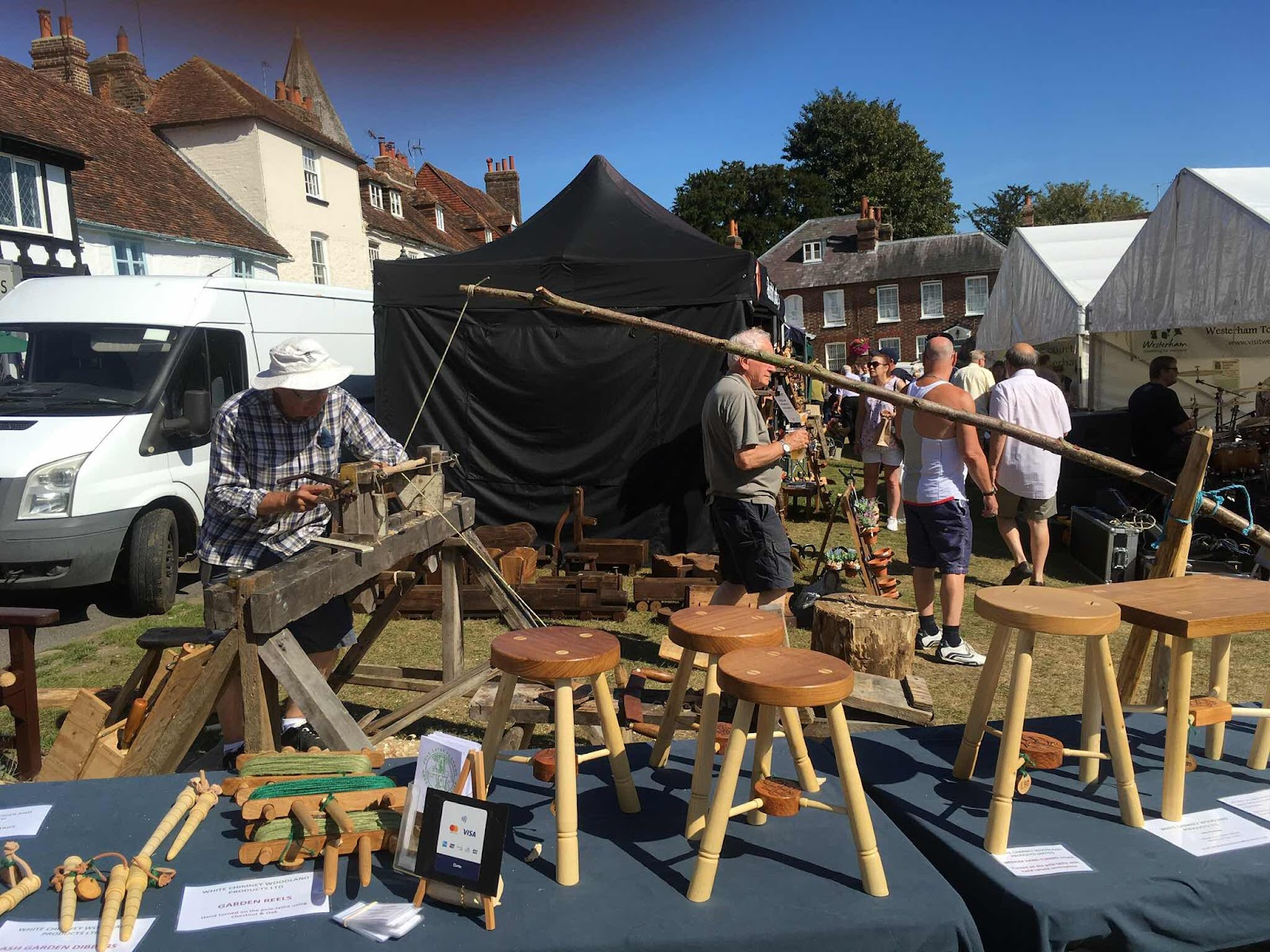
Outside on the green, we wandered round the stalls and were really taken with the chap with the home-made lathe.


It was certainly very slow work though. 

Once my son and grandson arrived, we took him immediately to the Punch and Judy, which had already started as they were late. He loved it all, but especially the crocodile!

Then we took him on the chair-o-plane, something I haven’t seen since I was a child myself


It was definitely a vintage one, not a replica. He enjoyed his ride on it, but refused a candy floss afterwards - he had no idea what it was, and didn’t think it looked nice! 

We tried all the stalls, failing to drop the quoits on the pegs or beat the rat successfully. But he did manage to hook a duck and won some crayons.

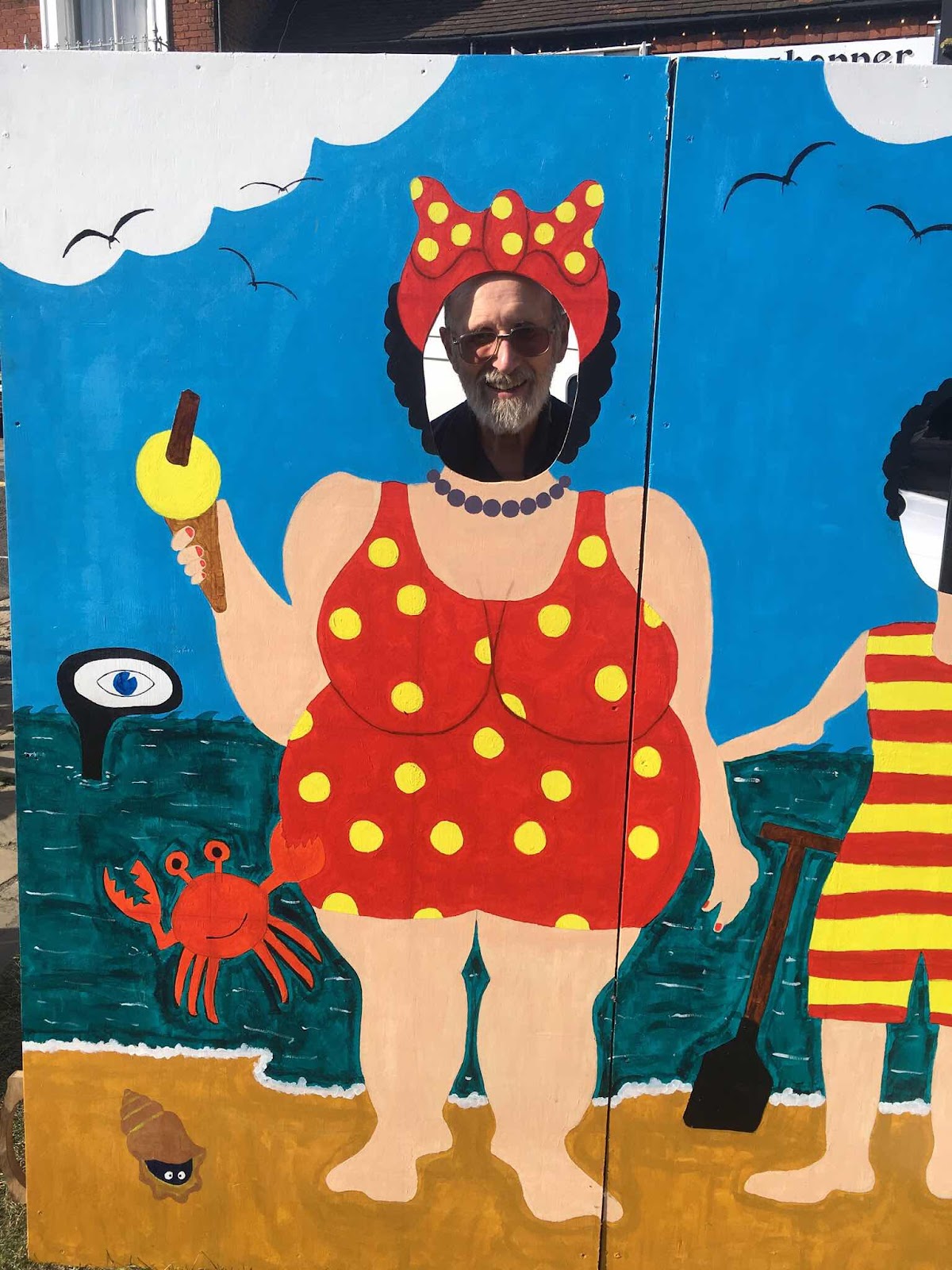
Then we took a silly photo of grandpa! 


He refused to have his photo taken next to grandpa though! 


September at Kew

Sunday September 8th

Sunday was a beautiful day, and we went to Kew to see the Dale Chihuly exhibition. It was stunning, so I’m going to write very little and just let the photos speak for themselves.

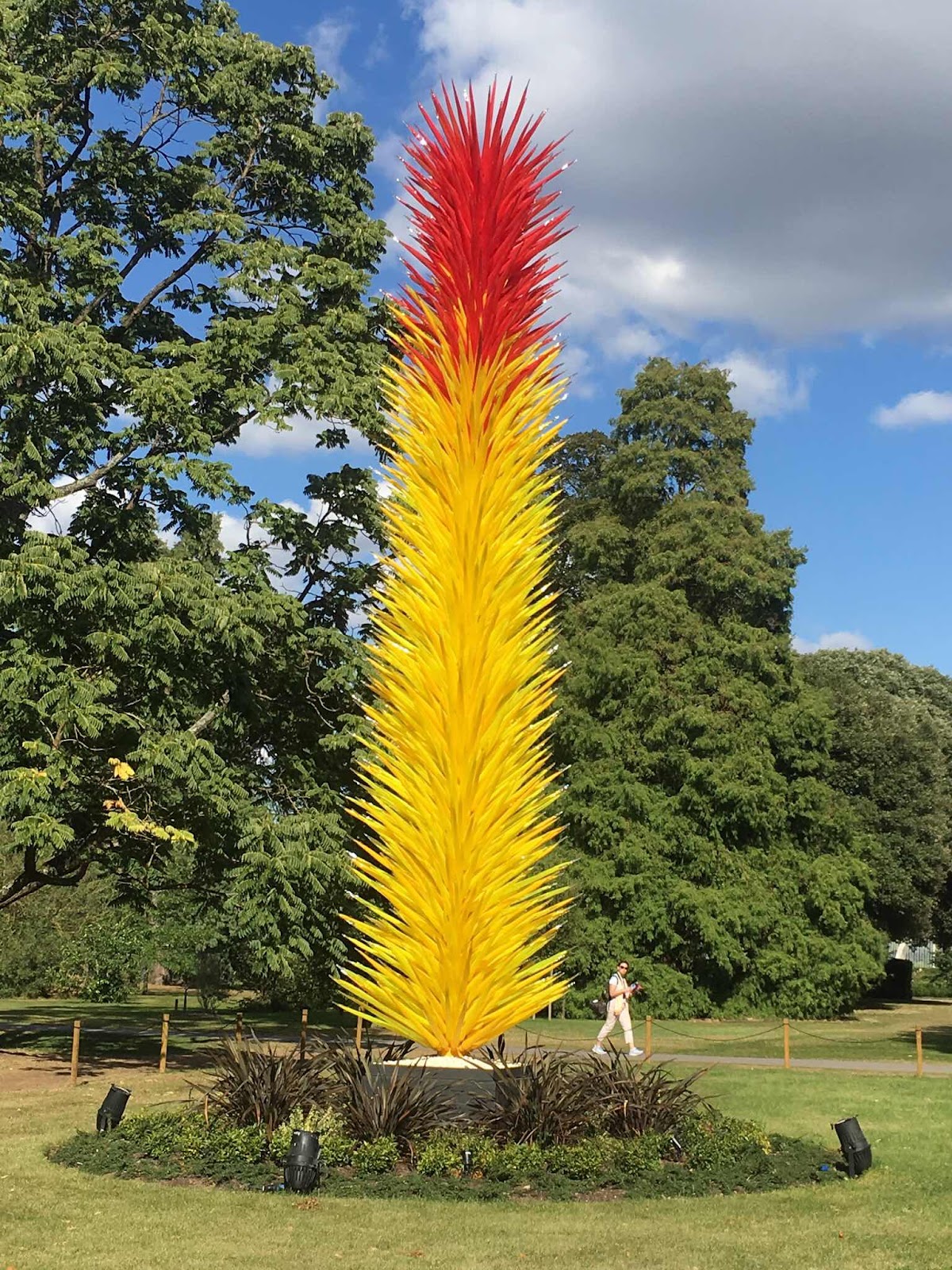
This was the first one we saw, close to the Victoria gate.


It’s the one used on all the posters advertising the exhibition.

The one below is at the Japanese Minko House.


It’s just simple coloured glass spheres resting on the raked gravel, but it just looks right somehow. You can just see the pagoda in the background. 

The entrance to the Temporate House is flanked by 2 of these. 


Inside the Temporate House, there is so much to see and most of it is breathtaking. This blue creation hangs from the ceiling in the centre.


Close to it, in the middle of lush planting, is this white design, like some sort of strange plant. 


Opposite it is a green one


You need to look carefully to see which leaves are part of the plants, and which are the glass leaves.

Red spears of glass appear in various parts of the garden


These are in the Temperate house, where I also saw this bloom, as big as a dinner plate


Outside King William’s Temple is a symphony of violet and turquoise.


These huge white flowers were in the water in the Waterlily House


It was hard to photograph because it was extremely hot and humid in there. Because it was so spectacular, it was also very crowded, and once you were in, it was quite hard to get out again!

I can’t remember in which part of the garden we saw this next spectacular explosion.


Although this is Kew Gardens, I don’t seem to have photographed many plants, but outside the Palm house I couldn’t resist this display. 


Just in the background, you may see the fiery explosion which I photographed in closeup.


I don’t think I can torture this application any more by posting any more photos as it keeps crashing. But it was a wonderful display, which is why I took so many photos and have posted so many here.


The last of August - Chirk Castle

Saturday August 31st

With our family back early from their camper van expedition owing to inclement weather, we spent part of Friday with them visiting Chester, where we took a boat down the river Dee.

On the Saturday, we set off into Wales again, slightly further south of Wrexham this time, to Chirk Castle. 

Chirk Castle was built in 1295. When King Edward I defeated Llywelyn ap Gruffydd, he established a Marcher lordship and granted it to Roger Mortimer in recognition of his service in the wars. Roger Mortimer built the castle to guard the Dee valley and to  be the local administrative centre. It was probably overseen by Master James of St George, an architect much favoured by Edward I and it was part of Edward I’s chain of fortresses across the north of Wales. It is the only one of Edward’s Marcher fortresses which is still inhabited today.

It has had quite a checkered history. Roger Mortimer supported his nephew (the other Roger Mortimer) and took up arms against the King (Edward II by that time) and was thrown into the Tower of London where he died. Chirk castle then regularly changed hands between some of the important men of the age as they fell in and out of favour. 

The castle was eventually bought by Sir Thomas Myddleton in 1593 and passed down through the Myddleton family. The family leased it to Baron Howard de Walden from WW1 until after WW2, but later returned to Chirk castle. It is now owned by the National Trust.

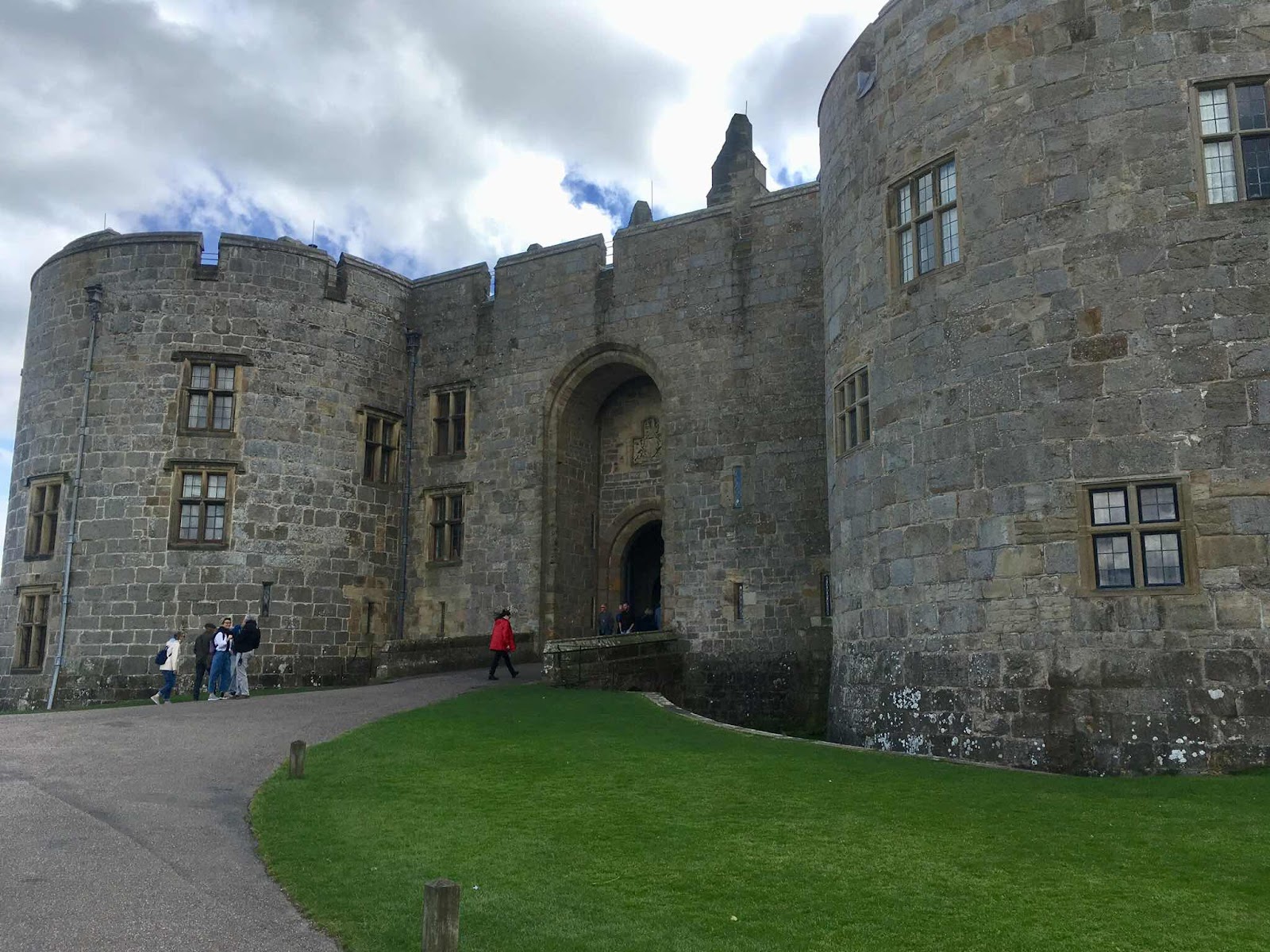
This is the entrance, still massive, but windows have now been cut in the walls to modernise the original medieval towers. 


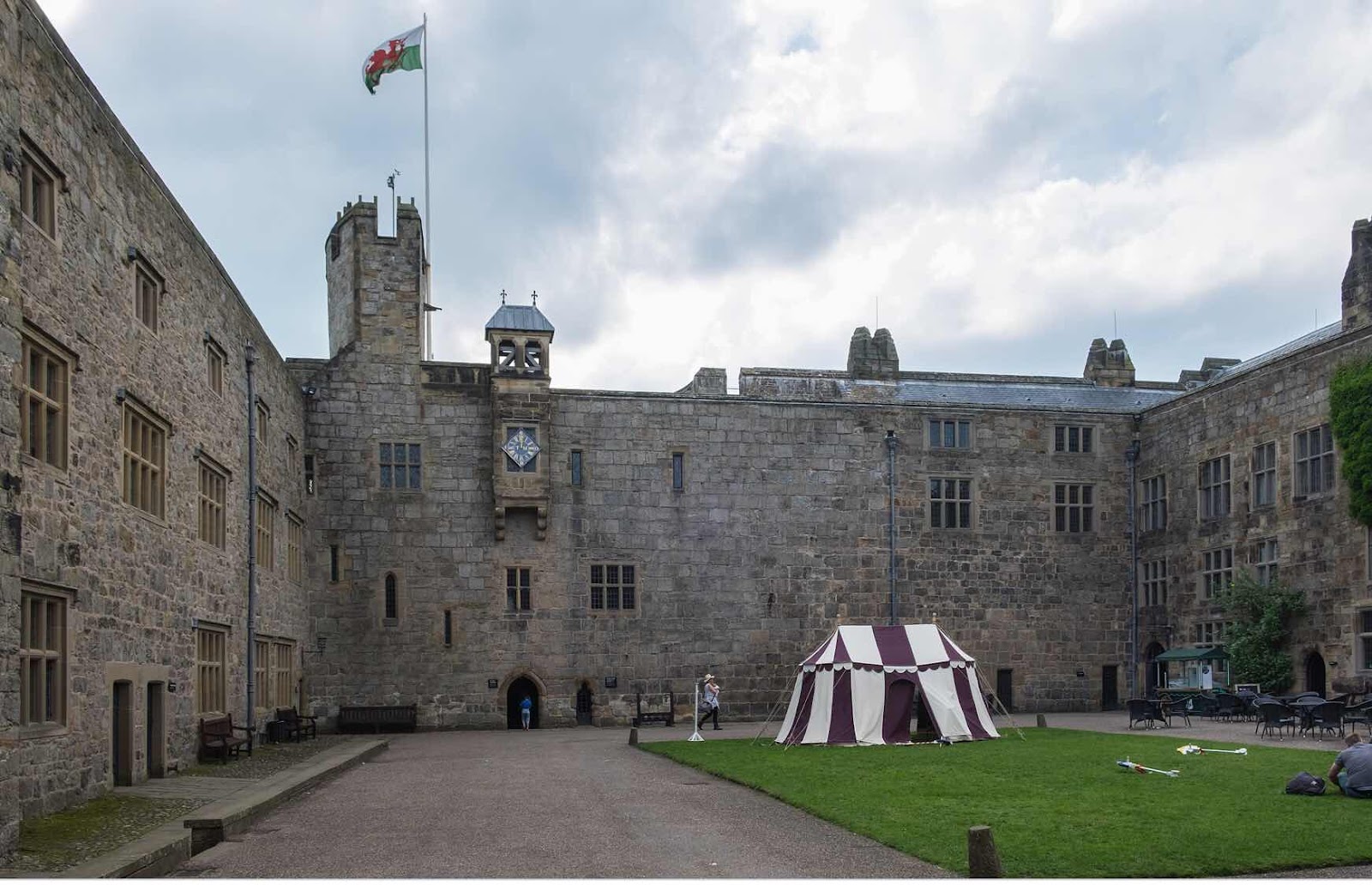
There were 4 round towers that allowed archers a wide field of fire. The four corner towers were joined by a narrow curtain wall with half-towers in each side. The design has changed a bit over the years, as you can see from the courtyard.


At the far side of the courtyard, you may just be able to see the stocks, which I got Paul to try out for size.


There’s even room for a friend!

Inside the castle, there is fairly little evidence of the medieval, though there is still a dungeon deep under one of the towers. I took one look at the dark narrow spiral stairs and decided not to bother going down. Paul went and said it was very dark and he had no desire to stay for long - a sentiment with which I’m sure those imprisoned there would concur!

Changing fashions are reflected in the different State Rooms you pass through. You enter through the Cromwell Hall, with a collection of rare Civil War era firearms. Other rooms display the influence of the 18th century neo-classical style, and some rooms are influenced by later Pugin neo-gothic styles. 
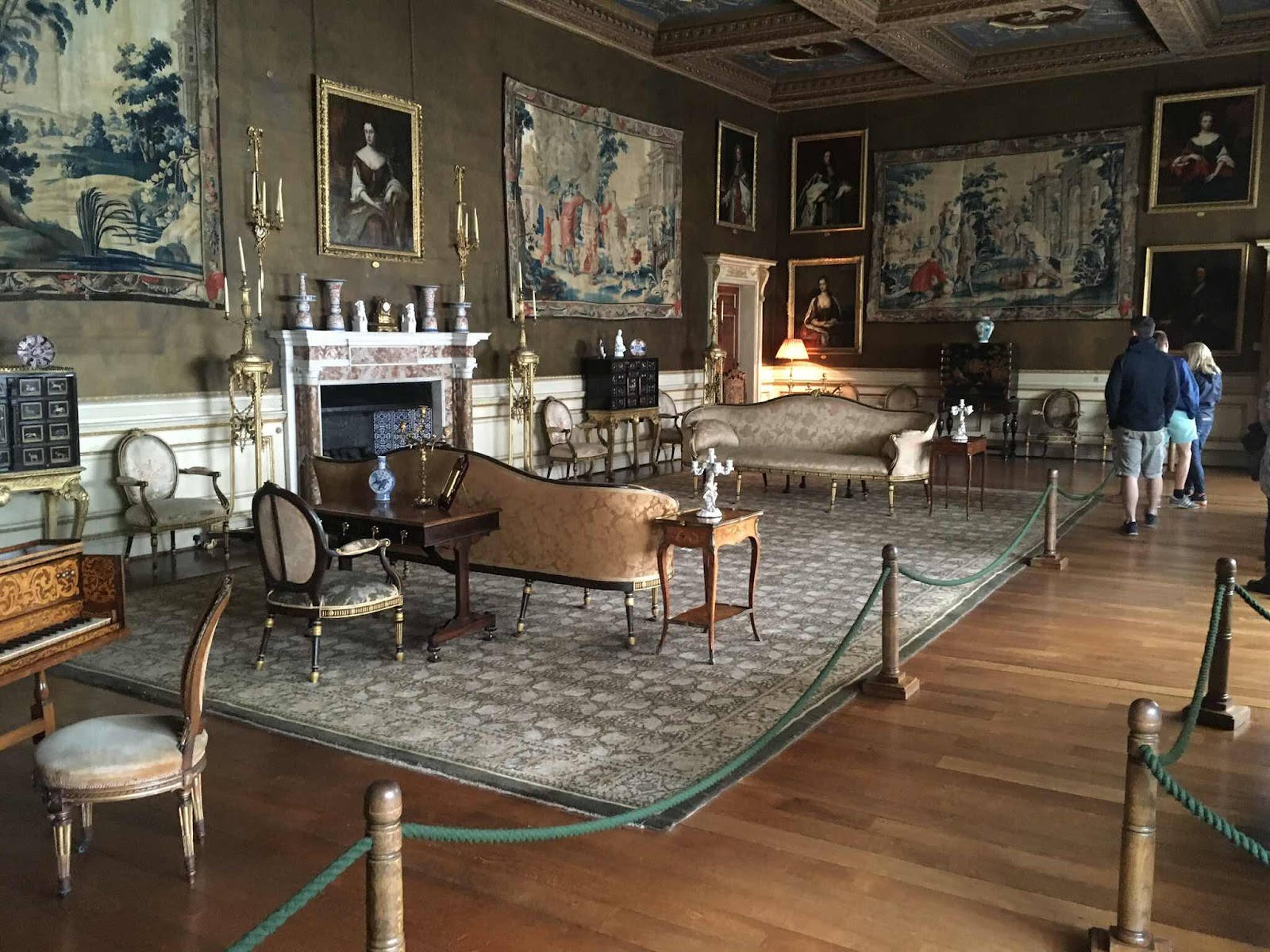
The dining room is currently in the neo-classical style, with plasterwork decoration on the walls and ceiling influenced by Robert Adam. 


Apparently, this room was re-decorated by Pugin in neo-gothic style, with the panels remained to represent dark oak, but it was returned to the original style in 1963. I think I like it better this way.

Next came the Salon.


The Salon is also Robert Adam inspired, and was created in the 1770s. The coffered ceiling, which I’m afraid you can hardly see in my photo is filled with paintings of Greek mythology. It was redecorated by Pugin who re-coloured the ceiling and put up flock wallpaper! It has been since removed. The harpsichord you might just be able to see part of in the far left of my photo was made in 1742 and is one of the earliest examples of the maker’s work which is still in playable condition. 

Below is the Long Gallery. It is 100 feet long and was designed to create indoor space for gentle exercise when it was too cold and wet to go outside.


It was begun in 1670, which was when the wainscot work was done. The ceiling panels are the work of Pugin, who also designed the cast iron fireplaces which you really can’t see too clearly in my photo as it’s so dark.

There are various painting here, but I took this next photo for the cabinet.


Its called the King’s Cabinet and was a gift from King Charles II to Sir Thomas Myddleton. Sir Thomas had originally been a Parliamentarian, but grew disillusioned with them and ended supporting the restoration of the monarchy and Charles II.

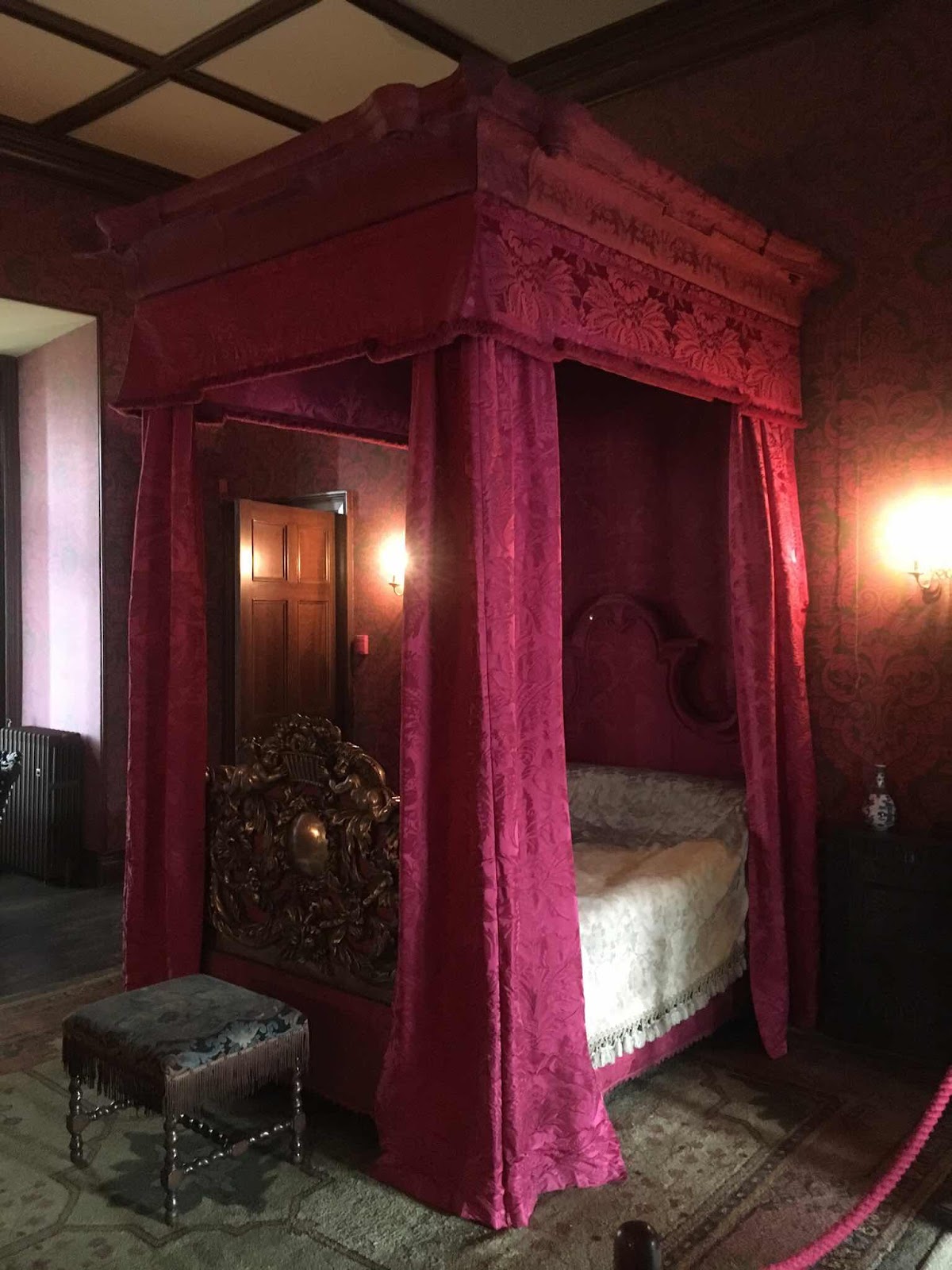
The photo below is of the Kings Bedroom


It commemorates the two nights Charles I spent at Chirk Castle during the Civil War, though it is far from certain that he actually slept in this room. He certainly didn’t sleep in this bed, because it wasn’t made until 1700, 50 years after the King was executed.

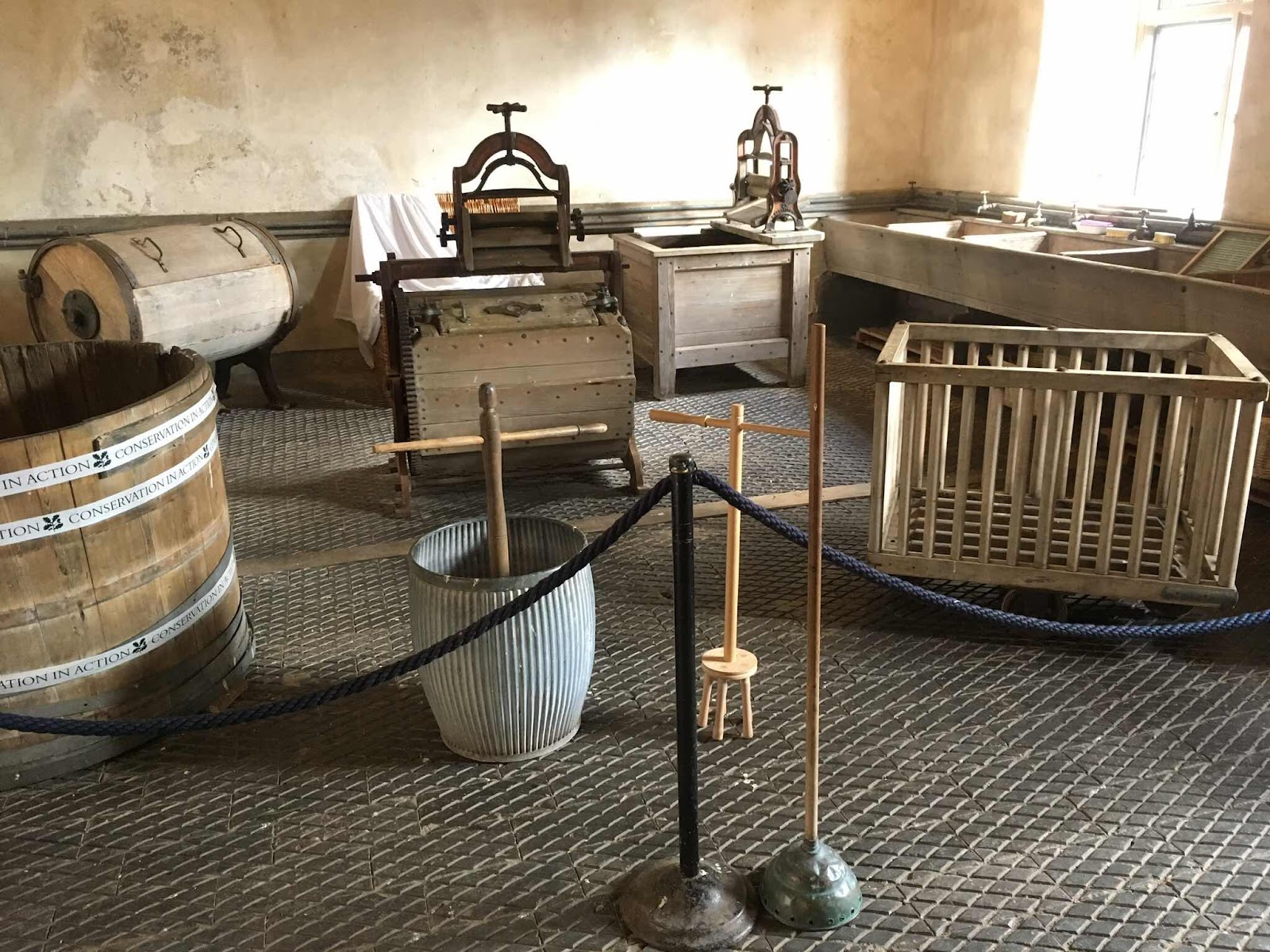
Outside, you can visit the laundries and the drying ground. 


I am sorry to say I can recognise quite a few of the artefacts in the laundry, a hangover from my own childhood. The mangles look horribly familiar, there’s a washboard just outside my photo, and the dollies, the things like 3 legged stools with a long handle are not unlike things I saw my grannie use. The big tub on the left was to do the washing in, and the maids got inside it to trample the washing. We did this with sheets in the bath when I was a child, though our clothes were all washed by hand. The thing like a playpen on wheels was for moving the washing about, as there was an awful lot of it. The program for the week shows the laundry maids washing on Monday and Tuesday, mangling on Wednesday, ironing on Thursday and Friday, sorting the clean washing and cleaning the laundry on Saturday, and bathing and going to church on Sunday. The drying ground was a large back lawn required to hang out such a huge quantity of washing.

The grounds are quite extensive, but we didn’t spend too long exploring them because there was a large group of medieval re-enactors re-enacting the battle of Crogen which took place nearby, and of which I had never heard. It was a battle between Henry II and an alliance of various Welsh princes and took place in 1165. 

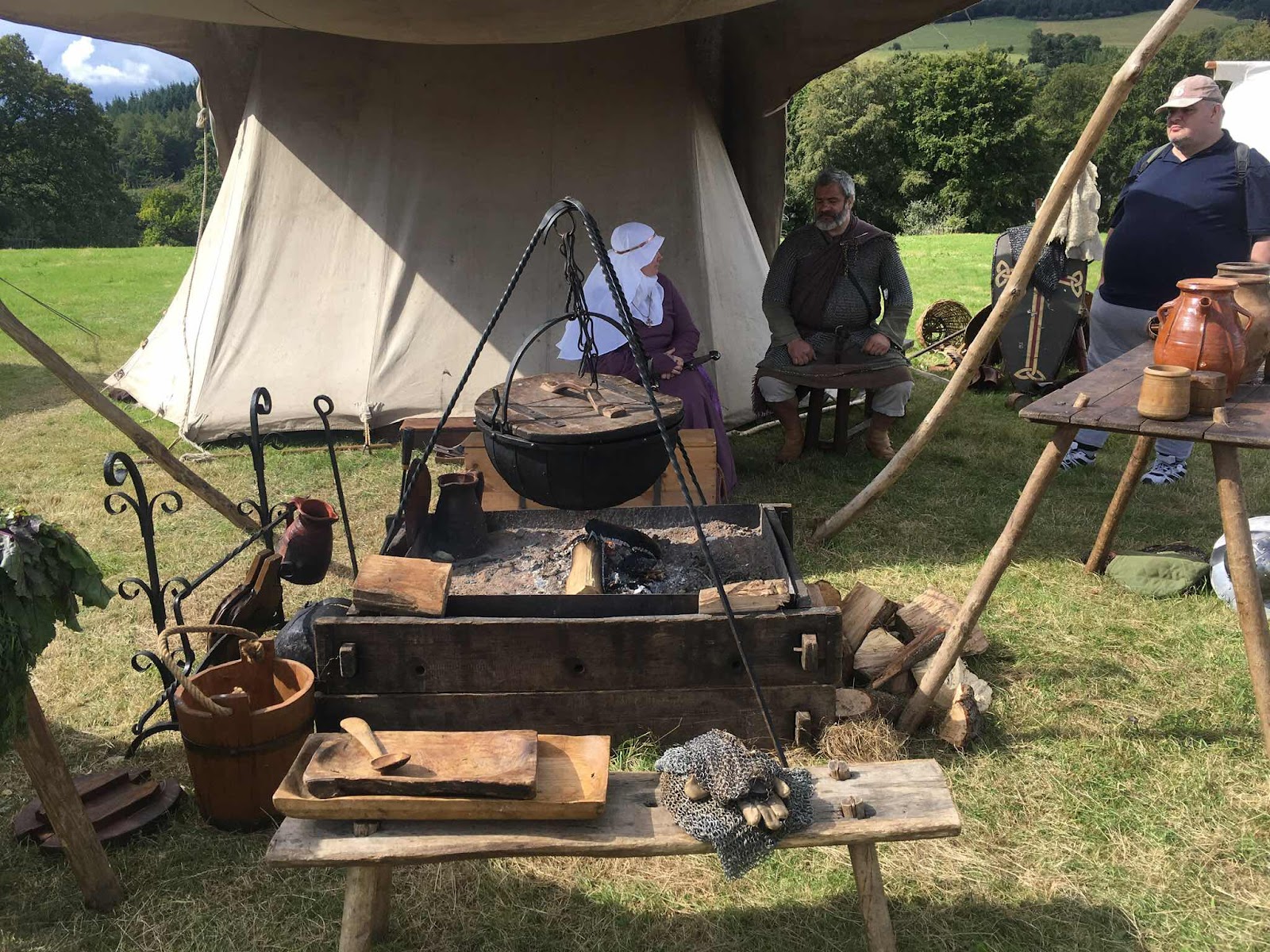
We couldn’t get near enough to see any of the Battle, but, like any of these things, I imagine it was more interesting to take part in than to watch. We did like the medieval encampment though.


Visiting children all had a great time, they were all recruited into a children’s army and equipped with tabard, wooden swords and shields and encouraged to line up and bash the swords on the shields and shout threats at the line of medieval soldiers and their parents. 

After all these visits, it was time to return home, and we drove back to Surrey on Sunday.