Wednesday, 6 July 2022

Wednesday July 6 2022

Well, we finally managed to get to Molveno at lunch time today, after what feels like a very long journey. As the plane was scheduled to leave just before 6 am, we had to get up at 2.15am and the taxi came at 2.45. We were at Gatwick about half an hour after that, and, though it was busy, it wasn’t nearly as bad as the scenes we’ve seen on the news. I suppose that’s not surprising at 3am. We dropped the bags successfully and didn’t need to queue long for security. I set off the security alarms again though, I don’t know why.

We boarded and left more or less on time, and arrived 15 minutes early - almost 9am local time, which is 8am at home. Again, there were few queues at Venice Marco Polo, but of course we had to join a 3rd country queue rather than the EU queue, which didn’t exist anyway. With an EU passport, you just walked straight through.

We were met by a driver and 6 of us got into a minibus and drove along a rather dull motorway for about 90 minutes to Verona airport, where we picked up a couple from Scotland. The drive to Molveno was another 90 minutes, though it was a rather more interesting drive. The countryside was flat at first, but we soon approached the mountains. 
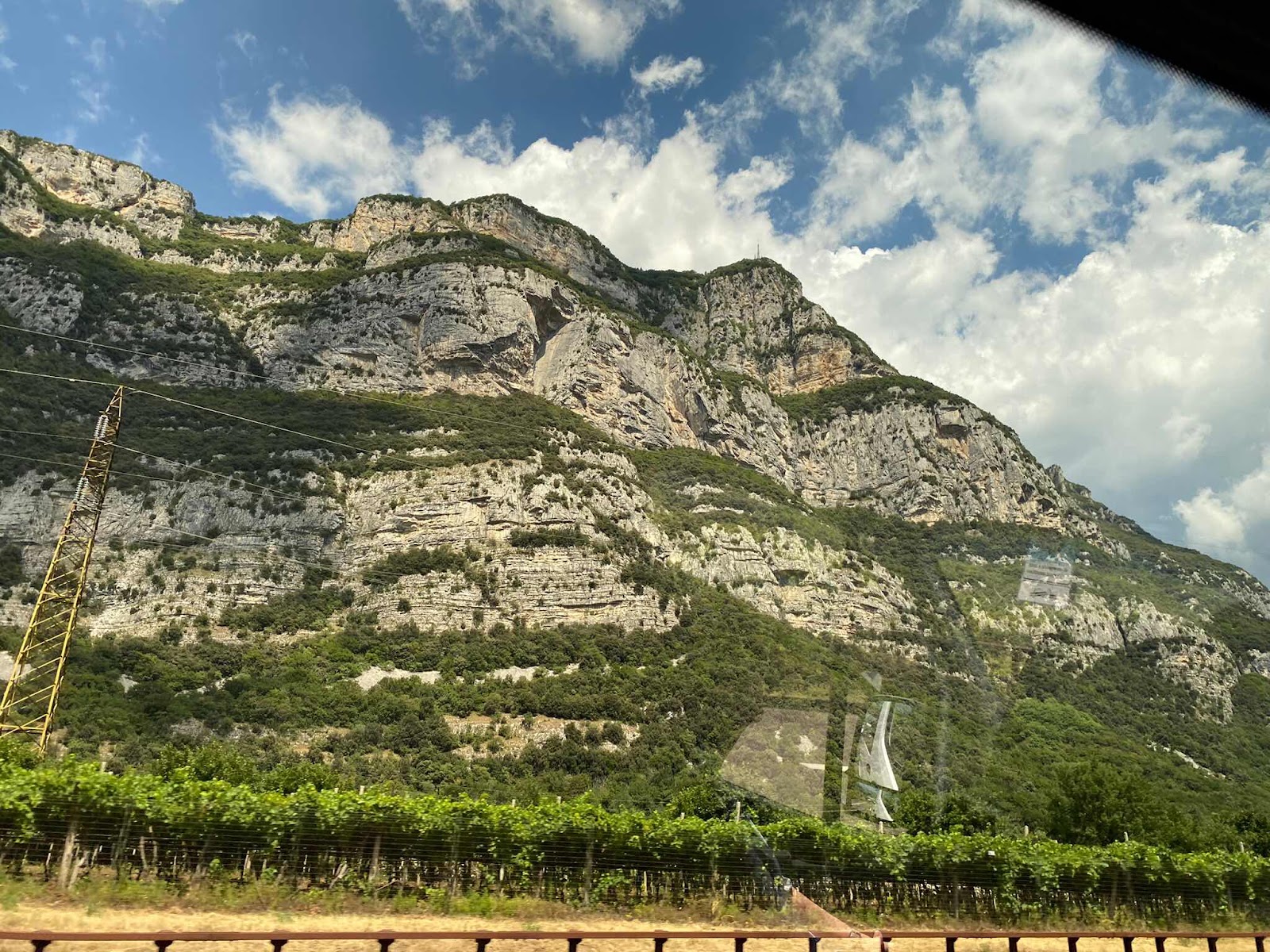
I’m afraid this is a poor photo, taken from the minibus which was travelling at speed, but it gives an idea of the countryside.


The valley floor is flat and the bare rocky cliffs hang over it. The valley floor is almost completely covered with vineyards. I noticed a few olive trees as well, but not many. 
We left the motorway and joined a local road, then we started to wind up the mountain on a road with the most amazing hairpin bends. Our driver tacked these at a far greater speed than I would have done, and I had the feeling he would have gone even faster had it not been for the car in front of us, the road being too narrow for passing. There was, sadly, no view, the road winding through quite a thick forest of what looked like pine trees,

Eventually we reached the highest extent of the road, after lots of ear popping, and drove through a couple of ski resorts. The houses were definitely of the alpine type but I couldn’t see anything that looked even vaguely like a piste, so perhaps they were even higher up. I did see a cable car and it was working, so presumably carrying walkers.

Finally, around 1pm, we drove into Molveno and found our hotel. Although it was lunch time, we were too tired to do anything except fall on the bed, having had little sleep the previous night. Later we woke up and walked down the hill to admire the beautiful Lake Molveno.


The lake is beautiful, surrounded by the hills and jagged peaks. The hills and peaks are obviously good for parasailing; on the top right of my photo you might be able to see one person coming down over the lake, but there were several others.

The lake must be at least partly artificial because there are information boards showing how it was partly drained some years ago in order to facilitate repairs to the hydroelectric power station. 

People were swimming and canoeing in the lake and in another area there were lots of boats.


You can see just how jagged and rocky some of the peaks are.

It was quite a long steep walk down to the lake, but fortunately we found a shorter way back to the hotel. After dinner, we looked at the garden and and saw there was an even quicker way down to the lake for the bottom of the garden, but I’m not sure how usable it is. Paul and I had gone looking for the garden earlier, and found the only door to it was locked.

We are half board here, and the delicious dinner had rather more courses than we are used to eating! This is the view from our hotel balcony.


Even though this was taken about 7 at night, the weather looks a bit grim, and it looks as if it rained a bit while we were eating dinner. But apparently it is to be hot tomorrow, and we are taking a funicular up the mountain and visiting a winery later.


Tuesday, 5 July 2022

Experiment

This is just an experiment to see if this application still works, as it hasn’t been used for so long.


Emmets Garden last week.

Tuesday, 24 September 2019

Orvieto

Tuesday September 24th

Thank goodness the rain had stopped overnight and the sun broke through from time to time, so I was able to put away the warm trousers and get the sandals out again - albeit for only one day, as the rain will be back tomorrow. 

In the early morning we set off for Orvieto, a town some distance from Assisi standing high up above the plain on the remains of old volcanoes. It was a rich Etruscan city which was taken and more or less destroyed by the Romans in 264 BC. It revived in the Middle Ages and became powerful again, but was devastated in the Black Death and eventually came under papal control.

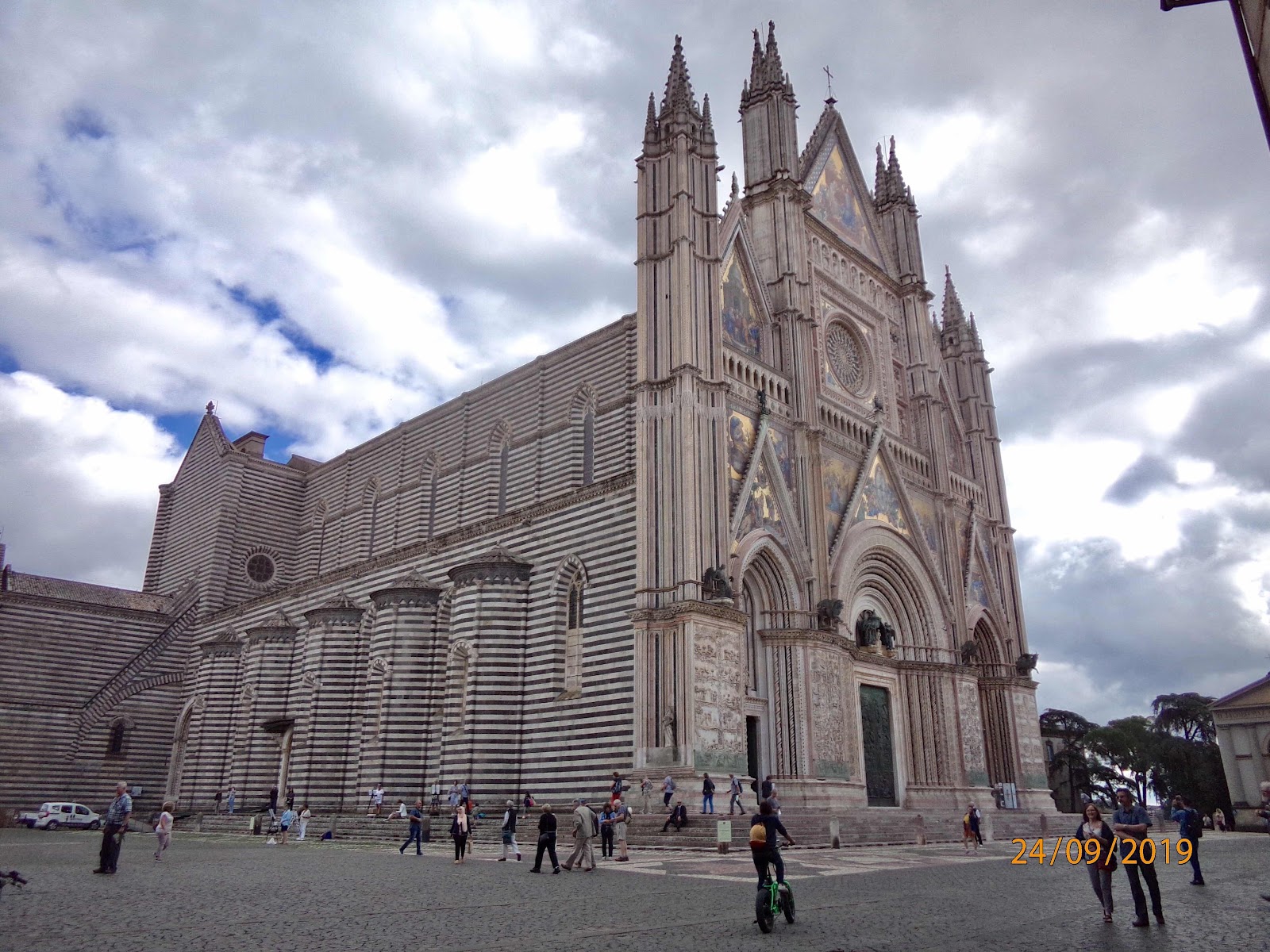
We arrived first at the Piazza del Duomo, and the Duomo is pretty striking.


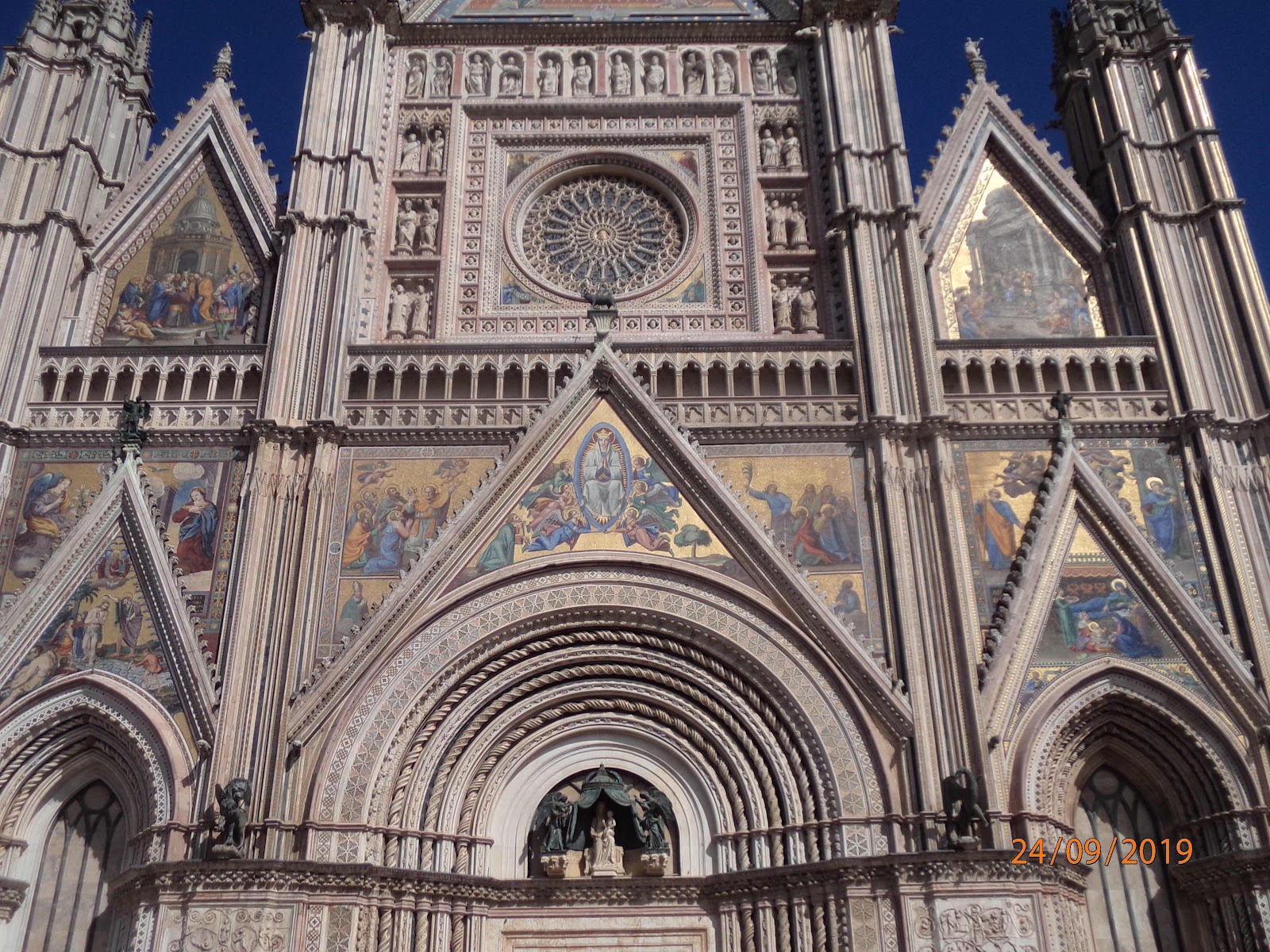
This is a side view to show the striped design of alternating bands of black basalt and lighter coloured tufa - this is a volcanic area, after all! The church was begun in 1290, though it wasn’t completely finished for 300 years. Its walls started to bulge, and a Sienese architect was brought in to correct it in 1308. As well as stopping it falling down, he is largely responsible for the marble reliefs and statues at the front, the rose window and the mosaics which are gold and really glitter in the sunlight. I can’t resist a closeup up of some of those features.


This was taken when the sun was shining in the afternoon, and my camera really doesn’t do justice to the mosaics - and the top one is missing altogether. The church is dedicated to the Virgin Mary, so the mosaics are about her life, and the top one is her coronation as Queen of Heaven.

Inside, the striped theme continues in the Romanesque nave, and the windows are very thin alabaster to let in a golden light. The sanctuary walls are completely covered with frescos by a local artist and there are further frescos in a chapel on the left which contains a reliquary to hold a miracle cloth which had been showered with blood (supposed to be the blood of Christ) when the host was broken at the mass. We weren’t allowed into this chapel as there was a service in there.  

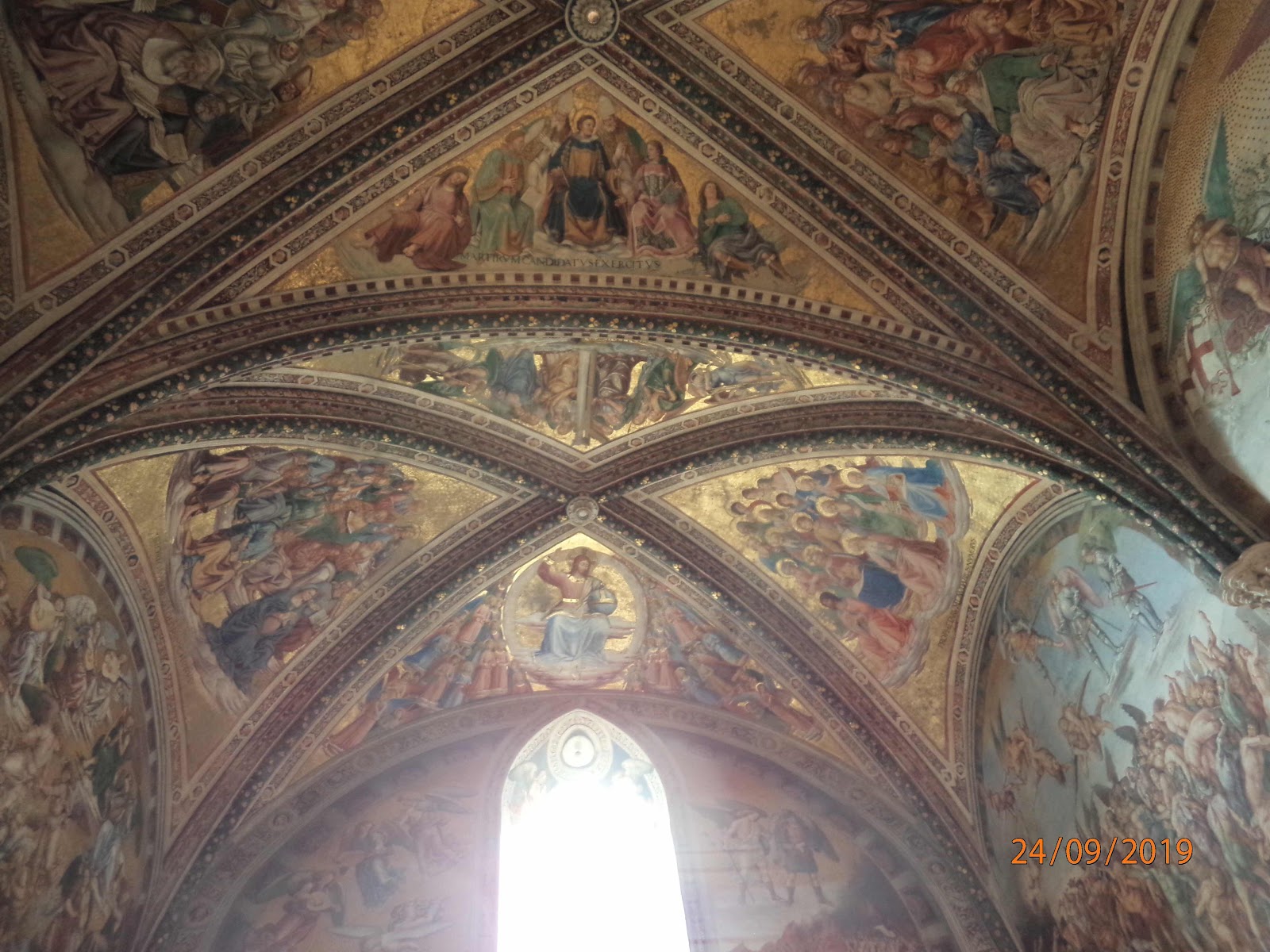
We did go into the chapel opposite though, the Capella della Madonna di San Brizio. This is also completely covered in frescos. They were begun by Fra Angelico in 1447, but he only did some of the ceiling, as he was only there for three months.


He left drawings for the rest, and the chapel was finished by Luca Signorelli 50 years later. The panels below the ceiling ones deal with the end of the world. The anti-Christ is shown with the world descending into chaos. Signorelli has painted himself into this one at one side. Then other scenes show the Last Judgement. He has painted his unfaithful mistress in one of these scenes, being carried off by a demon! 

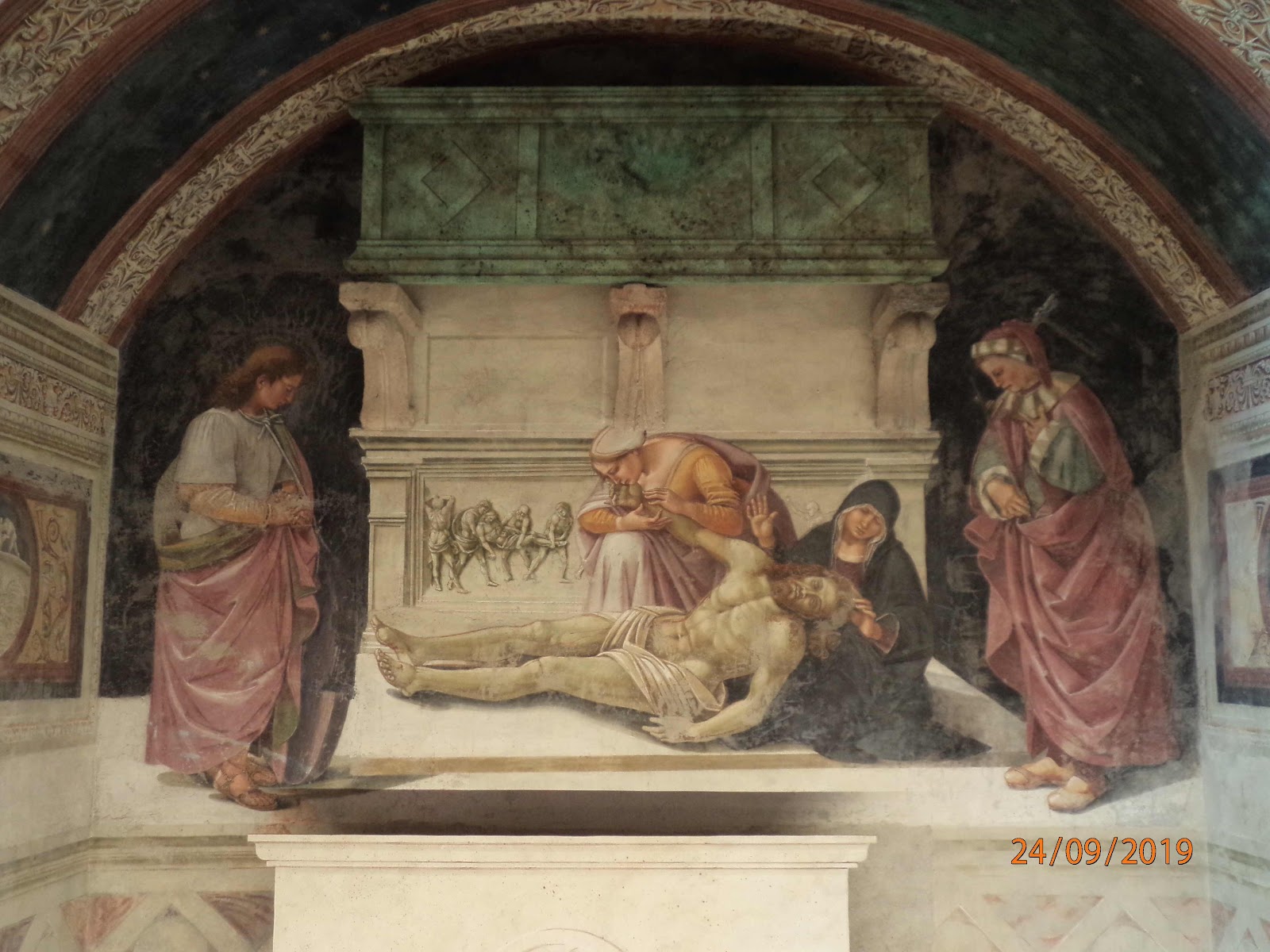
They aren’t easy to photograph, so I have chosen this one instead, which I really admired.


These scenes are regarded as some of the finest of the Renaissance. It is said that Michelangelo stopped here on his way to Rome, meaning to stay a couple of nights, and ended up staying three months to study these frescos. 

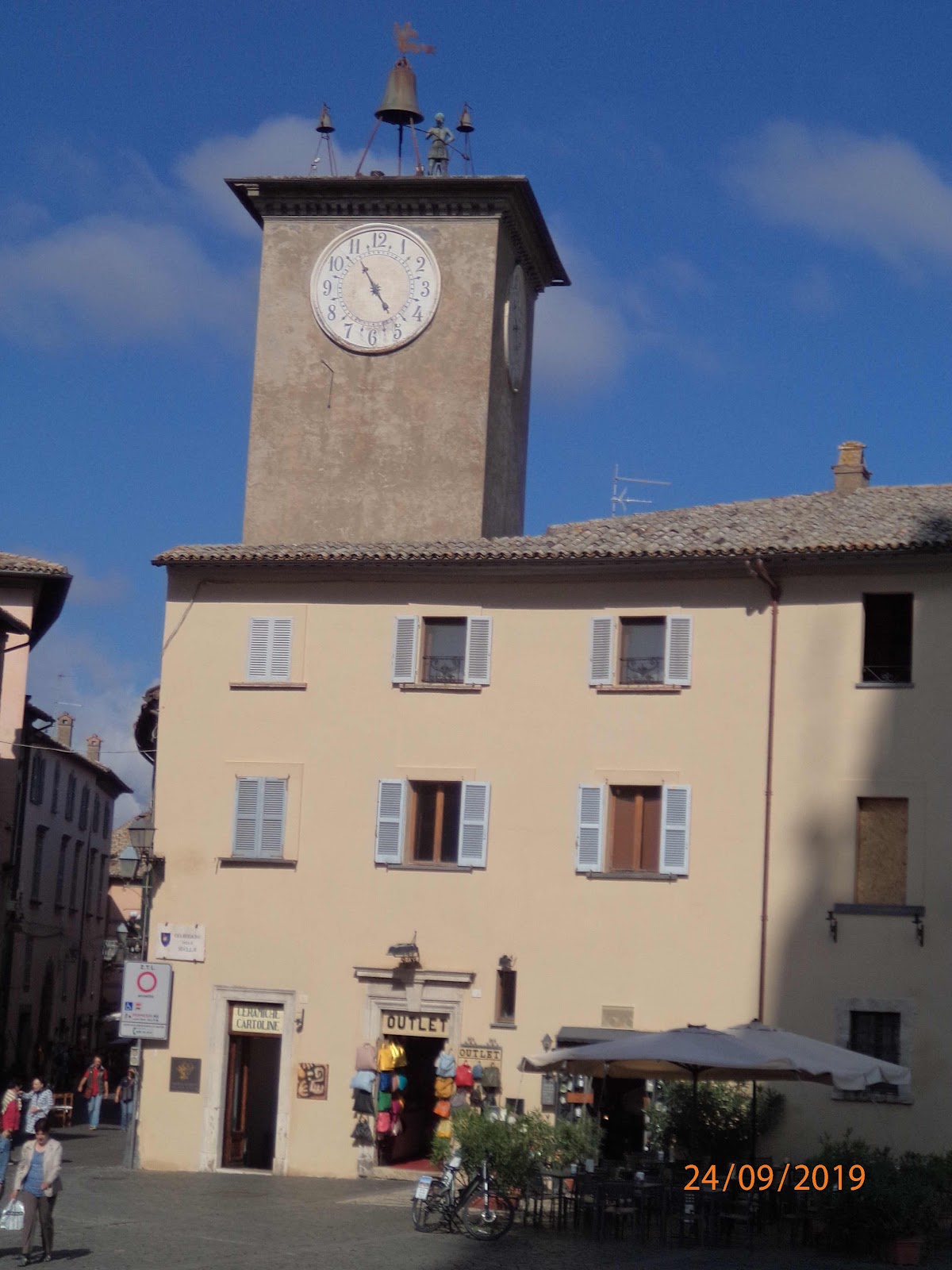
Outside in the square, we had a view of the Torre del Moro, with an automaton on the top. He strikes every quarter of an hour; I haven’t been able to find the exact  date, but some time in the 14th century anyway. Our guide called him the world’s first robot!


We walked round the town, admiring some of the fascinating little streets and shops.


There were some lovely ceramics which I coveted, but they were all very heavy. Also, anything I really liked seemed to be over €300. I would have liked to replace my big serving plate with one of them - but not at that price!

We walked back to the Museum, to look at some of the art works from the Duomo and various other churches. I photographed quite a few of them.


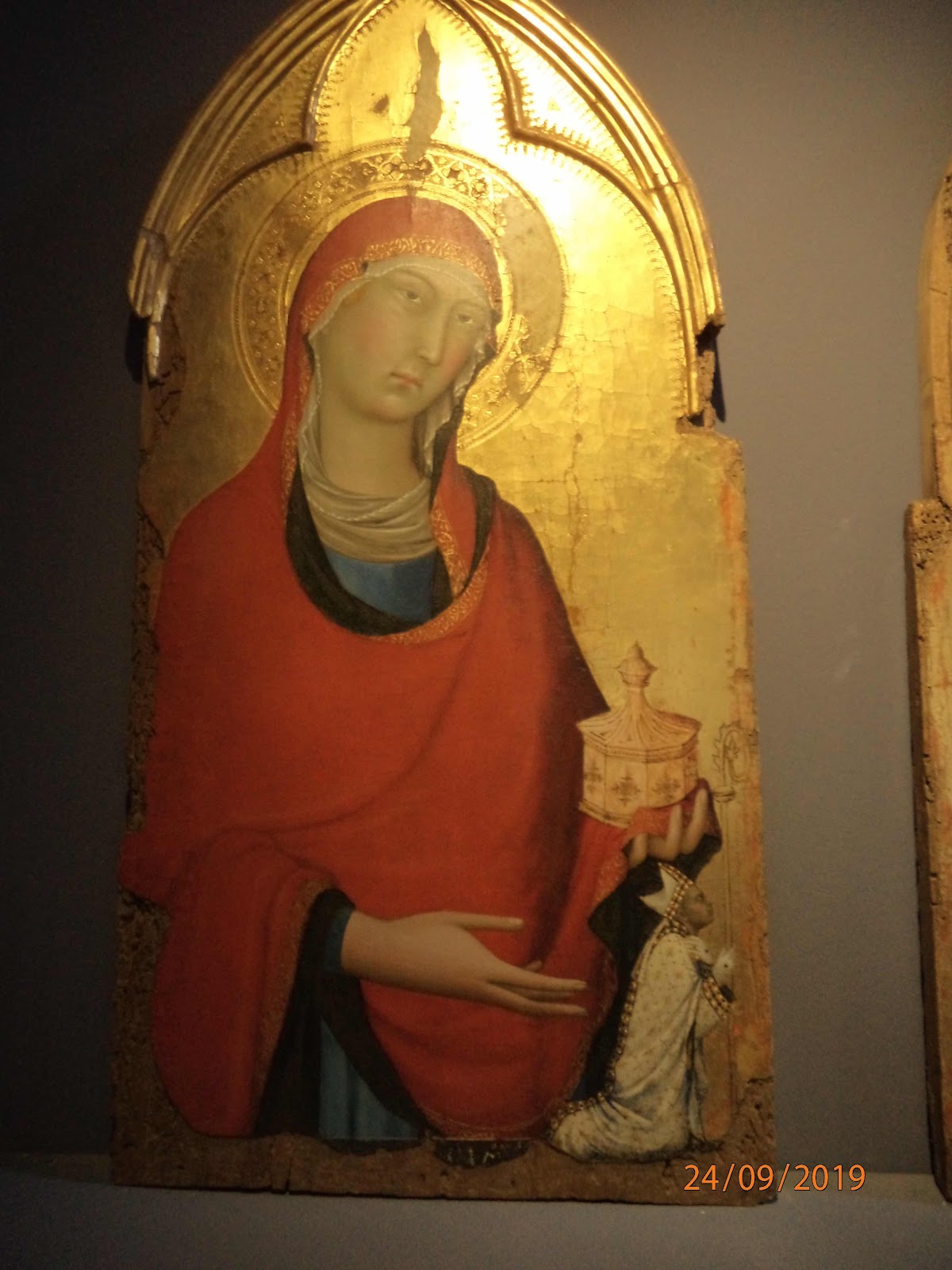
This is a St Mary Magdalen by Simone Martini. Quite a few of the local churches seemed to have examples of his work, which I suppose might be connected with the architect of the Duomo being from Sienna, as Simone Martini is from Sienna too. Though I know these popular artists were much in demand all over the region.

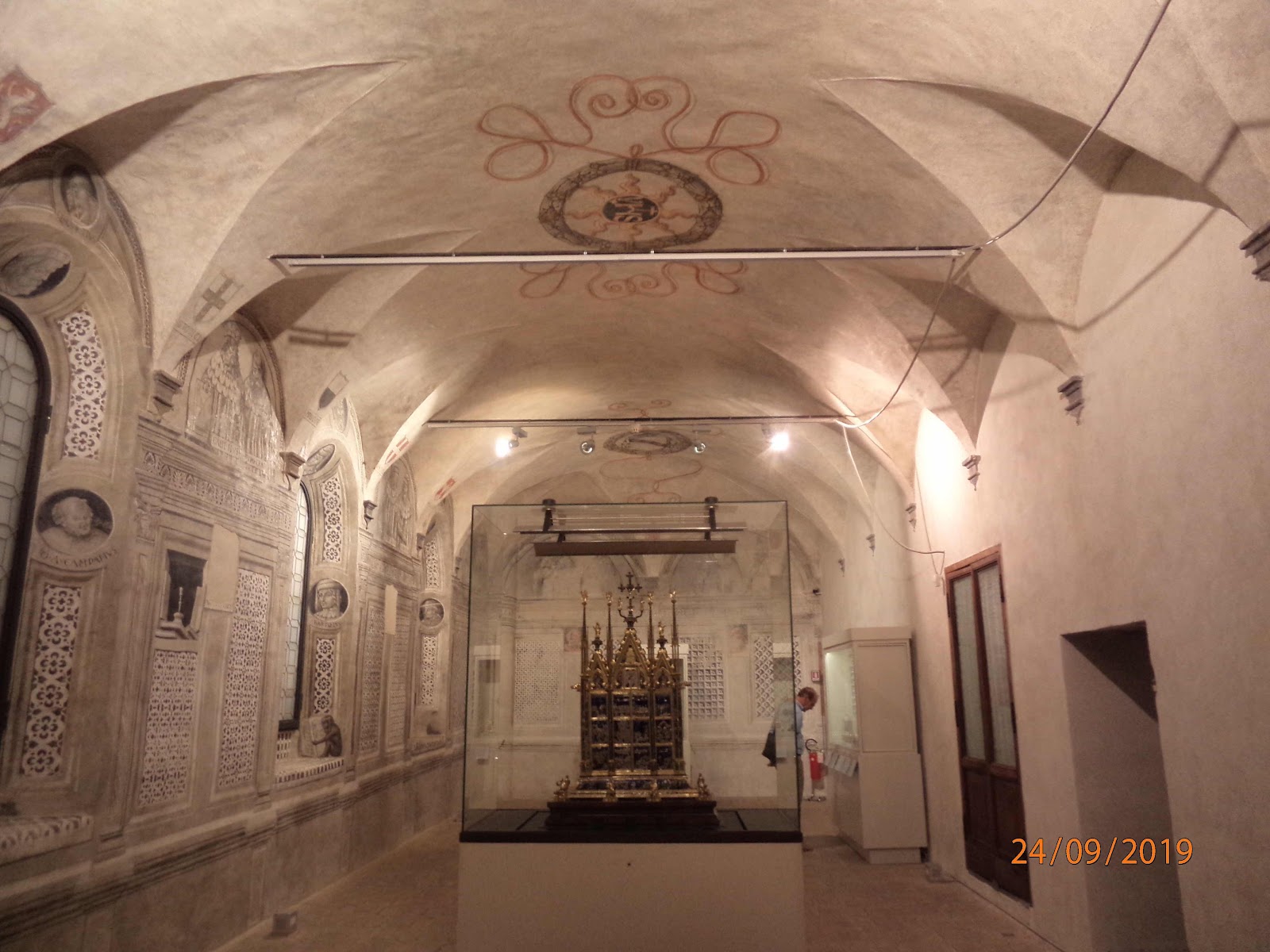
The Museum is in what is referred to as the Palace of the Popes, since so many popes stayed in Orvieto. This was the Library.


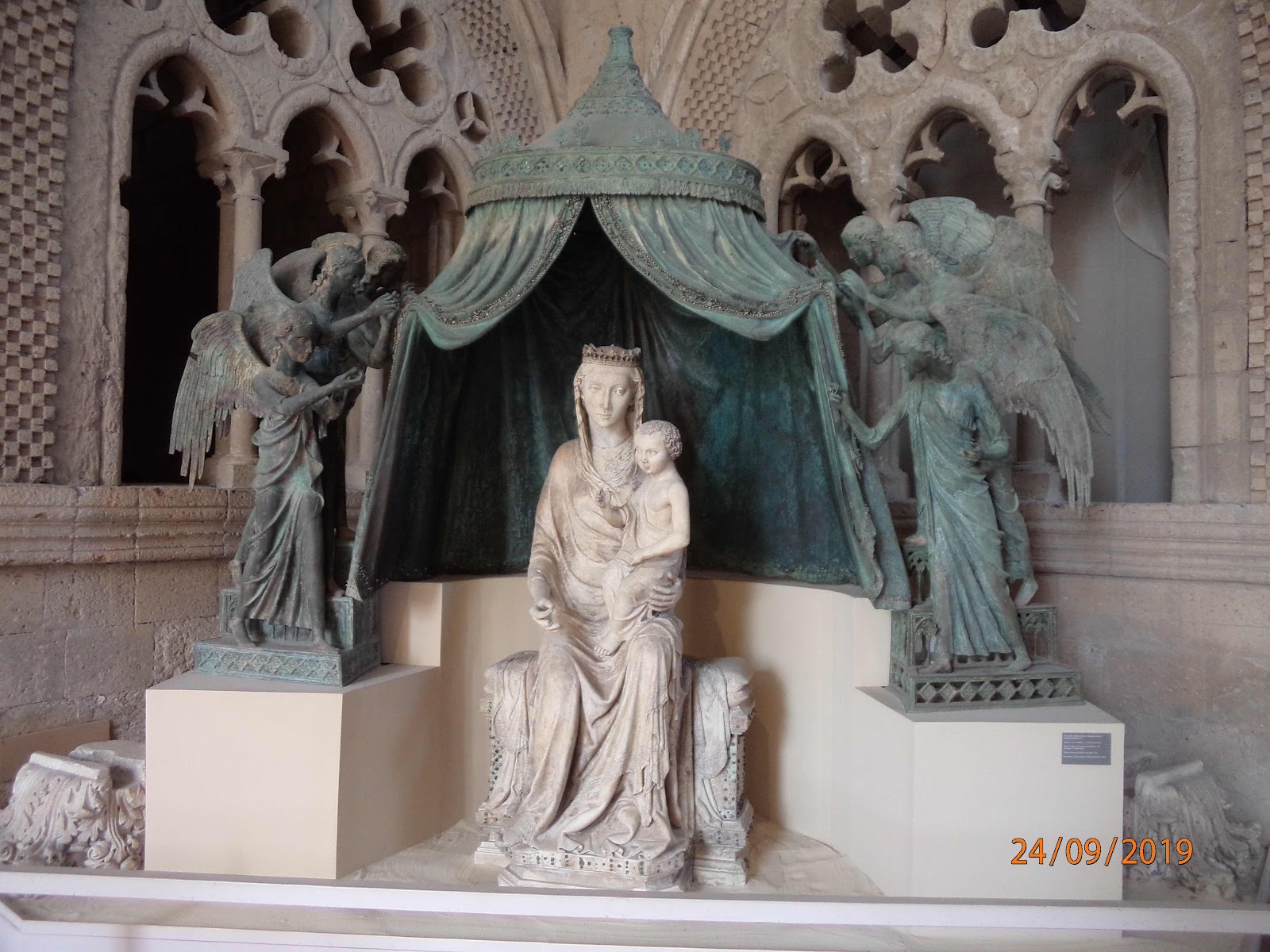
And this is the centrepiece when you enter and leave the Museum.


If you look at my photo of the front of the Duomo, you will see this group above the main door. The current group on the front of the Duomo is a reproduction. This is the original, placed here to protect it from the elements. The reproduction is very good though, I had no idea it wasn’t original. I understand the mosaics are reproductions too.

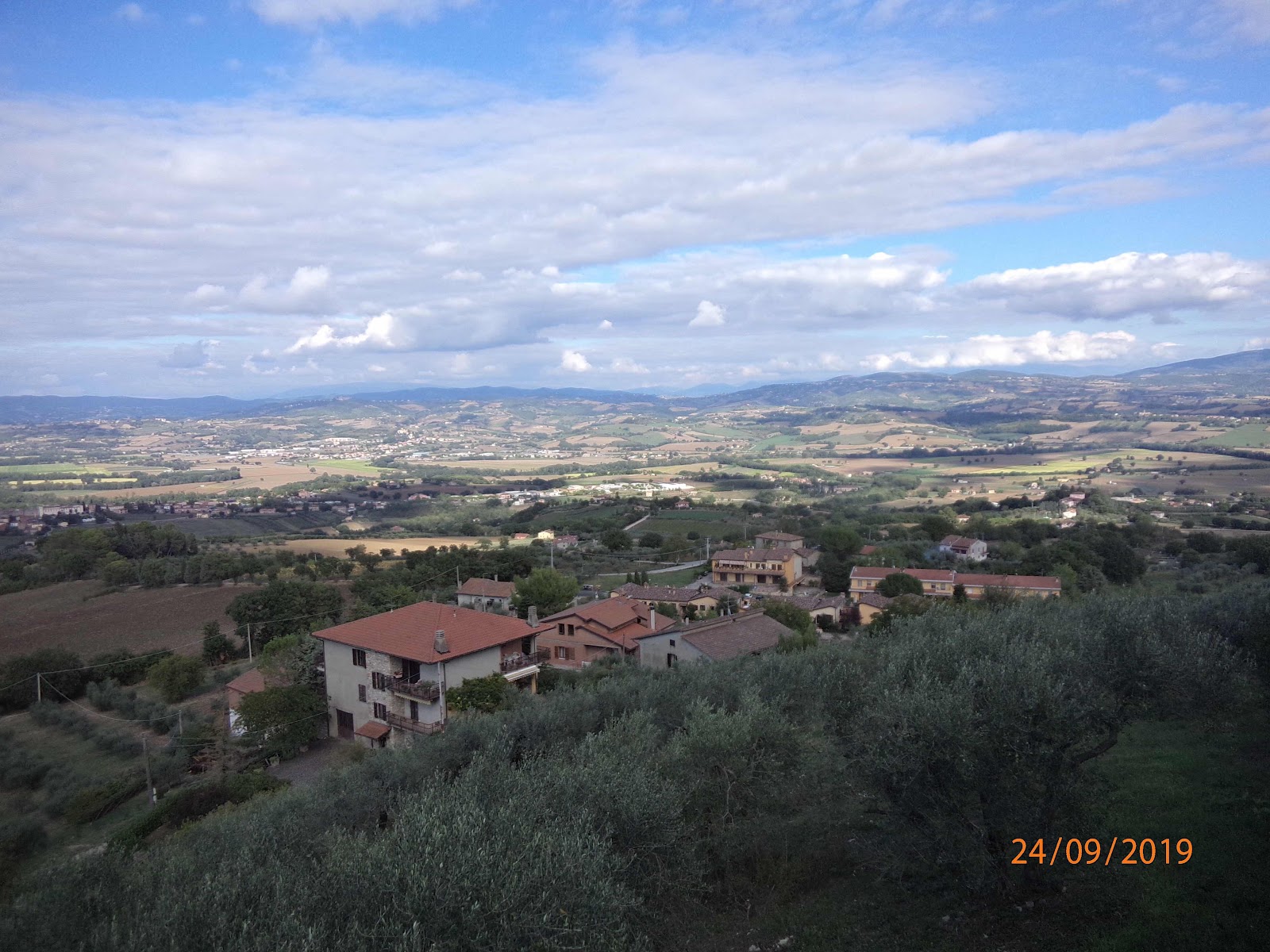
After Orvieto, we set off to Monte Castello de Vibio, to view a tiny theatre. Monte Castello, like Orvieto, is set high up on a mountain. The views, though lovely, are not as good as those from Orvieto (which I seem unaccountably to have forgotten to photograph).


After admiring the view, we set off through the town, parts of which are still quite medieval.


That’s a well in my photo, now capped off and functioning as a plant stand!

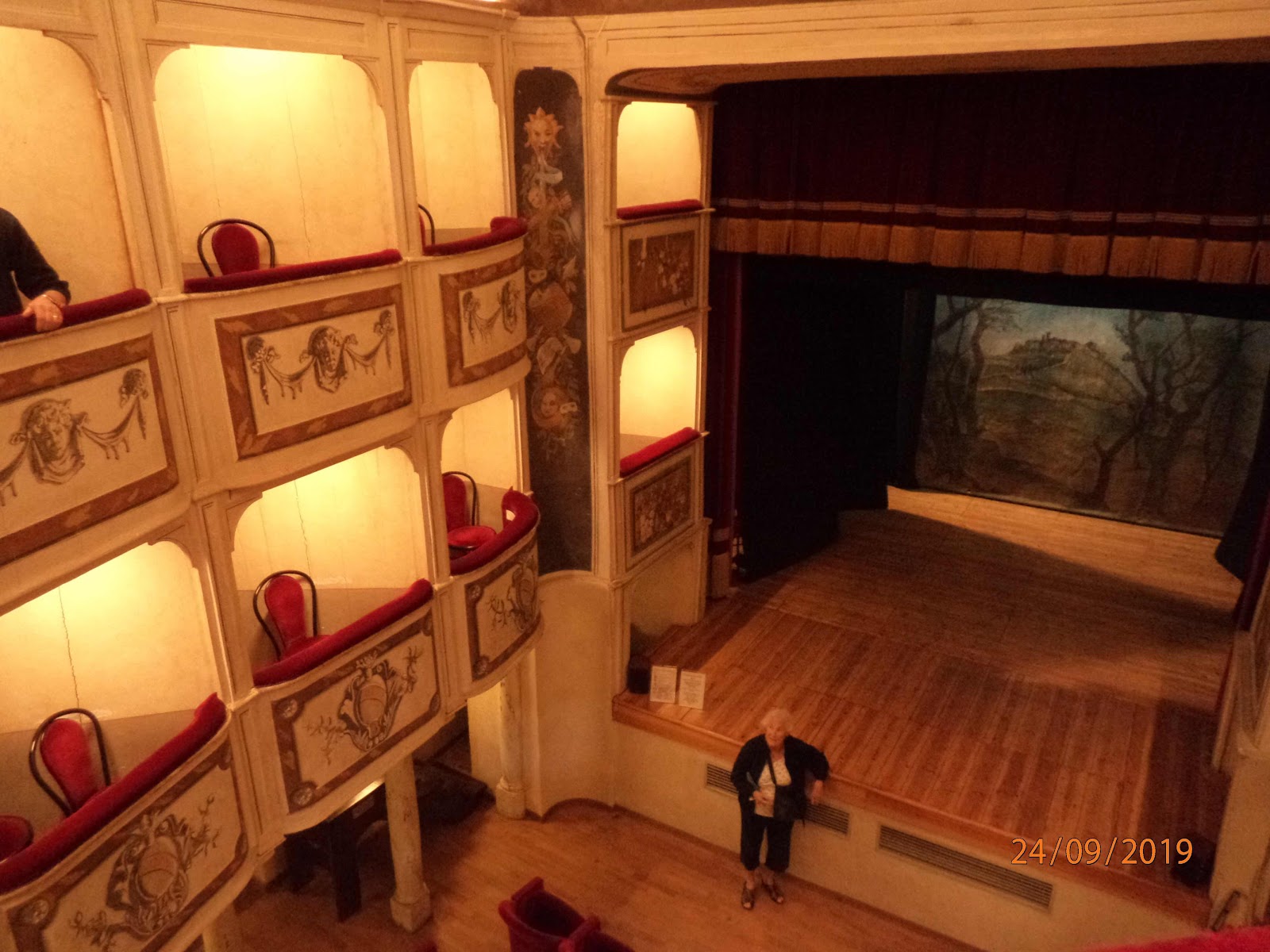
We went to view the Theatro della Concordia, which only seats 99 people. It was built in the early 1800s, and inside is entirely built of wood which has been painted and decorated with frescos. 

There are only about 40 seats in the stalls, all the rest are in boxes. It still holds a great many theatrical productions. You can book a theatre weekend, with B&B and a theatre visit! 

After this visit, we went back to Assisi to rest before going out to our final dinner, which was 3 courses taken from a recipe book belonging in the Vatican, with dishes served to various popes. We had a soup with vegetables and some sort of cereal in it, pheasant on toast with a green vegetable which was possibly chard, and some delicious crepes with a sauce made from fruits of the forest and chocolate! Then we had to go back to the hotel and pack, which was not so good. 

We are off to the airport at 9.30 am.

Monday, 23 September 2019

Lake Trasimeno and Perugia

Monday September 23rd

Today we set off fairly early to go to Lake Trasimeno, the 4th largest lake in Italy. It is also the scene of battle in 217 BC at which Hannibal comprehensively defeated the Romans.

We stopped at a small town called Passignano, which is a town of Etruscan origin. We didn’t go into the town though, just stayed on the lake shores and admired the views and then ran for a café when it stayed to rain. You could see it’s a pretty place in good weather, but it was fairly gloomy today, so we set off for Perugia.

Perugia has always been the largest town in Umbria, much larger than Assisi. The historic centre, at the top of a steep hill as usual, is medieval in appearance but is built on an Etruscan layout. It was settled by the Etruscans in the 5th century BC or earlier, and conquered by the Romans in 309 BC. It’s greatest splendour was in the 13th and 14th centuries, after which civil strife undermined it.

We first took the escalator down to the underground medieval street, which was once buried beneath a fortress which was built in 1543 on the orders of a pope who annexed the city in 1540. 


This is part of the street, which is called Via Baglione Sotterranea. There are what look like the remains of shops and houses, and the street itself is rather like a tunnel.

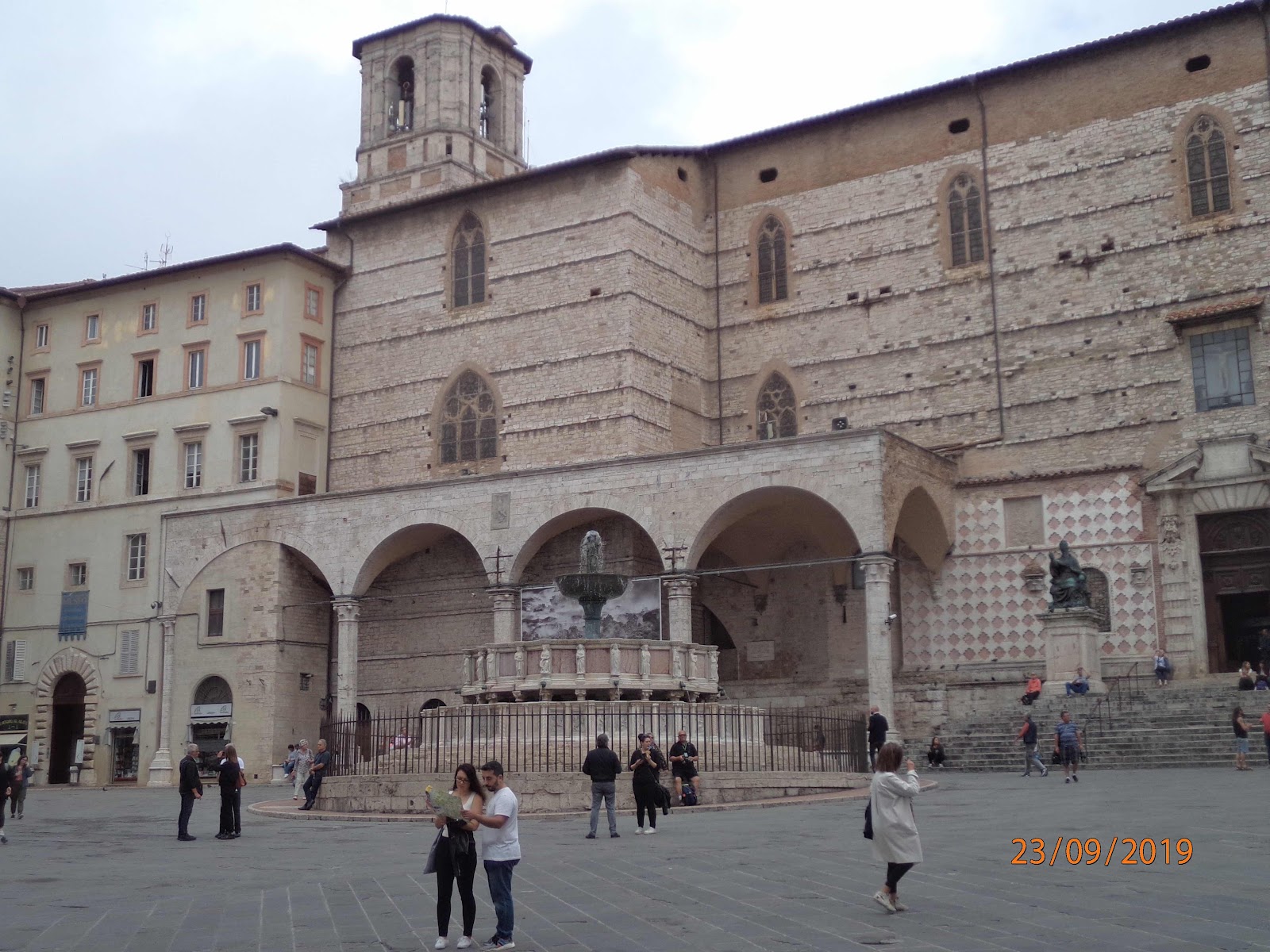
Once up at ground level again, we went up the main street to Piazza IV Novembre and looked at the Duomo, St Lorenzo, and the Fontana Maggiore.


The Duomo is to the right of my photo, and I haven’t managed to include the doorway, for some reason. We went inside the Duomo, and found it dark and rather solemn, and a bit Baroque.

Outside, I couldn’t resist taking a closeup of the Fontana Maggiore, the fountain built in 1275.


It was designed by a monk whose name I forget, but the decorated panels are by Nicola Pisano and his son Giovanni, in 3 cycles depicting episodes from the Old Testament, the Liberal Arts and the Labours of the Months. On the upper basin are sculptures representing biblical figures, Saints, mythological figures or allegories from the history of the city.

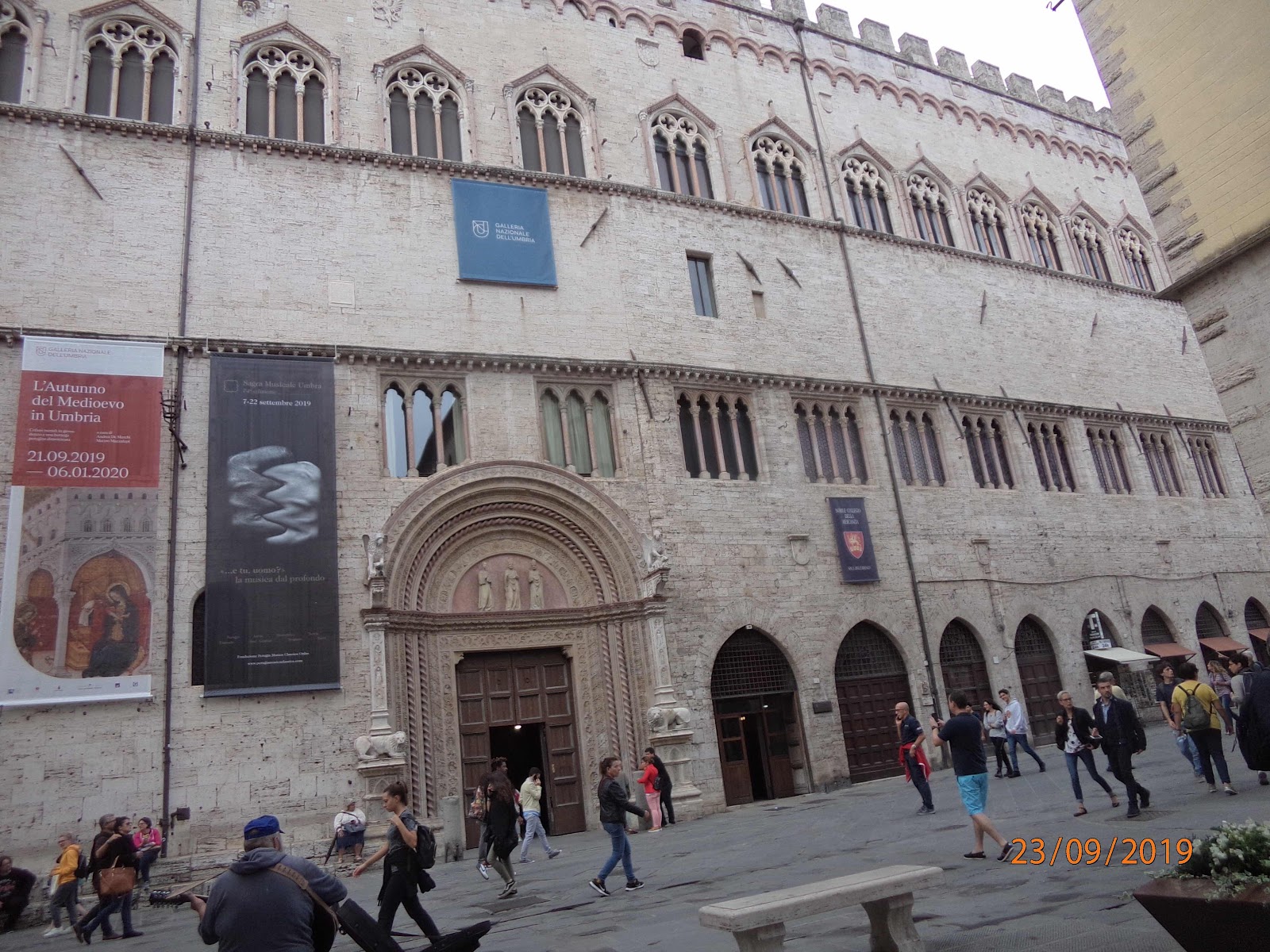
We walked back to the Palazzo dei Priori, which originally was built between 1293 and 1443 to hold the town council’s administrative offices. There are now several visitor attractions housed in it and we were interested in the Galleria Nazionale dell’Umbria.


This is the imposing entrance, dating from 1346, which is adorned with sculptures and reliefs, representing vices and virtues, as well as mythical animals. The gallery houses a splendid collection of art, so I have just picked out a few which I liked.

It’s all religious art


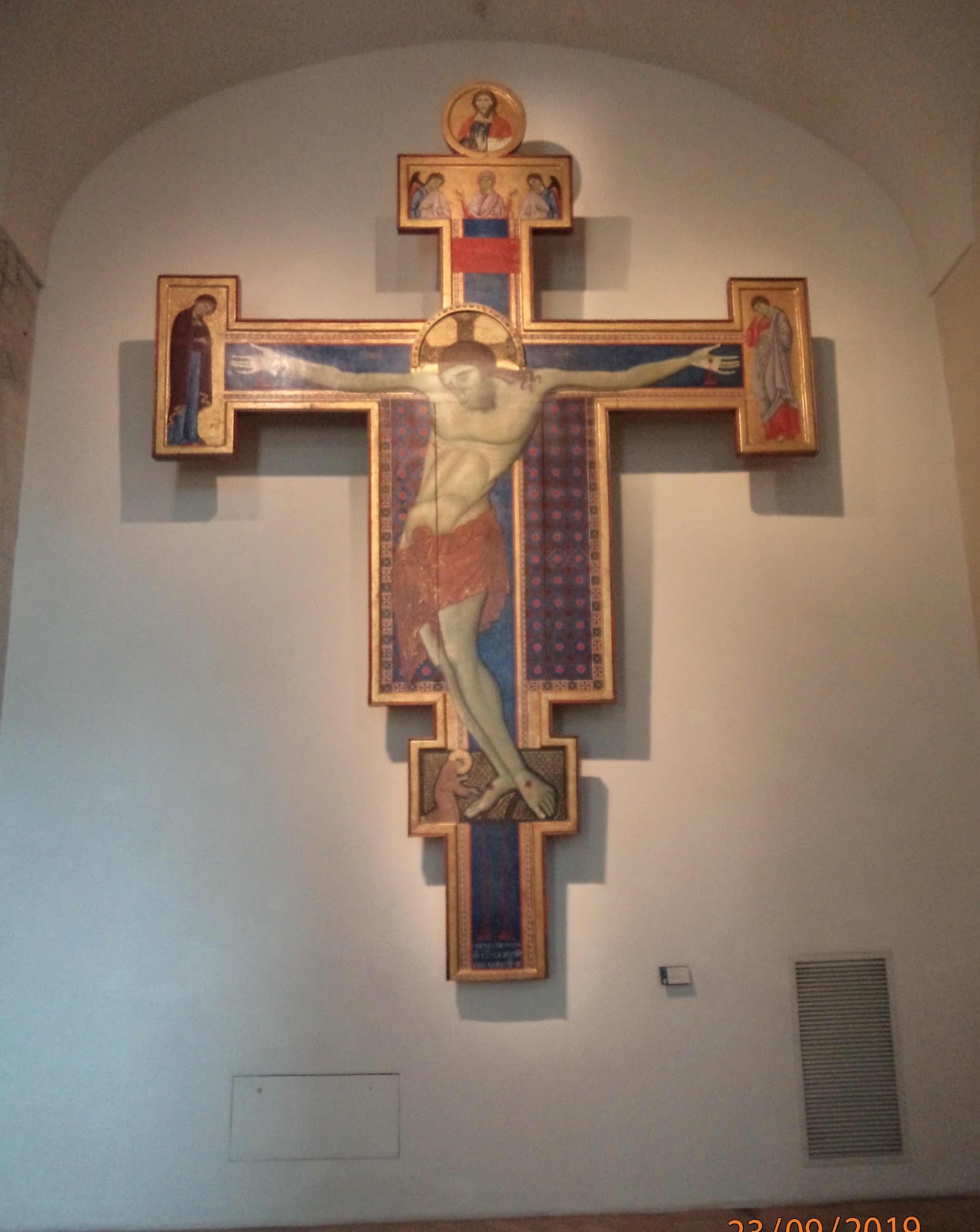
This crucifix is huge, and they don’t even know the name of the painter. He’s just referred to as the Maestro di San Francesco, and there are a number of his paintings in the gallery.

There are also some better known works


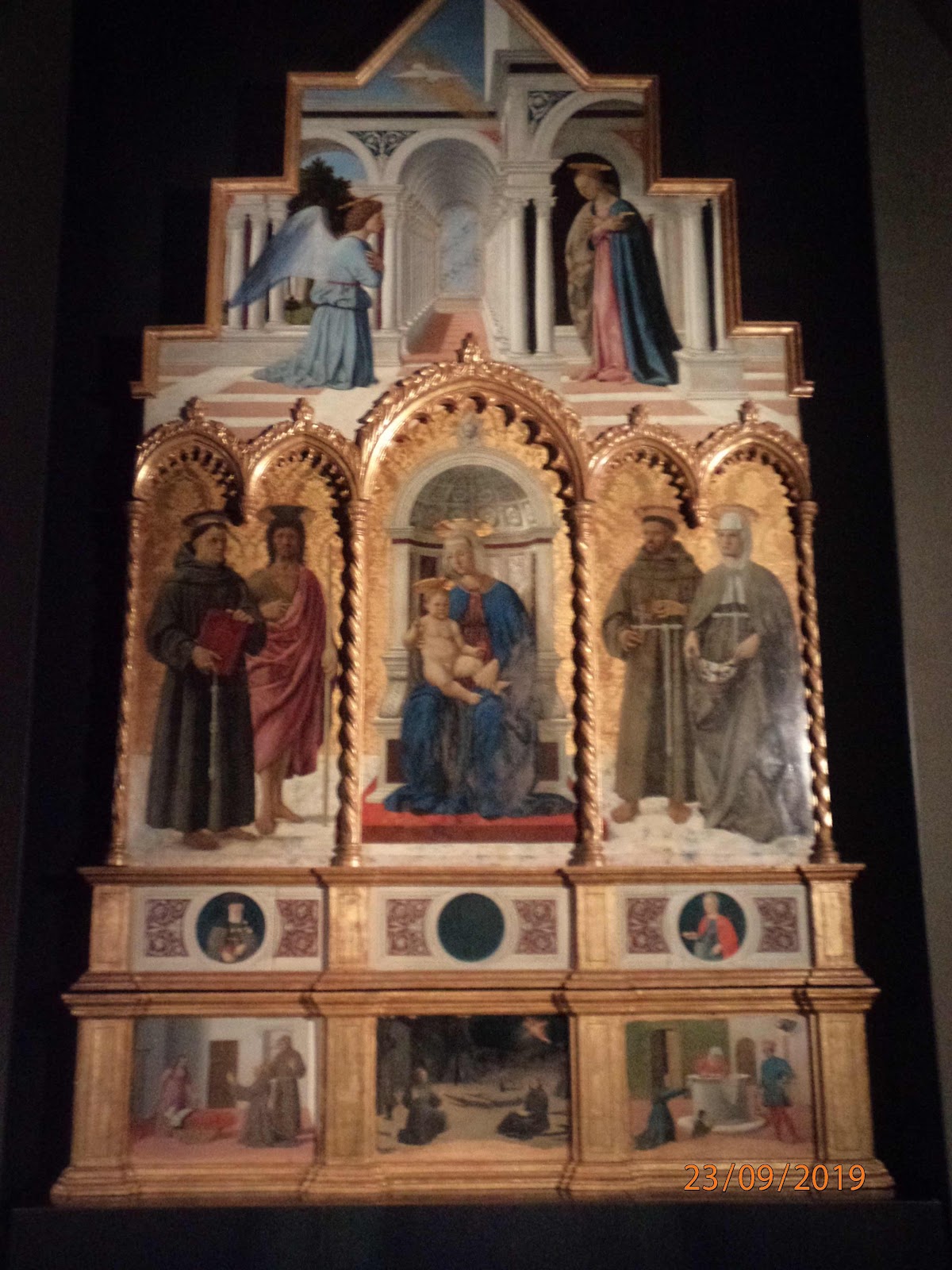
This is the St Anthony Polyptych, painted by Piero della Francesca in about 1468. It shows the use of perspective, which was innovative at the time.

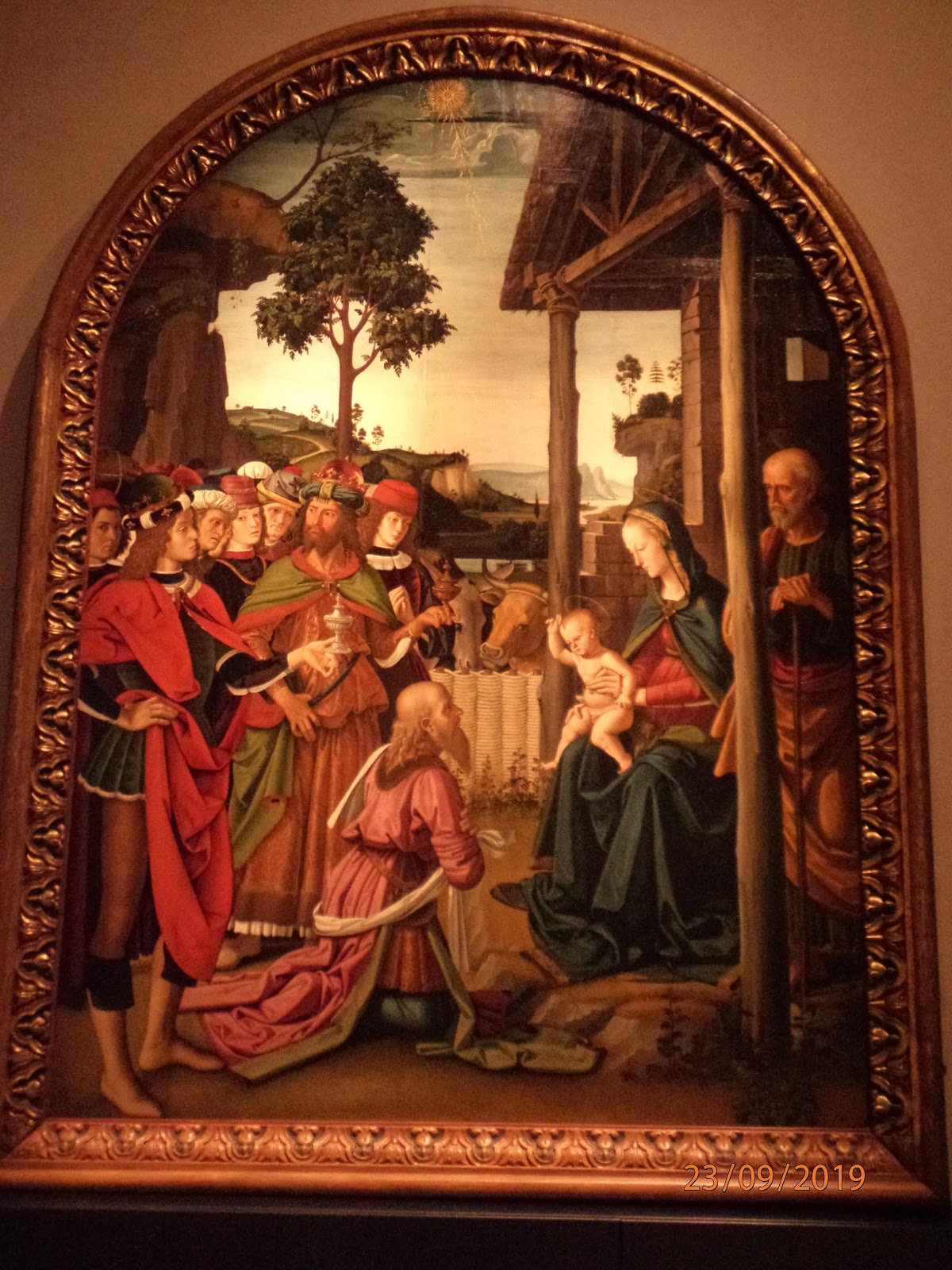
Just slightly later, in about 1473, is this Adoration of the Magi by Perugino.


Pietro Perugino was born Pietro Vannucci. His nickname characterises him as being from Perugia, in fact there is a big statue of him in one of the squares. His most famous pupil is Raphael.

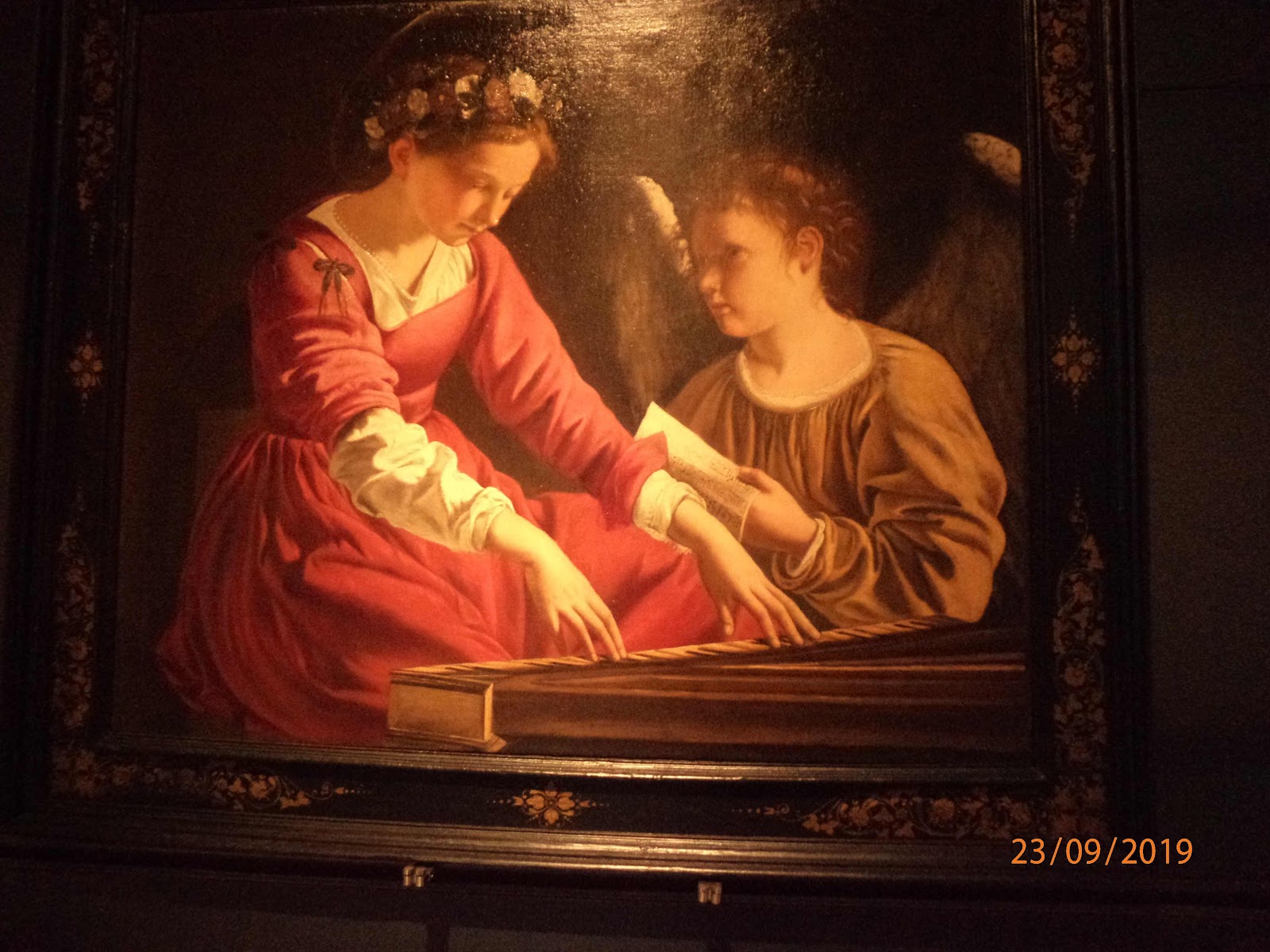
Somewhat more modern is this one, by Orazio Gentileschi, father of Artemisia. 


It’s called St Cecelia at her Spinet, Assisted by Angels. 

We were in the gallery for a couple of hours, and I was ready to eat something and rest my back, so we went to a café in the main street and sat under big umbrellas to eat panini and drink something. Then the rain started, heavier and heavier, until it was really pouring down. We had to move our feet to the table base as rivers of rainwater several inches deep rushed through from outside - the street in on a slope. Then the rain became so heavy it bounced up and under the umbrellas and everyone, including me, was getting quite wet. Some people put their own umbrellas up as well, even though they were under the café umbrellas. Then the thunder and lightening started, and the café owner came out and ordered us inside so he could furl the umbrellas!  I was glad to be inside, my trousers were quite wet, and we drank hot coffee until the rain went off and we could leave. In fact it was nearly time to meet our transport, so we just had time to admire the view from one of the terraces.


You can probably see the rainclouds still hanging over other areas. 

We made a very quick visit to the Etruscan gate which still exists in the city walls. There was too much traffic to stop for photos, but we admired the big blocks so exactly cut that no mortar was needed, even to hold the arch.

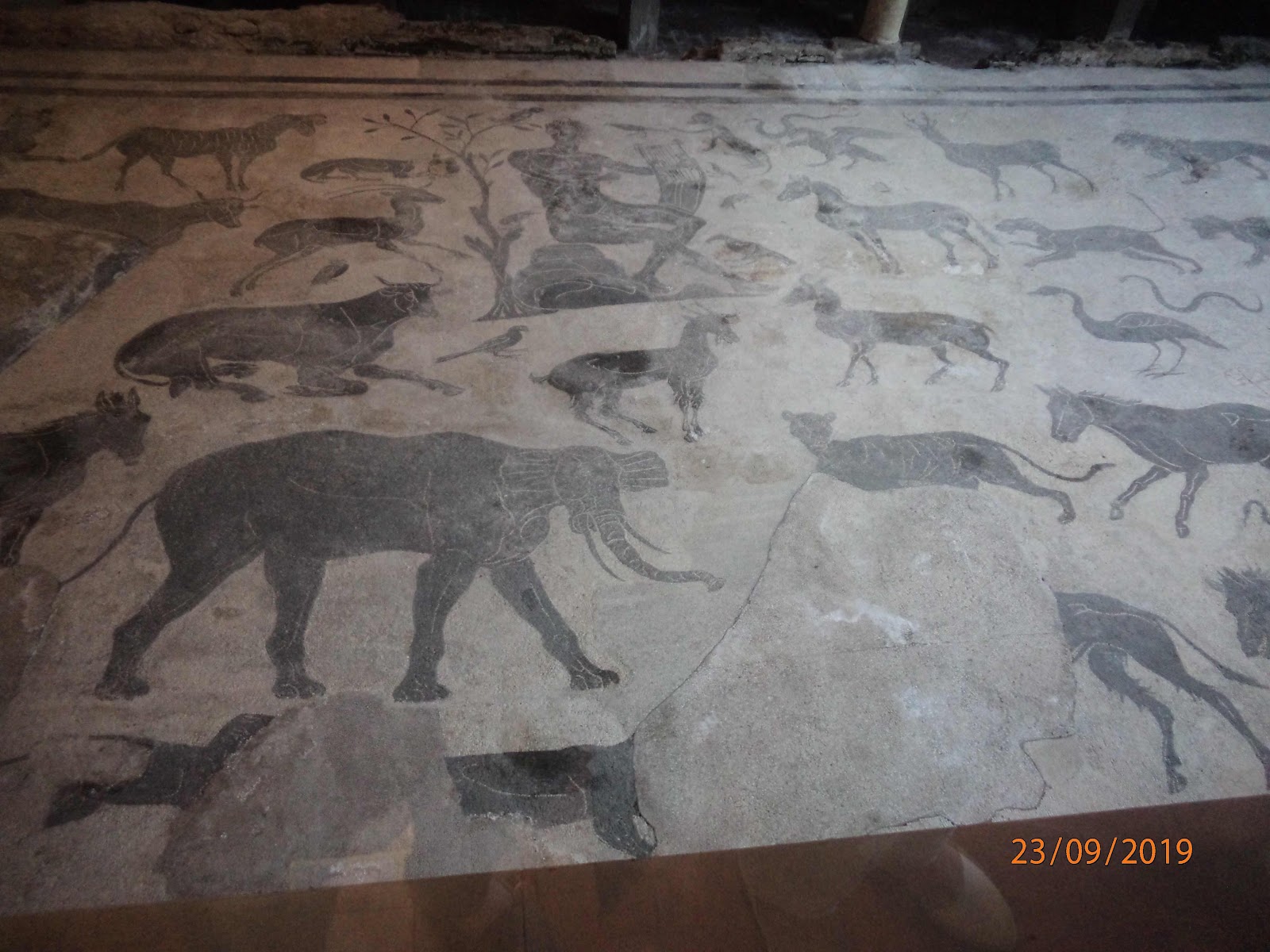
We went down to the university, to look at a Roman mosaic of Orpheus and the beasts which was found there in 1875. It was part of the public baths, and was outside the Roman walls. It’s so massive I couldn’t get it all into the photo.


There are 40 different beasts, presumably all being charmed by his music.

We were back in Assisi by 5 in time for a short rest before going out again to wine tasting and dinner with our host Roy. I am now so exhausted I’m hoping for a good rest when I get home!


Sunday, 22 September 2019

Urbino

Sunday 22nd September 

Today we visited Urbino, a medieval walled town some distance away from Assisi in the Marche region of Italy. Sadly, it was a day of rain so, though there were some lovely views as we crossed the Apennines for the second time, it was hard to see them through the rain and drifting clouds.

The town of Urbino retains much of its medieval appearance. We walked round part of the walls at first, and looked down on the many streets that are far too narrow for cars.
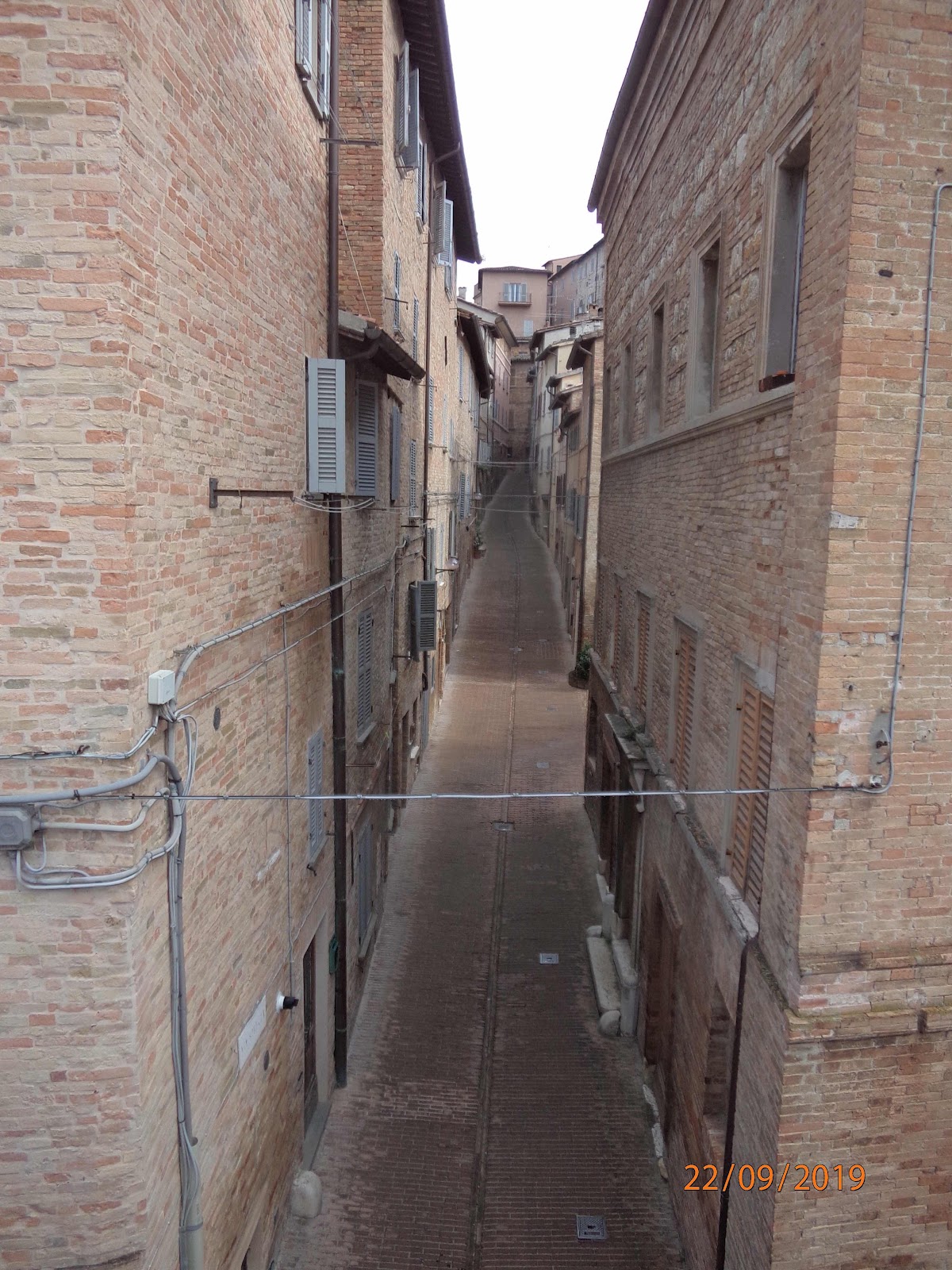


The town is built on two hills, and the streets vary between being steep and being very steep. Some are so steep they are more like ladders.
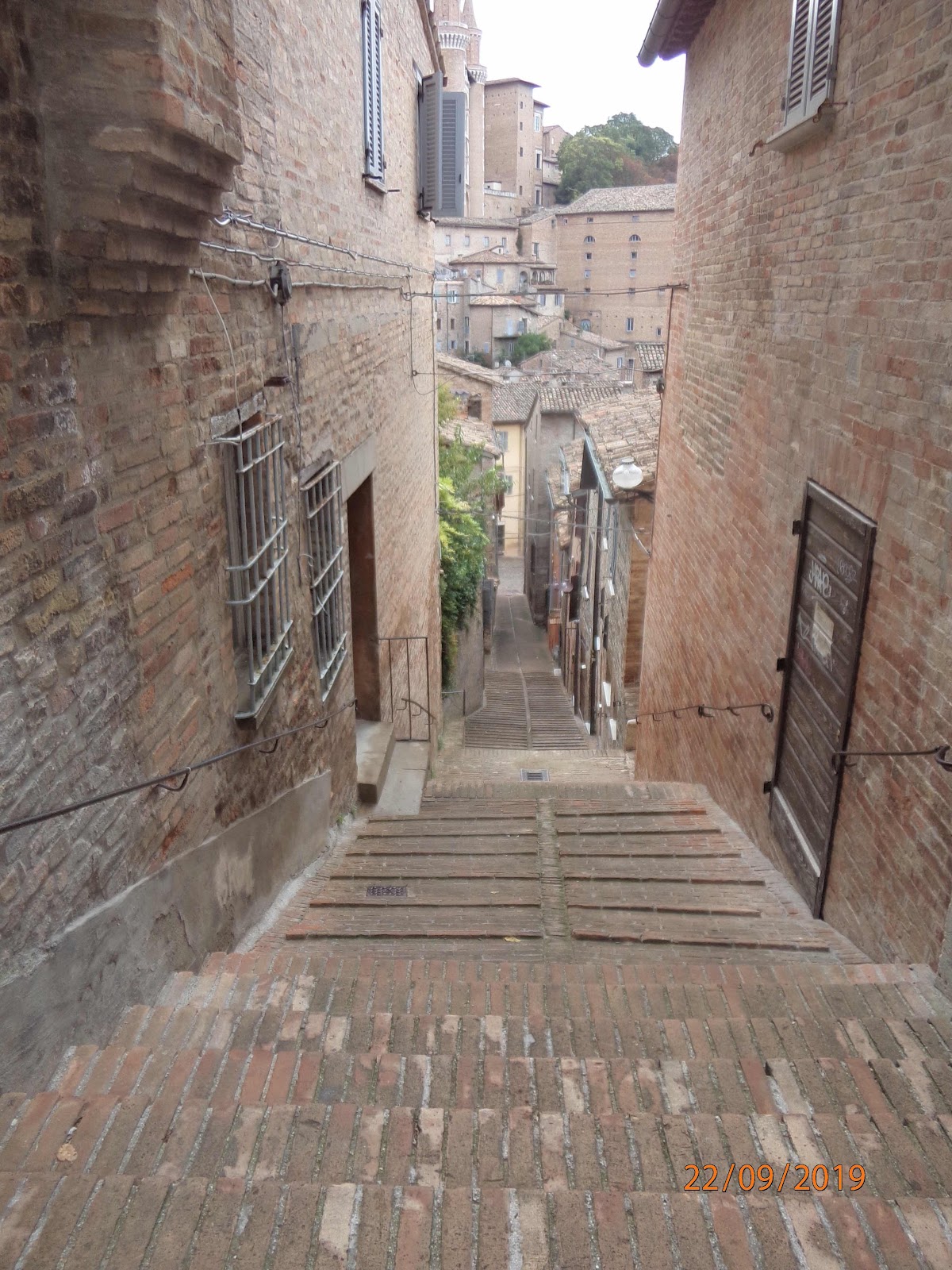

This one is actually called a ladder - Scalette di S. Giovanni! We asked our guide how women with pushchairs managed; she said she had had twins and used a twin pushchair, so she soon had very well developed arm muscles!

We visited the Oratorio de San Giuseppe - St Joseph to you and me. The members of the confraternity of St Joseph helped the families of people who had been executed, but delivered this help while wearing long dark robes with pointed hoods and face coverings with just two eye holes. This was to conceal their identity but it must have been extremely worrying to open your door to somebody who appeared to have dyed their ku klux klan robes black by mistake.

The chapel is rather too Baroque for my taste, but it does have an altar built to house a copy of a painting by Raphael, who was born in Urbino, though he left as a young man.

The nice thing about this oratorio is the room that has been decorated with stucco to look like a cave which contains a life size representation, also in stucco, of the Nativity. 
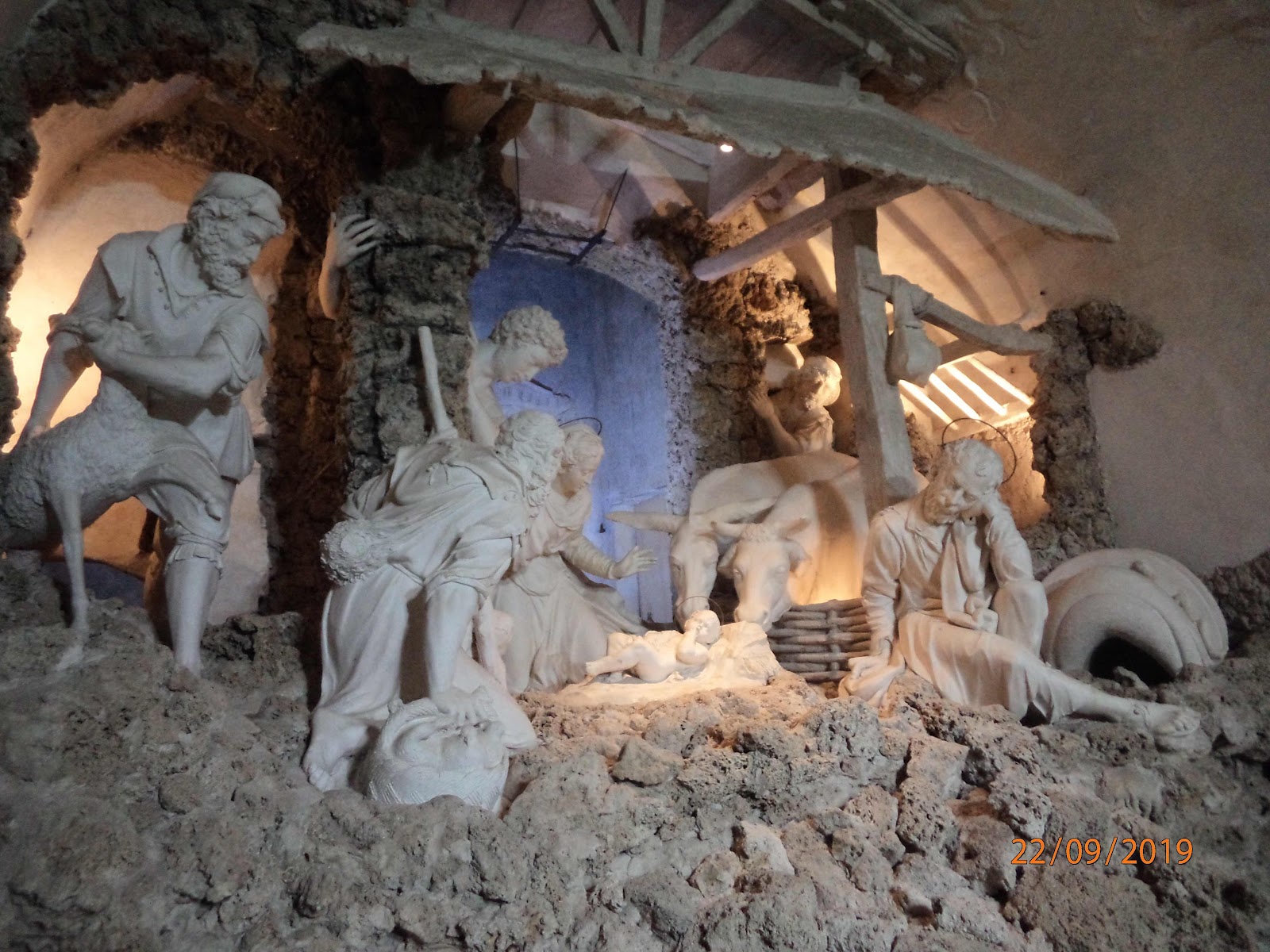

The shepherds and Mary are looking at the baby, as are the cow and the donkey, and poor St Joseph looks about to collapse with exhaustion.

Another room in the Oratory has a portrait of Charles Edward Stuart, the Old Pretender. He lived in exile in Urbino for a couple of years shortly after the failed 1715 rebellion, and was a member of the confraternity. 

Close by is another oratorio, that of San Giovanni Battista - St John the Baptist. This was very much more to my taste. It has a stunning late Gothic style fresco cycle of 1416, painted by 2 brothers called Lorenzo and Jacobo Salimbeni, of whom I had never previously heard. The subjects include 2 Madonnas, one by each brother, and a Crucifixion.
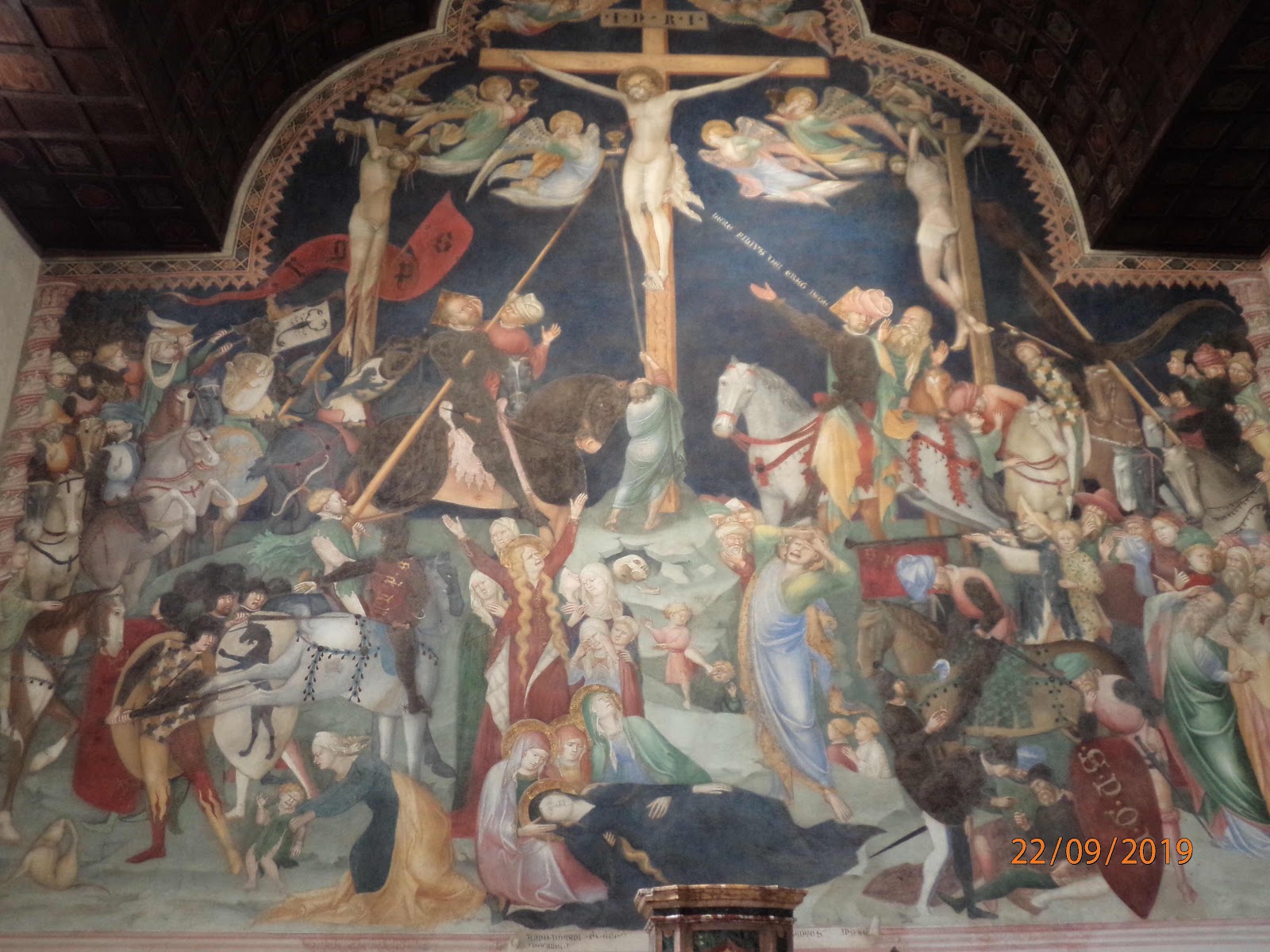

This scene is so full of characters and there is so much to see. The artists have included not only the agony of some of the onlookers but the indifference of others, and has also put in  such details as two naughty little boys fighting at the foot of the cross, a dog washing itself in the left corner, and an angry mother trying to prevent her child approaching the dog.

The whole of the right hand wall has scenes from the life of John the Baptist.


I could have sat and stared at these for ages, they are all so full of life and detail, but it was time to press on to the Ducal Palace, which houses a great many masterpieces.

The Ducal Palace was built for the Duke Frederico da Montefeltro in the mid 15th century. The Duke is the chap with the impossibly hooked nose in the famous portrait by Piero della Francesca in the Uffizi in Florence. The Duke’s nose such a strange shape because he lost his right eye and the bridge of his nose following an injury in a tournament. 

It’s a typical renaissance palace. This is the interior courtyard


It’s apparently built on the remains of an earlier palace, but I couldn’t see any remains of anything earlier.

There are so many masterpieces in the Palace it would be ridiculous to include them all here. There’s a very beautiful Madonna by Giovanni Bellini, but it was impossible to photograph because of the very bright light shining directly onto it.

There’s a very famous Flagellation of Christ by Piero della Francesca but I don’t like it very much. I far preferred his Madonna.
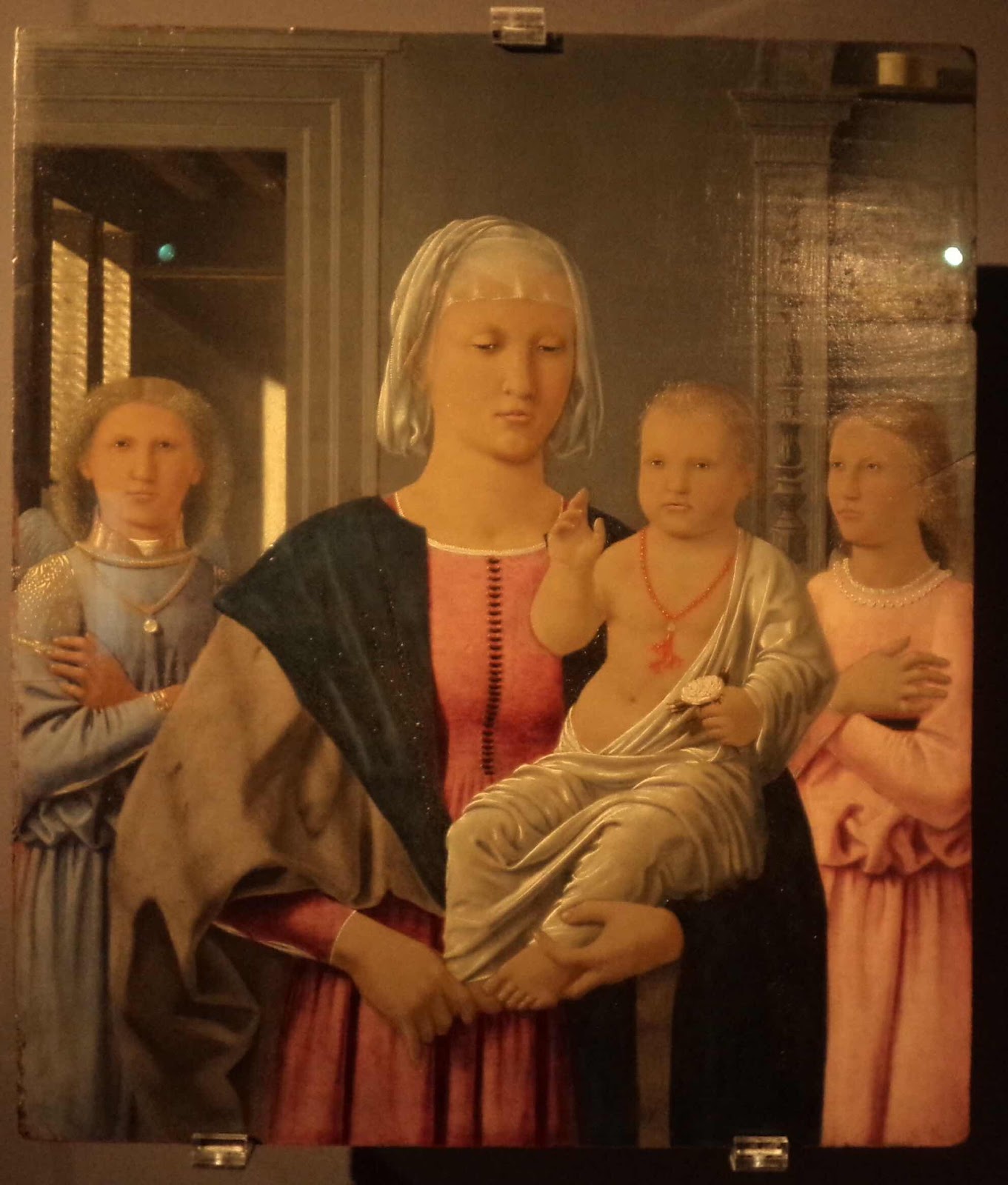


I’m afraid I didn’t quite manage to eliminate the reflection of a light nearby, so there are a couple of bright spots on it which don’t belong.

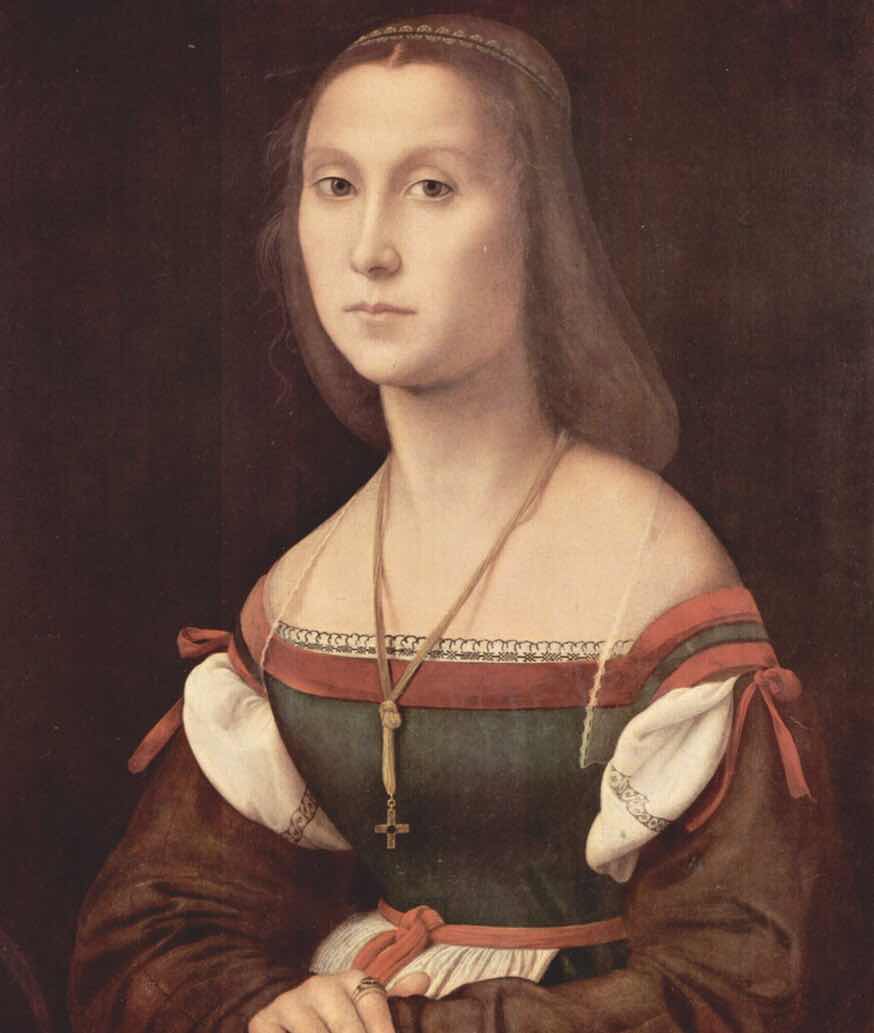
There’s a masterpiece by Raphael, dated about 1505,  called La Muta, which I didn’t really like either. She looks so miserable, but that’s possibly because she has just become a widow.


I much preferred another by Raphael called St Catherine, but it was completely impossible to photograph because of the reflections from the light on the glass covering it. Raphael being one of my favourite painters,I did manage a photo of tapestries copied from his cartoons, but they haven’t come out well enough to appreciate.

There are a couple of paintings by Titian, one is this Last Supper
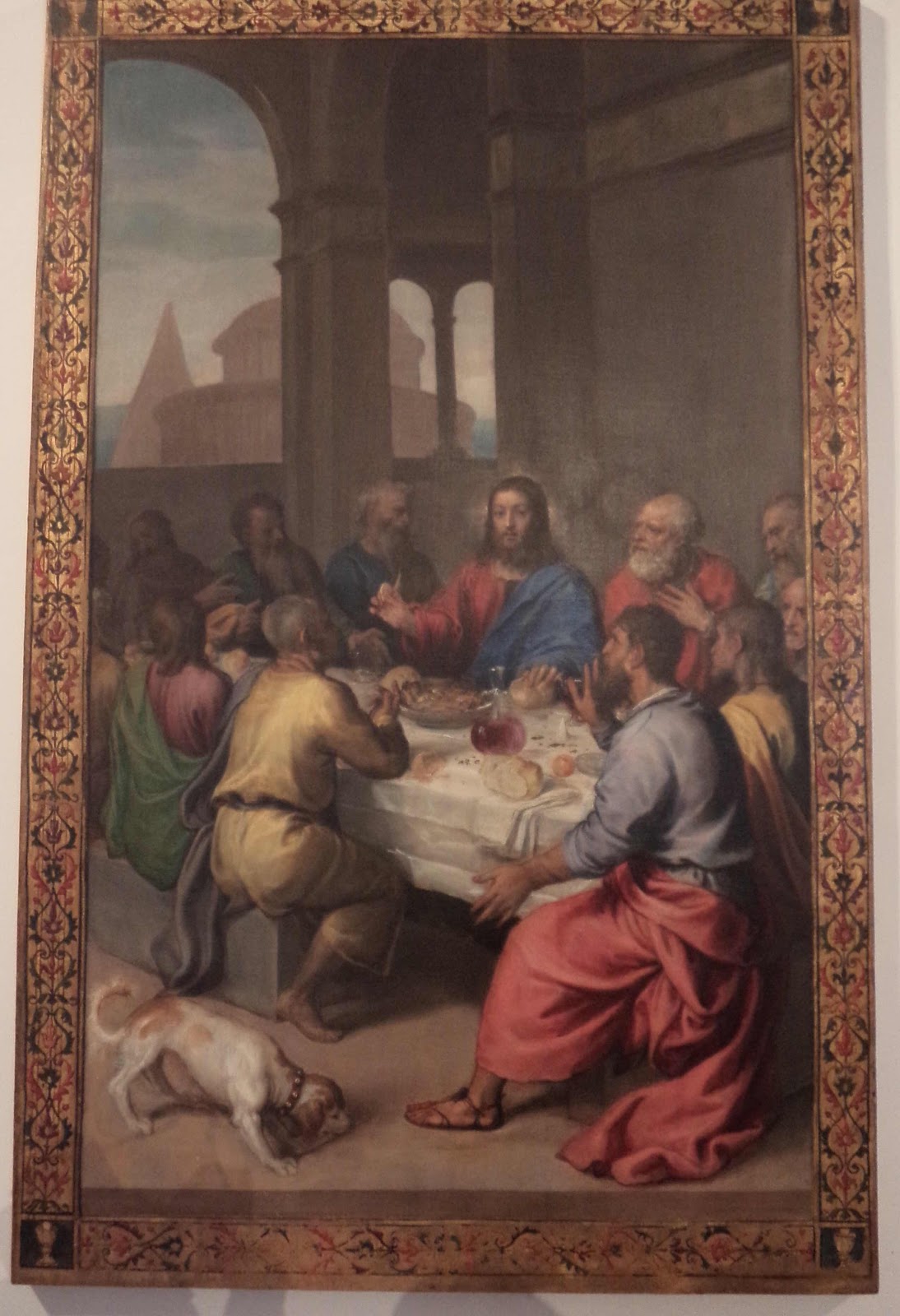


As usual, I have managed to photograph it squint. I think it comes from trying to take the photo quickly and get out of the way, though I suspect it might not be much better however long I took. I probably need a tripod! 

There’s a painting by Paolo Uccello called The Miracle of the Desecrated Host but it’s in 6 scenes, it’s 10 or 12 feet long, I didn’t understand it but I think it might well be anti-Semitic, so I’m not posting it here.

The palace also featured some rooms personal to the Duke, like one called the Studiolo, a small study for contemplation. Its walls are completely covered in wood, with inlays so that various scenes are represented. This is one I particularly liked.
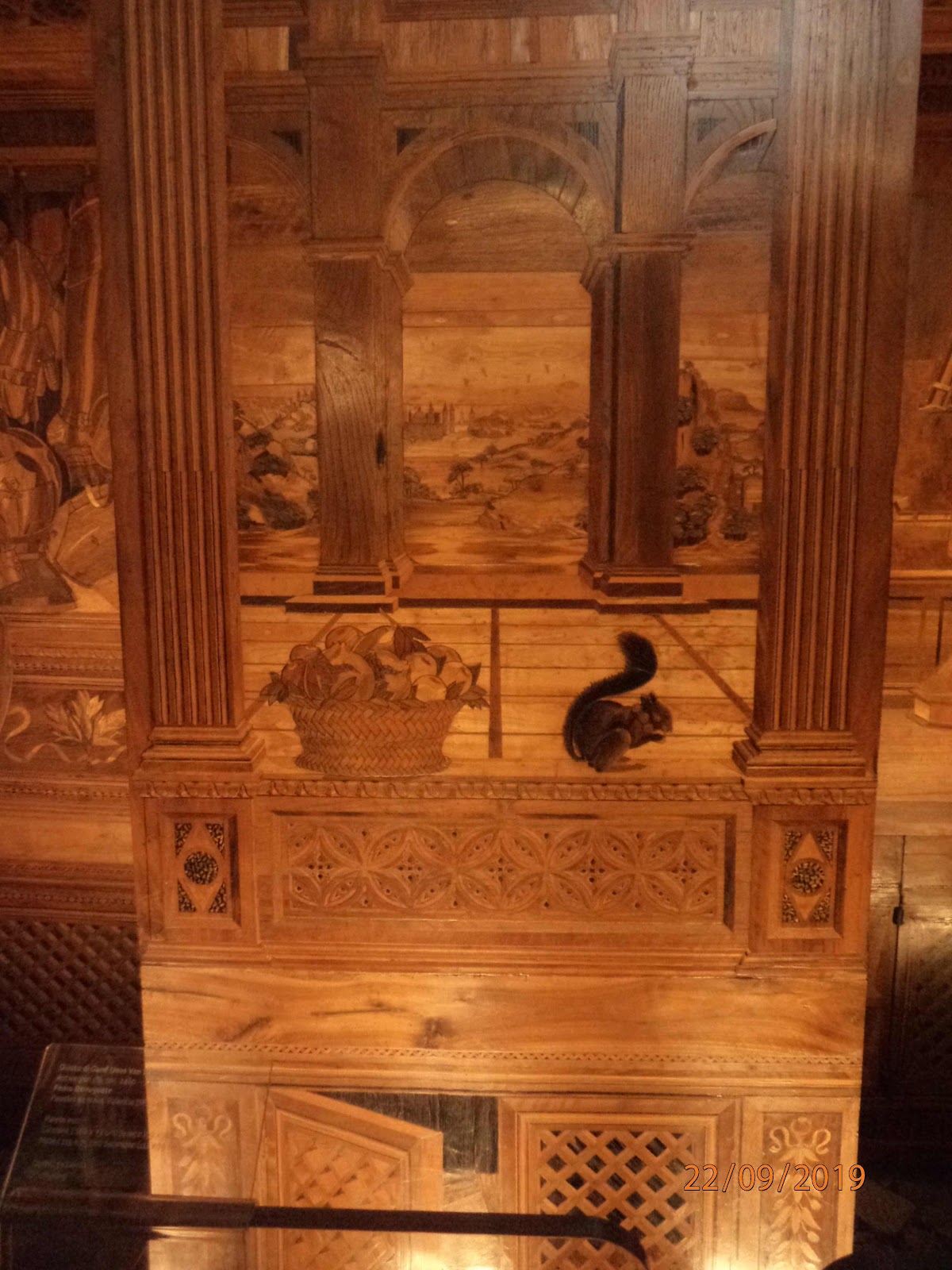

It’s hard to believe this isn’t painted or carved, the base looks so 3 dimensional. It’s entirely created from wooden inlays of different colours.

There is also a room, not very large, where Charles Edward Stuart, The Old Pretender, lived while he was in exile in Urbino. And there are a couple of garden areas, one where we sat and ate a sandwich after we had spent a couple of hours in the place. We had hoped to find time to visit Raphael's house, but we had so little time to eat and visit the bookshop that it was soon time to go. 

After we left Urbino, we returned to Assisi in time to look into Basilica Santa Ciara, which we had missed through lack of time when doing our tour of Assisi. It’s the Basilica that was built for St Clare after she died in 1253, and her body was brought down from San Damiano which we visited a few days ago. The Basilica is a bit of a strange shape.


It’s built into another church which you can see on the right, and Roy says he thinks the enormous buttresses on the left were probably built to balance that.

No photos are allowed, but I just took some quietly without flash. This is the miraculous crucifix that spoke to St Francis, which is left in a special room at the side of the church.
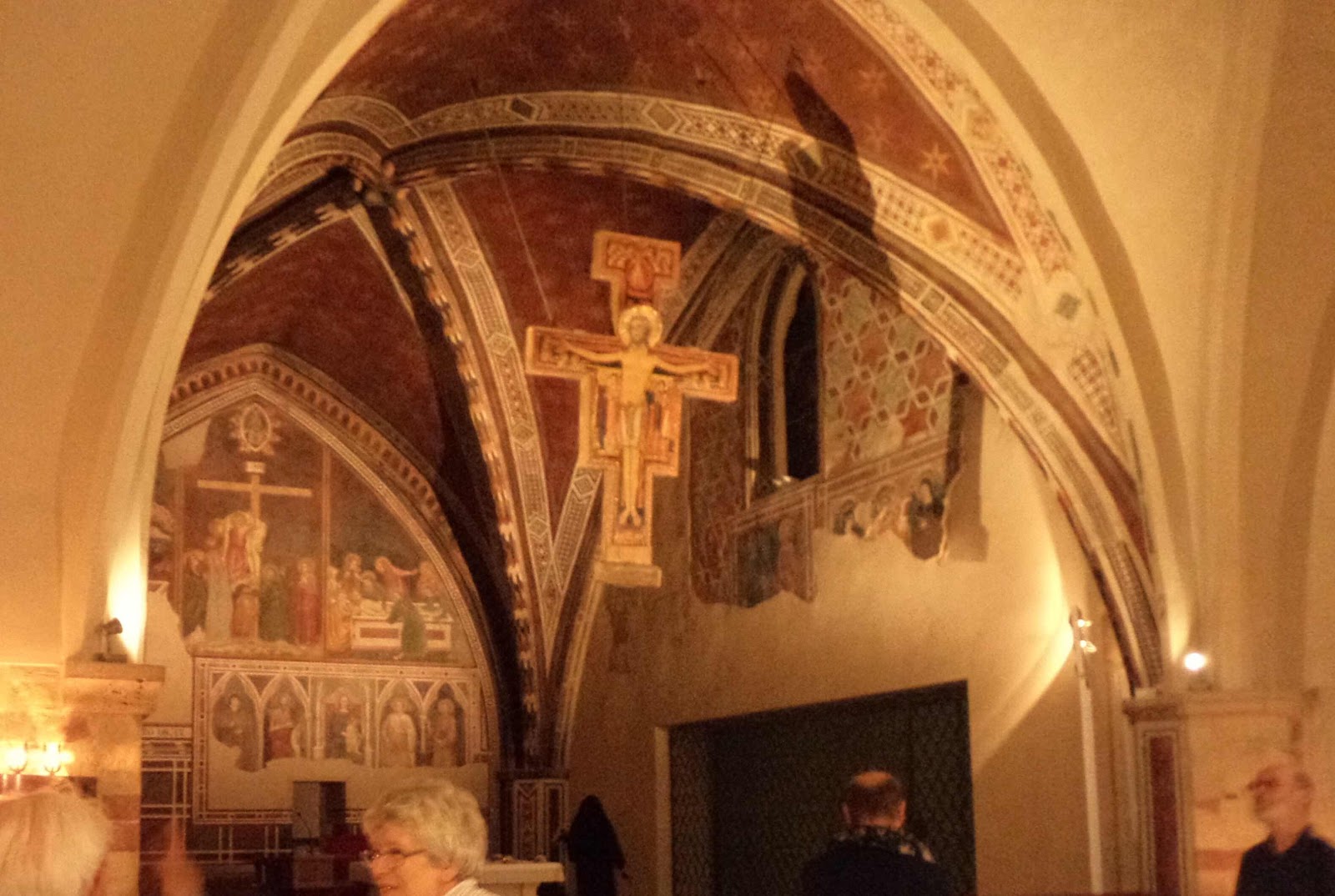

We 
This is painted in the very early style, when Christ on the cross is depicted as triumphing over death, rather than dying like a criminal. The church itself has one in a slightly later style, where He where is is shown as suffering, with a drooping head and twisted body.

We went down to the crypt to view Clare’s body and her ragged robes which have been kept for nearly 800 years, but there were so many devout people praying down there that I didn’t like to take photos.

We walked back up the hill to our hotel, it being almost 6, so I could write all this up. Tomorrow we go to Perugia and Lake Trasimeno, and out to a special dinner, so I don’t know when I’ll get time to post anything. 


Saturday, 21 September 2019

Ravenna

Saturday 21st September

Today we drove through the Apennines right down to the east coast to visit Ravenna, which is noted for 5th and 6th century Byzantine mosaics. The drive took somewhat longer than intended, since parts of the motorway had been closed, without apparently much notice, for some sort of race, so many people were driving about in a confused way and the traffic was truly terrible. We were 45 minutes late in meeting our guide, which meant our visits were more rushed than they need have been. And the drive back also took much longer than expected.

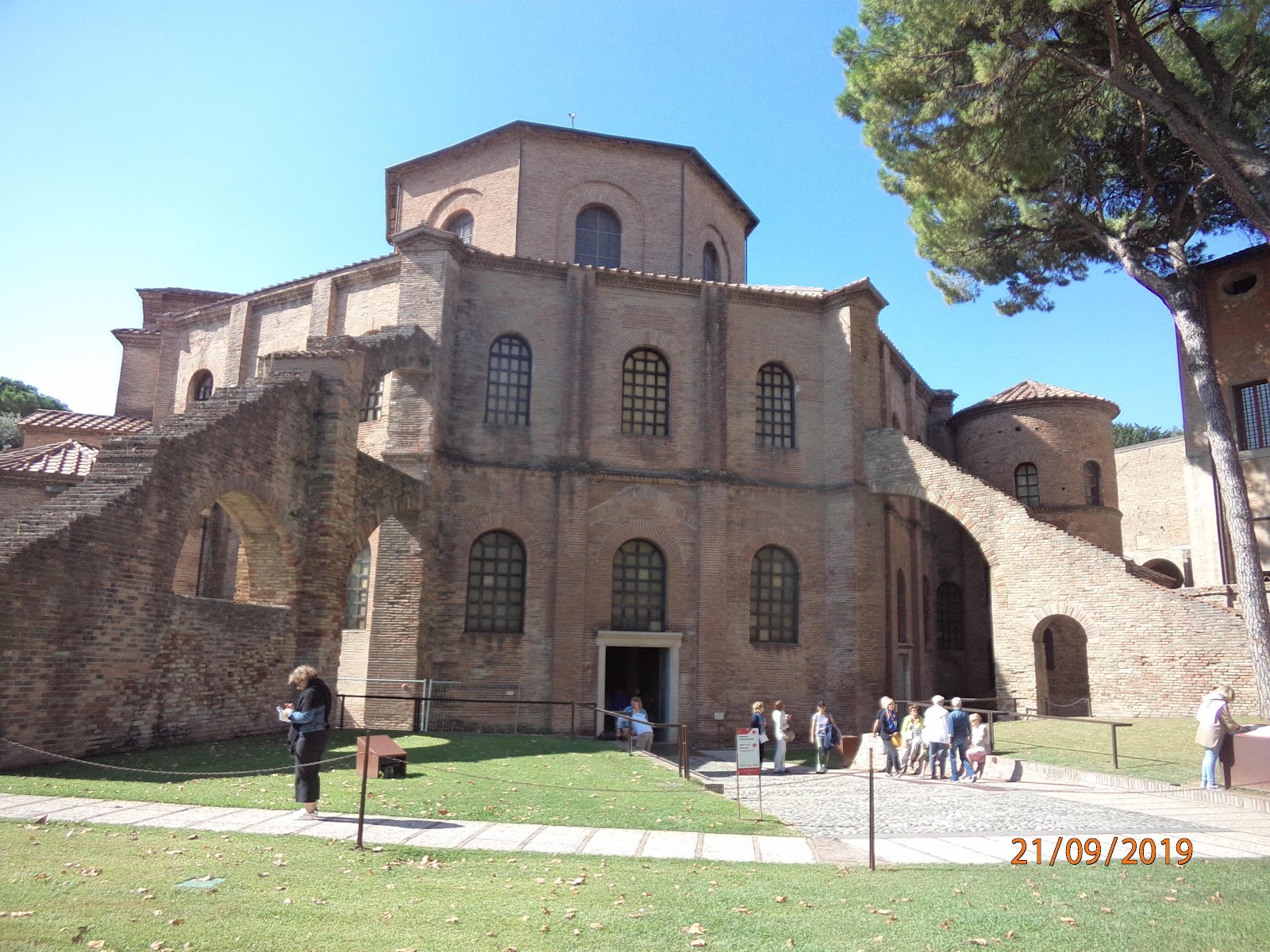
Our first visit was to the Basilica of St. Vitale, a saint of whom I had never previously heard. This is not particularly surprising because he may not in fact have existed at all. All that seems to be known about him was that he was martyred by being tortured and then buried alive in a pit, possibly during the reign of the emperor Nero in the 1st century AD, or possibly some time in the 3rd century, or possibly even during the Diocletian persecutions early in the 4th century. He is the patron saint of Ravenna and according to local tradition, his octagonal Basilica stands on the place where he was buried alive. 


The Basilica was started in 527 AD and is most famous for containing the largest and best preserved Byzantine mosaics outside Constantinople. Below is the one in the apse.


This one shows a Byzantine Christ, young and beardless and more like a pagan image of Apollo, seated on the globe. Angels stand on either side of him, and at his right hand (the left of the photo) he is handing a martyr’s crown to St Vitale. Although this isn’t my best photo of this mosaic, I included it because it shows the surroundings as well; every square inch of the surface is covered with glittering mosaics.

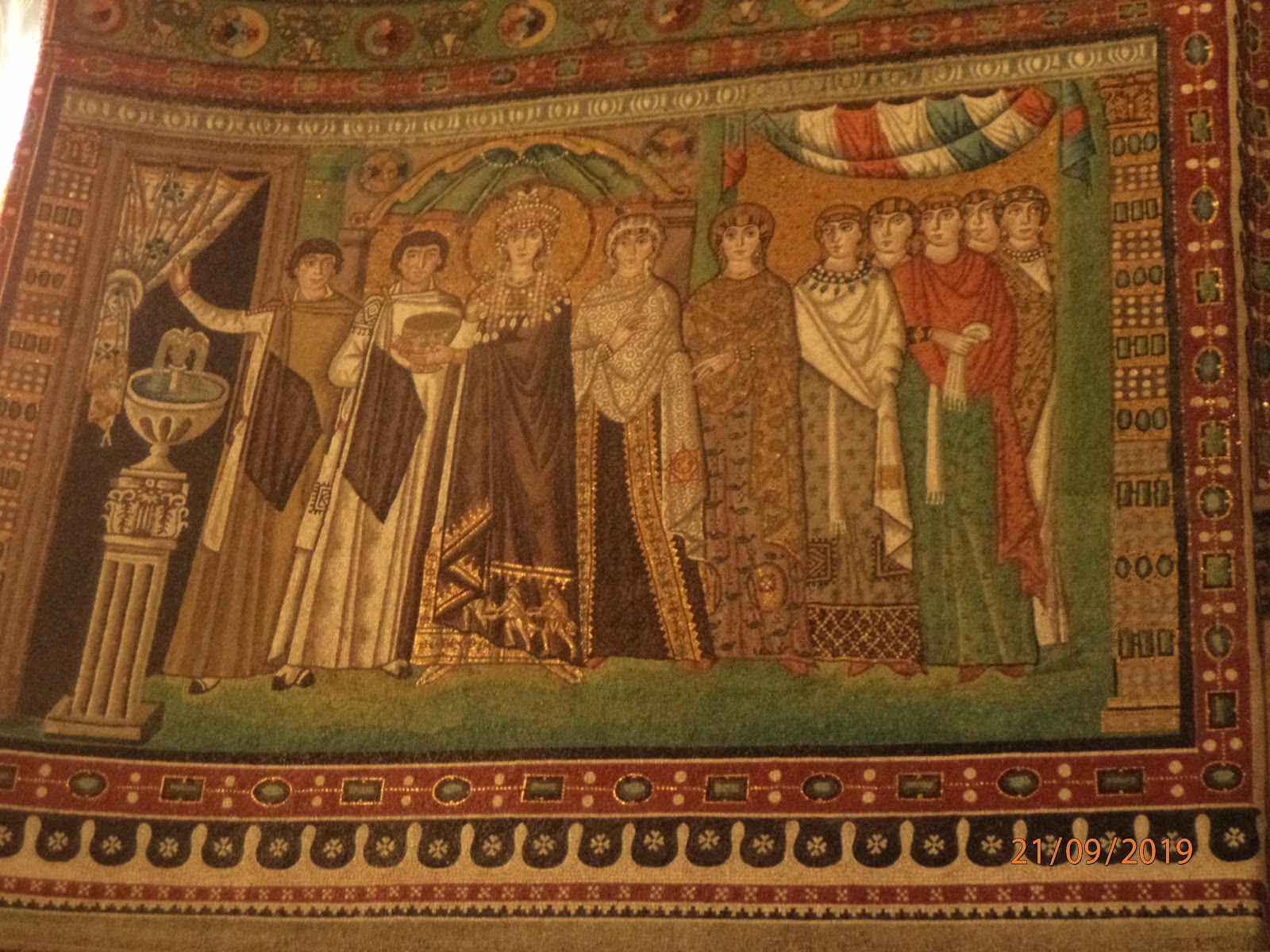
There is a very famous one which shows the Emperor Justinian, but I prefer this one of his wife, Empress Theodora.


She never visited Ravenna, so this probably looks nothing like her. She was Empress of the Eastern Roman Empire by virtue of the marriage to the Emperor Justinian. Various sources say she was the daughter of a priest, others say she was a circus performer, or a dancer, or even a prostitute. It seems that fake news is nothing new!

Very close to this Basilica is the Mausoleum of Galla Placidia.


It is tiny, in contrast to the Basilica, and is built in the shape of a Latin cross. It is also a century older than the Basilica, having been built between 425 and 430 AD, and was originally a chapel dedicated to St Lawrence of Rome. 

Galla Placidia was the daughter of Emperor Theodosius. She was captured by the Visigoths (whose leader was called Alaric) and married Ataulf, Alaric’s successor. After Ataulf’s death, her brother persuaded her to marry Constantius, who became one of the two rulers of the western Roman Empire. Eventually, she became regent for her young son, and ruled the Western Roman Empire from 425 to 437. She died in 450.

The inside is rather dark, without windows, and so it is hard to photograph.


This panel shows the parable of the good shepherd, with the barrel vault above showing the deep blue of the night sky, full of stars.

We walked some distance through the town after that, to the Basilica of St Apollinaire Nuevo, yet another saint of whom I had never heard. He came from Antioch in Syria, and was the first Bishop of Ravenna. He faced constant persecution, and was exiled from Ravenna during the persecutions of Nero, or possibly Vespasian, or even possibly a later Emperor. 

This Basilica was erected by the Arian Christians in the first quarter of the 6th century and re-consecrated to the Orthodox Church in 561. Arianism is now regarded as heresy; it related to Jesus Christ and the nature of the Trinity -  Arianism is a non-trinitarian doctrine. 
The Basilica was not originally dedicated to St Apollinaire, but to St Martin. It was only named for St Apollinaire when his bones were moved there from Classe in 856, so it was called Nuevo. We saw St Apollinaire in Classe later in the afternoon.

This church has a simple interior with three naves divided from one another by columns.


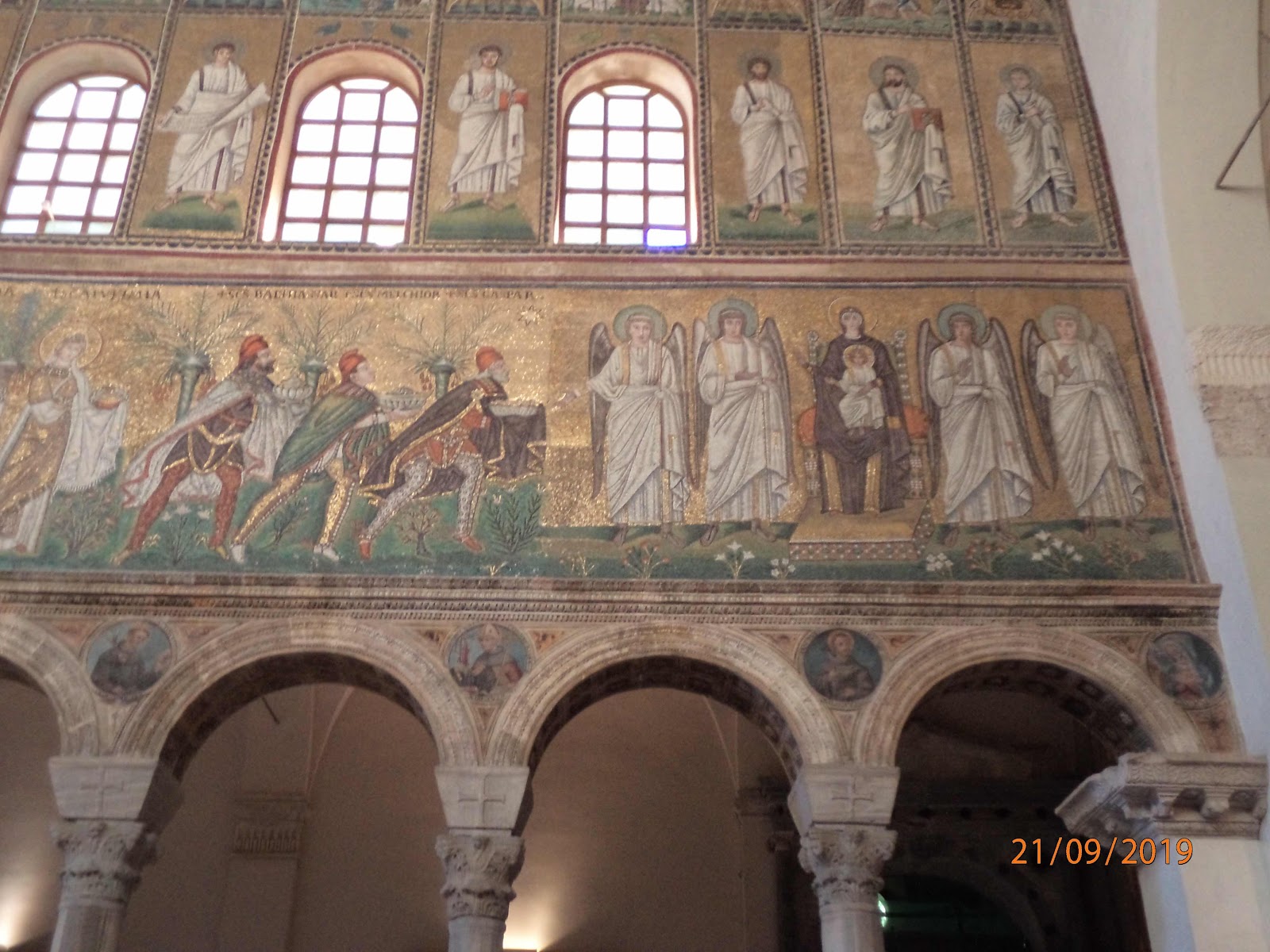
It is quite bright, especially when contrasted with the mausoleum we had previously visited. There is an unusual mosaic along one side.


The main mosaic here shows the visit of the three kings. What is unusual apparently at this time is the importance of Mary, who is shown here on a throne. 

After this, we wandered about on our own for a while. We visited an Arian Baptistry, with a nice mosaic on the domed ceiling.


That’s the figure of the youthful beardless Christ being baptised by John the Baptist. I think it’s Arian because it’s a dove above him and not the hand of God, but most people, including me, find the arguments about Arianism and non-Arianism hard to follow! The baptism is surrounded by 12 apostles, 10 of them holding crowns, Paul holding 2 scrolls and Peter holding a key.

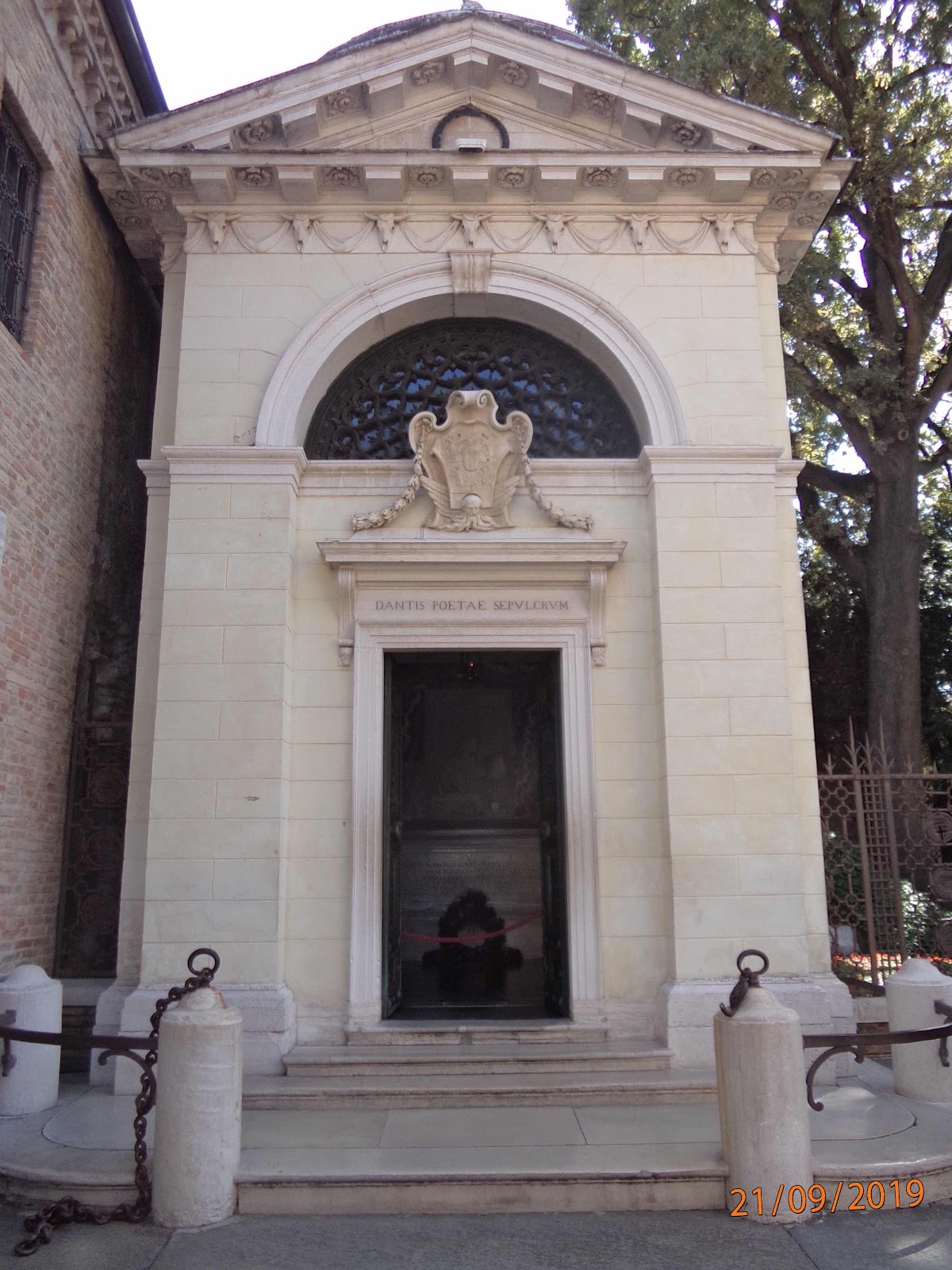
We walked next to see Dante’s tomb, which actually wasn’t built until 1780. 


Dante was exhaled from Florence, and died in Ravenna in 1321 and was buried in a votive chapel. The pope ordered that his bones be removed to Florence in the early 16th century, but the Franciscans hid them and they were kept hidden until 1865 when they were placed in their current sarcophagus. The bones were buried in the adjacent garden to keep them safe from the bombing in World War 2.

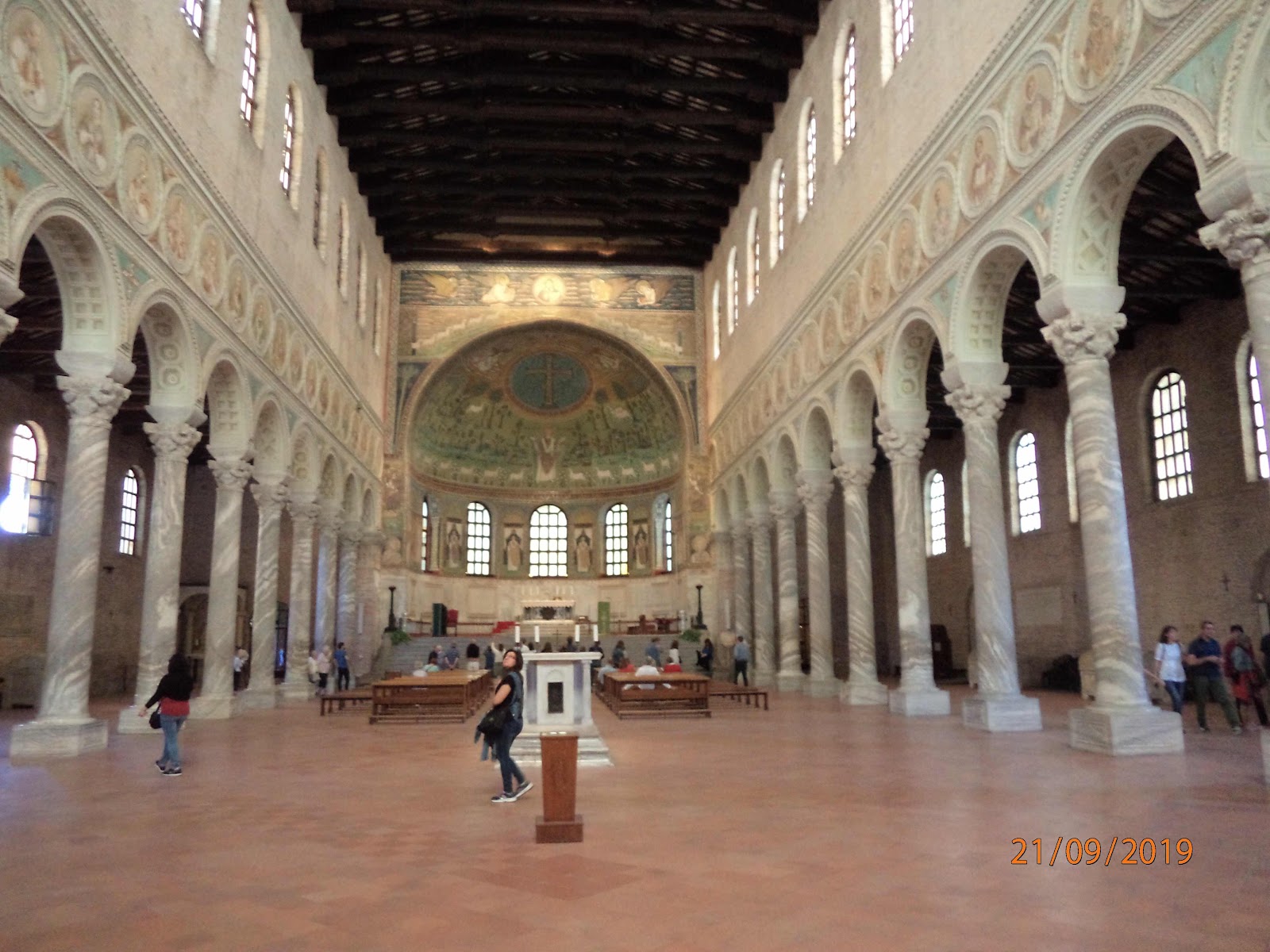
We had hoped to see more, but after we had seen all this and eaten some lunch, it was time to rejoin the rest of our party. We then drove to Classe to see the other St Apollinaire. It is similar in shape inside to the other one in Ravenna.


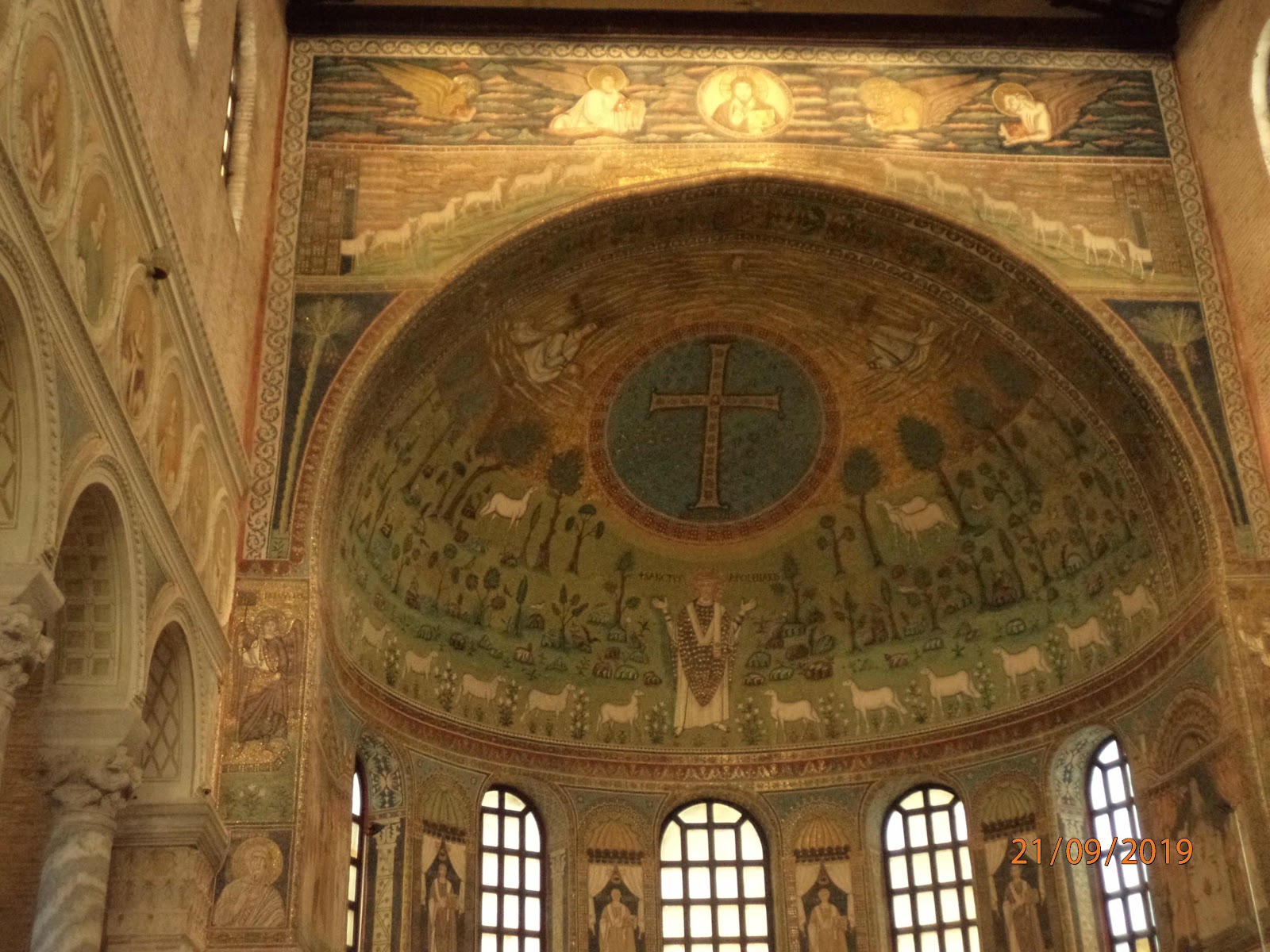
This church dates from 549, but, unlike the other St Apollinaire, this one has always been dedicated to him. There are some rather dull mosaics of various different figures along the sides but the mosaic in the apse is attractive.


It shows Christ as the good shepherd, with 12 sheep, the 12 apostles. The crucifix above him has his head in the centre, but rather too tiny to see unless you are very close. The figures above the cross are Moses and Elijah.

Paul said he was rather tired of mosaics by then! 

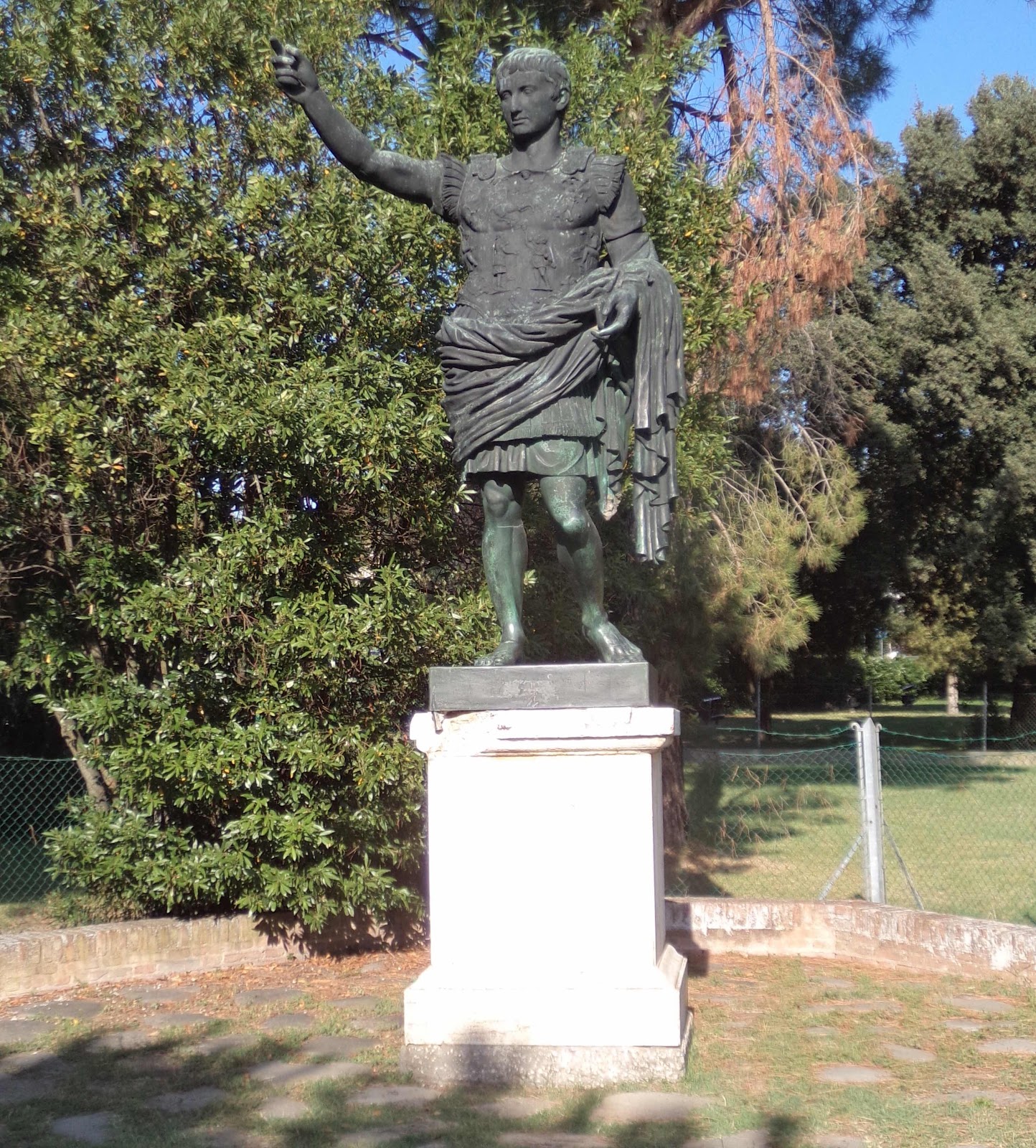
Outside is a nice statue of the Roman Emperor Augustus, looking very young and handsome.


He was very important to the area because he founded the port of Classe and was responsible for stationing the Roman fleet here. It’s no longer a port though - the sea has receded some miles.

After all this, we were all glad to get back in the bus and head back to Assisi, but the motorway was still blocked off in unexpected places and the journey back was just as long and even more confusing.