Sunday, 14 May 2023

Two Churches

Saturday May 13th, 2023

We didn’t really start out today until after lunch, as Paul slept late and wanted to spend time with his email which was getting out of hand, and I did my Zoom Pilates class so that made me quite late too. It was an odd sort of day, because it was very cold in the flat, and the forecast was for rain all day, so we went out in coats and raincoats, only to find it was sunny and warm and the coats and raincoats needed to be taken off and consigned to the rucksack.

We decided to look at some churches today, starting with San Giorgio Maggiore, which is on a little island of the same name. The view from the water is one of the most photographed and painted images of Venice, so I took further photographs, this time from the number 2 boat which we had caught - it’s the only boat that stops there.


It’s another church designed by Palladio and was completed in 1576; this is the side view, showing the campanile, which you can go up by lift. Paul declined to do this, though I believe there are wonderful views over Venice. At the front, the facade of white marble looks to have been recently cleaned, because it shines brilliantly in the sun - and there was fortunately plenty of sun today. I wished I had a hat and sunglasses.


The interior is very bright and spacious, with massive columns, typically Palladian as they are modelled on the classical style of Ancient Rome.


The major works in the church are 3 late Tintorettos, two on the chancel wall behind the altar. They aren’t easy to photograph, as you can only get to the side of them. This is the one I preferred.


It’s called The Gathering of the Manna. The other one, opposite it, is The Last Supper. There’s also his very last work, The Deposition, in a side chapel. Tintoretto died while painting it and it was finished by his son. I’m not a great fan of Tintoretto anyway, but I didn’t like that one at all, though I did photograph it.

There seemed to be a long wait for a boat back to where we had started, so instead we took the first thing that came along, which was the number 2 back along the Giudecca canal again, repeating yesterday’s trips. It was a gloriously sunny day though, so we enjoyed the views. I was able to get a much better photo of both of yesterday’s churches since I was sitting by a window on the best side of the boat. This is a much better view of the Redentore church.


These churches are much better photographed from the water.

As we approached the Zattere stop, I also managed a much better photo of the Gesuati church.


We continued on round to the railway station where we changed boat to the number 1 for the long slow trip down the Grand Canal. Because it’s slow and there are so many stops, we had ample opportunity to appreciate the lovely views. Some of my photos were spoiled by reflections in the window, but there were beautiful views of the palazzos and the little canals between some of them, with small wooden bridges across them.


This view is quite typical, and you can see the little wooden bridge is quite busy with the people crossing it.

It was a disappointment to see, as we approached Santa Maria della Salute that the church was covered with scaffolding and the facade was hidden behind painted canvas, so there are no photos. I imagine it is being cleaned so that it will be gleaming white like San Giorgio Maggiore. It seemed a shame not to have a photo of the dome of Salute which has become such an emblem of the city and has been much painted and photographed.

The huge baroque church was built in thanksgiving for the deliverance of the city from plague in 1630, hence the name ‘Salute’ which means both health and salvation.

The interior is a huge octagonal space, with eight side chapels.


The main altar’s sculptural group represents the Virgin and Child protecting Venice from the plague. It houses a Byzantine icon from the 12th or 13th century which came from Heraklion (then called Candia) in Crete after the fall of the Ottoman Empire.


Some of the best works in the church are by Titan but they are behind the altar where visitors are not allowed. Another painting by Titan, The Descent of the Holy Ghost, is in one of the side chapels but I’m afraid I didn’t like it. There’s another one by Titian in the sacristy, along with a famous Tintoretto, The Wedding at Cana. However, the sacristy isn’t open very often, and it wasn’t open today, so there was no chance of seeing either. I seem to remember that, on a previous visit to Venice, I went to Salute 3 times before I was able to get into the sacristy! 

It was closing time and we were practically the last people out of the church. Fortunately, there wasn’t long to wait before we could take the boat back to Arsenale. The sun was still shining and we appreciated the wonderful views. Lots of people were out in gondolas also appreciating the sunshine. It’s just as well to do it today, rain is forecast for tomorrow! 


We had beautiful views of the the Campanile, a glimpse of San Marco and the Doge’s palace as we passed.


I also photographed The Hotel Danieli, one of the most celebrated hotels in Europe.


 It was built as a palace in the 14th century and became famous as a venue for the first opera performed in Venice, a work by Monteverdi. It became a hotel in 1822, and became popular with the literary and artistic set. Famous guests include Dickens, Ruskin, Proust, Balzac, Debussy and Wagner. George Sand and Alfred de Musset chose it for an orgy, and, when de Musset became ill, George Sand left him and ran off with her doctor.

By the time we reached the Arsenale, the sun had gone in and there was a cold wind, so we hurried back along Via Garibaldi to the flat and cups of hot tea and coffee. 


Saturday, 13 May 2023

A Better Day

Friday 12th May, 2023
We woke to better weather, and in fact there was little or no rain during the day and quite a bit of sun, though it was still cold in the shade. It seemed sensible to stress my back as little as possible, so the plan was to take as many boats as possible, do as little walking as possible, and go to see some churches as you can sit down there in between looking at the paintings and sculptures.

We began by walking to the nearest vaporetto stop, San Pietro. We walked past the church of San Pietro, which was the site of one of the earliest churches in Venice, probably established in the 7th century. The existing church dates to the mid 16th century and was the original cathedral of Venice until 1807. It’s built to a Palladian design and has a free standing campanile.


We intend to visit the church later, so I won’t say any more about it now.

We caught a boat that took us round past Arsenale, giving us views of the Doge’s palace and the Campanile of San Marco.


From there we passed into the Giudecca canal and round to the railway station. Here we changed to the number 1 boat, intending to travel a few stops down to the church of San Stae. 


San Stae is a striking baroque church, which appears to be undergoing some restoration at present, and was unfortunately closed. There was no information displayed on the church, but the internet helpfully told me that it was only open a few days a week, the next time being apparently  Sunday afternoon. So we can try again then! We took the boat back to the railway station so as to sit down to have something to eat, then we retraced our steps back down the Giudecca canal to the Redentore church. This is the Giudecca’s principal monument, having been built by Palladio. It was built in thanksgiving for the end of a plague in 1576, and every year, the Feast of the Redeemer is celebrated here in July.


This church really needs to be photographed from the water but I was on the wrong side of a rather crowded boat, and the Giudecca was very choppy anyway, so this was the best I could manage. It had to be photographed from one side as I don’t walk on water! 

The interior is more austere than many venetian churches, having apparently been a design deliberately chosen by Palladio to be humble.


The altar is rather baroque though.

I didn’t particularly like many of the paintings, which were mostly, I thought, in need of cleaning. The illustrations in the church leaflet showed the paintings to better advantage, especially a Resurrection of Christ by Bassano, and Christ’s Ascension, attributed to Tintoretto’s workshop; these were both so dark as to be almost impossible to photograph. I preferred one of the lunettes above the entrance by somebody called Pietro Muttoni, showing a Madonna and Baby Jesus and St Felix.

We caught a boat across to the other side of the Giudecca to visit the Gesuati church. This was built by the Dominicans who began work in 1726 when the Gesuati order was suppressed. The facade is quite stately, reflecting the facade of the Redentore opposite.


The interior is remarkable for the frescoed ceiling by Tiepolo, which I did not even attempt to photograph. I would have needed to lie on the floor in the middle of the aisle, and I did not think this would meet with the approval of the very stern lady who took our tickets, as well as being rather in the way of other visitors.

The interior is rather more baroque than that of the Redentore, and not so much to my taste.


I think the roundel you can see above and behind the altar is also by Tiepolo, but I couldn’t get close to it as that part of the church was roped off. 

This church is full of sculptures and bas reliefs, many by Gian Maria Morlaiter, another artist of who I had never heard. Some of the paintings here were also rather dark, but there is a Crucifixion by Tintoretto which I think must have recently been cleaned.


I also admired a sculpture of the Madonna of the Rosary by Antonio Bosa, which gives church the alternative name, Santa Maria del Rosario.

Then we got back onto the number 2 boat and retraced our steps again past the railway station and down the grand canal. I would have liked to photograph the Rialto bridge, but the boat was far too crowded for that, we would have needed to get off and I was mindful of the need to take care of my back. We changed at the Academia to the number 1 boat so we could get off at Arsenale and walk back to the flat, which takes around 15 minutes. We walked up the Via Garibaldi, a broad street which was created by Napoleon in 1808 by filling in a canal. The first house on the right of the street was the home of John Cabot and his son Sebastian, navigators who in 1497 ‘discovered’ what they though was the coast of China.
It was actually the coast of Newfoundland.


The plaque under the lion of St Mark names them, and the lower plaque, which is under the title ‘Canada’, points out that they were then in the service of the English king Henry 7th.

By the time we had walked home, my back was quite tired and I was glad to lie down and drink a nice cup of tea!

Thursday, 11 May 2023

A difficult day

Thursday May 11th, 2023

Everybody slept late - Paul because he was exhausted and my friend and I because of having had a bad night. My back seemed better so I did my Zoom Pilates class, thinking the exercise could only help. However, as soon as I started showering and getting dressed afterwards my back became painful again, so there was little prospect of my going out and walking around. It was raining and windy anyway. It was also very cold - 14 degrees. Clearly, winter hasn’t gone away.

My back seemed better after lunch, and the rain had more or less stopped, so we decided to walk to the Arsenale stop and take a boat to do some sightseeing. It takes just over 15 minutes to walk from the flat to the Arsenale, and by the time we got there, my back was so bad it was clear there was no prospect of any sightseeing, so we were obliged to turn round and go back to the flat. 

Although it was not actually raining, it was very dark and the streets were very wet. 


This is the view towards San Giorgio Maggiore. You can see how dark the sky is - the rain arrived again shortly after I took this.

The sky looked slightly better in the other direction, up towards the Arsenale.


So we will hope for better weather tomorrow. And we’ll hope for my back to be better. I really don’t want to have to spend my holiday lying down swallowing paracetamol!


Arrival in Venice

Wednesday May 10, 2023

No photos today, for reasons which will become obvious!
We set off for Venice on a cold rainy day, and the weather only got worse. The plane was on time and we were quickly through passport control, though there was a very long wait for baggage. We discovered there were ticket machines for both the Alilaguna boat into Venice and the 7 day public transport tickets for the vaporetto. We were able to use the machine to collect the vaporetto tickets we had already bought on-line, but we had to join a queue to collect our Alilaguna tickets. Another time, we might not bother getting the tickets on-line since there was no queue at the ticket machines, but long queues at the ticket offices.

I got a text from my friend to say that she had fallen and broken her arm, and had gone to the hospital. She pointed out that we would need to meet her there if we wanted to get into the flat, as she had the keys. So we took an Alilaguna boat which stopped at the hospital, joining another queue. The strong wind and the wake from passing speedboats made the lagoon quite rough, even though our boat stopped whenever a speedboat approached. Not only was it very windy, the rain was very heavy and so visibility was very limited - hence the lack of photos. 

When we reached the boat dock at the hospital I found it hard to get off the boat as it was moving up and down so much, and Paul had to take my suitcase off as I doubt I could have managed it.  The rain was heavy and it was too windy for umbrellas, so we dragged our suitcases through the rain to the hospital, relieved that we had no clothes in our backpacks, as they were getting even wetter than our suitcases. 

By the time we had found the Emergency Department, our friend had been X-Rayed, had her bones set and had her arm plastered, so we just waited until she had her prescription for painkillers, and then braved the weather again to get a vaporetto to the nearest stop to the flat. Once again, I found it difficult to get into and out of the heaving boat, though by the time we got out at San Pietro, the rain had slackened a lot. 

During the walk to the flat, my back became painful again and during a subsequent visit to the supermarket for supper, it became much worse, which did not bode well for the holiday. Supper was late, and we all went to bed, though it was a long time before I was able to sleep as my back was so bad. 

Tuesday, 13 September 2022

Travelling back home

Monday September 12th 2022

When the alarm went at 5, we woke very unwillingly, and I discovered I had a sore throat, which gradually worsened during the day.

We were down in hotel reception by 5.45, and were soon on our way. The sun rose shortly after 6.


It was an almost 2 hour drive to Munich airport, and quite difficult to find the EasyJet desks once there. The terminal is organised into A, B, C and D, which none of us realised, and we were dropped outside D. After panicking because our plane was not on the destination board, somebody ran about and discovered EasyJet in B, so it was a long walk there, and an even longer walk to passport control, because we were not able to use the automated passport gates and had to walk the entire length of the terminal to get to a person. Then we had to go through security and walk the entire length of the terminal a second time to get to our gate. However, we had been given the gate number at check-in, so at least we were able to go there and sit in one of the few seats. I was starting to shiver and feel quite unwell.

Fortunately, it was a short flight, but I was feeling really unwell by the time we arrived. The queues for taxis seemed to be long, so we ended up getting 2 buses, one to Redhill and one to Oxted, and then a taxi home from there. I got straight into bed, feeling really rotten. Thank heavens whatever it is didn’t strike me until this last day! At least it didn’t ruin my holiday.

Oberammergau

Sunday 11th September 2022


After the 6am alarm, a rushed breakfast and final packing, we left Kramsach just after 8 am in driving rain. The first part of the journey was difficult, not only because of the rain but because of the very low clouds hanging in the valleys. Sometimes as we travelled along the valley floors we were below the low-hanging clouds. Sometimes as we climbed the mountainside we were above them and not able to see the valley floor. And sometimes as we snaked along the mountain roads and navigated the hairpin bends we were actually in the cloud and visibility was only a few yards. That was quite worrying, like driving in a heavy fog, and suspecting there was a sheer drop on one side of you but not being able to see how big a drop it was, as the fog of cloud obscured everything. There are no photographs, unfortunately, as those I took were so hopeless I deleted them all.


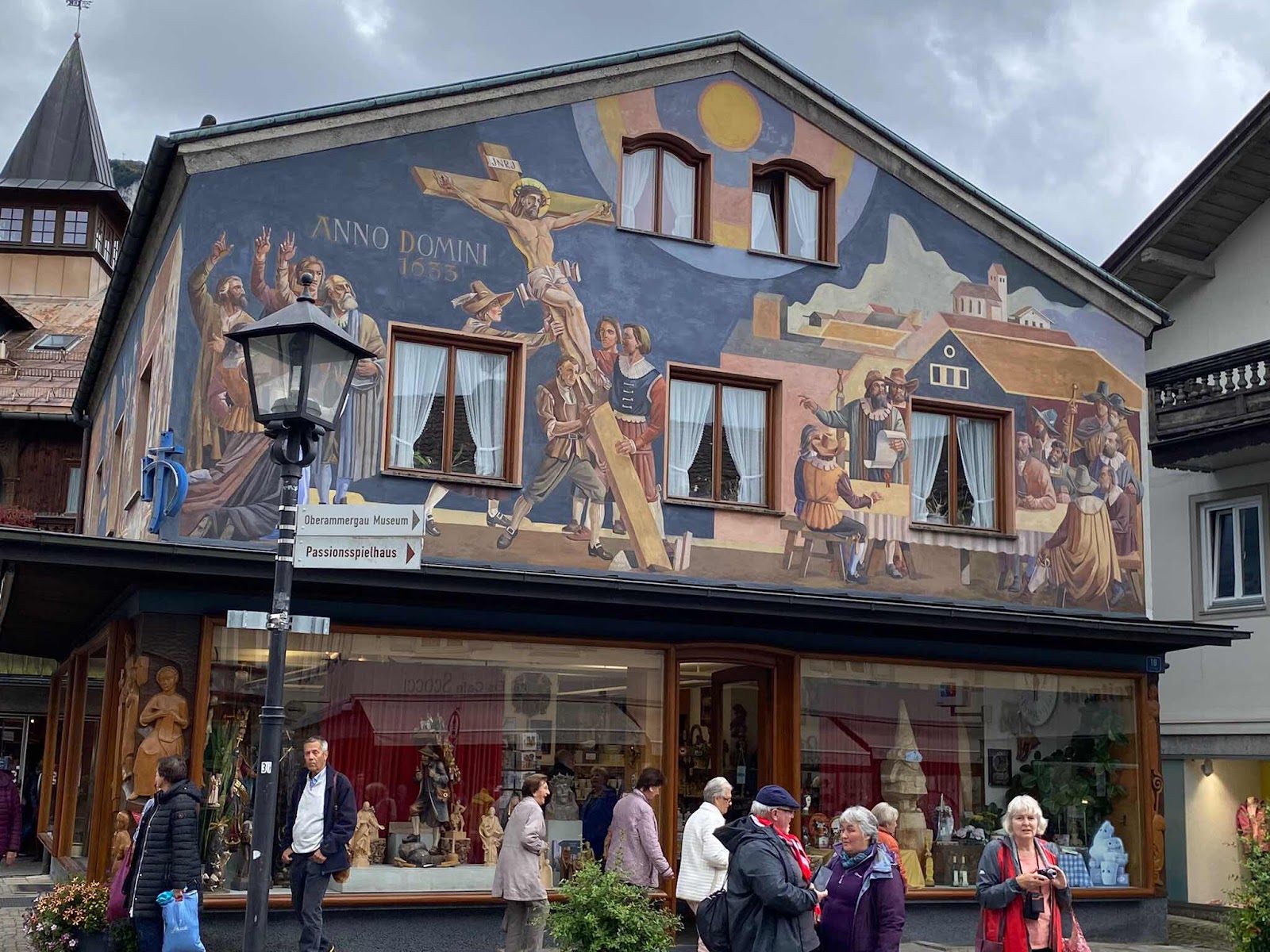
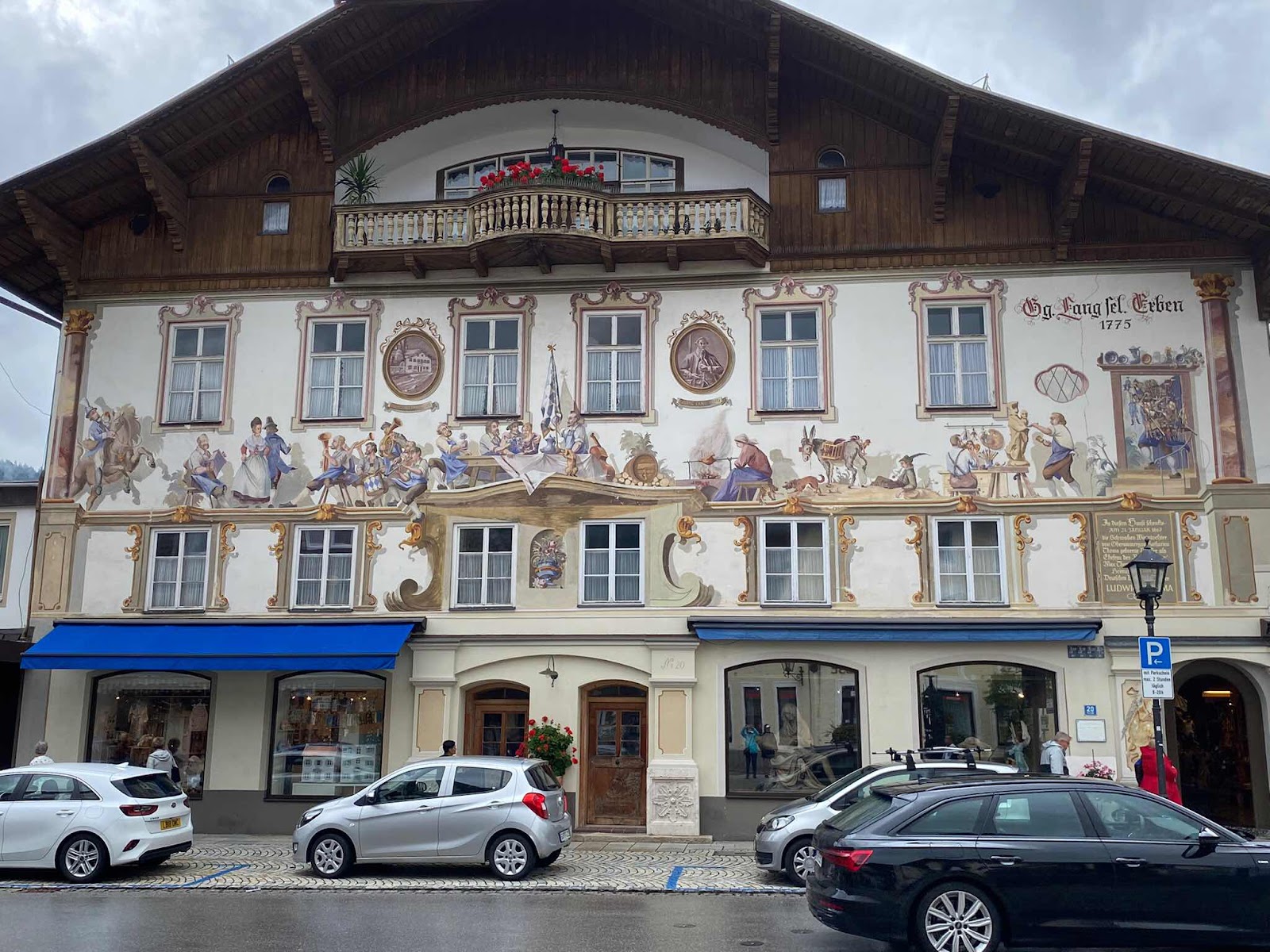
It was a bit of a complicated day because we were not staying in Oberammergau but in Garmisch- Partenkirchen which is a half hour drive away. Our tickets were waiting at the hotel, but the tour guide did not want to make the detour, so she dropped us in Oberammergau just before 11 and then the bus went to Garmish to get the tickets and drop our baggage. We only had time for a fairly quick look round (and to buy blankets because the theatre is open to the air at the front) and make a quick stop for cake and coffee before it was time to meet her at 12.45. The town is quite interesting because of the many painted buildings. 


This is probably the most spectacular. But there are others.


Some were painted all over, like this one.


Others just had painted panels.


The performance began at 1.30 and we had to go through security, so we needed plenty of time. We waited for our tour guide outside the theatre, close to this fountain.


This is an image repeated at the start of the play.

Unfortunately, there were traffic jams outside Oberammergau so our tour leader did not get to us with the tickets until 1.15, by which time we were a bit stressed - and she was considerably more stressed. However, we did manage to pass security and take our seats before the performance began. 


I should explain that the Oberammergau Passion Plays are every 10 years, following a vow taken in 1634. There was plague in the area, and eventually it came to the village and 80 people died. So the villagers prayed to be delivered from plague, and vowed in return to put on the Passion Plays every 10 years if they were delivered. Since that time, nobody has died of plague. I didn’t ask about Covid!


We were originally booked for the 2020 presentation, but it had to be postponed until this year. I am told the next one will be 2030, and there will be an extra one in 2034 to celebrate 400 years of the presentation. All the parts are played by local people; the players have to commit to growing their hair, they must have their own hair - and their own beards, if they are older men. That would let me out, I’ve never been able to grow my hair successfully. 


Obviously, it has been much commercialised since it started. As I watched the scene with Christ driving the merchants out of the temple, I did wonder what He would make of the shops full of tat, and the expensive blankets and cushions being sold to stop you freezing to death during the 5 hours or getting a numb bum in the uncomfortable seats. 


I’d love to be able to post photos here, but all photos are forbidden and it’s quite strictly policed by marshals who watch like hawks and make you put the phone away. Nobody objected to photographs before the play began, fortunately.


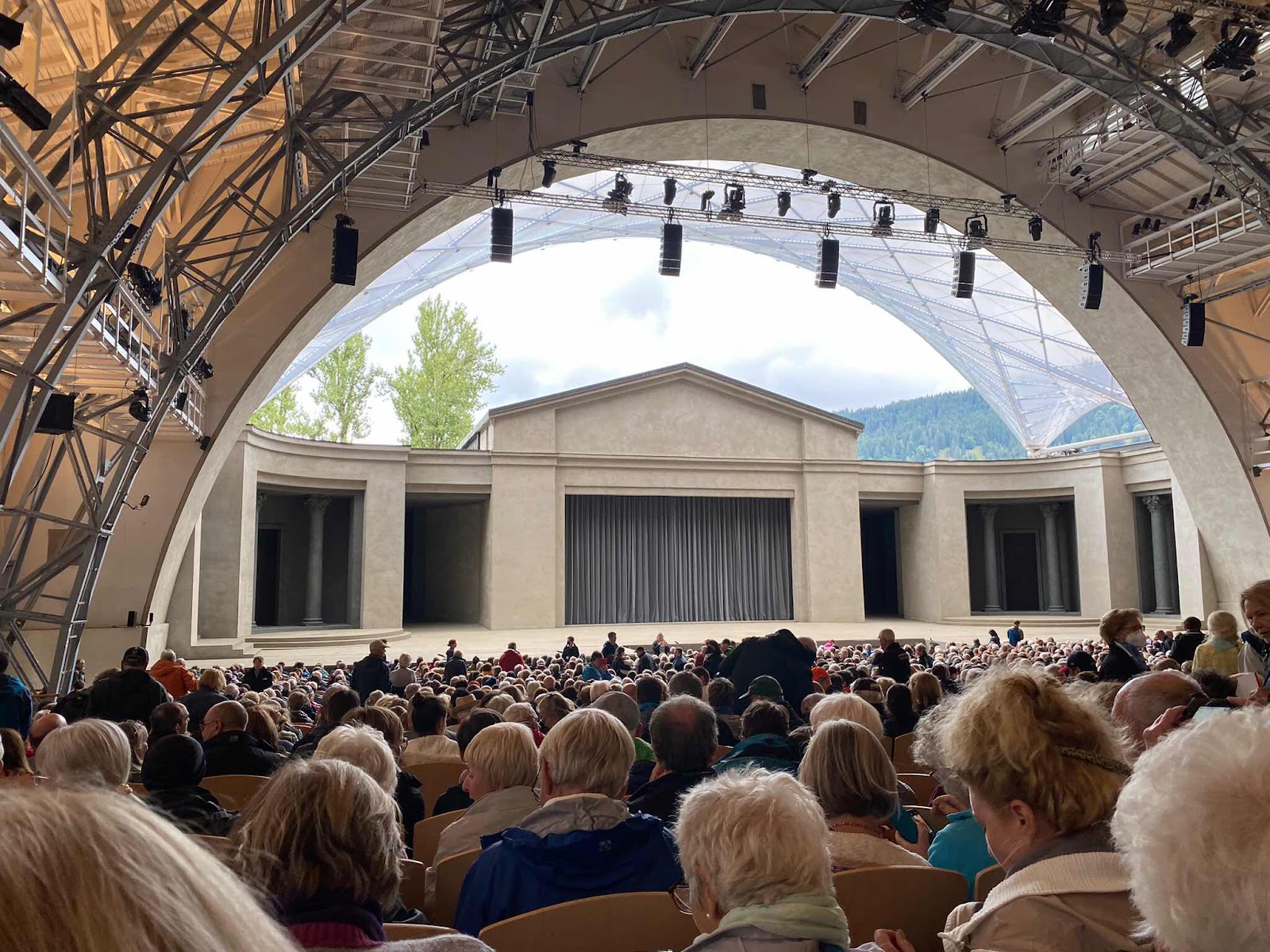
You can probably see from this why we were in danger of freezing to death - the theatre is not really a building, it’s just a roof. And the temperature went down below 10 degrees once the sun went down, so we got very cold sitting still.

It’s not quite like the medieval miracle play cycles with which I’m familiar because it has been modernised. The most different thing is that the 5 hours are all devoted to the life of Christ. The earlier Bible stories get a nod in between scenes because the choir and soloists sing about other stories and there is a tableau at the back of the stage illustrating the story. The choir was excellent, as were the bass, soprano and contralto.  The tenor wasn’t as strong, but I suspect that was possibly because he was really more comfortable being a counter tenor, as became clear during one of his later solos. I assume all the singers and musicians are local too, along with the actors. Mostly, the actors were very good, though I thought the men were generally stronger than the women. It’s a demanding commitment for everybody. They have to commit to at least 80 performances. Performances are 5 days a week, and last for 5 hours; they are in two parts with a break half way for food. The main parts are all covered by 2 people so that’s about half the performances each, as it runs from mid-May to the first week in October. Heaven knows how you hold down a job as well. Our bus driver to collect us after the plays and take us to the hotel was one of the cast, an older man with a magnificent mane of white hair and a long white beard. He just said he played many of the parts, when asked. But he was also a good bus driver!


The plays were in German of course. But you get the English text in a book so you can follow it. You need a torch once it gets dark, of course. They sell those too. I used my phone. 


There were some wonderful set pieces which I wished I could have filmed. Fairly early on, we saw Jesus riding in to Jerusalem on quite a large donkey, with a huge crowd waving palm fronds and lots of excited children. 


Later, the casting out of the merchants in the temple was excellent. It featured several well-behaved sheep and goats, and a basket of white doves which were released at the end of the scene and flew up out of the theatre through the open part. 


The Roman soldiers were interesting. They wore round black helmets and black leather chest armour. Some had Roman looking kilts in grey, but the majority wore narrow grey trousers and jackboots. Their commander rode a horse. So did Herod, in a later scene, and he also had a camel! Sometimes it was hard to hear over the sound of the hooves on the floor, as there were several occasions when people rode horses around the stage. And I was trying to hear, because I was trying to follow the text, so I was listening for people’s names and the odd German word I might recognise. 


The riot scene, when the people shouted for Barrabbas to be saved, was particularly well done and must have been difficult to control, there were so many people on-stage. It wasn’t like a usual amateur production where a crowd is usually represented by about 5 people. The huge stage was filled with people and they yelled their heads off. You really felt they were rioting and would be hard to control. 


The second part had all the gruesome scenes. Judas really did hang himself. The scourging and the crown of thorns looked believably awful. And the crucifixion scene was, as you might expect, awful but mercifully, fairly short. Though I imagine it felt much longer to the unfortunate 3 men hanging there. 


I didn’t find the last scene, in the Garden of Gethsemane, very believable, as I didn’t think the women were as good as some of the men. But that could have been exhaustion on my part, after sitting for so long. 


It started at 1.30, and the first half finished at 4. Then we walked round to our designated restaurant for a meal. It took a while to collect the group, so it was long past 4.30 when we reached the restaurant. The meal was good and efficiently served, and we were back at the security checks by just after 6.30, in good time for the 7pm start. 


Everything was over by 9.30, but it seemed to take ages to collect everybody, then we had a fairly long walk to the bus. There were two hotels, ours being the second, and we had to check in and find our luggage which our tour leader had stored for us in the luggage storage room. So it was well after 11 when we reached our room, and midnight before the light was out and we could sleep. And I had to set the alarm for 5am.  - we had to leave the hotel at 5.45. 

Saturday, 10 September 2022

Kramsach

Saturday 10th September 2022

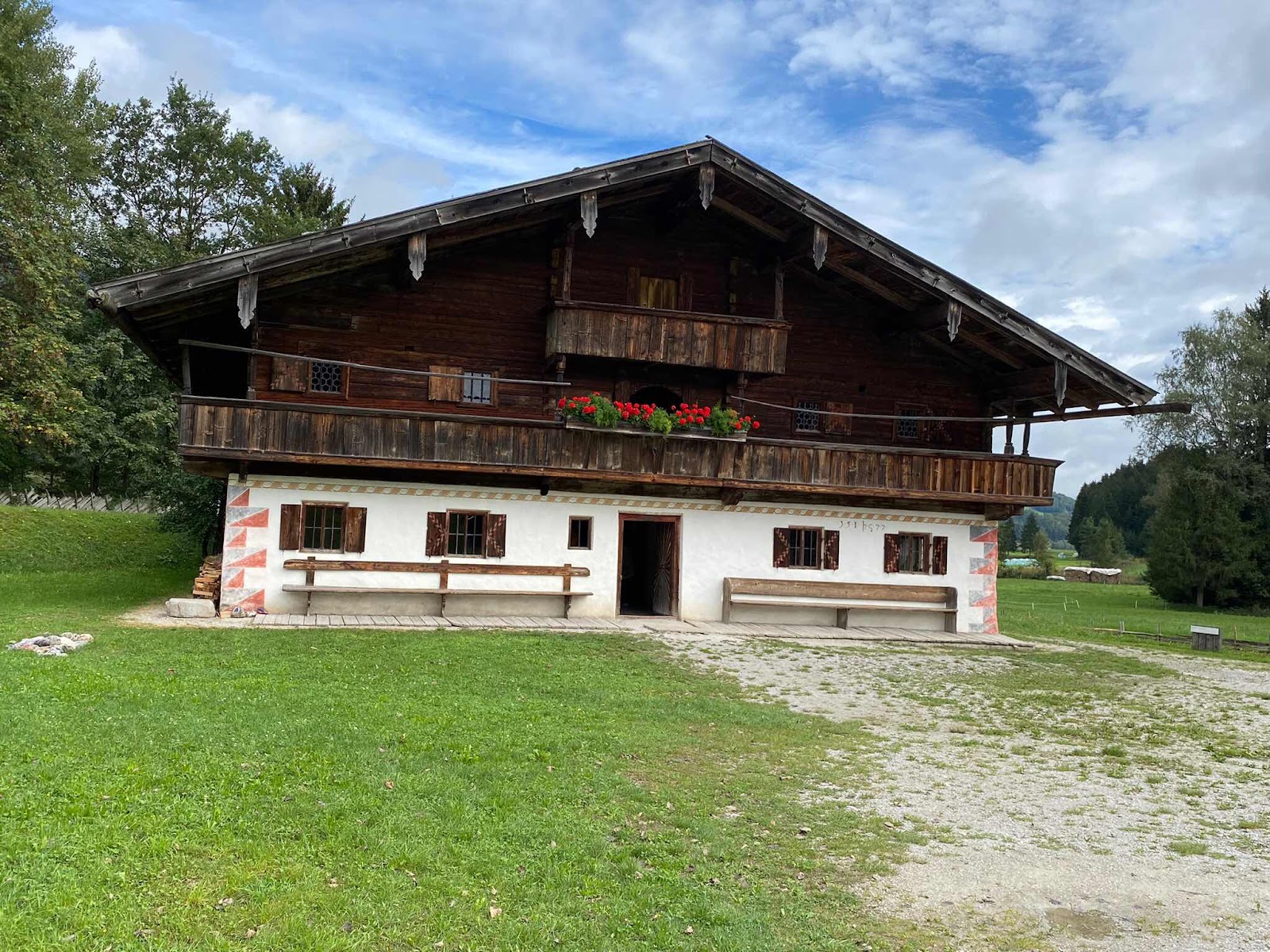
Today was a free day, when we could choose whatever we wanted to do - or do nothing, of course. It was quite tempting to stay in bed! However, after breakfast, buses being few and far between, we decided to take a taxi to visit the Museum of Tyrolean Farms. This is a collection of traditional farm buildings, all of which are several hundred years old, brought from all over the area and re-erected here. It proved to be a fascinating visit.

This is one of the typical farmhouses. This one dates from 1577. The date is known because it was displayed over the two windows on the right.


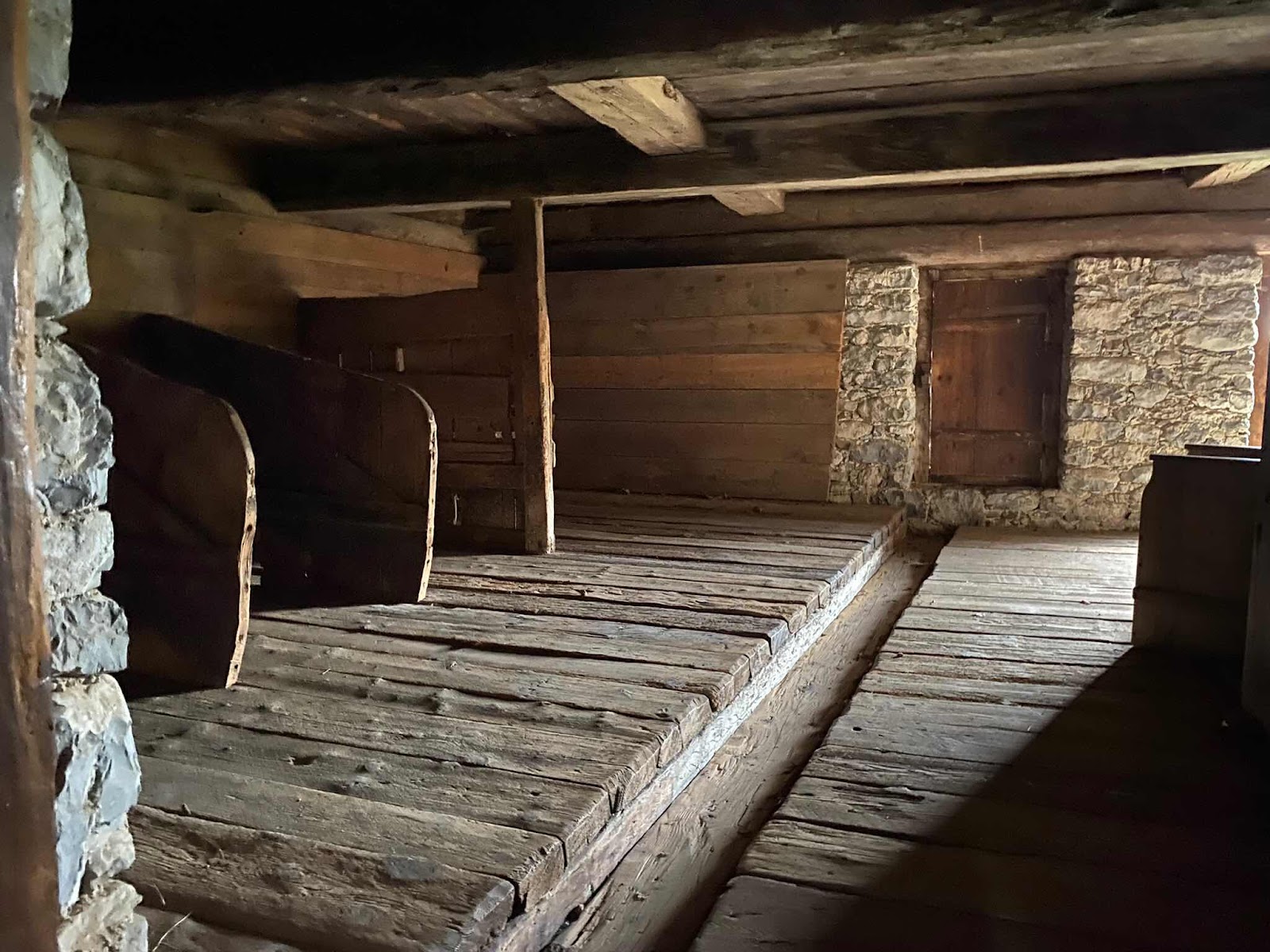
This one has a central hall, with rooms on either side. There is a stable at the back, as it was usual to keep the animals here in the winter. In this case, the stable housed 12 cows, a horse, and some pigs and goats. Another house we saw had a separate pigsty, which might have been preferable. One of the houses has food stalls which could be moved up, since the stable was only cleared out once a year. So the accumulation of straw and manure rose up higher and higher so the floor was higher and the food stalls had to be moved up as well. When it was finally dug out, a pickaxe had to be used. We tried not to think of the smell! 

This one presumably had rather more frequent arrangements, judging by the gutter at the back of the animal stalls.


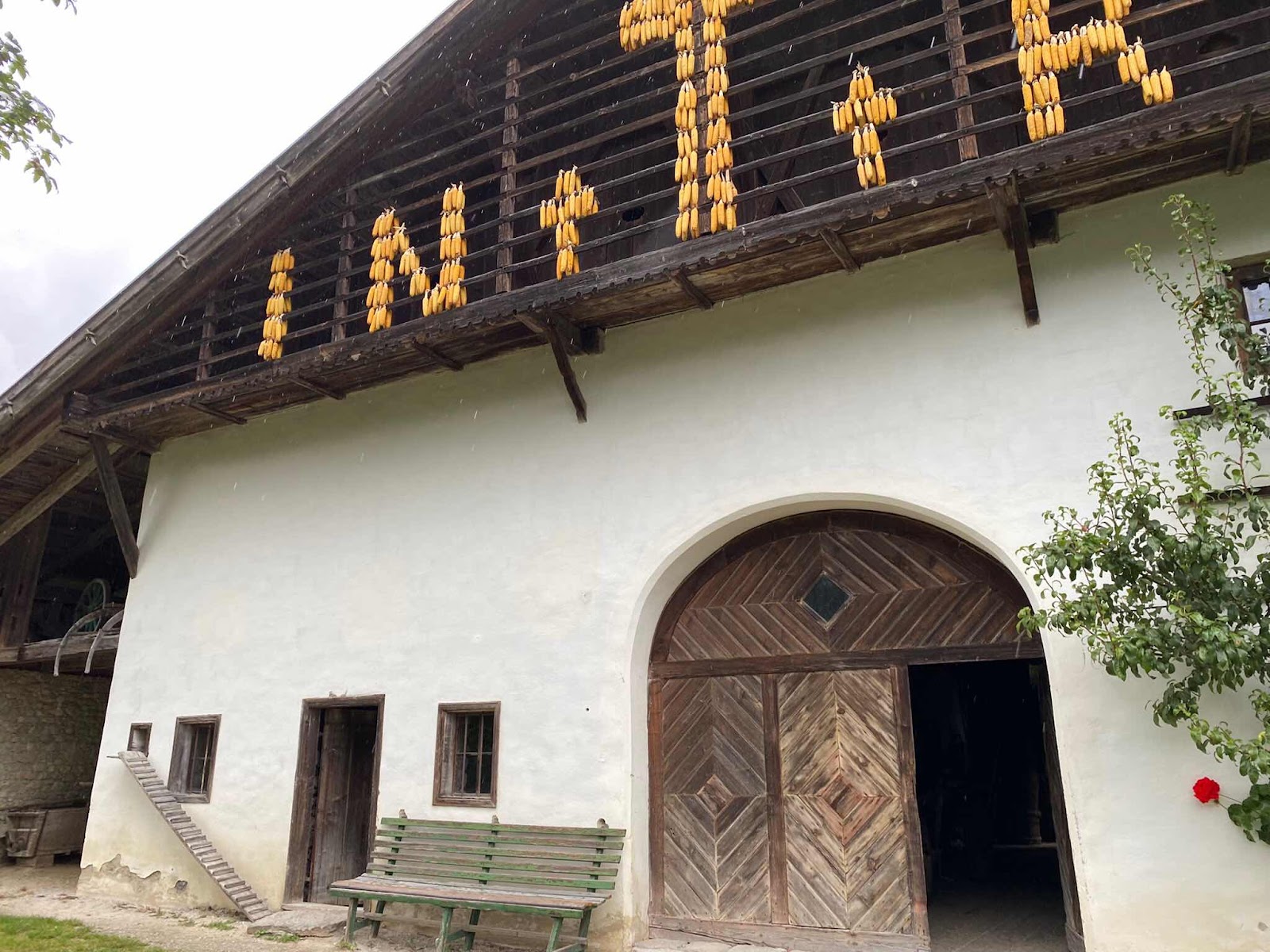
Most of the houses only kept a few cows - 8 or 9 was quite common. There would also be goats and a pig or two, as well as hens. Sheep were mentioned a few times as well. Most of the houses had chicken coops. We liked the arrangements for the hens in the house below.


This house has a little stair on the left for the hens to climb up at night. Their coop is inside against the ceiling of the stable, above the cows’ heads.

Maize could be grown in the milder climate of the area where this particular farmhouse originated. Those are cobs of maize hanging up to dry under the roof.

Inside the house, the kitchen would have been very smoky because the cooking was usually done over an open fire.


The bread oven was often outside


You can see this one has been pretty heavily used and consumed a lot of wood. Apparently, bread was baked once a month.  I would guess it must have been pretty hard by the end of the month, if the bread I bake is anything to go by!

The parlour was usually heated by a stove, and had simple wooden furniture. Nothing looked very comfortable.


This was one of the better furnished ones, some of the houses had very little furniture. 

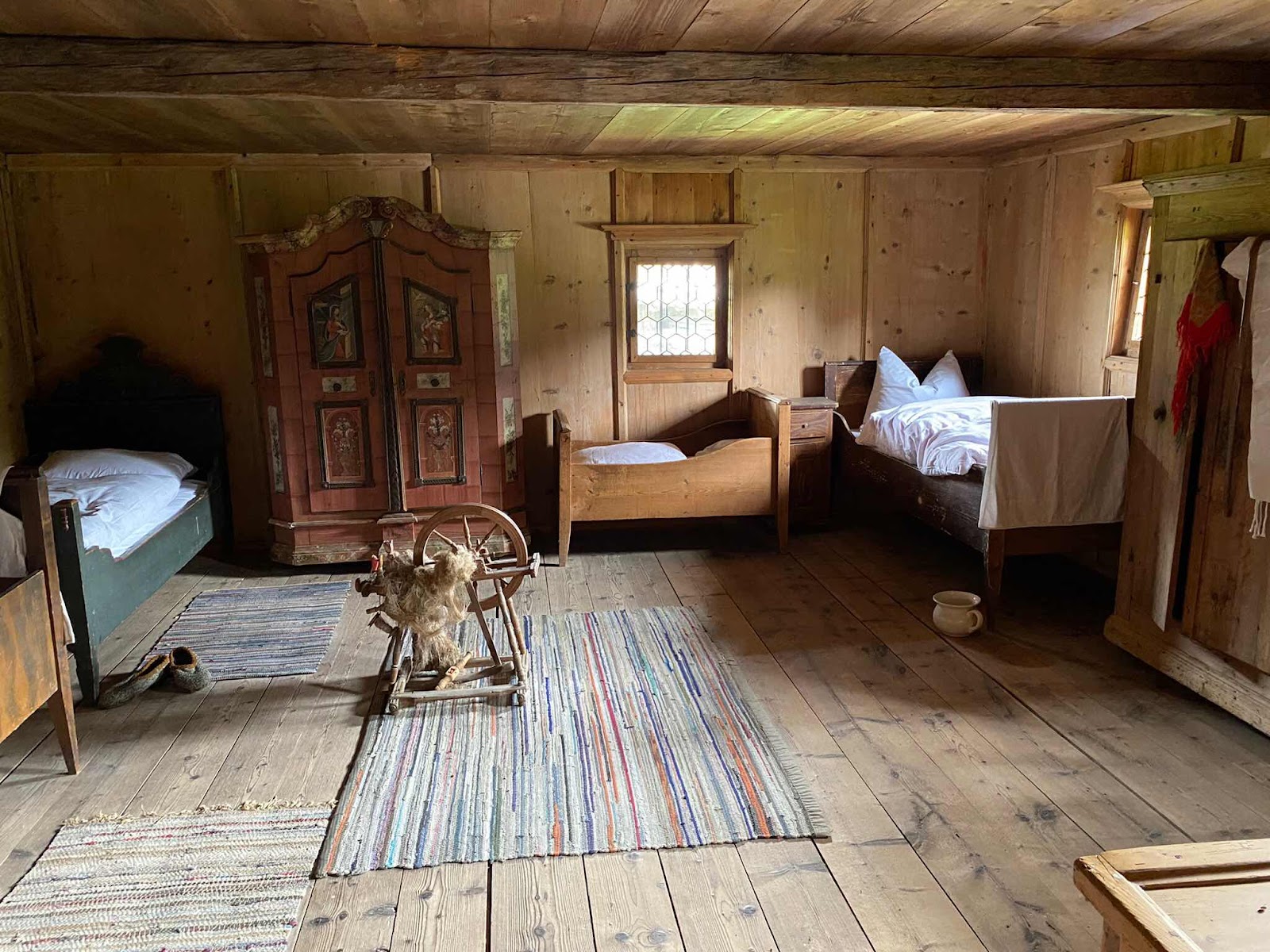
Although there was sometimes a downstairs bedroom - especially in the case of farms where there was an extended family and the older members might be less able to manage the stairs. This was not surprising, I found some of the stairs quite difficult as they were frequently steep and narrow, and always poorly lit. In fact, all of the houses were extremely dark inside. The bedrooms upstairs were very simply furnished, sometimes with just beds and a chest for storage. This one has more furniture.


This was about the only house I saw with a rug on the floor. The spinning wheel was more commonly found downstairs, and most houses seemed to have one.

All of the bedrooms we saw had a pot under the bed. Apparently, there was sometimes a channel on the wall for the men to use to urinate at night; we saw one that went down to the lavatory at the side of the house. The women had to use the pot. I only saw one lavatory, attached to the back of the house, which I unaccountably failed to photograph, but I imagine all the houses had one. 

All of the houses had very high thresholds to each doorway, you had to step over very carefully. I imagine this was so there were no draughts under the door.

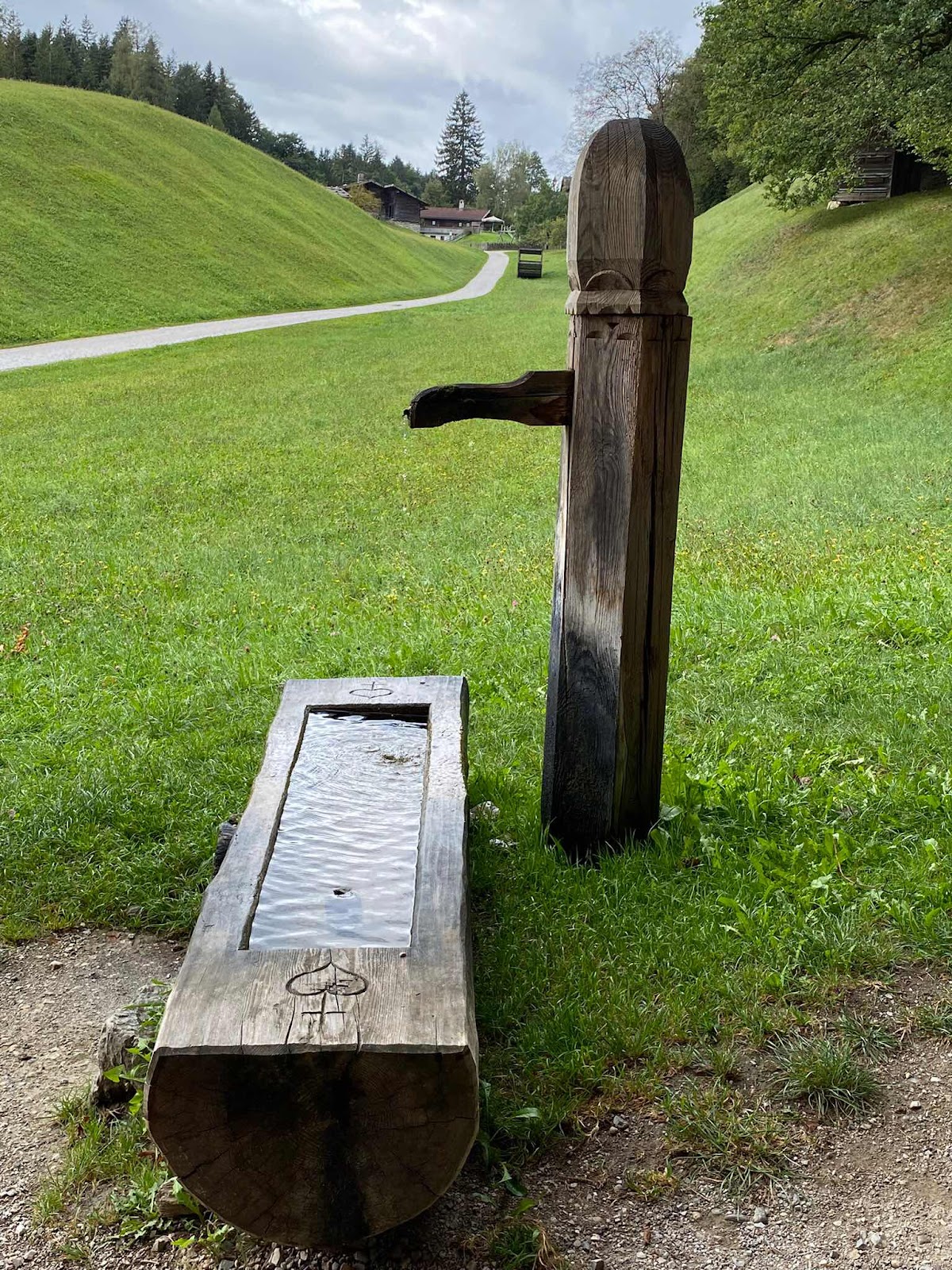
There was no running water in the house of course.


This seems to have been the most usual arrangement, though there was no pump handle, so this one must have worked by water pressure. Goodness knows what happened in a drought! One or two houses had water supplied like this, another had a well.

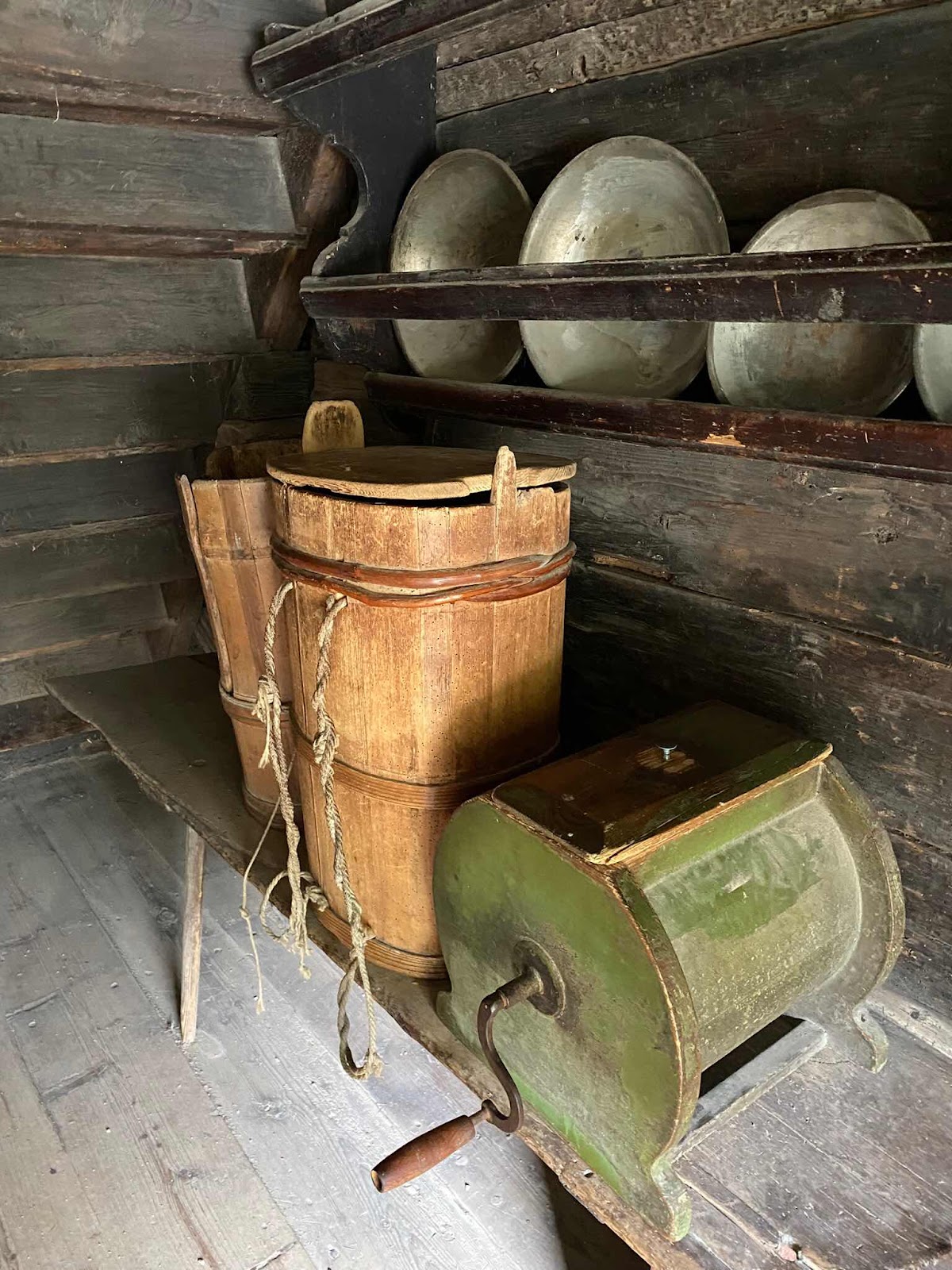
As well as keeping the animals, people grew vegetables in little vegetable plots and made cheese. Many houses had a cellar to keep the cheese cool while it matured. Inside, there were huge cauldrons to heat the milk, as well as churns and cheese presses.


I would imagine cheese was made in most of the houses, I’m not sure about butter.

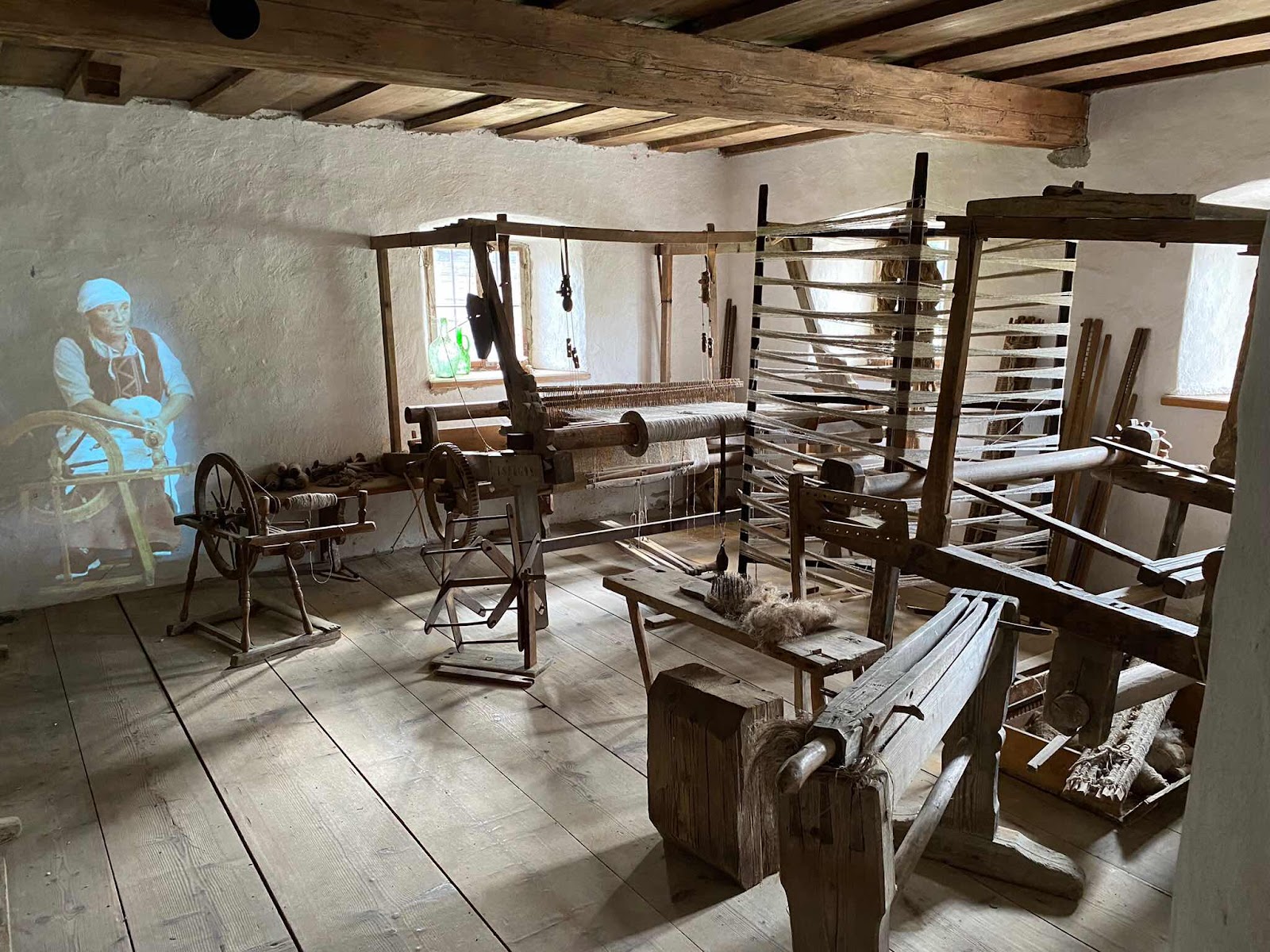
Most of the houses had a spinning wheel, but there was only one where I saw a loom.


Plenty of sheep must have been kept, judging by the number of spinning wheels I saw, but not much mention was made of them on any of the information boards. Goats were more often mentioned, and both animals could have been used to make cheese, of course.

The whole community would have had to work together to build a mill like this one.


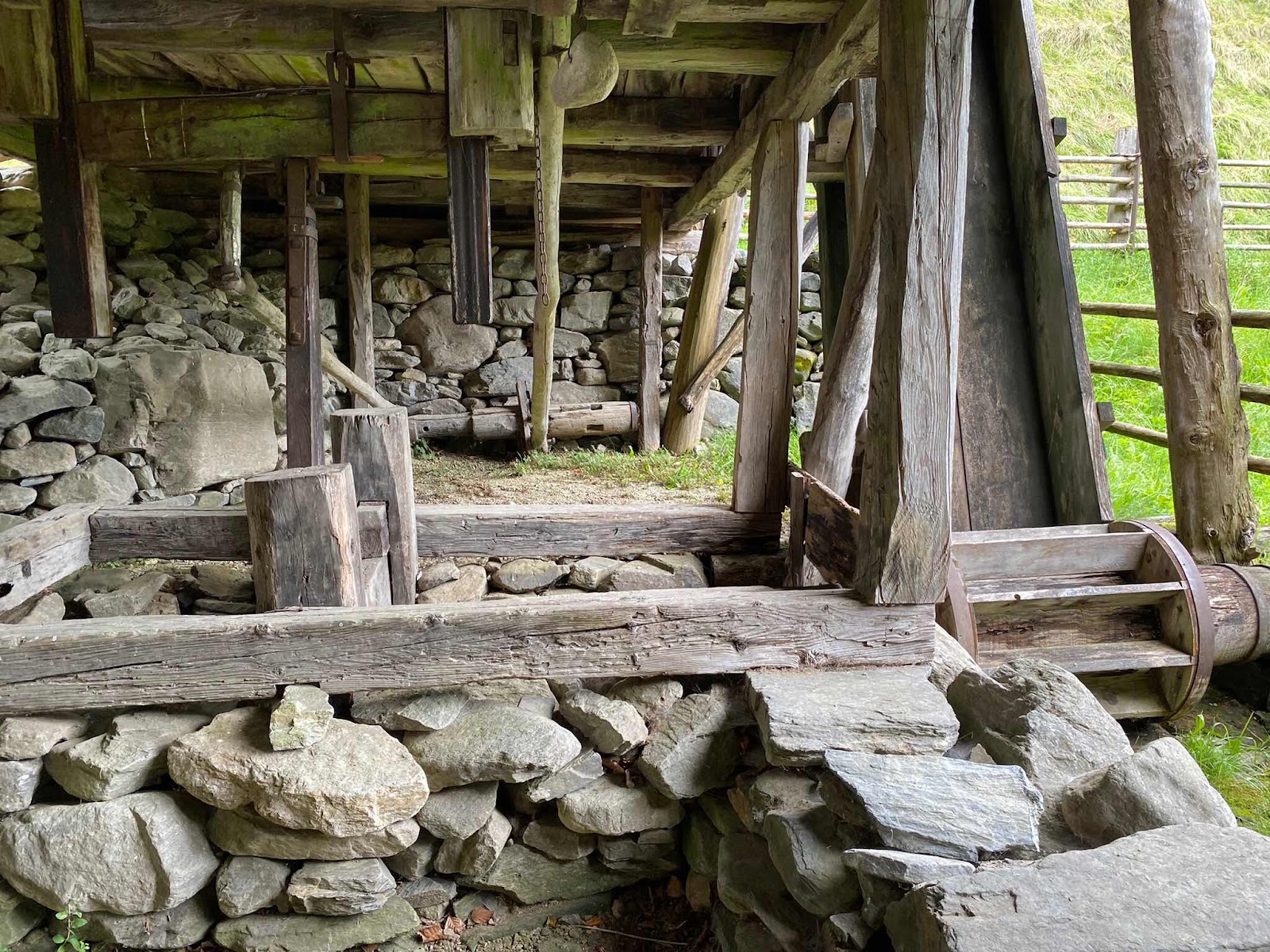
This is an overshot wheel, with a long channel being used to bring the water from a nearby pond. There was a simple chain to pull the water channel over or away from the mill wheel. The same channel also served a sawmill in the distance as well as a small nail forge behind it. 

The sawmill was quite ingenious


You can see where the water comes down the steep channel on the right to turn the wheel. The power from the wheel was converted into 2 different movements. The rectangular frame holding the saw blade moves vertically, while the carriage runs horizontally on rollers. With the huge amount of wood being used, I imagine there was some need for a mechanical means of sawing it up.

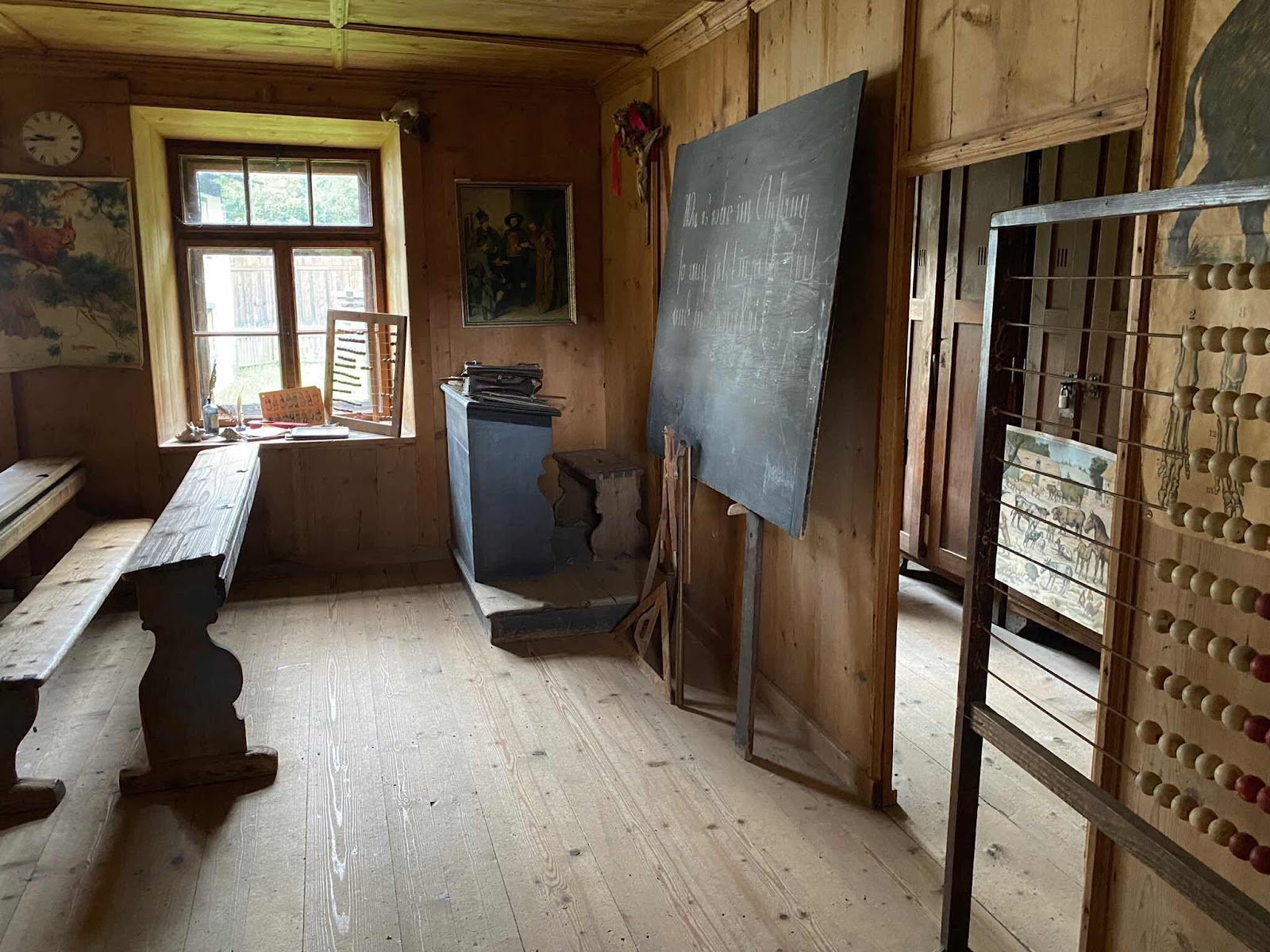
Other community buildings include 2 tiny chapels and the schoolhouse.


Obviously in the classroom here the emphasis was on reading, writing and simple arithmetic.

As well as the two chapels, we encountered boards marking the Stations of the Cross as we walked round. I’m more familiar with these being in a church, but of course the chapels in these villages were too tiny, so it made sense to arrange the Stations of the Cross outside. I don’t know whether they were permanent or only there around Easter.

I can’t end this without posting the photo of the oldest building in this collection.


This house dates back to a period between 1200 and 1280. It is what is called a housebarn, the stable being that stone built part on the left. It has the threshing floor above it. The stable could house 4 cows, some calves, 3 pigs and 5 sheep. The living quarters were on the right of the door, and all the ground floor rooms communicate directly with the kitchen. There are poles in the kitchen to hang meat for smoking.

We were pretty exhausted after walking round all these houses, which are arranged so you can follow a circuit. The circuit ends at a restaurant, so we were able to go in for something to eat and drink, before going back to the museum entry building to view some films about the museum and old Tyrolean customs, and to see an exhibition of handcrafts. Then we went down the hill to the car park where we were able to catch a bus back to Kramsach, which dropped us a fairly short walk from our hotel.

At supper, our guide explained the next 2 days to us. Tomorrow it’s early breakfast as we leave at 8 for Oberammergau, and our luggage with go to our hotel in Garmisch-partenkirchen, where we will not rejoin it until about 10 o’clock at night after the plays. Our bus will leave us in Oberammergau without any luggage as we are not allowed to take anything much into the plays. 

Then we will have a very short night because we must leave at 5.45 am on Monday morning to drive to Munich to catch our plane. So details of the last day of our holiday, which is Sunday, will not be posted until Monday or Tuesday. I don’t imagine I will have many photos of our last day, I can hardly be taking photos at the plays, so it could be quite a boring post, which I might be able to do at the airport I suppose.