Friday, 10 October 2014

Down the Rhine 6 - Koblenz to Bonn

Tuesday September 23rd.
Dear me, I am behind again, for reasons I'll explain later.

After breakfast we left Koblenz and sailed back down the rather less interesting part of the Rhine, back towards Cologne. Just before lunch we moored in Bonn, and after lunch, we set off on a guided walk round the city.

As well as having been the capital of West Germany for some time, Bonn is known as the birthplace of Beethoven, so our first visit was to the Beethoven House, which is now a museum. The house, as you can see, has a baroque stone facade was apparently erected around 1700 on an older cellar vault. It is one of the few remaining middle-class houses from that era.

Originally, this was the neighbourhood preferred by the employees of the courts, in the heart of the town between the castle, the town hall with the market square and the banks of the Rhine river. Today it is still in the centre of town and is a pedestrian precinct.


It looks quite imposing, but five families lived in the multi-storey front and back buildings, and there were also shops here. The imposing door was only created nearly 70 years after Beethoven's birth, when the earlier door was widened to create a gate entrance.

Beethoven's father was a singer at the court, and had to supplement his income by giving music lessons, indeed the family was quite poor and only had a few attic rooms at the back of this building - the front rooms were more expensive.

This is the courtyard at the back of the building, looking back towards the street.


Beethoven was born in one of the upper rooms at the right of my photograph - probably the one with the open shutters.

The family only lived here until 1774, when Beethoven was about 4, but the other houses in which the family lived later no longer exist. And of course Beethoven left Bonn in 1792. Unfortunately, no photographs are allowed inside the house, where you can see interesting documents, like Beethoven's baptism entry in the church register of the St. Remigius church, portraits of Beethoven's employers, silhouettes and portraits of his family and friends, portraits of his later teachers Haydn and Salieri, and so on.

There are larger and more interesting things which I would have liked to photograph, such as the console of the organ that once stood in the St. Remigius church and that Beethoven had regularly played from the time he was ten years old. There are two pianos, one of them Beethoven's last piano, and a set of string quartet instruments. He had to support the family himself after 1784, and he moved to Vienna in 1792, so many of the later things you see come from the Vienna period. His hearing problems are documented by his very strange looking ear trumpets and a conversation booklet, in which people wrote down things they wanted to say to him - easier than shouting down the ear trumpet I daresay! Letters, notes, various contemporary music instruments and items of daily life give an idea of him as a human being. And of course there is his death mask.

I had to content myself with a photograph of the garden.


As you can see, there are two busts of Beethoven in the garden.

These are, naturally, not the only statues of Beethoven in the city; there is a Beethoven Monument on the Münsterplatz, one of the main squares.
Franz Liszt is largely responsible for this statue. He contributed not only financially but also organised concerts from which the funds were put towards the cost of the statue.


On one side of the square is the Bonn Minster, one of Germany's oldest churches. It has five towers, square flanking towers on the east end, a round central tower 315 feet (96m) high, and two slender turrets on the west end. All the towers are topped with spires. Sadly, I couldn't get far enough away to photograph more than a small portion of it.


When I say it's old, I really mean it; apparently there might have been a religious building on the site as early as the 4th century, and this was expanded several times, particularly in the 8th century. Around 1050 this early church was demolished and construction began on the present Romanesque building, which dates from the 11th to 13th centuries. By the end of the 13th century, Bonn had grown in importance, becoming the capital of the Electorate and Archbishopric of Cologne, which was then a separate sovereign state.
Lying in the open plaza on the east end of the basilica are large sculpted heads of the Roman martyrs Cassius and Florentius, the patron saints of Bonn. According to legend, Saints Cassius and Florentius were beheaded for their religious beliefs at the present location of the Bonn Minster. The two enormous sculpted heads I have photographed here, rather badly, were sculpted in 2002.


By this time I was feeling quite martyred myself, suffering from dreadful heartburn and indigestion and getting terrible backache from the slow pace of the walking tour. We were at a standstill far too often, and I don't think I've ever walked so slowly.

Apart from the Minster, much of medieval Bonn is long gone, but one part that still stands in the Sterntor, a gate from the 13th century city walls. But even this is a bit faked: it's the original design and original bricks, but it's been moved. The original location caused traffic flow problems, and so they moved it, brick by brick, to its present spot, in between two Starbucks.


We weren't able to get a decent view of the Poppelsdorf palace, a giant Baroque building, because there was an enormous lorry parked in the way, and the tour didn't include the long walk there. We did see another palace, now part of the University.


By this time I was beyond enjoying any more of the tour, and we left and went back to the boat. In the evening, there was a gala dinner, though I was hardly able to eat anything. Afterwards there was an entertainment put on by the crew, which Paul refused to attend, so we just went to bed.

- Posted using BlogPress from my iPad

Tuesday, 23 September 2014

Down the Rhine 5 - Mainz to Koblenz

Monday September 22nd
I'm having some difficulty with finding my photos on the iPad. For some reason, the camera forgot the date, so several days photos have filed themselves under the date 31st December 2012. One of the many delights of an iPad is that it files your photos by date, you have no control over it, and you can't change it.

Another difficulty I had today was that the camera battery ran out unexpectedly. So we were sailing back through the extremely scenic and picturesque Rhine gorge, and I was without a camera! Not that it mattered all that much - it poured with rain, so photographs were nearly impossible anyway. However, I've already posted more than enough castle photographs and information.

Once again we passed the Lorelei, but again I failed to take a decent photo of the statue, only having the phone, as the camera was still charging. However, I managed to crop and sharpen the last one I took, so you can see the statue, which is not very large and is sitting in an extremely inelegant pose!


Like the Siren, the Lorelei sang as sailors passed, and this one distracted them so that they drowned. When somebody made a determined attempt to capture her, she called on Father Rhine to save her, and he sent a huge wave to cover her so she disappeared and was never seen again.

During lunch, we turned out of the Rhine into the Moselle and moored in Koblenz. After lunch we set off on a guided walk which took us first to the cable car over the Rhine, up to the huge Ehrenbreitstein fortress that overlooks Koblenz. This is only one corner of the fortress, but you might care to imagine this bit bristling with cannon, with one cannon poking out of each embrasure.


The other side of the embrasure could house soldiers rather than cannon if it wasn't a time of war. Below is the type of accommodation for soldiers just after the fortress was built in the early 1800s.


Apparently, there would actually have been up to 8 bunk beds in a space of this size. Note that there were no cupboards here - soldiers in this era presumably didn't have any personal possessions. By 1900, each soldier had a cupboard.

Of course, in such a commanding position, on a high promontory overlooking two rivers, there had been some sort of fortification there for over 5000 years, and there were Stone Age tools on display as well as Roman artefacts.

The views from the fortress were superb, even in the rain.


We looked down on the monument to Wilhelm l; it is 37 meters high and this photo gives you good idea of the scale. You can also see a couple of the cable cars that we used to cross the Rhine and get up to the fortress.

The Rhine is the river that runs horizontally across the bottom of the photo. The Moselle is the one that joins it and runs towards the top of my photo. You can also see the oldest bridge in Koblenz (14th century) just behind the boat which is manoeuvring in the middle of the Moselle. Only the arches on the left of the bridge are 700 years old - the part on the right was re-built when the river was canalised.

Just beside the boat which is manoeuvring you may be able see another boat moored on the left bank of the Moselle. That's our boat. We'll be doing the manoeuvring tomorrow morning when we leave, as our boat is currently facing down the Moselle and will have to sail back to the Rhine.

Once down again on the banks of the Rhine, we paused to look briefly at St. Castor's Basilica, which has become quite a symbol of Koblenz.


It was originally founded in 836 and the present building was completed in 1208, though the roof is later. Koblenz was 87% destroyed during the Second World War, and this was one of the buildings which was re-built afterwards. Being so close to the Rhine, this church is often flooded.

We walked on into the town, and paused to admire Jesuit Square, so called because the Baroque building on the left was originally a Jesuit College. It is now used as the City Hall.


The roof apparently has 25 windows in it, and there is a Christmas Market in the square, so the windows are used as the Advent Calendar.

We went through the big grey archway you can see in my photo to see the statue of the spitting boy, which has become the mascot of Koblenz.


You can see my photograph actually captures him spitting - he spits every two minutes. He represents every irreverent boy rebelling against authority, and his image can also be seen on all the manhole covers.


We next visited the church of Our Beloved Lady (Liebfrauenkirche) which was also originally 13th century, with later additions.


This just illustrates the fact that 13th century churches don't have to be as gloomy as Cologne Cathedral. This church was damaged in the war but not destroyed, and now all the glass is modern. The stained glass behind the altar commemorates women who were felt to be important to Christ.

You probably won't be able to see the crucifix by the window on the right of the altar, but the crucifix is modern and the body of Christ is 14th century. The two statues you can see, one of Joseph with the Christ child on the left, and the one of Mary on the right are 13th century.

We walked into the elegant nearby Florinsmarkt; on the building directly ahead there is a very old clock and underneath it is the image of a man's face - probably too small to see in my photo.


The image commemorates a robber baron who was executed in the square in 1536, and apparently told people to erect a monument to him and it would bring luck to the town. On the scaffold he rolled his eyes and stuck his tongue out, so the image rolls its eyes in time with the pendulum, and when the clock chimes, the image puts his tongue out.


- Posted using BlogPress from my iPad

Sunday, 21 September 2014

Down the Rhine 4 - Rüdesheim to Mainz

Sunday 21st September

Well, apparently the fireworks last night were wonderful, and the rain stopped in St Goar just before the fireworks started! I was very disappointed not to have seen them, but Paul was just glad not to have got any wetter. Our raincoats are more showerproof than cloudburst proof, so we would have been soaked to the skin.

We left Rüdesheim in fairly heavy rain at about 9.15 in the morning. We also left behind the area known as 'The Romantic Rhine', because now the countryside is much more flat. There are still little towns along the river, as well as Wiesbaden, the nearest city to Mainz, on the opposite side of the river.


I believe this is Schloss Biebrich, the former residence of the Dukes of Nassau.

We arrived in Mainz during lunch, and after lunch, we went on a guided tour of the city. It was extensively bombed in the Second World War, and 80% of the centre of it was destroyed. Mostly, the destroyed buildings were replaced with architecture typical of the 50s and 60s, but some were replaced in the original style so it is hard to know whether the buildings you see are really old or are replicas. Our guide told us that often the replica was only the facade anyway, and locals referred to the style as 'cardboard Baroque'.

Fortunately, the cathedral was not damaged in the bombing.


Renovation, restoration and new buildings are all going on all over the city, so it seems it's almost impossible to take photos without some evidence of the building going on. You can also see it was raining at the time - I fear it is due to rain for the rest of this holiday.

Building of the cathedral was started in 975, and it was consecrated in 1009, so it is really old. It has been extensively changed since this early time of course, including a time at the very end of the 1700s when Mainz came under attack by the Prussian army and then spent some time under French occupation, when the cathedral became virtually derelict and had to undergo renovation.

Inside of the cathedral is pretty gloomy, and Paul couldn't wait to get out.


I was interested to hear that the cathedral was used for coronations and several of the Holy Roman Emperors had been crowned here. Remembering my history, I was sufficiently interested to check and noticed that I was correct and Matilda, wife of the Holy Roman Emperor Henry V was crowned here in 1110. That's Matilda, daughter of King Henry l of England. Anybody who remembers that far back in English History may remember that Henry l died with no son to succeed him (his only son was drowned) and the English throne was claimed by both Matilda (by then married to Geoffrey of Anjou) and her cousin Stephen of Blois, precipitating the English Civil War known as the Anarchy. Even those who don't remember the history, or never studied it may have read Ellis Peters' novels of Brother Cadfael, which are set in that period. The Civil War ended at the death of Stephen, when Matilda's son Henry inherited the English throne and became Henry ll. Enough history!

Because there was originally a monastery associated with the cathedral, there is an attractive cloister.


Since it wasn't raining quite so hard, we were able to leave the cathedral and go outside.

There are several pretty town squares, with some old buildings, though I don't know if any of them is original.


The square in the photograph below seems to be the main square.
It is used for events and entertainment, indeed there seemed to be some entertainment going on even in the rain. The strange red pillar on the far left of my photo is a pillar of red sandstone, from which the cathedral is also built.


Our guide told us that unfortunately red sandstone is very susceptible to pollution and acid rain, and this is quite an industrial area of Germany, so the cathedral and other buildings made from this material need constant maintenance.

I had been quite keen to visit the Gutenberg Museum, which is shown in the photo below.


However, it was due to close shortly after we arrived, as we were quite late. Also my back was a bit painful, as it always is after standing about or wandering slowly. I would still have given it a go in the 40 minutes or so before the museum closed - I wanted to see the Gutenberg Bible, and they also had a early edition of Canterbury Tales printed by Caxton - but Paul had had enough by then, so we just went back to the boat. In hindsight, this was probably a good thing, as shortly afterwards the heavens opened again and we would have been soaked.

We had an interesting dinner this evening; 12 of our boat crew are Balinese, so they dressed in Balinese costume and we had an Indonesian Rice Table with my favourite things - Nasi Goreng and Beef Rendang, not to mention Chicken Satay of course. It was all delicious, and one of the crew performed a traditional Balinese dance after dinner as well.

- Posted using BlogPress from my iPad

Saturday, 20 September 2014

Down the Rhine 3 - Boppard to Rüdesheim

Saturday September 20th

I was woken in the night by a huge Viking River Cruises boat mooring onto ours, but we disengaged ourselves at breakfast time and sailed towards Rüdesheim. Our way took us past numbers of castles, but most of them disappeared in the mist which hung about for most of the morning. The first castle, now a ruin, was referred to as Burg Maus. It was actually named Thurnberg, but mockingly named 'Mouse' by the counts of Katzenelnbogen, whose castle nearby (Burg Katz) was much bigger. Burg Maus was built in the 14th century, and blown up by Napoleon in 1806. It was rebuilt on the original plans in 1900. I would post a photo of it, but you can hardly see it in the mist.

The next castle was the huge Burg Rheinfels; built in 1245 to collect tolls, it was the biggest castle on the Rhine for 5 centuries. It was eventually destroyed by the French in 1797, and is now just a shell.


It stood above the pretty town of St Goar, at one time the most strongly fortified town on the Rhine.


We next came to Burg Katz, also shrouded in the mist, facing St. Goar.


Burg Katz was built in 1371, another castle intended to control traffic on the river. It was destroyed at the orders of Napoleon in 1806. It was rebuilt about 1900, and bought in the 1990s by a wealthy Japanese businessman who intended to turn it into a tourist attraction for Japanese tourists, since it is so close to the Lorelei rock. He failed to get his plans accepted by the local authority and just abandoned the castle so it is now derelict.

I did manage to take a photo of the Lorelei statue as we swept past, but it's a very poor one so I'll try again on the way back. The statue stands on a spit of land which was built to give barges protection from the ice floes which used to sweep down the river. The actual Lorelei rock, with a steep cliff face, is next to it.


Even though it was quite late in the morning, the top of the rock was still shrouded in mist.

Below the Lorelei are some killer rocks, known as Die 7 Jungfrauen or The 7 Maidens. The legend is that they were the seven daughters of a king who wanted them to marry and called in his knights so they could choose husbands; the girls didn't fancy what was on offer and ran away, escaping across the river on a boat which overturned and drowned them, and they turned to stone. Large flocks of cormorants find these rocks convenient as fishing spots, so they are covered with big black birds, wings stretched out to dry.

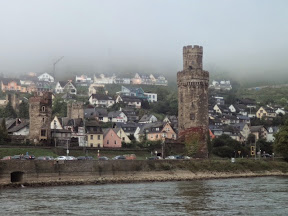
The town of Oberwesel came next, with towers and the remains of old city wall.


It is dominated by another castle, Schönburg, but that had also disappeared in the mist.

I'd be inclined not to post many more castle photos, but couldn't resist Burg Gutenfels.


There are two reasons for that. One is the story told by our guide that the castle was so strong that the Swedes failed to take it after many months, and eventually agreed to spare the defenders if they gave up and came out, to which they agreed. When the gates finally opened, the defenders that came out were two old people and one goat; the goat had lived on the grass inside, and the old folk on the goat's milk. Believe it if you like! The other reason for this photo is that it shows the very steep vineyards. These vineyards produce very good wine because the underlying rock is black slate, which retains the heat of the sun which builds up during the day and radiates it out at night. So these vineyards produce very superior grapes that make wine of a very high value.

I also couldn't resist this little castle, Die Pfalz, set in the middle of the river.


It was built there in the 1300s to tax the river traffic, which it did very effectively, lowering a chain which stopped the boats. It was never captured, and could be held by a small number of soldiers. The town of Kaub became very rich on the duty charged. Kaub is also notable for a big statue of General von Blücher, who outwitted Napoleon by building a pontoon bridge here to cross the Rhine, outflanking him. Von Blücher subsequently teamed up with Wellington to defeat Napoleon at Waterloo.

I won't bore you with photos of Burg Stahleck above the town of Bacharach, but the town itself is interesting because its records go right back to 923. It produces some of the Rhine's very best wine.

We passed further towns and castles, and moored in Rüdesheim, which is opposite the town of Bingen. Bingen was known to us because of Hildegard of Bingen, often referred to as an early feminist. She was born in 1098, became an abbess, and was a noted and popular composer, whose music is still sung today after nearly 1000 years. She corresponded with many powerful people, and through her existing letters we know that she was a well-known critic of both secular and religious leaders - rather unusual for her time.

The castle opposite Bingen, Ehrenfels, was built in1208 and destroyed by the French in 1689. Enough of castles! We went for a walk round Rüdesheim, which was stuffed with tourists. There were some very delightful old half-timbered buildings in the old part of the town.

This is Klunkhardshof, a slightly curved building dating back to the early 1500s. The solid back wall formed part of the town's oldest fortifications.


The most attractive building of all is probably the former residence of the Brömser family, the Brömserhof.


It currently houses a museum of mechanical musical instruments.

We didn't climb as far as either the burial place of Hildegard of Bingen or her abbey, both of which are claimed to be here; instead, we returned to the boat and had a very early supper so we could catch a coach back to St. Goar to see the fireworks display referred to as 'Rhine on Fire', which is supposed to be very spectacular. The drive took just over half an hour, but just before we arrived the rain began, and it quickly became a thunderstorm and then a cloudburst. We got out of the bus, but most people were soaked to the skin in the few seconds it took to try and find some shelter. Most of the bars and cafés were already packed with people trying to keep dry, and the prospect of waiting for two very wet hours to see fireworks in the pouring rain did not appeal. About half of us just got back in the bus and returned to the boat. We'll find out tomorrow morning if we should have stayed!

- Posted using BlogPress from my iPad

Friday, 19 September 2014

Down the Rhine 2 - Linz to Boppard

Friday September 19th

We woke up this morning just after 8 to find first, that the ship was moving - we'd slept through our leaving - and second, that the UK still exists, to our great relief. We had slept unexpectedly late though, so we had a bit of a scramble to get showered and dressed. We weren't really concerned about missing breakfast, which goes on until 9.30, but somebody wanted to come in and re-organise our cabin. During the day, our cabin has two bench seats. During dinner, somebody comes in and turns them into two beds. During breakfast, they want to turn them back into seats again.

There's so much food nice here, we worry about getting hugely fat. I should have taken a photo of my dinner last night; it was a stuffed courgette flower, and so beautifully presented it seemed a shame to eat it. Dinners are at least 4 courses - an appetiser, soup, main course and dessert. And there's a cheese buffet as well!

As we progressed down the Rhine, the Internet disappeared completely, and it not clear whether it was the higher banks or just pressure on the connection from too many iPads and phones trying to connect, so I was free to stop dealing with email and go onto the deck to admire the scenery.

The first place of any size we passed was Koblenz, a town situated where the Rhine meets the Moselle. We could see other boats, including other tourist boats, turning down the Moselle. The meeting place of the two rivers is marked by a monumental statue of Emperor William l.


We stop there on the way back - though my guide book describes it as 'not a nice city' - so I expect I'll have more to write about it then.

After Koblenz, you start to see many of the Rhine castles. The first remarkable one, Schloss Stolzenfels, is a romantic re-build, and is currently undergoing restoration, as you can see.


Oppose this Schloss is the little town of Lahneck, which also has a castle, Burg Lahneck. A Burg is a defensive fortress, a Schloss is a showy palace. Burg Lahneck is set further back and it was a very dull morning, so my photo of that isn't good; the little town looked quite attractive though, and had a defensive tower.


The next castle, Marksburg, pictured below, is the only surviving medieval castle on the Rhine.


As you can see, it is everybody's idea of what a medieval castle ought to be. Because of its commanding position, it was apparently never attacked in the Middle Ages - though the Americans captured it in 1945. It is now set up as a museum, with various rooms set up to show aspects of life in a castle. Unfortunately, we won't have time to visit it. Our guide on the boat told us that you could see medieval chastity belts on display, but my guide book tells me that women only wore these when travelling as a protection against rape.

At lunch time, the ship stopped at Boppard, a small town which apparently has some impressive Roman remains, but we have not had time to find them. After lunch, we set off on an expedition to Cochem, a town on the Moselle. (If you wonder how to pronounce the name of this town, the 'Coch' part is pronounced like 'Loch' in Scotland)

A coach took us on the one hour drive back to the Moselle, which was rather more exciting than we had expected. The road climbed to quite a height - high enough for the temperature to drop by 4 degrees - and was extremely narrow and winding, with very few crash barriers. One of the hairpin bends was almost 180 degrees and the road was only really wide enough for one vehicle. We did meet a few cars, but they found somewhere to pull off - it's hard to argue with a big coach! There were several occasions when we really didn't see how such a big coach could manage to get around such a tight bend on such a narrow road, but we obviously had a very experienced driver. The road eventually descended to the Moselle which we drove alongside for quite a while. The river is much calmer and quieter than the Rhine, but, like the Rhine, is also bordered by vineyards.


The Moselle here doesn't look big enough for the big tourist boats, but quite a number of them were moored in Cochem. I haven't managed to photograph the steepest vineyards here, but you can see them going quite a way up this hillside. We were told that most of the hillsides in this area are so steep that most of the work (apart from the spraying by helicopter) has to be done by hand. The work is hard and demanding on the steep hills, and workers have to face up the slope when working in the vineyard, to avoid falling on their faces, or needing to have one leg longer than the other! Apparently, many young people no longer want to do such hard manual labour, and we saw many vineyards around Cochem which had become derelict. Out of the 27 vineyards which surrounded Cochem a generation ago, only 8 remain in use. I am indebted to our young German guide, Markus, for all of these details.

Cochem is a small town of 5000 inhabitants, though it has over 2 million visitors a year. Many come for the wine, but some come to climb up to visit the castle, parts of which are Medieval. This is it.


The remaining Medieval parts are the big tower in the centre and the smaller tower to the left of it. Originally built in the 13th century, it was mostly destroyed by the French under Louis XlV in 1689, and was largely derelict for almost 200 years before being bought and restored by a rich Berlinner.

Of course in the Middle Ages, the town was walled; most of the walls now only remain as a line of hotels, but you can still see the town gates.


The yellow building on the right belonged to the gatehouse keeper.
The towns inhabitants kept smallholdings outside the walls for growing their food, and many made holes in the wall so that they could easily get out to tend their crops. Only one of these is left; our guide referred to it a a 'foxhole'.


The Moselle has risen and flooded the town on a number of occasions, and the highest floods are marked on a wall.
You can see how high above people's heads the floods reached.


The town was bombed a good deal in the Second World War, and 70% of it was destroyed. But there are still some 300 or 400 year old half-timbered houses left, and there has also been a good deal of restoration.

This is the main town square, with the pink 'Rathaus' on the left, and the onion-shaped dome of the church behind. Apparently, the onion-shaped domes on the churches reflect the influence of the Prussian style. There's a visiting band from the Netherlands performing in the square.


We tasted and then bought some peach liqueur. It's made from some tiny peaches which only grow in this small region; they're called red vineyard peaches, they are only the size of a small plum and have a very big stone and a very thick furry skin.

- Posted using BlogPress from my iPad

Down the Rhine 1 - Cologne to Linz

September 18th

I'm back using the iPad for the moment, but far from sure whether I can post many photographs using the Wi-Fi on the boat. It's a bit unreliable, it keeps coming and going. I might be reduced to posting text only, and adding in photos one at a time.

We awoke this morning to light rain, much to our chagrin. However, it wasn't cold so after breakfast we set off at a fast pace to have another look at Cologne cathedral, which was a 15 minute walk from the boat. We hadn't much time though - it was 9.30 when we left and we were honour bound to be back no later than 10.45, so the boat could sail by 11 at the latest.

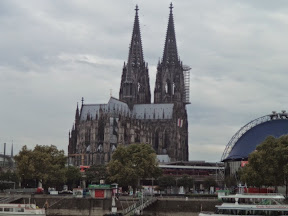
I did manage some better photos of the outside of the cathedral, the morning light being better. The photographs are still somewhat spoiled by the scaffolding and the huge digital screens in the piazza outside, so this photo was taken from the river as we sailed away.


Part of Cologne cathedral dates back to 870, apparently, but this isn't the bit you see. The current gothic cathedral was begun in 1248, but it stalled during the religious wars and wasn't finished until 1880, though it was built then to the original plans. My guide book calls it the most ambitious building project of the thirteenth century north of France. It's certainly imposing inside, the 140 foot high ceiling reminding you of your place in the vast scheme of things. There's lots of stained glass too, some of it very old.


The first cathedral housed a famous relic, the bones of the three Magi, acquired in 1164. This relic attracted so many pilgrims that the Cathedral Chapter decided to build a new cathedral. Unfortunately, the part of the cathedral which housed these relics was closed off, so we weren't able to see it, along with something else I had hoped to see, an old crucifix dated to 976.

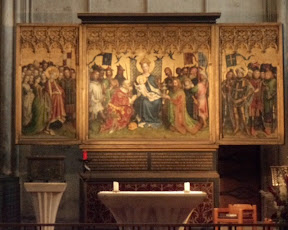
I did manage to see this painting, painted around 1440, in the Chapel of the Virgin.


It's called The Patron Saints of Cologne and is one of the most famous paintings of the School of Cologne. It shows the Virgin surrounded by the saints - though there was nothing to explain exactly who the saints were, and it wasn't possible close enough to see anything in detail.

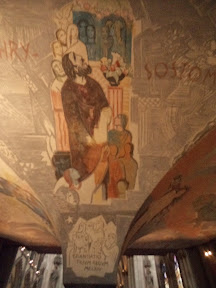
The interior of the cathedral was probably entirely painted. There are just a few paintings left, which gives you an impression of how it must have looked.


Just before 11, we set off down river towards Linz. This part of the Rhine flows through flatter lands, with forests and agricultural land on one side and smart houses on the other.

The first interesting town we passed was Konigswinter, a small resort town at the foot of the romantic Drachenfels mountain. The mountain is crowned by the evocative ruins of a castle built in the early 12th century by the archbishop of Cologne. A cave in the hill is said to have sheltered the dragon which was slain by the hero Siegfried.


After that, we passed Remagen, better known for its bridge, built during World War I and captured in World War II by the Americans after two failed attempts to demolish it. It was the subject of a popular film.

The bridge collapsed a few days after its capture, and has never been re-built. We saw the remaining towers of the bridge as we sailed past.


We moored at the small town of Linz, an attractive town because of the large numbers of old half-timbered buildings.


There are two of the old town gates, one with the date 1748 on it, and both with a portcullis.


- Posted using BlogPress from my iPad

Wednesday, 17 September 2014

Arrival in Cologne

Wednesday Sept 17th.

I'm on a boat about to go down the Rhine, and it seems there is very little Wi/Fi here, so I'm trying to post from the phone as an experiment. I won't write too much in case it doesn't work.

Our journey this morning was made difficult by London Transport breaking down almost completely, as far as we could judge. It took us 2 hours to get from Oxted to St Pancras, through appalling crowds. We did think we might just as well have spent the night with our children in Manchester, it wouldn't have taken much longer and would have been far less stressful!

Eurostar was fine - I slept in the tunnel as we'd been up at 6, and we were soon in Brussels. The train to Cologne broke down though, so that part of the journey was more trying, and we were late arriving. The boat is quite nice - this is it, taken the following day.


Our cabin is not one of those practically in the water, it's on the middle deck.

Because we were late arriving, we only had time for a brief look at the outside of the cathedral.


I think this is one of the worst photos I've ever posted, but it's hard to get far enough away, the evening light was difficult and the cathedral is being renovated so it's covered in scaffolding and screens.
If there's time, I may try to do better tomorrow before we leave.

- Posted using BlogPress from my iPhone