Thursday, 15 June 2017

Plitvice Lakes

15 June 2017
Plitvice Lakes

Plitvice is pronounced more or less as 'Plit-vee-chay' 

A coach called for us at 8.30 in the morning, so we were up early in order to shower, dress and breakfast before that. 

Today is a public holiday, Corpus Christi, so it seemed much of the population of Zagreb was on the motorway and our progress across the flat plains south of Zagreb was slow. After just over an hour, we left the motorway for narrower roads through the hills and the roads were much less crowded. Thankfully, it seemed that not everybody in Zagreb was visiting Plitvice Lakes!

Plitvice Lakes National Park, founded in 1949, is one of the oldest national parks in Southeast Europe and in 1979, was added to the UNESCO World Heritage register. The national park is formed of lakes and cascades. There are currently 16 lakes which result from the confluence of several rivers, both on the surface and subterranean. The lakes are all interconnected and are separated by natural dams of travertine, a porous carbonate rock formed by the sedimentation of calcium carbonate from the water. It builds barriers and sills, creating waterfalls both large and small. Over time, the water changes its course, so everything is in a state of change. We last visited Plitvice Lakes in 1975, and it was somewhat different then - there were hardly any visitors, for a start!


The Lakes can vary in colour, but tend to be varying shades of green, blue and turquoise. 


We began by descending into a canyon - rather slowly, as the paths and trails were very crowded with hundreds and hundreds of people. There are a myriad of streams cascading down the canyon.


Some of the trails are on boardwalks, and you may be able to see from this photo the hundreds of people surging along the boardwalk at the far side of the canyon.

The water in the lakes and streams is very clear; I have several photos where you can hardly tell where the water begins. You can see the fish (mainly Chub, Rudd and Trout) clustering near the boardwalks in the hope that tourists will feed them. You aren't supposed to, but people obviously must do so, or you wouldn't see so many of them looking hopeful!

Once down in the canyon, we were able to admire Veliki Slap, the tallest waterfall in Croatia at 78 m.

It was almost impossible to take a photo without an awful lot of people in it. The whole park seems overrun by people with selfie sticks and taking photos can be difficult at the good viewpoints - you have to queue!


You can see that the waterfalls and cascades vary in size.

This is a view from one of the boardwalks.


Some of the lakes are calm and peaceful.

It was possible to find quiet spots from time to time, and appreciate the gorgeous colour of the water. The colour does change with the light, so it can be much brighter when the sun comes out, and darker when there is cloud cover.

Sometimes the water makes channels down through the abundant vegetation


At other times you can more clearly see the travertine sills


Sometimes the waterfalls are so close to the path that conversation becomes difficult - the water is very loud.


There were places where the water was even closer to the walkway than this, but they were often places where it would have been dangerous to stop to take a photograph. There was often quite a press of people going in both directions, and you are so close to the water there is always the worry that some impatient person will inadvertently shove you in!


After a couple of hours we reached a picnic spot, where we stopped for lunch, after which we caught the boat along the lake.


The boat takes 100 people, but we had to queue for a very long time as there were more than 300 people in the queue in front of us. After that, you climb and descend some stairs to catch another smaller boat across the lake. Then it's a lot more climbing to get back towards the road.

These upper lakes have fewer cascades and are altogether quieter and less scenic, and you can hire a rowing boat to get closer to nature than you can on the bigger boat. But our coach was waiting for us at 3.30, as it was a 2 hour trip back to Zagreb, a rest from the heat and then dinner in the hotel. 

I have always wanted to come back here, ever since the first time we visited. Now I'd like to come again and spend longer and explore more of the park. But I'd try to avoid a public holiday and hope it wouldn't be quite so crowded.

We have to get up at 5.30 tomorrow, it's a 6.30 start! We are off to Split next.

Every time I post this and then preview it, the text has changed in some paragraphs in either font or size or both; I've tried 3 times so far, so if it happens this time, I'm just leaving it - I have a case to pack!


Wednesday, 14 June 2017

Zagreb


Wednesday 14th June, 2017

Zagreb

My goodness, I seem to have got everything to work!
Today we woke to gloomy skies and, just as we set off for our tour of Zagreb, the rain started. It got worse before it got better!

Zagreb is distinguished by its 18th- and 19th-century Austro-Hungarian architecture, of which this is a good example - this is the National Theatre. 


Shortly after we passed this building, the rain came down in torrents. I had an umbrella, but other people has neither umbrella not raincoat, and we had to make an unscheduled umbrella buying stop. Paul had to buy an umbrella! After that, we pressed on to the old part of the town.

The first recorded appearance of the name Zagreb was in 1094, at which time the city existed as two different city centres: the smaller, eastern Kaptol, inhabited mainly by clergy and housing Zagreb Cathedral, and the larger, western Gradec, inhabited mainly by craftsmen and merchants. Gradec (now referred to as the Upper Town) can be reached by a funicular which was unfortunately not running today, so we were obliged to climb a great many steps instead. Gradec was fortified, and this is a watchtower remaining from the fortifications. 

A small cannon protrudes from a window on the fourth floor, and it is fired at noon. We weren't there to hear it, unfortunately. 

St Marks Church is the parish church for this area, and the original church dates to the 13th century. It has been reconstructed several times.


The colourful tiles on the roof are orange, blue, white and black. The left hand illustration represents Croatia in three parts, Croatia, Slavonia and Dalmatia. On the right  is the coat of arms of Zagreb.  The church is flanked by a government administrative building on one side and the Parliament building on the other side.

From there, we walked down a slope towards the Kamenita vrata, or 'stone gate', which originally formed the main eastern entrance to the town. Inside the gate – which is really more of a long curving tunnel than a gate – lies a very popular shrine, a sixteenth-century icon of the Virgin in a grille-covered niche. Miraculous powers have been attributed to the statue, largely on account of its surviving a fire in 1731. There were quite a few passing city folk offering a quick prayer; I spotted one lady with a candle, and later, a man kissing the grille.

Once through the tunnel of the gate, you continue to descend the slope and find this statue of St George.


Actually I think the dragon looks more like a catfish!

Below St George is a street our guide said had been a popular medieval shopping street.


At the foot of it we came to a street that had once been a stream and marked the boundary between Gradec and Kaptol. One old building opposite had been a medieval brothel. 

We climbed up towards Kaptol, making a stop at the market for a quick look round - and a quick coffee on my part, as my back needed a rest. Then we headed on up to the cathedral. 


The cathedral  is almost wholly neo-Gothic, having been rebuilt by Viennese architects Schmidt and Bollé after a catastrophic earthquake in 1880. They are also responsible for many other buildings in Zagreb.

Kaptol was also fortified, though little evidence of this remains, just this tower and a small section of wall.


Our last visit was Governor Jelačić Square, or Trg bana Jelačića, a hectic place full of cafés, hurrying pedestrians and clanking trams. It’s apparently the biggest tram stop in Zagreb, at the intersection of seven cross-town tram routes, so it's always busy and noisy.

At its centre is the equestrian statue of the nineteenth-century Ban of Croatia, Josip Jelačić, who won some autonomy for Croatia in the late 1860s. The square was renamed Trg Republike in 1945 and the statue – considered a potential rallying point for Croatian nationalism – was dismantled after the war in 1947. Its parts were stored away until 1990, when it was restored to the square, although it now faces in a different direction. 

I managed to photograph it with a pigeon sitting on the feather on the general's hat!


Paul and I went back to the hotel for a rest, and later retraced out steps so as to have a closer look at many of the things we had seen earlier in the day. We also took the opportunity to visit the Museum of Naive Art, which is situated close to St Marks Church. This necessitated a second climb up the steps to the Upper Town as the funicular was still not working! 

We enjoyed the little museum which exhibits works painted mostly in the last century by completely untrained 'Sunday painters', many of whom were peasants. The paintings were hard to photograph because many of the painters were too poor to buy canvas and painted on odd pieces of glass, and the reflections don't make for a good photo.


This is one I particularly liked, called 'Cows Hauling Wood', painted in 1965 by Ivan Večenaj

Tuesday, 13 June 2017

Lake Bled to Zagreb

Tuesday 13th June
Lake Bled to Zagreb

We were due to leave Lake Bled at lunch time, so we had a fairly leisurely breakfast,  checked out of the hotel, and set off around the lake again to take a look at what used to be Tito's mansion. He certainly would have had some wonderful views from it.


The lake continues to amaze you, it's so beautiful its hard to resist taking more photos. This is a closer view of the island and the church - you pass it to get to Tito's mansion.


Tito's mansion is now a hotel, called Villa Bled. It's probably more than a third of the way around the lake, so it was quite a walk, and today was really hot. I was glad we weren't walking any further. 

The villa is large and cream coloured and quite a large hotel, so it's surprising to think it used to belong to a communist leader. This is the view of it from the lake.


The view from the front is even more imposing.


The garden is extensive, probably more that 5 acres, and is carefully tended with colourful flower beds. 


There are Art Deco style lights on imitation Egyptian pillars all round the grounds, but there's no indication of when they were put up, they could be very recent.

We were extremely hot when we got back to the hotel, and it became hotter still outside. We were taken to the station by coach, but had to wait quite a while for the train - it was extremely late. The station is tiny, so tiny there is no bridge between the platforms. You look both ways carefully and cross over the rails. An approaching train hooted at me rather crossly, but it was about a hundred yards away when I crossed.

The train journey of just over 3 hours is, I think, the hottest journey I have ever experienced. When we got to Zagreb, it was 37 degrees! The train wasn't air conditioned and frequently sat for long periods in the sun getting hotter and hotter. There are 6 of us in our compartment so we couldn't stretch out or even move much, and my feet swelled up like balloons.

We are extremely relieved to see an air conditioned coach meeting us at the station, and even more pleased to see our hotel. We had to wait in the coach for 10 minutes because some celebrity with lots of secret service personnel was leaving. The hotel wouldn't say who it was, but people who had the energy to look out of the window thought it might have been Christine Lagarde. It certainly looked like her.


We had time for a short rest and a cool shower before meeting for the walk to a local restaurant for dinner. The dinner was delicious but it took 3 hours, so we were very tired when we got back. And it's still 29 degrees at 10 o'clock at night!

Monday, 12 June 2017

Ljubljana and Postonja Caves

Monday June 12th
Ljubljana and Postonja Caves

Today didn't start well with no coach to take us to Ljubljana- the driver had misread an email cancelling our trip from Bled Station to the hotel on Saturday (since we had been obliged to take the coach from Schwarzach St Veit in Austria as trains were running no further than there because of engineering work.) He assumed we weren't coming at all, so he didn't turn up today either!

Fortunately, our efficient tour manager managed to contact him so he arrived about 45 minutes late and we were soon on our way to Ljubljana. It was motorway all the way, in a flat valley at the foot of the mountains.

We had a tour guide in Ljubljana, who explained some of the history of the town. The original city, called Aemona, was founded by Rome in around 50 BC. There are the remains of a Roman wall, apparently, which we didn't have time to see. After the fall of Rome, it isn't very clear what happened to the city, as the next written records date to the middle of the 12th century. 

The medieval city suffered an earthquake in 1511, so parts were rebuilt in Renaissance style, whose influence you can still see today. Later, in the middle and the second half of the 17th century, foreign architects built and renovated numerous monasteries, churches, and palaces and introduced Baroque architecture; a number of these buildings still remain. 

There was another earthquake in 1895, after which parts of the city were rebuilt in Art Nouveau style. You can still see these influences around the city today, indeed we began our tour in the Art Nouveau area, which is really just one street. We saw the first building in that style, which influenced others. 


It is bright pink, and the windows are outlined with shapes in blue, terracotta and pale orange. It's not the sort of building you could miss! Nearby was another, rather more restrained, in cream with blue tiles.

The street led down to the central Square, Preseren Square, which is dominated by the Franciscan Church of the Annunciation, built in the 17th century in the Baroque style. I'll explain the trees later!


This is the beginning of the Baroque part of the city. The Square is also used for art installations and the one there at present is a representation of Ljubljana weather, so it sprays water out from time to time. It was hard to hear our tour guide because there a large group of primary school children were running through it to get cool and screaming with delight!

There is also a statue of the Slovene national poet Preseren. He is holding a book which represents his most famous poem, the seventh stanza of which is used for the Slovene national anthem. 


Our guide told us a lovely story about the statue, which stands near the Franciscan church, and also shows his muse above his figure, symbolically inspiring him. She was a lady called Julia whom he couldn't marry because she was too rich and aristocratic, but he wrote a lot of love poetry because of her. Her statue is wearing very little. Apparently, the women of Ljubljana complained that it wasn't fitting that the first thing a man would see on coming out of the church was a naked lady. So the city fathers planted trees so the statue couldn't be seen from the church!

We walked down other streets of beautiful old buildings and arrived at Congress Square, an important square which was built in 1821 for ceremonial purposes such as the Congress of Ljubljana after which it was named. Since then it has become an important center for political ceremonies, demonstrations and protests, such as the ceremony of the creation of the Kingdom of Yugoslavia, or the protests against Yugoslav authority in 1988 etc. It also houses several important buildings, such as the Philharmonic Hall and and Ljubljana university. 


This Neo-Renaissance University building used to be the governor's palace, but became the university in 1919. 

We crossed the river Ljubljanica on Cobblers' Bridge, (so called because in the medieval period there were cobblers booths there) and one of our party remarked on the fact that many of the old buildings had been beautifully renovated but there was one close to the bridge which was in a dreadful state of disrepair. 


Our guide explained that, at the end of the soviet era, the government decided to give back the buildings which had been taken away from the original owners in socialist times. However, in order to get the buildings back, the families of the original owners had to produce adequate documentation to show that they had really owned them. In some cases, this documentation did not exist, and while arguments raged about who the owners were, nobody was inclined to pay for restoration and renovation. 

We passed on to Town Square, which is dominated by the Town Hall. The original building was built in a Gothic style in 1484, but between 1717 and 1719 it underwent a Baroque renovation with a Venetian inspiration. This building is adorned with dragons, which have become the symbol of Ljubljana, possibly because of the city's association with St George. Nearby is a Baroque fountain by Francesco Robba, a Venetian who lived in Ljubljana at the time. It has Carrara marble figures representing river gods.


Also nearby is Ljubljana Cathedral or St. Nicholas's Cathedral. It is easily identifiable because of its green dome and twin towers, which I did not photograph because I was concentrating on its bronze doors and the fresco on the front of it. This Baroque building was designed in 1701, though the dome was not added until more than 100 years later. 


The cathedral is close to Ljubljana Central Market and we admired the beautiful fruit and vegetables there. 


There are also public scales so you can check the weight of the produce you have bought, and a wonderful enormous fresh milk machine. You can bring your own bottle or pay for one of their plastic ones, and apparently the milk is so fresh that it was rumoured, when it was installed, that there was a real cow inside!

We crossed Butcher's bridge, adorned these days with hundreds of love locks, and made our way back to Preseren Square, where our tour ended. 


Our guide had recommended a cafe of the 12th floor of a building called Nebotičnik, which translates as The Skyscraper, so we made that our lunch time visit. It was very inexpensive and there were good views from the terrace.


I was able to get a good photo of Ljubljana castle, a medieval castle originally built in the 12th century which has Romanesque, Gothic, and Renaissance architectural elements as it evolved over the centuries. There is a funicular to get up there, but unfortunately we didn't have time as we had to get back to the coach to set off for the Postonja Caves.

An hour's journey in the coach took us to the village of Postonja where the caves are situated. These limestone caves were carved by the Pivka River over millions of years, and are quite damp and drippy inside.

When you first go in, you have to put on a jumper, because it really is very cold. You get onto a little train and it transports you deep underground in a ride that takes about 10 minutes. Then you get out and walk. The whole cave system is almost 25 km, and you see about 5 of them, admiring the formations. There are stalagmites, stalactites, and formations called curtains or draperies that look like folded curtains. 


Some of the oldest pillars are over 350 thousand years old and are still developing, so you mustn't touch them. There are non-slip concrete walkways with metal railings, because the slopes up and down are very steep and we walked quite fast. In one section, there is a narrow bridge over quite a deep chasm. The bridge is called the Russian Bridge because it was build by Russian prisoners of war during the First World War.


You pass a completely white stalagmite called the Brilliant  (also sometimes called the Diamond) and the neighbouring baroque pillar, which have become symbols of the cave. 


Above that, in a darkened fish tank, you are able to look at some of the olms, a cave salamander. Because they live in a completely dark environment in a cave which normally has no light, they are colourless and blind, and can live to over 100 years old. No photos are allowed, unfortunately. If you really want to, you can buy a soft toy version in one of the souvenir shops!

You then enter the Concert Hall, which is the largest in the cave system and can accommodate 10,000 people for musical performances. Our guide invited any of our group to sing, but nobody volunteered! 

After that, you get back onto the little train and it takes you back to the entrance. I stopped to ask the guide if there had ever been any humans living there. She told me no remains had ever been discovered, possibly because the original entrance was so low, long and narrow and the interior was so very cold and damp it wouldn't have appeared very attractive. Few animal remains were found either, possibly for the same reason. The bones of a cave bear found might have belonged to one who got lost by mistake.


This conversation took so long that I was locked in the cave by mistake. I don't know where the guide went, but the woman who locks the gates had already locked them before she met me scuttling about trying to find the entrance. We were the last group of the day and she thought we had all gone. I was quite glad to get back to the coach!

Sunday, 11 June 2017

Sunday June 11th Lake Bled

Sunday June 11th

Lake Bled

We had beautiful views of the lake this morning at breakfast - no idea why I didn't take a photo immediately. I was probably too busy thinking about my choice of juice at breakfast. The choice was tomato juice, carrot juice, or beetroot juice. I just had to try beetroot juice, and I'm afraid it was a big disappointment. I love beetroot - plain boiled, with no vinegar - but this wasn't very nice. So tomorrow I'm going to try the carrot juice.

After breakfast and some emails etc., Paul and I set out to walk round the lake, which we had been advised would take us about 90 minutes. I'm afraid that was a bit of an underestimate, as we walked fast and it took a bit closer to two hours. Mind you, we did stop a lot for photos. The lake is absolutely beautiful. The colour of the water varies with the light, sometimes it is a deep emerald green and sometimes turquoise. 


The steep hillsides that surround it are covered in trees with dark green foliage. A stark white church with a dark narrow spire is prominent at one side of the town, and huge steep rocky cliffs above it are crowned by a medieval castle.


Walking round the lake gives you lots of beautiful photo opportunities, especially as you approach a small island at the far end which is almost completely occupied with another white church with a dark spire. 


You can visit the island by boat, and the lake is busy with lots of different boats. The most popular ferry to the island is a large rowing boat with a canopy to keep off the sun. The boat seems to hold 10 or 15 people, and is rowed by a very strong man who rows it standing up at the stern. 


There are lots of other boats on the lake though, as well as pedalos and paddle boards. There were also lots of sculls today too, since it seems Bled is hosting the World Rowing Championships and there were quite a few races going on. 


We didn't stop to watch though because it was rather hot and we were trying to stay in the shade.

It was lunch time by the time we had completed the circuit, so we went back to the hotel to rest and cool down. By 2.30 we were somewhat rested so we went out again with the intention of visiting the castle. The castle dates back to 1011, though various things have happened to it since then, so we expected it to be quite interesting.

We set off by walking part of the way round the lake towards the castle. It would have been possible to take a taxi up, but for some reason that never occurred to us. We climbed; first up to the church that dominates the town, and then up the very steep hillside. About 15 long flights of stairs lead up towards the castle, with steep paths between. A notice board at the foot of the stairs tells you the stairs will take about 15 minutes. I suppose there are people who can climb stairs for 15 minutes without stopping, but I'm not one of them. So it took me a lot longer with all the little rests at the top of each flight. 

At the top, more steep paths take you up to a path just below the castle and you cross through the castle gate on a wooden drawbridge. There is then a long and very steep cobbled path winding up to the ticket office. After that, there's only one more flight of stairs and you are stumbling into the lower courtyard.


The views over the lake are spectacular and you can see for miles. 


The castle print shop is housed in the lower courtyard, and views of the castle were being created by a most handsome young man in medieval costume using an old printing press.


The prints were for sale - sadly, the handsome young man wasn't, so I didn't buy anything.

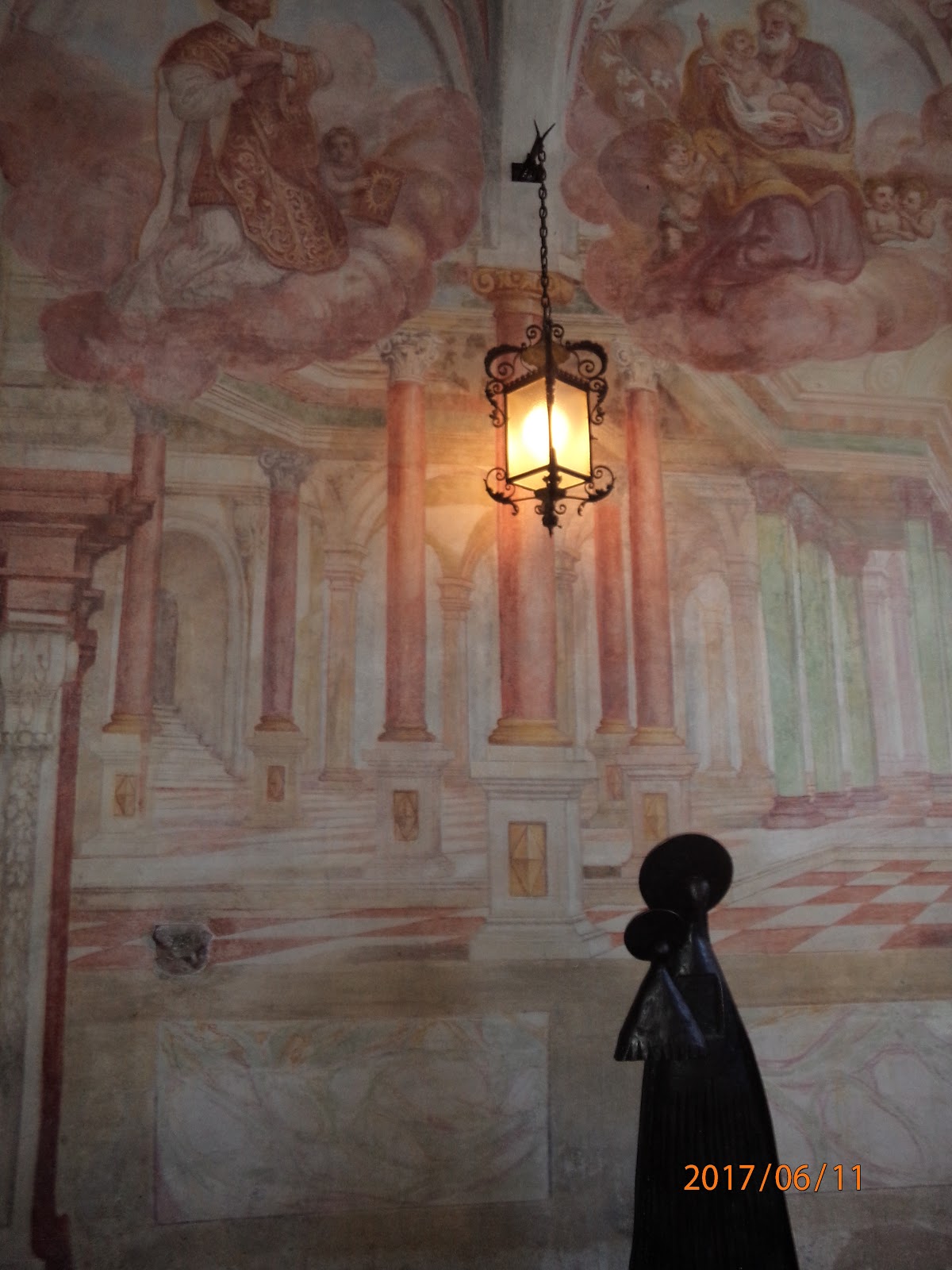
We staggered up more stairs to the upper courtyard, where the most interesting place was the chapel. I'm not sure of the starting date for this, but it was altered in 1690 after an earthquake and was elaborately frescoed at that time. 


The frescoes at the back of the chapel look quite fresh.


Near the chapel is the forge, but the blacksmith was taking a break so we weren't able to see him making anything. He was quite a burly young man with a beard, and he was drinking a cup of tea from quite a dainty cup with a saucer. He was quite anxious to sell people wrought iron candlesticks and dragons but we haven't much room in our cases, fortunately.

There is also a small museum, which shows artefacts from the castle area that demonstrate that it was first inhabited by Stone Age hunters, and there are also bronze and Iron Age artefacts and Roman finds as well. 


The date of 1011 is the first date at which there is documentation about the castle, but there has clearly been occupation there from earliest times.

We staggered back to the lower courtyard to have a cold drink in the café there, and sat in the shade close to the well. The castle is too high for any spring, so the well is dug into the rock to make a cistern for collecting rainwater. It is 10 or 12 metres deep apparently, so it covered over now of course.


Once I had got some strength back from sitting in the shade drinking home made lemonade, I had to face the long climb down all the stairs. It was considerably quicker than coming up though. Once down, there was still part of the lake to go round, and the climb back up the hill to our hotel, where showers and rests were necessary. We managed to find a restaurant fairly close to our hotel for our evening meal, fortunately. Neither of us felt capable of much more walking!

Saturday, 10 June 2017

June 10th Munich and Bled

Saturday 10th June
Munich and Bled

My Internet connection was so bad, I could post no photos. I could have added the photos when the connection improved, but the tour was very busy, the weather was unexpectedly hot, and I was constantly tired.

After a whole day of traveling yesterday, we arrived in a very comfortable hotel just opposite the station in Munich for an extremely late dinner - it was well after nine. 

This morning, we had a few hours in Munich to sightsee, and the sun was shining and everything looked very attractive. Our tour manager had said she would walk us down to Marienplatz in the old city centre, which wasn't far away.

It was only a few minutes walk along a Main Street, Bayerstrasse, to get to Karlsplatz, a main square at one end of the pedestrian street that leads to Marienplatz. Bayerstrasse itself was fairly unpleasant, as the whole street was being dug up for the trams. Many buildings were shrouded in scaffolding and screens so photography was very difficult.

Karlsplatz is a picturesque square with an enormous water fountain.


 At least one of the buildings in the Square is fifteenth century, but I'm not sure which. There is a gothic looking gateway leading into the pedestrian street, but it looks to me like a modern replica.


It was an interesting walk down the pedestrian street, past the Frauenkirche, (Church of Our Lady) which is apparently the most visible symbol of Munich. It has two onion domes, so it is very distinctive. Unfortunately, it was one of those buildings which was shrouded in scaffolding and screens, so a photo was impossible. I have managed a view of the domes from a more general view of Marienplatz.


The street itself is lined with the shops you see everywhere - you could be anywhere in the world. But you pass the most astonishing building, the Church of St Michael, which the map supplied by the hotel described as 'a Renaissance jewel'. It is certainly eye-catching. 


Paul was disappointed with the inside, which was Baroque. There is also the tomb of King Ludwig 2nd, the mad one who built the fairy-tale castles, but I was so overwhelmed with the symphony of white and gold on the inside I forgot to look for it.


The most amazing building on Marienplatz is the neo-gothic new town hall, which is absolutely smothered in statues, carvings and curlicues, and houses Germany's largest Glockenspiel, which plays jolly tunes when the clock strikes. It is adorned with Bavarian knights who apparently do things at 11am, but we were elsewhere by then. 


There's also an impressive Opera Museum in the Square, but it too was shrouded in screen and scaffolding. And in addition, everything was hard to photograph because of all the people, the street furniture and the many delivery vans! 

There were at least 4 accordion players, some better than others. The one I photographed wasn't the best musician but he was wearing lederhosen!


Before  midday, we were back at the station so we could catch a train into Austria. Engineering works on the line meant that we could not catch a train all the way to Bled, but only to a little place I had never heard of, called Schwarzach St Veit. From there, we would need to have a coach.

The train was no longer the fast Intercity express, but a much slower one, and which had old-fashioned looking compartments and no wifi.

We began by crossing a flat plain, but were fairly soon in the mountains which was much more scenic and interesting. There were many long tunnels as the mountains became higher. I had hoped to take photos but the train windows were too dirty. We were really only aware of crossing he border into Austria because our mobile phones changed provider. 

As we approached Salzburg around 2.15 or 2.30, we got a fleeting glimpse of the castle, and about an hour after that we arrived in Schwarzach St Veit and got off to find our coach. The place was full of Rail replacement buses - quite like home really!

It was a 2 or 3 hour drive from there to Bled, and again we appreciated the beautiful mountain scenery, much like Switzerland. 


In spite of this, we travelled on fast motorways and sometimes across enormous viaducts. We crossed the border into Slovenia, avoiding huge queues of local motorists.

By 6, we had arrived in Bled and were in our hotel. Our tour manager tells us it is really beautiful and worth the two long days of travelling to get here. We shall see tomorrow!

Friday, 9 June 2017

On Holiday Again

Friday 9th June 2017 

I see I haven't posted anything for 9 months. This isn't because I haven't been anywhere, it's because I seem to have been quite busy and somehow haven't got around to posting anything. So I have a mass of unused photos which I won't have time to use now.

So now I am starting again because I am off on holiday - travelling towards Slovenia by way of France, Belgium and Germany. Later I'll be visiting Croatia, and spending a day in Montenegro.

In the interim when I wasn't posting anything, I see I can no longer use the very wonderful BlogPress, and goodness knows how I will get on using whatever facilities Google offers me. Instructions currently in Flemish will no doubt change to German, which will only make things slightly easier, and by Saturday night I expect they will be in Serbo-Croat which will be quite hopeless.

 Today is the day of three trains - Eurostar to Brussels, on to Cologne, then later to Munich for the night. As we had to check-in very early, we spent the night near Kings Cross and were at St Pancras before 7.30am. Arrival in Munich was 14 hours later!

 I can see that adding photos to this will be trying. After some minutes of waiting, Google looked at my 2014 photos, so I could get very old waiting for it to reach 2017! Below is an experiment to see what I can do by uploading something to Google photos.

This is supposed to be a photo of a beautiful azalea photographed on a walk into Oxted a week ago. I don't feel it has been a very successful experiment!


And then it was a real effort to stop the text being centred!

And it's really difficult to move around in the text, as the iPad has no scroll bar, so I can't edit previous text. I had to borrow the laptop to get as far down as this bit, Now the font size seems to have changed, and even editing the HTML hasn't helped. So I'm starting to think that this blog may not work very well on this holiday.

Google must really have something against iPads!