Thursday, 23 May 2019

Wednesday May 22nd

It was a fairly late start this morning as we spent a long time chatting to our friend and organising ourselves, as well as discussing where we meant to go and what we should do. In the end we decided to spend a day wandering and orienting ourselves, and visiting some of the Chorus Churches for which we have already purchased a ticket.

We began by walking, having decided on a visit to a church called Santa Maria dei Miracoli, which is so called because it houses an image of the Virgin Mary believed to have miraculous powers.

The church was built between 1481 and 1489, and is strikingly decorated outside with panels in various shades of marble.


The inside is embellished with pink, white and grey marble and there is a barrel vaulted ceiling which had 50 portraits of saints and prophets. You can either see the photo of the barrel vaults or the one of the miraculous image, so I have chosen the one with the image.


The image in this photo is rather small I’m afraid, I wanted to get some of the surroundings as well.

Outside, we crossed little canal bridges and we noticed the high numbers of people who were taking the expensive gondola trips.


Venice is extremely busy with this being a Biennale year, which might explain the high numbers of tourists in gondolas. However, Venice has become much busier and more crowded since the last time we were here a few years ago; we certainly didn’t notice so many people taking gondola trips last time.

Our next visit was to another church fairly nearby, Santa Maria Formosa. This one, at one side of the Campo Santa Maria Formosa, is not so handsome as the last one and is much bigger. 


Inside, I was quite taken by this painting of St Barbara, surrounded by other saints, and the dead Christ supported by Mary at the very top. It is by Jacopo Palma il Vecchia, a painter with whose work I am not familiar.


By the time we had viewed all the paintings in this church, it was well past lunch time, so we stopped for a drink and a sandwich at a bar at the corner of the Campo. Then, refreshed, we set off for the Rialto.

The crowds here were awful. It was really difficult to walk anywhere and we were obliged to do so very slowly indeed. This was not good for my back! Once we were on the Rialto Bridge, there were so many people taking photos I had to queue to to take mine.


However, I think it was worth the wait. Just call me Canaletto!

We then went in search of another chorus church, San Giovanni Elemosinario, which we failed to find in spite of wandering about for a long time. This church apparently cannot easily be spotted from the street as it is part of another building. Apple Maps misdirected us, we seemed to be getting nowhere, the crowds made progress difficult and we were so late that the markets we had hoped to see were closed. In the end we decided to give up and return to base. It was almost 5pm anyway, so we caught a water bus down the Grand Canal, not forgetting to photograph San Marco as we passed.


At Arsenale, we changed water bus to another line to take us right round to Fondamenta Nove. On the way, we passed the hospital, with ambulances waiting outside. Stupidly, it had not previously occurred to me, but all the ambulances are of course boats. 

A little further on we heard a siren, and one of the ambulances passed us at great speed, throwing up a huge wake which completely soaked our boat. A couple of other English tourists unwisely sitting by an open window got very wet indeed, and I made a mental note to keep the boat windows closed when not taking a photo! 

Wednesday, 22 May 2019

Tuesday May 21st

Today we flew to Venice, but there are no photos because it was a late flight and it was dark by the time we arrived.

We were extremely lucky to fly at all, because there was a baggage handlers strike in Venice airport and no flights there took place all day. Ours, at 5.40 pm, was the first one which wasn’t cancelled, and we were far from convinced we would be able to leave until we actually took off.

It was a short flight, just under 2 hours, and though it was not quite dark when we landed at 8.50 pm local time, it was dark by the time we had our baggage and had made it down to the dock. 

The walk to the dock takes almost 15 minutes and we almost ran so as to catch the 9.30 boat. We made it with about a minute to spare, which was fortunate as there are only 2 boats an hour.

The journey, via Murano, took about 40 minutes to Fundamente Nove, which is a fairly short walk from where we are staying In Cannaregio. As it was so dark, there was not much to see apart from the fast boats which swept past us, leaving us wallowing in their wake. 

April and May 2019

April seems to have been a very busy month.

At half term, we took my younger grandson to the Science Museum to see Rocket, but to his disappointment, it was out on loan. We saw plenty of other engines though, so it wasn’t a total loss. We took lots of photos, but they all have him in them, so there’s nothing to post here. The next day we took him to London Zoo, where he had a lovely time looking at various monkeys and the lions, and playing in the adventure playground. He was much taken with the Squirrel Monkey Experience in which they play in the trees around you, and the Rainforest Experience where you get very close to different tamarinds and where we saw this lovely sloth.


Just after half term, spent more than a week being extremely ill with vomiting and diarrhoea; I can’t remember when I was last that bad, it took me a long time to recover and has left me with balance problems. 

Once I was out of bed and was more or less recovered, we went back up to Cheshire for my older grandson’s birthday. We were fortunate to have a beautifully warm day, so the huge inflated pool in the garden was very well used, and there was also a bouncy castle cum slide which was popular.

Back home I n early May we visited Emmets Garden to see the bluebells. They were lovely, but I posted a photo of them last year, so here is the rockery instead.


Later in the month, we visited Nymans Garden for the rhododendrons, which were spectacular, and in some wonderful colours.


There was a whole hedge of rhododendrons with which we were much taken.


Some come in many different colours which look lovely clustered together.


The house on the Estate belonged to the Messel family and was mostly destroyed by a fire in 1947. The front of the ruin is covered by wisteria.


On May 21st, we set off for Venice!


Tuesday, 21 May 2019

January to March 2019

The year began, as usual, with Paul going off skiing.

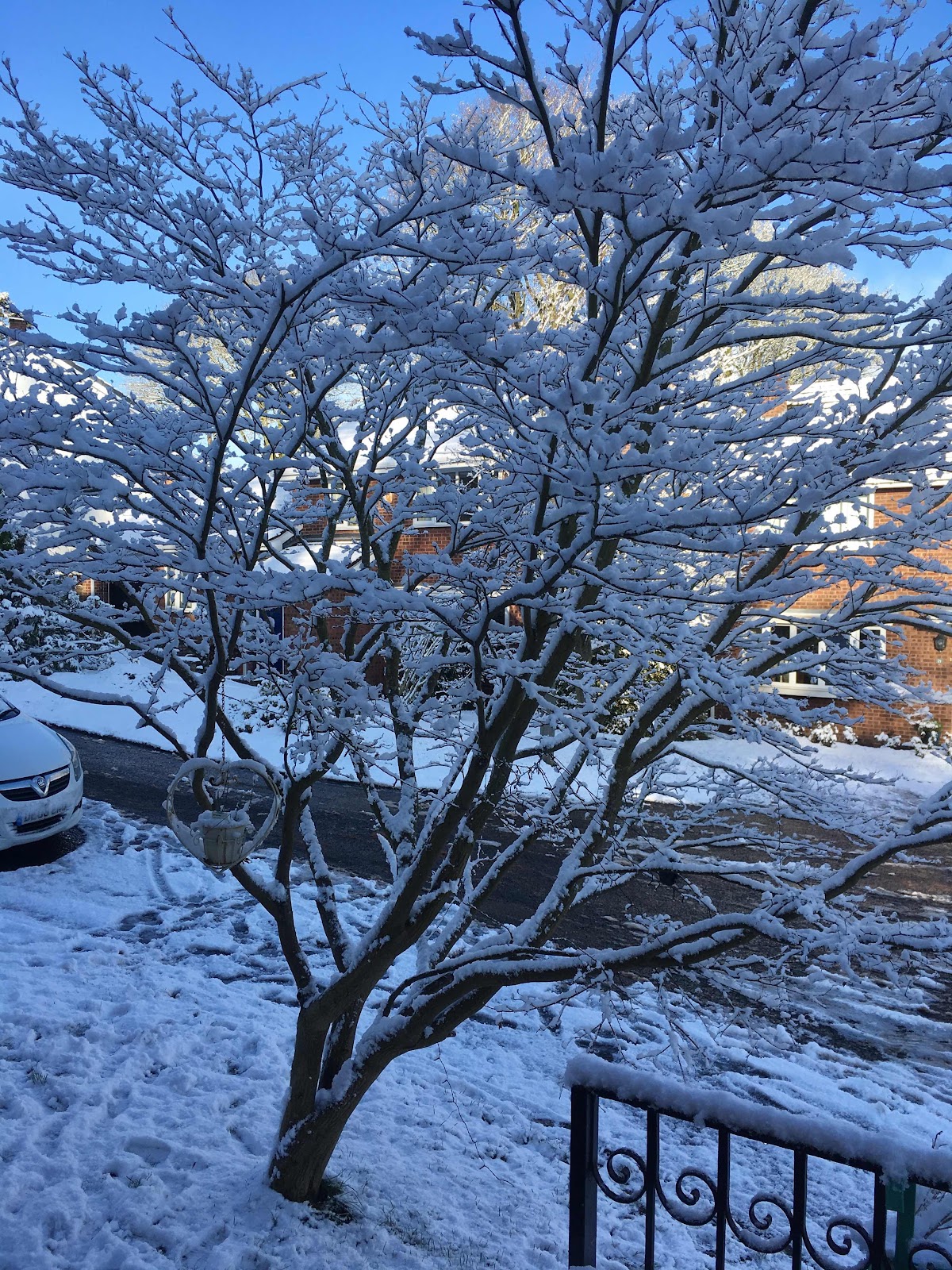
I visited Cheshire for my granddaughter’s birthday and we had some snow!


Nothing like Paul’s snow in Colorado and Utah though, and sledging on a bin bag was not a success, I’m afraid!

At the beginning of February, I made a second visit to the Burne Jones Exhibition at Tate Britain, and would have liked to take something home!


I was worried Paul wouldn’t like my choice though, so the reproductions remained in the shop I’m afraid. (It’s a mystery to me why all my photos of paintings come out squint!)

Later in February, my daughter-in-law and grandchildren were back for a further trip to the French Consulate, then I was off to Edinburgh again to visit friends. There are few photos of Edinburgh this time, but we did visit Glasgow and Dundee.

In Glasgow we visited the Kelvingrove Gallery and saw the famous DalĂ­ Crucifixion.


I really liked this view of the Port of Algiers by Albert Marquet, a painter of whom I had previously never heard.


In Dundee, we went to see the newly opened V&A, but found the contents a little thin. It is still in the process of being opened and filled with objects, but I learned a bit about the history of Dundee - jute, jam and linoleum! This museum concentrates on Scottish arts and crafts, but my photos were rather poor because it was very crowded, so I won’t post them here.


This photo shows part of the outside of the museum on the left, with the polar vessel Discovery to the right of it. We didn’t have time to visit that, unfortunately, but intend to see it on some subsequent visit.

I was back up to Cheshire in early March, where we took the children to Beeston Castle, somewhere I had never visited before. I hadn’t realised how high it was, the climb up took ages and the views were stupendous, though the wind nearly blew us over!


After that, Paul was home again and we visited the Watts Art Gallery near Guildford, dedicated to the work of Frederick Watts. I wasn’t impressed with the paintings by the artist himself, but his wife Mary Watts decorated the nearby chapel and it was wonderful.


The end of March saw me visiting Kew for the wonderful spring flowers and blossom.


And there was time before the end of the month for another visit to the Tate Gallery - Tate Modern and Pierre Bonnard this time.


The end of 2018

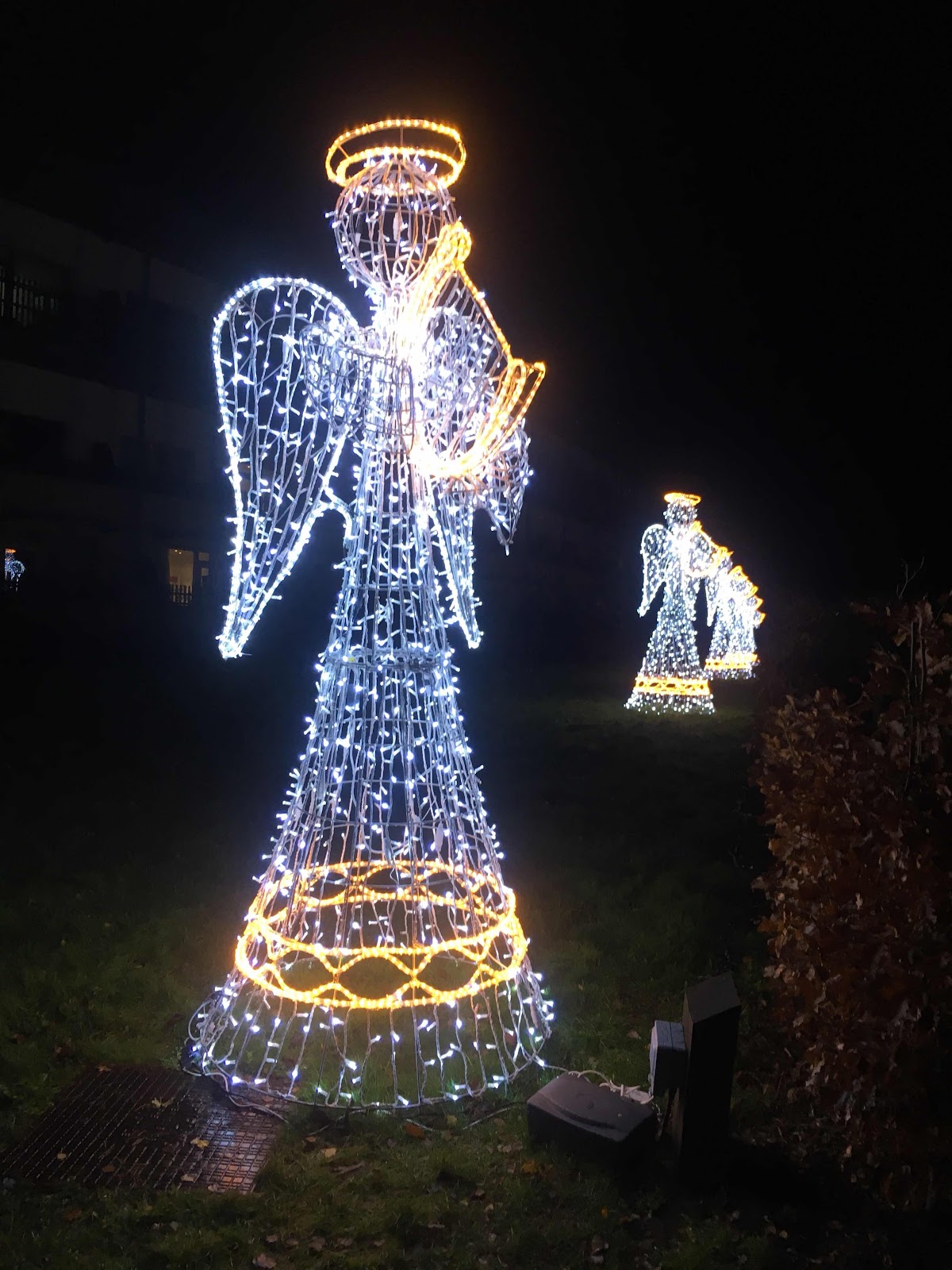
There was little of 2017 left after we came back from Cyprus, but I see we had a long weekend at Centre Parcs with friends. We admired the Christmas decorations and lights, 

and with no grandchildren this time, we weren’t obliged to spend every day in the pool and were able to go for walks and wander about.

I see I visited Tonbridge in December for a talk on Jane Austen - I must say I previously had no idea there was a connection between her family and Tonbridge - her brother Henry was a clergyman there.

I also had no idea there was a castle there


You can see it was a lovely sunny day, very fortunate in mid December

After that, the family arrived for Christmas - Christmas dinner for 10 - and some of them stayed until the New Year so it was a busy time. My French daughter-in-law stayed to visit the French Embassy in early January, as she wants the children to have dual nationality. It’s opposite the Natural History Museum so we were able to take the children to see the dinosaurs, and to have their photos taken with Andy’s clock!


Wednesday, 28 November 2018

Wednesday 21st November 2018 - Homeward bound

It was another early start this morning as we set off for Paphos airport and the journey home. There being little of interest to write about today, I though I would just include a few photos that I didn’t have space to use earlier on.


From Thursday, the first day of the holiday, this is a photo taken out of one of the windows of one of the towers in Kyrenia Castle.

It really shows the thickness of the walls.

On our second day, Friday, we travelled to the west, to GĂĽzelyurt.


This is one of the derelict piers that used to be used for loading the copper ore onto boats. It seems rather sad that copper is no longer mined because the mines are in ‘no man’s land’, but possibly there is little copper left anyway, since it has been mined in the area for thousands of years.

On Saturday we travelled to Nicosia.


This is a photo of the outside of the Great Khan, the caravanserai built in the 16th century which I liked so much. You can see the wonderful chimneys which were used for each of the upstairs rooms so the travellers could light fires and stay warm. By that stage of the day, Paul would have liked a fire to keep warm, he was wearing my cardigan he was so cold!

On Sunday, we visited St Hilarion Castle and Bellapais monastery


This is another view of St Hilarion castle, taken from the middle ward looking down towards the Barbican. You can possibly appreciate the sheer size of the place, when you consider that the middle ward is behind me, and there are two levels above that, the royal apartments and the Prince John Tower.


This is another view of the beautiful gothic cloisters Bellapais Abbey, which was partly destroyed by an earthquake.

Monday was our day of rest, and we spent it looking more carefully round Kyrenia.


This is a view of a typical Cypriot kitchen in times gone by.

On Tuesday, we visited Famagusta and a number of places nearby


These are some of the other beautiful medieval dunks in Famagusta.

After that, we returned exhausted to the hotel to pack for our journey home.

There is little to say about the journey home. It was pleasantly warm in Cyprus - 25C on our last day, and about 10C when we landed in Gatwick. So there was some hasty suitcase opening to put on warmer clothes! 

This was the scene from my bedroom window on Thursday morning


It was a bit of a shock to the system, after lovely holiday weather in Cyprus!


Tuesday, 20 November 2018

Monday November 20th - Famagusta and nearby

We had to be up early today and in the coach by 9 for a long day of visits. Our first visit to the area near Famagusta was to the monastery and tomb of St Barnabas. 

St Barnabas was one of the founders of the independent Greek Orthodox church, and is the patron saint of Cyprus. He was originally a Jew, born on Cyprus, and went to Jerusalem to continue his education, where he converted to Christianity in 33AD. He was appointed archbishop of Salamis and returned to Cyprus in 45AD, intending to convert the Jews of Cyprus. This did not work too well, and during a second visit to the island he was imprisioned in a synagogue and later stoned to death. His followers secretly buried his body, and the grave was forgotten until it was discovered again in the 5th century AD. The Byzantine emperor at the time had a church built on the spot where the grave was discovered. This church was badly damaged in Arab raids in the 7th century, and the current church and monastery date from the 1750s. The number of monks gradually reduced over the years, and by the 1950s there were only 3 left. They continued to take care of the church and monastery until 1974, but were then obliged to retire. Nowadays the Greek Orthodox Church takes care of the site because it is so important. 

The church has now become an icon museum.
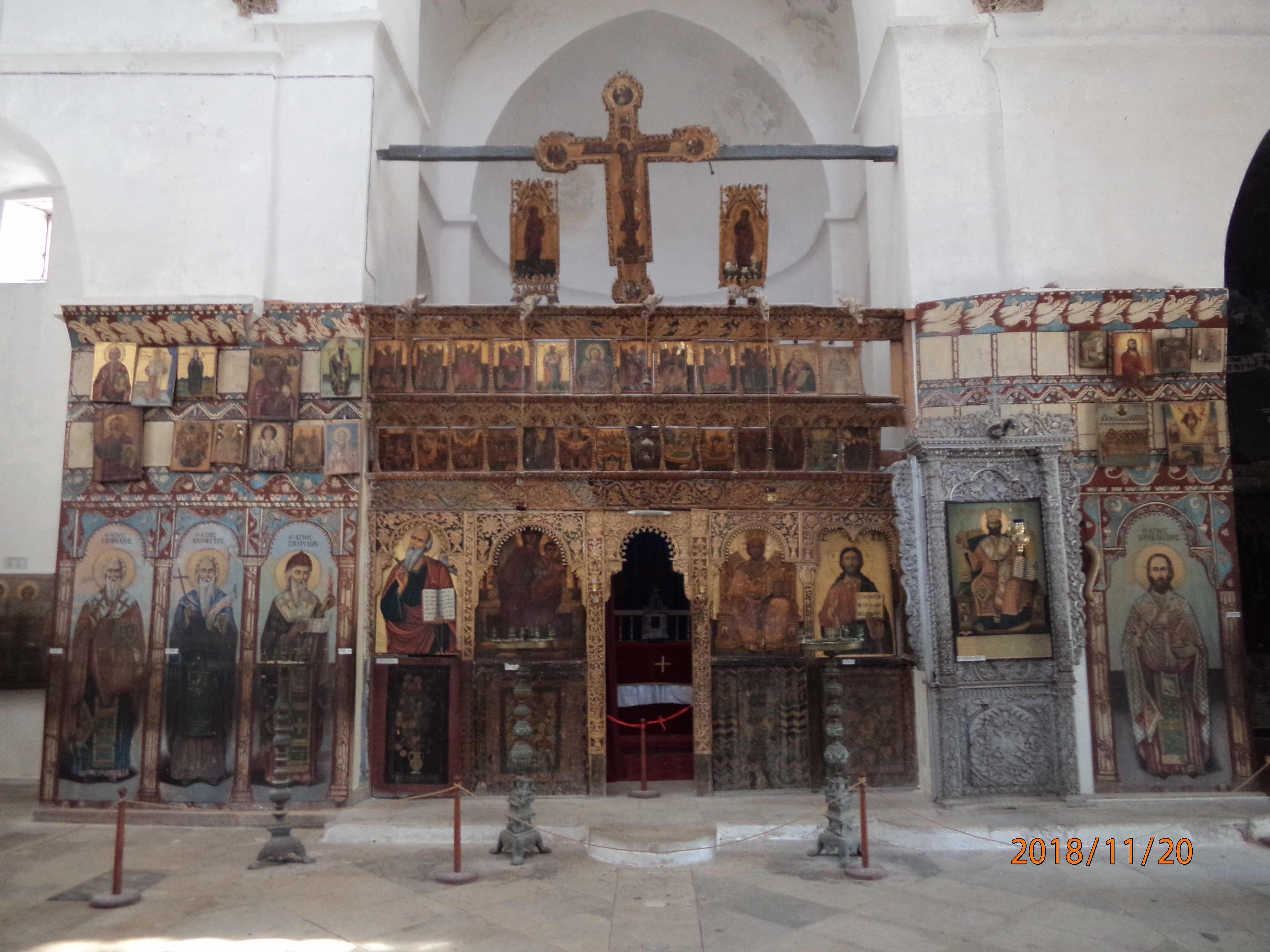


Most of the icons were painted by the monks, and, as far as I could see, the majority dated from the 19th and 20th centuries.

The monastery is very attractive.


It now houses an archaeological collection of finds from the local area, and is quite extensive. 

The earliest finds are from the Neolithic and extend through the Bronze Age to classical and then Roman times. This was my favourite object.


This Sphinx is from the Classical period, 475 - 325 BC

About 100 yards from the monastery, there is a small mausoleum built on the spot where the saint's remains were discovered. There are 14 steps which take you down to the cave under the building where the body of St Barnabas was hidden by his friends. We paid a visit to that too.

After this, the coach took us to the ruins of the city of Salamis, which aren’t far away. (This Salamis is not to be confused with the Salamis in Attic Greece, where there was the famous naval battle between the Greeks and Persians in 450BC, which took place between the Greek mainland and the island of Salamis in the Saronic Gulf near Athens)

The earliest archeological finds from this area date back to the 11th century BC, and though our guide told us there is a foundation myth which says that the founder of Salamis is said to be Teucer, son of Telamon, who could not return home after the Trojan war because he had failed to avenge his brother Ajax, there is no evidence to support this foundation myth.

The site is extremely extremely extensive, our guide says it is actually bigger than Ephesus, but not much of it has been excavated. Because the city was so extensive and in use for so long, the ruins we saw were Roman, rather than anything earlier. The cultural centre of Salamis during the Roman period was situated in the north part of the city, where a gymnasium, theatre, amphitheatre, stadium and public baths have been excavated. As well as the baths, there are public latrines (for 44 users), various little bits of mosaic, a harbour wall, a Hellenistic and a Roman agora and a temple of Zeus. We saw the theatre, the amphitheatre, the gymnasium, the public baths and (of course) the latrines.

The theatre was originally enormous and could seat 15000 people, as it was considerably higher than it is today.


As with the earlier theatre we saw at Soli, this theatre was originally Greek and converted by the Romans, and has been extensively restored. It is still in use today for various Famagusta festivals.

There is a wide road leading up to the gymnasium


The columns seen here are not necessarily the ones that belonged here, they have been erected to demonstrate the general appearance of the area.

The gymnasium was the usual open area, surrounded by colonnades, of which not much remains. Adjacent to this, we saw the Roman baths with various plunge pools


You can still see the hypocaust under the floor of the hot room, and there are a few remaining mosaics


Somewhat disappointingly, the 44 seat latrine did not actually have any seats remaining in it


The marble seats would have been on top of the supports you can see in the photo. What you can’t see in this area is that there were two channels for water, a lower one which was quite deep to carry away the waste, and an upper one nearer the seat level with water you could use to clean yourself with. I wasn't familiar with this idea, having always been told that the Romans used a sponge on a stick.

 
After the visit to Salamis, we drove to Famagusta which is nearby. Famagusta was founded around 274 BC, after the serious damage to Salamis by an earthquake, but it was quite small. Later, as a result of the gradual evacuation of Salamis due to the Arab invasion, it developed into a small port.


After 1192, when the Lusignans ruled Cyprus, Famagusta increased in importance due to its natural harbour and the fact that the Lusignan rulers built walls that protected its inner town. Its population increased and by the 13th century the town had become a centre of commerce for both the East and West. An influx of Christian refugees fleeing the downfall of Acre in Palestine in 1291 transformed it from a small town into one of the richest cities in Christendom.


In 1489, Famagusta fell under Venetian rule. Just as in Kyrenia and Nicosia, the Venetians strengthened the walls and changed the shape of the towers from square to circular to suit more modern artillery.


We drove into the old city past the walls, which are quite extensive, and made our way to the Othello Castle. There seem to be two different stories about this name. One is that Shakespeare’s play Othello which is believed to be written in 1603 might have taken its name from this castle. Another is that the castle gets its name from the play. In the play Othello the Moor was a Venetian commander, sent by his masters to Cyprus, where "The fortitude of the place is well known to you."  From Act II onwards, the play is simply set in 'A seaport in Cyprus' and also in 'A hall in the castle'.


We crossed what had once been the moat, which is shown in my photo above. It was drained in 1900 to help prevent malaria. We entered by the main gate, which is adorned by the Lion of St Mark and the date 1492.


A dark tunnel leads you into the castle courtyard is not nearly as large as Kyrenia Castle.


This is a view of the courtyard from the walls above. At the far side of the courtyard is the Great Hall, which is vaulted and gothic.


We climbed the walls for views of the port and of the old city.


The ruins you can see are those of the former Royal Palace. On its left is the former cathedral of St Nicolas, which was turned into a mosque when Cyprus came under Ottoman rule. We weren't  able to go into the mosque because of prayers taking place, but this is the main door.


You can see it is once again a typical French Gothic cathedral. It is the largest medieval building in Famagusta. It was built between 1298 and 1312 and was consecrated in 1328. The Lusignan rulers of Cyprus would be crowned as Kings of Cyprus in the St Sophia Cathedral  in Nicosia (which we saw on Saturday) and then crowned as Kings of Jerusalem in the St Nicholas Cathedral here in Famagusta. Our guide said that this was the significance of the crown you can see on the door. Of course, by the this period, the Lusignans were only using the title of King of Jerusalem, since Jerusalem was being ruled by the Ottomans.


We were pretty exhausted by the time, and needed to sit down and to eat. By the time we had done this, it was 3 o’clock and time to get back into the coach. We just had time for a brief look at Varosha, which was originally a lively and very luxurious resort nearby which was much frequented by celebrities but was abandoned during the war in 1974. It is now just a ghost town.


Then we set off on the journey back to the hotel, for final packing and the farewell dinner. Tomorrow will be another day of travel as we make our way home.