Tuesday, 13 September 2016

To Turin

Tuesday September 13th

Goodness, what a long day. I am quite exhausted, though I have done nothing but sit all day. And now my internet connection is so poor I can't post any photos. They'll have to come later, when I've got a decent connection.

We were up at 6 and in a coach by 7.30, leaving Vieste.


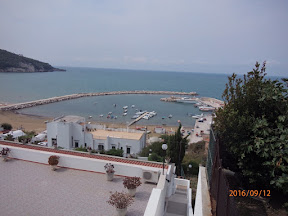
This is our last view of the little harbour, taken through the bus window

We were driven back along the Gargano Peninsula, enjoying further spectacular views.


Then we drove across the plain to Foggia, which took two hours. Then we had an hour's wait for the train to Milan, which I have to say was exactly on time, and delivered us to Milan station exactly on time, 7 long hours later.

We had a 40 minute wait in Milan station for the train to Turin. Milan station is rather monumental looking, though the impression is somewhat impaired by the large screens all over the place.


We had a one hour journey to Turin, followed by a short walk to our hotel. We were at the hotel by about 7.45, having had a journey of just over 12 hours. I was almost too tired to eat my dinner, and left the table before coffee and tea, otherwise I might have had to put my head on the table and sleep.


- Posted using BlogPress from my iPad

Monday, 12 September 2016

Peschici

Monday 12th September

A boat trip around the grotto-ridden coastline was planned for this morning, and we hurried our breakfast and walked down to the harbour and around it to the boat. But Paul did not care for the look of the boat, which was an open boat with wooden benches on the deck. It was already crammed with people and I had the feeling I would be squashed in like a refugee. We were assured there were life jackets, but Paul was doubtful about the expedition. It was a very sunny day (for once) and he had the feeling he would either be fried or drowned. And I'm not a great fan of sea caves - neither is he for that matter, having gone into the Blue Grotto in Capri and not really enjoyed it. It least it wasn't an open rowing boat, like the one on Capri, but he had memories of having to lie flat in the boat to get into the grotto, and didn't fancy repeating it. So we left.

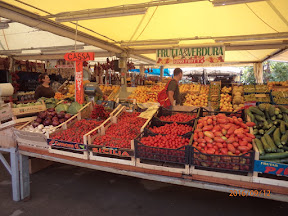
We decided instead to take the bus to Peschici which is supposed to be a very attractive small town about 30 minutes drive away. It was some time until the bus, so we stayed in the cool hotel, and left later, going through one of the local markets which was full of very attractive produce.


It was hard to resist buying something. As well as the wonderful fruit, there was a huge selection of cheeses, and I've never seen so many varieties of pasta in my life.

We found what appeared to be the bus station but it turned out not to be, and we had to return to the hotel for further directions before setting off again. We finally found the bus station and bought the necessary tickets just in time. The bus left at a time which bore no relation either to the printed timetable book or to the timetable displayed in the bar which also sold the tickets, but we got in and were off.

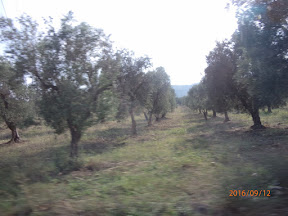
The journey was slightly less hair-raising than the coach drive to Vieste, though there were many hairpin bends, but at least we weren't travelling along steep cliffs leading down to the sea. We drove between acres of olive fields


Though sometimes these gave way to the wilder forests of the national park.

When we reached Peschici, we were dismayed to find the bus stopped well outside the town, and we had a 15 minute walk to get to the centre. It was quite steeply downhill, so I didn't look forward to our return.

Peschici is a little smaller than Vieste, and is perched on top of a rocky vantage point above a beautiful sandy bay. The houses are piled on top of one another in a jumble, which makes the streets hard to navigate.


It was built in AD971 as a defence against the Saracens, and there are remains from that time.


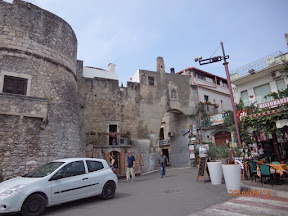
This is the entranced to the walled centre of the town. The historic centre is full of a labyrinth of narrow streets, normally full of shops and restaurants; but today, everything was shut.


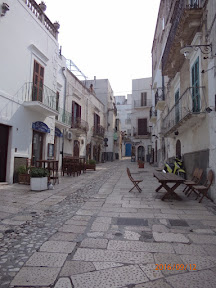
The streets were steep and the wider ones were paved with marble slabs, though the narrow ones were ankle-turning cobbles.

We had hoped to be able to see the 10th century castle, but it was shut too. After stumbling over the cobbles for a long time, and navigating some very steep stairs, we came out on the road above the lovely bay.


As you can see, we were still a considerable distance above the beach. We continued walking, hoping to find a way down, but we were so far above the beach that, in the end, we just contented ourselves with the lovely views.


This was the charming little harbour. As you can see, there were sets of steps going down, but many of them led to private houses and it wasn't possible to tell except by going down. And if it was somebody's house, you would have to come all the way up again.

We clambered up and down for well over an hour, and never managed to get down to the beach. Eventually, we settled for going back to the modern town for something to eat and drink, and to go back to the bus stop. Once again, the bus arrived at a time that was not advertised, and we went back to Vieste to collapse onto our beds in a state of exhaustion.

This is the last real day of our holiday, the rest is travel towards home. Tomorrow we have to be up by 6 as we are being driven to Foggia to catch a train. It appears we will spend 10 hours in trains and end up in Turin - as long as there isn't flooding on the line!

- Posted using BlogPress from my iPad

Sunday, 11 September 2016

Vieste

Sunday 11th September

My connection is so poor at present I am having difficulty posting even text, so it may take a while for any photos to appear here. Writing this after midnight seems to help - then I'm not competing for bandwidth with every single other person in the hotel.

As we had no excursions today, we did not wake early and didn't appear at breakfast until 9 - a great luxury. It was pouring with rain outside, so there was no reason to get up early anyway. After the unfortunate dinner last night, it was a surprise to find that breakfast was excellent, with a huge range of things including 2 types of focaccia and little squares of omelette with asparagus or tomato, as well as the usual eggs. And the pastries were excellent as well, as was the coffee, which was a welcome surprise after we had been served cups of mud after dinner the previous night.

The skies cleared after breakfast, so we went out to explore the town, making for the historic centre. The town is at the very edge if the Gargano Peninsula, and is surrounded by water. In medieval times, it was frequently attacked by pirates, so it was walled, and many of the walls still exist, except where the buildings were on top of steep cliffs.


As space is limited, the houses are all piled up together in a jumbled mass. The centre is a jumble of fascinating little alleyways with overhanging balconies.


We visited the shell museum, which was both fascinating and informative and wandered through the narrow streets. I've so far resisted buying anything, though there is a lot of jewellery and some very good ceramics, all housed in attractive old buildings.


The streets are all paved with marble, which becomes very slippery in the rain, so walking about can be quite hazardous if it's wet - which is frequently was today. We were fortunate that, shortly after we went out to explore, the sun came out and then I needed my hat and sunglasses.

After we had wandered all over the historic part, we went looking for a lunch time sandwich is the modern Main Street, which is lined with cafés and restaurants.


We sat under an awning to eat, as it was quite hot by then. However, once we had eaten, the rain started again, and soon it was hammering down once more. The canvas of the awning where we were sitting was not entirely water resistant, so after a while, we began to get wet. We put up our umbrellas and one of our group took a photo of us sitting with umbrellas up under the awning which he says is illustrative of exactly what the holiday has been like. He said it was hard to take a photo because the rain was so heavy! What he couldn't photograph was the fact that we even had to move our feet because of the depth of water running down the road or we would have been ankle deep in water again.

Once the rain had slackened off we went back to the hotel to find some dry clothes.

We ate in a local restaurant this evening, which made a change from the hotel. It also meant 4 courses - antipasti, pasta course, main course, dessert. There will have to be a lot of dieting when we get home!


- Posted using BlogPress from my iPad


Saturday, 10 September 2016

To Vieste

Saturday September 10th
I cannot really describe today as a good day, in many ways it went from bad to worse. And the network connection where I am now is very slow, so I don't know if I can ever post any of the few photos I have taken.

Apparently it rained extremely heavily last night, with the result that no trains ran in this whole area today, because of flooding on the line. It all sounds horribly familiar.

A coach collected us from our hotel at 10am and drove us to the station to catch our train. It dropped us 100 yards or so from the station as the traffic was awful and we walked to the station to find it completely crammed with people all gesticulating and shouting and no trains at all.

Fortunately, we have a tour manager and he managed to hire us another coach at vast cost - €1500. But because of bad traffic, flooding etc, the said coach was very late so we waited for 3 hours in the station. There was no waiting room, so we sat in the café, but soon were asked to leave as the seats were for patrons of the café - not unreasonably. Paul and I solved this problem by buying things from the café and then taking a long while to eat and drink them, so we had seats for most of the three hours.

Eventually, the coach arrived, but not before the rain had started hammering down again. The coach came as close to the station as the mad traffic would permit, and we waded out to it. Paul and I must have been more fortunate than most because our cases didn't get too wet - possibly because we had purchased huge umbrellas in Lecce. People with small British umbrellas got very wet, and some people's cases were soaking and they had to unpack and try to dry their clothes once they arrived.

Heaven knows how the poor driver managed, because visibility was very poor, but he drove us through flooded olive groves and flooded fields and down flooded roads to Bari, where we had to change coach. The coach which had been supposed to meet us at Foggia station met us at a service station north of Bari instead, and we changed from one coach to another. Fortunately, it had stopped raining by then.

We drove through a flat area of salt pans and market gardens, most of which were flooded.


Eventually, we reached the Gargano Peninsula and then the road turned into a switchback full of hairpin bends. We wound our way through forests high above the sea, with superb views from time to time through the thick forest. I took some good views.


You can see how high up we were - and how threatening the sky looks!

Part of the peninsula is a national park, and there are some spectacularly pretty parts.


We arrived at the hotel eventually, after more than 5 hours in the bus, and found our rooms.

Dinner did not go well. The hotel was very full and there was not enough food for the buffet of antipasti. We had been given a choice of turkey or vegetables for our main course, so I had chosen vegetables. The antipasti was a variety of grilled cold vegetables. The first course was vegetable pasta. Then I had my main course of vegetables. Strangely enough, the pudding was tiramisu. I wouldn't have been much surprised if it had been some sort of vegetables!

Our boat trip for tomorrow has been cancelled, as the weather is too rough. Our tour manager had planned to take us instead on the public bus to a local beauty spot, but tomorrow is Sunday so there are no buses. So he suggested going to the beach on the hotel shuttle bus. But the hotel shuttle bus has come to the end of its summer contract. Anyway, the weather forecast tomorrow is for thunderstorms and heavy rain. It's probably just as well we have plenty of books on our kindles!


- Posted using BlogPress from my iPad


Friday, 9 September 2016

Galatina and Gallipoli

Friday September 9th
We made a not too early start today and went to Galatina to see a famous church there, the church of Saint Catherine of Alexandria, a rare survival in the Gothic style. It was built between 1384 and 1391, but what is so remarkable about it is the frescos inside.


This is not my photo, it comes from the Internet - my photos are nothing like as good as this!

A number of artists of the school of Giotto decorated the church with a cycle of seventeen subjects, including scenes of the Apocalypse, Noah’s Ark, Genesis, the life of Jesus, the four evangelists, the life of Mary and also scenes of life Saint Catherine of Alexandria.

This shows the detail of some of the frescos.


These are scenes from the life of Christ. You might recognise the flight into Egypt at the top of the arch.

The only other frescoed church I've ever seen in the least like this is the Scrovegni Chapel in Padua, and this one doesn't equal it and unfortunately it isn't so well preserved, but it's still quite stunning. The date is a little later of course, though still mainly 14th century. There are some later frescos; one we saw was dated 1425, and there were some from a century later.

I'm not sure of the date of the ones below


The fresco shows St Catherine herself and on her right is an Annunciation. It was hard to get far enough away from it to get a photo of all of it, as there are pillars in the way.

We paid a quick visit to the Diocesan Museum where there is a charming cloister (it used to be a convent) decorated with 16th century frescos.


The museum itself houses Franciscan choir stalls and a large collection of reliquaries.

We visited a nice coffee shop to get out of the rain, then we were off again in the bus to Gallipoli, a town on the west side of the heel of Italy's boot.

Gallipoli, like many towns, has a new part and and old town. In this case, the old town sits on a tiny island connected to the mainland by a 17th century bridge. It is almost completely surrounded by defensive walls, built mainly in the 14th century.

The east side is dominated by a robust fortress dating back to the 13th century, but largely rebuilt in the 1500s when the town fell under Angevin control.


These fortifications say a lot about Gallipoli’s history; thanks to its strategic position, it was frequently under siege. Early in its history it was part of Magna Graecia and remained so until it was conquered by the Romans. (People in this south eastern region of Italy still speak a dialect which bears a lot of relation to Ancient Greek. Our guide for the day said his grandmother, who came from England and lived in the area for 3 years, learned the dialect but no Italian)

After the town had been sacked successively by hordes of Vandals and Goths, the Byzantines arrived, rebuilding the old town very much in the form it can be seen today. Normans, Angevins and the Bourbons arrived in successive waves until the Unification of Italy in 1861.

The island centre of Gallipoli is home to numerous impressive Baroque churches and aristocratic palazzi, testament to the town's former wealth as a trading port. It was apparently well known for the export of lamp oil.


This is the cathedral, dedicated to St Agatha. It doesn't have a big square in front of it like most churches because the island had limited space and the population grew so every square metre was used for housing.

There is a positively labyrinthine weave of narrow streets all eventually leading to the sea-front promenade.


What we found surprising about these narrow streets is that cars drive up and down them. Pedestrians hastily jump out of the way when they hear one approaching.

There is a wonderful fish market, which sells that day's catch.


They even cook it for you on the spot. Many of our party lunched there on the fresh fish, but Paul said he had had such a big breakfast that he didn't need any lunch, so we did without.

After shopping and wandering, we went back to the bus and set off back to Lecce. We are off to Vieste tomorrow, though fortunately not with a very early start.


- Posted using BlogPress from my iPad

Alberobello

Afternoon of Thursday September 8th

I was so exhausted last night I was completely unable to do anything after dinner except go to sleep, so only managed to write up the first half of yesterday's visit. We climbed up and down so many flights of stairs and walked up and down so many hills I was completely finished!

After we had paid out brief visit to Matera, we had a quick lunch and got back on the bus to drive to Alberobello. This town is famous for the Trulli, little round buildings with steep conical roofs like witches hats. You will see the odd Trullo dotted all around this area, but Alberobello has 1500 of them. They are quickly built of the local stone without using mortar - a sort of house made out of drystone walls. The story is that the local landowners forced the peasants to live in them so that, when the tax collectors came, the houses could be quickly disassembled so the landlord was not assessed for as much as he might have been had there been more houses. The Trulli could be quickly built again after the tax collector had left.

This is a whole street of them - now mostly souvenir shops.


Some of them have rather strange symbols painted on the roofs, for good luck, apparently.


Some of the ones above are still being used as homes, others have been converted into hotels or bed and breakfasts. In order to enlarge them, all you did was make a hole in one part of the wall and then build on another one.

Many of them are so smart and plastered inside it is hard to see how they were originally built, but I did find one with a less smart interior.


You have to try and ignore the rather strange things being sold in this shop, and just look at the stones in the roof.

Sometimes there were little gardens between the Trulli.


If this hasn't posted too small, you may notice something green fixed on the trunk of the old tree. It's actually an old water pump. Presumably there would have been a cistern below. No extra water was needed on the afternoon we were there - the rain started coming down in torrents just after I took this photo!

It is also possible to build Trulli of more than one storey, as shown by the Trulli church.


I suspect, however, that more traditional building methods were used for the walls, and only the Trulli style for the roofs.

We were fortunate that there wasn't too much rain until the very end of our visit to Alberobello, but we got very wet indeed while waiting for the shuttle bus to take us back to the car park where the coaches have to be left. I got very cold and the resulting tiredness from all the stairs and hills in Matera and then the hills and the heavy rain in Alberobello and the two long coach trips meant I was too tired to finish this post last night!

- Posted using BlogPress from my iPad

Thursday, 8 September 2016

Matera and Alberobello

Thursday September 8th
I'm almost too tired to write this, it has been such a long day. We had to be up at 6 as the bus arrived to take us to Matera at 7. We drove through fields of vines rather than olives this time, and the roads were very narrow. I found it quite terrifying because we were in a big coach which was rather wider than half the road, and we kept meeting lorries which were similarly too wide for the road. Sometimes we passed with only inches to spare.

We were in Matera by 10, and set off to see the sassi, the caves where people lived. These were not natural caves, they were dug out of the soft limestone to provide places to live.

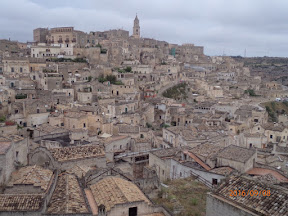
We walked through a modern city of baroque churches and graceful palaces. Then we found ourselves first looking down at the dramatic tangle of grey stone houses; a contrast with the elegance of the new town.


When you walk down a steep staircase, you are amongst this jumble of buildings. Buildings climb up and down the hillside, houses piled on top of each other, the roofs of some acting as streets for those above. They were carved out of the rock and the original caves extended with facades that look like normal homes.

Matera is one of the oldest continuously inhabited settlements in history dating back to the Palaeolithic period. What makes Matera different from other Palaeolithic settlements, though, is that those inhabitants, and their ancestors, never left. Instead, they dug in—quite literally. In the Iron and Bronze Ages, newly-equipped with metal tools, settlers dug underground caverns, cisterns, and tombs in the landscape’s soft volcanic stone (called tufa). Famously, they also dug dwellings.

Those dwellings, and those people, remained throughout the later waves of rulers and empires, from Greeks to Romans to Byzantines. They (and their descendants) are still there today.

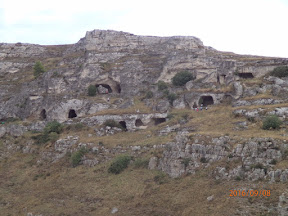
On the other side of the ravine from the town you can see the simple forms of the neolithic caves where people lived 7000 years ago.


Things were a bit more modern in later times, but not much. People continued to live in these one-room stone homes, without heat or plumbing, often with donkeys, chickens or other animals sharing the same space.

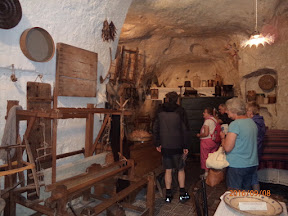
We visited the Casa Grotta di Vico Solitario, which shows what living there in the 1950s would have been like.

This was the one crowded room


The striped blanket on the right is on top of the bed.

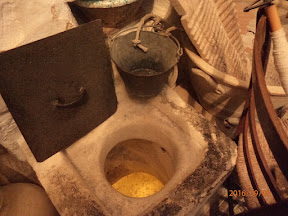
This house had quite a sophisticated kitchen, with two charcoal burners in the stove.


The water came from a cistern below the house. Rainwater from the roofs was stored in underground cisterns and pulled up in a bucket.


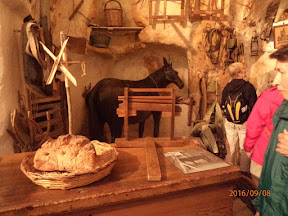
The donkey shared the living quarters


A hole in the floor was used to store the manure from the donkey, and this generated heat to heat the house. Don't even think of the smell! There was no bathroom of course - just a pot beside the bed.

Disease was rife. Conditions were so bad that, in 1952, the government of Italy passed a law forcing Matera’s dwellers out of their old quarters and into new, modern buildings. The sassi were left empty and unmaintained. But in 1993, the area was declared a UNESCO World Heritage site. And as it has become more popular, people have started moving back into the sassi, restoring them and even opening them as luxury hotels or smart restaurants.

There are also many rock cut churches, but I've run out of steam and will have to write more another day. I'm only about half way through the description of today as we went to Alberobello in the afternoon, but I'll have to write about that tomorrow.

- Posted using BlogPress from my iPad